If you had no back pain, what would your MRI say? ✦ Is pickleball actually dangerous? ✦ Did carbon-plate shoes really break the marathon? ✦ Why does a humid 75°F morning feel so bad? ✦ What happens to your body at every hour of a marathon? ✦ Whose Pain Gets Believed? ✦ How Fast Do You Walk? ✦ The $50 Hand ✦ What Actually Works for Back Pain ✦ What Would You Want Back? ✦ Second Place Is a DNF ✦ Every Prescription Is a Bet ✦If you had no back pain, what would your MRI say? ✦ Is pickleball actually dangerous? ✦ Did carbon-plate shoes really break the marathon? ✦ Why does a humid 75°F morning feel so bad? ✦ What happens to your body at every hour of a marathon? ✦ Whose Pain Gets Believed? ✦ How Fast Do You Walk? ✦ The $50 Hand ✦ What Actually Works for Back Pain ✦ What Would You Want Back? ✦ Second Place Is a DNF ✦ Every Prescription Is a Bet ✦
Why this exists
I came to medicine from the outside. I studied business and data science, worked in healthcare consulting, and only later found my way to medical school, so I remember exactly what medical evidence looks like to everyone else: locked behind jargon, paywalls, and papers written for other researchers. The science was sound. The communication was not, and people were left making real decisions about their own bodies from whatever fragments they could piece together. My mind has always worked the other way: take something complicated and make it digestible without making it smaller. So I built The PM&R Files, visual essays that treat readers as smart, show the actual numbers behind rehabilitation medicine, say plainly what the evidence cannot prove, and open a field that too often talks only to itself.
Jonathan Byrne, DO · Founder
Rehabilitation is practiced, not just prescribed. Homepage images are AI-generated illustrations; essay imagery remains sourced photography and data.
Medicine runs on odds. This essay reads one prescription the way an actuary would: as a priced bet on a single life.
Jonathan Byrne, DO · PM&R residentDRAFT: pending expert review
Start with one small white pill: aspirin. In a large trial of people with diabetes, aspirin stopped one heart attack or stroke for every 91 people who took it. In that same trial, it caused one major bleed for every 111. Help and harm, side by side, at nearly the same size.
That is not a fact about aspirin. It is the shape of almost every choice in medicine. Each drug, each test, each operation is a bet: some chance of gain, some chance of loss, and one person who has to live with how it lands.
So here is the claim of this essay. Good medicine is good betting. Not gambling, which is betting blind. Betting with the odds worked out, the stakes priced, and the size of the bet matched to the person in front of you. The field that does this for a living is not medicine. It is actuarial science, the math of pricing risk. Medicine borrowed its tools long ago. It just rarely says so.
Bet slip No. 17The five fields on every slip
The event
One bad thing, or not, in a set span of time
The odds
How often it strikes people like this patient
The edge
How much the treatment cuts those odds
The price
What the treatment costs in harm
The payout
The number needed to treat
A note from the person who wrote this slip. Before medical school, I interned in actuarial consulting and worked as a health care analytics analyst. I priced risk for groups of strangers. Now I treat one person at a time, and the same math keeps showing up at the bedside.
Scroll · the slip fills in
Slip section 01 · The machinery
First, the odds had to be invented
The tools on this slip feel like medicine. They are not. They were built to price lives for money, and the dates give it away.
1693
A price list for lives
Edmond Halley, an astronomer, took the birth and death records of one city, Breslau, and built a table: how many people are still alive at each age. The title of his paper says what it was for. It ends with the words “an attempt to ascertain the price of annuities upon lives.” The first life table was a pricing tool.
1825
Risk compounds like interest
Benjamin Gompertz, who worked in insurance, found the law inside the table. The risk of death does not grow in a straight line as we age. It compounds, at a steady rate, the way interest does. He wrote the math down to value life contracts: what a promise to pay is worth when no one knows how long a life will run.
1958
The table learns to lose people
Two statisticians, Edward Kaplan and Paul Meier, fixed the table's weak point. Real patients move away, quit, and get lost. Their method still counts each person fairly up to the day they vanish. It is called the Kaplan-Meier curve, and almost every survival curve in every drug trial since is this table's grandchild.
Hold on to one point. None of this was built to heal. It was built to price. Medicine took the tools over because the tools work. This essay borrows them back for a few pages.
Slip section 02 · The odds machine
Place the bet
Meet the patient on this slip. She has atrial fibrillation, an irregular heartbeat that lets blood pool in the heart, where it can clot. A clot that breaks loose can cause a stroke. A blood thinner cuts that risk a lot. It also makes bleeding more likely. So: bet, or no bet?
The price of the bet hangs on one score. The CHA2DS2-VASc score gives points for heart failure, high blood pressure, diabetes, blood vessel disease, age, and sex, with two points each for age 75 or older and for a past stroke or clot. More points, more risk. Tap a score. The slip reprices at once.
Your patient's score
71patient-years of blood thinner to prevent one strokeGood bet
Stroke risk, no treatment2.2% a year
Strokes prevented14.1 per 1,000per year of treatment
Major bleeds added, the harm lineUnder 3 per 1,000per year, at every score
Prevented
Bleeds
Plainly: of 1,000 people with a score of 2, treated for one year, the drug prevents about 14 strokes.
The math on this slip: benefit = baseline risk × 64%. Warfarin, the blood thinner in the trials, cut stroke risk by 64% (Hart 2007). The baselines come from 182,678 people with this condition in Sweden (Friberg 2012).
Guidelines draw their line at a score of 2 and up. Watch the verdict flip in the same place the guideline does.
The full slip, no tapping needed
Warfarin for atrial fibrillation, by CHA2DS2-VASc score. Baselines: Friberg 2012. Effect: Hart 2007.
Score
Stroke risk a year, no treatment
With warfarin
Strokes prevented per 1,000 treated for a year
Number needed to treat, patient-years
0
0.2%
0.07%
1.3
781
1
0.6%
0.22%
3.8
260
2
2.2%
0.79%
14.1
71
3
3.2%
1.15%
20.5
49
4
4.8%
1.73%
30.7
33
5
7.2%
2.59%
46.1
22
6
9.7%
3.49%
62.1
16
7
11.2%
4.03%
71.7
14
8
10.8%
3.89%
69.1
14
9
12.2%
4.39%
78.1
13
Scores 7 to 9 rest on far fewer people, and the Swedish rates wobble there: 11.2, 10.8, then 12.2 percent. Read those stops with care. The harm line does not move with the score: warfarin added fewer than 3 major bleeds per 1,000 people treated for a year.
Slip section 03 · Two more slips
The drug never changes. The odds do.
Slip twoA statin, priced over ten years
A statin lowers LDL cholesterol. For each 1 mmol/L drop, the pooled trials find about 21% fewer major vascular events: heart attacks, strokes, and deaths from them (CTT 2005; 90,056 people in 14 trials). Now hold the drug still and move the person.
10 year risk 2.5%NNT 191
10 year risk 5%NNT 95
10 year risk 7.5%NNT 64The line the US guideline draws
10 year risk 10%NNT 48
10 year risk 20%NNT 24
10 year risk 30%NNT 16
Same pill. Same 21%. The only thing that moved was who sat in the chair.
The harm column is real, and its clock runs at a different speed. Treat 255 people for 4 years and about one extra case of diabetes shows up (Sattar 2010). The benefit above is priced over 10 years, the harm over 4. A fair slip shows both clocks.
Slip threeAspirin, the bet that cancels itself
Aspirin went to three big trials in 2018, in three kinds of people. Same drug each time. Three answers.
ASCEND15,480 people with diabetes, followed 7.4 years. Prevented: one event per 91 treated. Caused: one major bleed per 111. The trial's own verdict: the gains were largely wiped out by the bleeding.
ASPREE19,114 healthy older adults, median age 74. Prevented: nothing that could be measured. Caused: one extra major bleed per 100 treated.
ARRIVE12,546 adults at moderate risk. Prevented: nothing clear. Caused: one extra gut bleed per 196 treated.
Three tables, one drug. The people, and their starting odds, did all the talking.
Slip section 04 · The house rules
Every house posts its limits
Casinos post their limits. Medicine posts its own, in guidelines, and they do the same job: they say where a bet turns worth placing, for the average person at the table.
1975Medicine wrote the rule down early. Stephen Pauker and Jerome Kassirer showed that each treatment has a break-even point: a chance of disease above which treating wins, and below which it loses. The point is set by the ratio of harm to benefit. Every rule below is that one idea, dressed for a clinic.
2The stroke slip gets its line at a score of 2. You watched the verdict flip there a screen ago.
7.5%The US cholesterol guideline sets its line at a 10 year risk of 7.5%. Above it, a statin is judged worth it for the average patient. Below it, not.
3% · 20%Bone care runs the same play. Treat when the 10 year chance of a hip fracture hits 3%, or of a major fracture 20%. That is the FRAX score, as used in US practice.
£Then the house prices the payout itself. One QALY is one year lived in full health. For years, NICE in England called a treatment good value at £20,000 to £30,000 per QALY. In April 2026, that line rose to £25,000 to £35,000. In the US, the review group ICER uses $100,000 to $150,000 per QALY as its yardstick. Figures checked October 2026.
None of these lines is a law of nature. A committee set each one, the way an underwriter sets the top price for a class of risk. Knowing the line is posted is the first step. Knowing when your patient should cross it is the craft.
Slip section 05 · The fine print
Read the fine print. It is the honest part.
Every real slip has fine print, and most people skip it. Do not. It is set in full size here, on purpose.
Prices vary by book
Across 17 studies of people with atrial fibrillation, the yearly stroke rate at a score of 0 ran from 0 to 2.41 percent. At a score of 2, it ran from about 0.48 to 7.84 percent. The odds on this slip come from one large Swedish group. Your patient may belong to a pricier book, or a cheaper one.
No one is an average
Every risk number is a price quoted for a class of people. You belong to many classes at once: your age group, your sex, people with your blood pressure, people who run marathons. Each class quotes a different price, and no rule can say which class was the right one. The philosopher Hans Reichenbach named this in 1949: the problem of the reference class. A score does not solve it. It picks a class in an orderly way. And the narrower the class, the thinner the data under its price.
Prices can be wrong
When two researchers tested the pooled cohort equations, the formulas US doctors use to price heart risk, on three large groups, the formulas overshot real risk by 75 to 150 percent. A wrong starting price flows through clean math and comes out as a wrong bet, with each step looking exact.
The score is a blunt tool
The stroke score sorts people only fairly well. Its accuracy score, called the c statistic, is about 0.61, where 0.5 is a coin flip and 1.0 is perfect. It still earns its place: a blunt price, stated out loud, beats a guess.
The big number hides its clock
The number needed to treat hides its time frame and its doubt. An event stopped in year one and an event pushed to year nine count the same inside a fixed window. And when a trial's benefit could be zero, as in the ARRIVE aspirin trial, the number runs off through infinity. A neat figure printed there is not a small benefit. It is no measured benefit at all.
The 64% is an assumption
This slip treats warfarin's 64% cut as the same at every score. The large reviews behind it found the cut roughly steady across groups. Roughly steady is an assumption, not a law, and the whole slip leans on it.
Newer drugs, modeled odds
Newer blood thinners beat warfarin by a further 19% in relative terms (Ruff 2014). No trial has tested them against no treatment at all. So any figure for them against nothing is built by chaining two reviews together. This slip prices warfarin only, because warfarin was tested against nothing.
You have to live to collect
A ten year bet assumes the person lives ten years to collect it. Other risks compete, and with age they compound. Gompertz again. Most bedside numbers leave this out. The bone score, FRAX, is one of the few that builds it in.
The last line is yours
The last line of the slip is not about risk. It is about value. The math treats each outcome as the same coin. Patients do not. When researchers asked people living with spinal cord injury what they would want back first, their order was not the one their doctors guessed. That story is Essay 15, What Would You Want Back? The actuary can price the risk. Only the patient can price the outcome. A good slip carries both prices.
The patient's price: ____________________
Nothing here is advice for any one person. These numbers describe groups of people in published studies. A bet this size belongs to a patient and a clinician, with the slip on the table between them.
Sources
Halley E. An estimate of the degrees of the mortality of mankind, drawn from curious tables of the births and funerals at the city of Breslaw; with an attempt to ascertain the price of annuities upon lives. Philosophical Transactions of the Royal Society. 1693.
Gompertz B. On the nature of the function expressive of the law of human mortality, and on a new mode of determining the value of life contingencies. Philosophical Transactions of the Royal Society. 1825.
Kaplan EL, Meier P. Nonparametric estimation from incomplete observations. Journal of the American Statistical Association. 1958.
Laupacis A, Sackett DL, Roberts RS. An assessment of clinically useful measures of the consequences of treatment. New England Journal of Medicine. 1988. Where the number needed to treat comes from.
Gigerenzer G, Edwards A. Simple tools for understanding risks: from innumeracy to insight. BMJ. 2003. Why this essay pairs every percent with a count of people.
Hart RG, Pearce LA, Aguilar MI. Meta-analysis: antithrombotic therapy to prevent stroke in patients who have nonvalvular atrial fibrillation. Annals of Internal Medicine. 2007. Warfarin's 64% relative cut, and its bleeding cost of under 0.3% a year.
Friberg L, Rosenqvist M, Lip GYH. Evaluation of risk stratification schemes for ischaemic stroke in 182,678 patients with atrial fibrillation: the Swedish Atrial Fibrillation cohort study. European Heart Journal. 2012. The baseline rates on the slip.
Ruff CT, et al. Comparison of the efficacy and safety of new oral anticoagulants with warfarin in patients with atrial fibrillation: a meta-analysis of randomised trials. Lancet. 2014.
Cholesterol Treatment Trialists' Collaboration. Efficacy and safety of cholesterol-lowering treatment: prospective meta-analysis of data from 90,056 participants in 14 randomised trials of statins. Lancet. 2005.
Sattar N, et al. Statins and risk of incident diabetes: a collaborative meta-analysis of randomised statin trials. Lancet. 2010.
ASCEND Study Collaborative Group. Effects of aspirin for primary prevention in persons with diabetes mellitus. New England Journal of Medicine. 2018.
McNeil JJ, et al. Effect of aspirin on disability-free survival in the healthy elderly (ASPREE). New England Journal of Medicine. 2018.
Gaziano JM, et al. Use of aspirin to reduce risk of initial vascular events in patients at moderate risk of cardiovascular disease (ARRIVE). Lancet. 2018.
Stone NJ, et al. 2013 ACC/AHA guideline on the treatment of blood cholesterol. Circulation. 2014; and Grundy SM, et al. 2018 AHA/ACC multisociety cholesterol guideline. Circulation. 2019. The 7.5% line and the risk bands.
Pauker SG, Kassirer JP. Therapeutic decision making: a cost-benefit analysis. New England Journal of Medicine. 1975; and The threshold approach to clinical decision making. New England Journal of Medicine. 1980.
Ridker PM, Cook NR. Statins: new American guidelines for prevention of cardiovascular disease. Lancet. 2013. The overprediction test of the pooled cohort equations.
Quinn GR, et al. Wide variation in reported rates of stroke across cohorts of patients with atrial fibrillation. Circulation. 2017. The 17 cohorts behind the fine print.
Christensen PM, Kristiansen IS. Number needed to treat: needs treatment with care. Basic and Clinical Pharmacology and Toxicology. 2006.
Reichenbach H. The Theory of Probability. 1949; and Hajek A. The reference class problem is your problem too. Synthese. 2007.
How the odds machine works: for the score you pick, it takes the Swedish rate of strokes per year with no treatment (Friberg 2012), cuts it by warfarin's 64% (Hart 2007), and turns the gap into a number needed to treat. Patient-years is the total time across people: an NNT of 71 means treating 71 people for one year each prevents about one stroke. Bleeding figures are major bleeds outside the skull, the harm Hart measured. Statin figures apply the CTT's 21% cut to 10 year risks, the frame the US guideline uses. The statin benefit is priced over 10 years and its diabetes harm over 4; both clocks are printed where the numbers appear.
The PM&R Files · Essay 18
The Table That Prices a Person
Ask how long a person will live after a spinal cord injury, and the answer comes from a table. That table was built to set prices. This essay opens it up: how the years are counted, why they stopped growing, and what happens when two honest tables disagree about one life.
By Jonathan Byrne, DO · PM&RDRAFT: pending expert review
First, the ground rule, because everything after it could be misread. A person is not a cost. Nobody's mother, brother, patient or client is a line in a ledger, and the years counted in this essay belong to people with names, homes and plans. But the care those years need has to be paid for, and it is paid for with numbers like the ones on this page. That is why the honest move is to look at the numbers directly: who makes them, who reads them, and how much care they fund. Often, the person arguing for the bigger number is the patient's own advocate, asking the system to fund more years of life at home.
One more promise. Where this essay is sharp, it is sharp about the machinery: the tables, the shortcuts, the assumptions. Never about the people inside the numbers. Essay 02 used this table's outputs, the survival curves themselves. This essay is about the machine that makes them, and the uses waiting downstream.
Scroll · Seven entries in the ledger
Entry one · The Object
The life table was a pricing tool before it was a medical one
In 1693, Edmond Halley published a table of deaths from the city of Breslau and did something new with it. He worked out how long people at each age could expect to live, and his paper's title says why: to find the price of annuities on lives. An annuity pays you every year until you die, so its fair price is your expected years, turned into money. The life table, the form at the heart of this essay, was built as an actuarial instrument: a machine for pricing time.
Medicine borrowed it later. When a doctor today says a patient has a life expectancy of so many years, the number comes out of Halley's machine, fed with modern data. Spinal cord injury is where the machine does some of its most serious modern work, because the stakes are long. Care after a cord injury runs for decades, and decades have to be estimated before they can be funded, insured, planned for or argued over.
So this number, expected years of life after injury, lives two lives at once. In the clinic it is a prognosis, spoken softly. Everywhere else it is an input: to a care plan, a court case, a settlement, an insurance file. The next entries follow the number at work.
Entry two · The Machine
How a life expectancy is actually built
Start with people, counted over time. Researchers follow a large group of injured people and log person-years: one person followed for one year is one person-year of exposure to the risk of dying. At each age, divide the deaths by the person-years and you get that age's mortality rate, written q(x). Then comes Halley's move. Take a made up cohort of 100,000 people, written l(x), and run it through the age by age rates. Each year some die, d(x), and the rest live on. Add up all the years the cohort lives, column T(x), and divide by the number who started. That quotient is e(x): the life expectancy. It is not a prediction about one person. It is the average length of a whole survival curve, summed.
There is a second dial on the machine, the standardized mortality ratio, or SMR. It compares deaths in the injury group with the deaths expected if that group died at general population rates. An SMR of 1.0 means the same mortality. After cord injury the model based ratios run from 1.86 for paraplegia down the cord to 4.75 for the highest complete injuries, C1 to C3. Insurance underwriters price in this same unit; above standard mortality, they charge table ratings. The research paper and the underwriting manual are denominated in the same currency.
Exhibit · The machine checks another group's workSpinal Cord, 2013
In 2013, Shavelle, Strauss and Brooks took an Australian study's own published death rates and rebuilt its life table in the open, column by column: l(x), d(x), q(x), m(x), L(x), T(x), e(x). Same data, second build. For the C5 to C8 group, life expectancy as a percent of normal, published against recomputed:
Age 25
74% → 66%
Age 35
72% → 62%
Age 45
68% → 57%
Age 55
66% → 51%
Age 65
65% → 52%
Their sentence: the published figures were systematically higher than the ones computed from the same data. The gap was not fraud; it was method, smoothing choices inside the build. That is the machine's first lesson. A life expectancy is an output of stated choices, not a reading like a blood sodium.
Entry three · The Grid and the Clock
The table everyone quotes, and the starting line hidden inside it
The numbers most often quoted come from the National Spinal Cord Injury Statistical Center, the NSCISC, which runs the Model Systems database. Its 2026 grid gives expected years of life left, by age at injury and injury type, for people who have already survived at least one year. Surviving that first year matters, and the grid is honest about it.
Injured at 20
Expected years left
Share of no injury
No spinal cord injury
59.2
100%
Motor functional (AIS D)
51.4
87%
Paraplegia (AIS A to C)
43.8
74%
Low tetraplegia, C5 to C8
38.6
65%
High tetraplegia, C1 to C4
32.0
54%
Ventilator dependent, any level
16.5
28%
Shares are calculated from the published grid (NSCISC Facts and Figures, 2026 edition), not printed on the sheet itself.
Now the clock. The same grid is also published from an earlier starting line: survival of just the first 24 hours. For a ventilator dependent 20 year old, the one year figure is 16.5 years. The 24 hour figure is 9.8 years. Nothing about the person changed; the estimate grew by about two thirds because the clock started after the most dangerous year. Every table in this field is conditional, true only from its stated starting line. Quote the wrong conditioning and you have priced the wrong life, politely, with a citation.
Read the grid again with that in mind and it becomes two facts at once. It is the best map the field has. And it is a set of decisions, about who counts and from when, wearing the calm face of a table.
Entry four · The Plateau
The gains stopped at the second anniversary, forty years ago
Everyone assumes survival after injury keeps improving. For the first year, it did, hugely. The adjusted odds of dying in the first year after injury fell by about two thirds between the 1970s and the late 1990s. Better trauma care, better surgery, better early medicine: real gains, in year one.
After the first anniversary, the line goes flat. DeVivo's 2007 Guttmann lecture said it in one sentence: first year mortality rates improved, but longer term mortality rates showed no improvement since 1982. The largest study then closed the question: 31,531 people who had survived two years, followed across 1973 to 2012. Adjusted odds of dying, against the 1970s, were 0.802 in the 1980s, 0.826 in 1990 to 2004, and 0.857 in 2005 to 2012. The title of the paper asks whether long term survival has improved. Its conclusion: long term survival has not changed over the past 30 years.
The cause of death table explains the shape. In the early decades of the British fifty year series, urinary causes ranked first among deaths; by the last two decades they had fallen to fourth, beaten back by better bladder care and antibiotics. What replaced them at the top has proven stubborn: in the current NSCISC figures, respiratory diseases lead at 19.6 percent of deaths after the first year, with infections, mostly septicemia, at 13.1 percent. The field solved the kidney problem and the first year problem. The plateau is what is left.
So the grid in Entry three is not a snapshot of a rising curve. It is a plateau that has held since roughly the early 1980s, which is one reason the fights over its exact values, later in this essay, matter so much. When a number stops moving, every year of it gets argued over.
Entry five · The Two Tables Machine
Two published tables. One future. Watch the price move.
Here is the dispute you can hold. The NSCISC grid is one published source. The Life Expectancy Project, the research group of Strauss, Shavelle and Brooks, publishes another, built with a person-year model on the same Model Systems database. They do not publish the same reference case, and this machine will not pretend they do. Both definitions are printed beside their numbers, in full. What the machine prices is the published disagreement itself: the gap a negotiation actually faces when each side arrives holding a different published table.
Every dollar below is years of care at home: nursing, therapy, equipment, help with the day. The dollars are shown because care is funded in dollars. The method is printed on the same screen as the money, every time.
Age at injury (NSCISC grid stops)
Injury profile
Tables to show
Discount rate (present value)
Table A · NSCISC grid, 2026 edition
43.8
Reference case: injured at age 20, survived at least 1 year. Both sexes and all races pooled. Source: NSCISC Facts and Figures, 2026.
Table B · Life Expectancy Project model
37.1
Reference case: a 25 year old white man, injured 3 years ago, nonviolent cause. Source: Shavelle et al., 2015, model table.
Read the gap as the published disagreement, not as two predictions about one named person. The two sources define their reference cases differently, and every element of the gap traces to those stated choices: age basis, starting line, who is in the class, data era. Where the reference cases come closest, ventilator dependence at 20, the tables nearly agree.
Entry six · The Readers
One number, four documents
The clinician
In the clinic the number is a prognosis, and it is handled with care. It shapes honest talk about the future: what to watch, what to prevent, what the years ahead usually hold. A good clinician quotes it as what it is, an average over a group, and then looks at the person in front of them, whose own risks may pull them well off the group line. Entry seven prices that gap.
The life care planner
The planner turns the number into a multiplier. A plan lists what a person will need, year by year: care hours, therapy, equipment, supplies, home changes. Then the table sets how many years of it to fund. One year of assumed life, at NSCISC's published cost for paraplegia of $93,409 a year, is $93,409 of plan. The planner is where the patient's own case for more funded years is usually made, line by line, in the open.
The courtroom
In a court case the number becomes an exhibit, and the two sides arrive with different published tables, as Entry five showed. The law knows the weakness and says so: forensic economics guidance states that a mortality table life expectancy is not conclusive, is an average, and is to be weighed with other evidence about this person's probable life. The groups who publish the tables disclose that they consult as expert witnesses. The dispute in print is what that testimony is built from.
The underwriter and the annuity desk
Read the table backwards and you get a rated age. When an injured person's settlement is placed as an annuity, company underwriters review the medical records and assign the age they will price as: the statistical age, not the birthday. A broker example: a person of 30, priced as 55 or 60 with severe injuries. A life annuity on a shorter expected life costs less for the same monthly payment, so the same verdict that would raise a life insurance price lowers an annuity's. Actuarial testing on about 350,000 real substandard settlement annuities found people lived longer than their rated ages implied, especially where the rate up was 20 years or more. For life insurance itself, the verified SCI figures are a reinsurer's experience data: overall mortality 1.85 times standard, up to 6.7 times for complete cervical injuries. Precise table letters for SCI, if your broker quotes one, are not published in sources this essay can stand behind, so none are printed here.
Entry seven · The Fine Print
What the table cannot see
It sees about 6 percent of the injured. The NSCISC database page currently estimates that it captures data from about 6 percent of new spinal cord injury cases in the United States, treated at federally funded Model Systems centers. The authors are plain about it: the database is not population based, and its patients may have greater needs and more complications than people treated elsewhere. Every figure in this essay rests on that selected slice.
It misses some deaths, so it errs long. Deaths are traced largely through the Social Security Death Index, with a stated sensitivity of 92.4 percent in this database. The 2015 authors conclude their results are, if anything, overestimates of survival. The ventilator table shows what that costs: published at 22 years for a 20 year old in 2006, revised to 17 in the 2024 update, largely because deaths had been reported late. Finding the missing deaths repriced the same future by about $845,738 at a 2 percent discount rate, using the high tetraplegia cost as the proxy the memo for this essay specifies. Data hygiene, as a seven figure event.
The ratio can move when the patient does not. Take one fixed profile: 30 year old white men with paraplegia, at least 3 years post injury. Its SMR was 4.1 computed in 1995 and 5.3 computed in 2005. The injury group's mortality had not risen. The general population's had fallen, so the ratio worsened around a standing patient. SMRs are not portable across calendar time, and any table built by holding one constant buys its simplicity with someone else's years.
And it cannot see the person. This is Essay 17's warning, one level up: a table prices a reference class, and the patient in front of you is not a class. The modifier research prices the distance. In one prospective analysis, a 20 year old man with a C1 to C4 injury and no risk behaviours had an estimated life expectancy of 43.03 years. At a pack of cigarettes a day or more, the estimate was 33.74 years: one habit, 9.29 years. Household income moves it by a decade too: at age 20, for C1 to C4 males, an estimated 29.22 years at low income against 41.41 at high income. The flagship database does not even collect some of these variables. Its authors list them as confounders it cannot see.
None of this makes the table useless. It makes it a bet, stated in years, about a group, used to fund a person. The discipline is to keep all three parts of that sentence in view at once.
The table will keep being read, because the care has to be funded somehow, and an honest table funds more of it, more fairly, than a guess. But hold the last fact beside all the arithmetic. What the funded years are for is not in any column: mornings at home instead of an institution, work, family, an ordinary life defended hour by funded hour. Essay 15 asked people living with spinal cord injury what they would want back, and the answers were capabilities, hands, continence, sensation, never a number. So price the care carefully. Argue for the bigger table when the bigger table is true. And never mistake the price for the person it is meant to serve.
Sources
Halley E. An estimate of the degrees of the mortality of mankind, with an attempt to ascertain the price of annuities upon lives. Philosophical Transactions. 1693;17:596 to 610.
National Spinal Cord Injury Statistical Center. Traumatic Spinal Cord Injury Facts and Figures at a Glance. University of Alabama at Birmingham, 2026 (life expectancy grid, causes of death, yearly and lifetime costs in 2025 dollars).
National Spinal Cord Injury Statistical Center. National SCI Database page, sites.uab.edu/nscisc (capture estimate, about 6 percent of new cases, current phrasing).
DeVivo MJ. Trends in spinal cord injury rehabilitation outcomes from model systems in the United States: 1973-2006. Spinal Cord. 2007;45(11):713 to 721.
DeVivo MJ, Krause JS, Lammertse DP. Recent trends in mortality and causes of death among persons with spinal cord injury. Arch Phys Med Rehabil. 1999;80(11):1411 to 1419.
Strauss DJ, DeVivo MJ, Paculdo DR, Shavelle RM. Trends in life expectancy after spinal cord injury. Arch Phys Med Rehabil. 2006;87(8):1079 to 1085.
Shavelle RM, DeVivo MJ, Brooks JC, Strauss DJ, Paculdo DR. Improvements in long-term survival after spinal cord injury? Arch Phys Med Rehabil. 2015;96(4):645 to 651 (SMR method and worked example, model life expectancy table, limitations, expert witness disclosure).
Shavelle R, Strauss D, Brooks J. Discrepancies in the estimates of life expectancy after SCI. Spinal Cord. 2013;51(12):937 (recomputed life table and percentages).
Frankel HL, et al. Long-term survival after spinal cord injury (50 year series). Spinal Cord. 1998;36:266 to 274.
Shavelle RM, DeVivo MJ, Strauss DJ, Paculdo DR, Lammertse DP, Day SM. Long-term survival of persons ventilator dependent after spinal cord injury. J Spinal Cord Med. 2006;29(5):511 to 519.
Shavelle RM, DeVivo MJ, Brooks JC, Strauss DJ. Update on the long-term survival of persons who are ventilator dependent after spinal cord injury. J Spinal Cord Med. 2024;47(3):459 to 460 (revised estimate, 17 years at age 20; late reported deaths).
DeVivo MJ, Savic G, Frankel HL, et al. Comparison of statistical methods for calculating life expectancy after spinal cord injury. Spinal Cord. 2018;56(7):666 to 673.
Krause JS, Saunders LL. Risk of mortality and life expectancy after spinal cord injury: the role of health behaviors and participation. Top Spinal Cord Inj Rehabil. 2010;16(2):53 to 60 (smoking and life expectancy estimates).
Krause JS, Saunders LL. Life expectancy estimates in the life care plan: accounting for economic factors. J Life Care Plan. 2010 (income and life expectancy estimates).
Klein G, Denker C. Substandard Structured Settlement Annuities, Best Estimate Mortality. Milliman white paper, November 2022 (professional actuarial source; rated age constructions and realized mortality on about 350,000 exposures).
Skoog GR, Ciecka JE. Journal of Forensic Economics. 2007;20(3) (mortality table life expectancy is not conclusive).
RGA. On the Risk. 2022 (reinsurer experience data: SCI mortality 1.85 times overall, up to 6.7 times for complete cervical injuries; professional source).
Amicus Settlement Planners. How Medical Underwriting (a Rated Age) Can Help Your Client. 2025; Kaas T. Using Rated Ages to Maximize Structured Settlement Annuity Payouts. 2017 (industry sources, rated age examples).
Method note for the machine in Entry five: present values use the annuity certain simplification, treating the life expectancy as a fixed payment horizon. A full life contingent valuation, weighting each year by the chance of surviving to it, would give lower values. Costs are NSCISC 2026, in 2025 dollars, direct costs only. Ventilator dependent pricing uses the high tetraplegia cost row as a labeled proxy, because NSCISC publishes no ventilator specific cost row.
The PM&R Files · Essay 19
Two Ways to Build a Clot
Blood builds a clot two different ways, and it builds them in two different kinds of river. In a fast artery, the working structure is a plug of platelets. In a slow vein, it is a net of fibrin thrown over trapped red cells. Every blood thinner in the cabinet blocks one of those two structures. Almost every prescribing mistake in this corner of medicine is a drug aimed at the wrong one.
By Jonathan Byrne, DO · PM&RDRAFT: pending expert review
This essay explains how the two drug families work and what the trials found. It is teaching, not dosing guidance: no regimen here is a recommendation. The founding measurement comes from a laboratory that pulled real clots out of real people and took them apart under an electron microscope. In coronary artery clots, platelets made up 31.3 percent of the volume. In vein clots, platelets made up 0.4 percent. One careful study, small numbers of specimens, and the cleanest explanation in this essay for why two families of drugs exist at all.
Platelets, share of clot volume · coronary artery31.3%The arterial clot is platelet led. Wall shear where it forms runs roughly 100 to 100,000 per second, among the fastest flow in the body.
Platelets, share of clot volume · vein0.4%The venous clot is 63.4 percent red cells in a fibrin net, formed at shear of only 10 to 100 per second. Platelets are nearly absent.
One honesty note before the machine. The lanes differ in leadership, not in membership. Even the arterial clot is 43.3 percent fibrin, more fibrin than platelet. Read the two lanes as "who is in charge here," not "who is allowed in." The drugs below work on the leadership.
Scroll · The machine, the microscopy, the map, the seams
Panel one · How each structure is built
A plug is assembled. A net is woven.
The platelet plug · primary hemostasis
Adhesion. A torn wall exposes collagen. Von Willebrand factor bridges the collagen to a platelet receptor called GPIb, and passing platelets tether. At arterial speed, this tether is the rate limiting step: nothing stops without it.
Activation. Stuck platelets change shape, sprout projections, and spill the contents of their granules, including ADP.
Amplification. Two chemical shouts recruit the crowd. ADP calls through the P2Y12 receptor. Thromboxane A2, made by the enzyme COX-1, calls the rest and tightens the vessel.
Aggregation. Activation switches on GPIIb/IIIa, the receptor that grips fibrinogen. Fibrinogen bridges platelet to platelet, and the plug grows.
The fibrin net · the cascade
Tissue factor. Injury exposes tissue factor, which meets factor VIIa and starts the enzyme chain. A second, contact driven arm (factors XII, XI, IX, VIII) feeds into the same chain.
Factor Xa. Both arms converge here. Xa, with its partner Va, is the hinge of the whole cascade.
Thrombin. Xa converts prothrombin (factor II) into thrombin (IIa). Thrombin is the foreman: it activates more platelets and more factors upstream.
Fibrin. Thrombin cuts fibrinogen into fibrin strands, which weave through whatever is present, platelets in an artery, red cells in a vein, and set it solid.
The two machines are partners in normal healing and rivals in drug design. Every toggle on the panel below cuts one named step in one of these two lists.
Panel two · The Two Lanes Machine
Run both lanes. Flip a drug. Watch the wrong one fail.
The panel is a diagram of mechanism, drawn to teach. It is not patient data and not a dosing tool. Start an event in either lane, then work the drug rail. Each drug sits at the molecular step it blocks, and its effect, or its failure, plays out in both lanes at once.
Two Lanes · Hemostasis InstrumentSchematic · Not to scale · Not patient data
Artery lane · narrow, fast, platelet ledWall shear about 1,240 /s
Vein lane · wide, slow, fibrin and red cellsWall shear about 62 /s
Artery · plug growth
Vein · net growth
Both lanes are running clean. Start an event, or switch a drug on first and then start one.
Events
Drug rail · each switch sits at its target
What the rail is made of, in one line each. Aspirin silences thromboxane for the life of the platelet. P2Y12 inhibitors mute the ADP call; clopidogrel and prasugrel must be switched on by the liver and bind for good, ticagrelor works as swallowed and lets go. Heparins hand antithrombin its speed: unfractionated chains strike Xa and thrombin about evenly, one to one; the shorter LMWH chains lean on Xa, enoxaparin about 3.8 to 1. Warfarin stops the liver building factors II, VII, IX and X, and works only as the old factors wear out. Xa inhibitors and dabigatran bind their enzyme directly, no middleman.
One thing the rail cannot do: nothing on it dissolves a clot that already exists. These drugs stop new growth and hold the line, and any slow shrinking on the panel is the body's own plasmin clearing the clot once growth is held. Dissolving a clot outright takes a different class of drug, the thrombolytics, at a different bleeding price.
Panel three · The microscopy
Real clots, taken out of real people
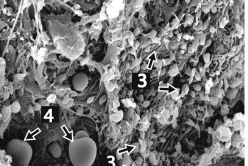
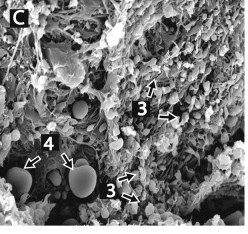
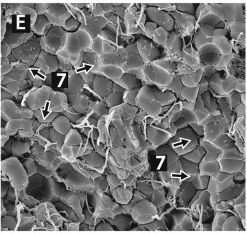
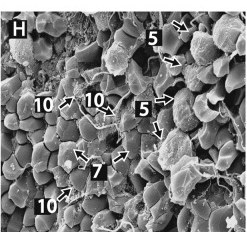
The machine above is a drawing. These are not. A team at the University of Pennsylvania extracted fresh human clots, 45 arterial, 25 venous, and 10 pulmonary emboli taken after death, and photographed them under a scanning electron microscope. Three panels from their first figure, cropped, carry the whole argument of this essay.
Arterial thrombus · coronary
Platelet aggregates (marked 3) packed into fibrin, with red cell balloons (4) squeezed inside the mesh. The plug, photographed.
Platelets 31.3% · Fibrin 43.3% · Red cells 17.1%Venous thrombus
A pavement of polyhedrocytes (7): red cells compressed into tiles by the clot contracting around them. Nearly no platelets anywhere in the frame.
Platelets 0.4% · Fibrin 35.0% · Red cells 63.4%Pulmonary embolus
The vein clot, travelling. Its recipe mirrors the venous tail it broke from: compressed red cells (7), white cells (5), microvesicles (10).
Platelets 0.8% · Fibrin 41.2% · Red cells 48.6%
Micrographs: Chernysh IN and colleagues, "The distinctive structure and composition of arterial and venous thrombi and pulmonary emboli," Scientific Reports, 2020. Panels C, E and H of Figure 1, cropped from the original. Licensed CC BY 4.0. Composition shares are that study's measurements on the specimens it quantified in depth, quoted as one careful study's findings, not as universal constants. Magnification bar in the original figure: 10 micrometers.
Panel four · The map
Who gets which, and the trial that settled it
Fourteen doors. Behind each one, a condition, the family that wins it, the reason in one line, and the landmark numbers. The caveats are printed on the cards, where they belong.
Heart attack, no stent yet · ACS
Antiplatelet, two at once
A ruptured plaque is a high shear platelet event. Blocking two platelet pathways beats blocking one.
CURE, 2001 · 12,562 patients. Death, heart attack or stroke: 11.4% on aspirin alone, 9.3% with clopidogrel added. Major bleeding rose from 2.7% to 3.7%.
The bill: the bleeding cost arrives immediately, not eventually.
After a drug-eluting stent
Antiplatelet, and duration is a dial
Bare metal in fast blood is a clot surface until the vessel lining grows over it. The question is never whether to run dual therapy, but for how long.
The DAPT Study, 2014 · Extending dual therapy from 12 to 30 months cut stent thrombosis from 1.4% to 0.4%, and death, heart attack or stroke from 5.9% to 4.3%.
The other end of the dial: moderate or severe bleeding rose from 1.6% to 2.5%, and all cause death from 1.5% to 2.0%, a signal driven by deaths outside the heart.
Atrial fibrillation
Anticoagulant
The clot grows in near still blood, pooled in the left atrial appendage. It is a fibrin problem that happens to fire into an artery.
ACTIVE W, 2006 · Stroke, embolism, heart attack or vascular death: 5.60% per year on clopidogrel plus aspirin, 3.93% on warfarin. Major bleeding: 2.42% versus 2.21% per year.
The lesson: aspirin based therapy lost on events and did not even win on bleeding. The full odds treatment of this choice is Essay 17.
Acute deep vein thrombosis or pulmonary embolism
Anticoagulant
Read the microscopy above. A venous clot is 63.4 percent red cells in a fibrin net. There is almost no platelet structure here for an antiplatelet drug to lead against.
The composition itself · Chernysh 2020: platelets are 0.4% of a venous thrombus by volume, against 31.3% in a coronary one.
Honest basis: no serious trial has pitted aspirin against anticoagulation for acute treatment. This verdict is mechanism plus standard of care.
Unprovoked VTE, anticoagulant stopped
Aspirin, second tier
Once the strong drug ends, aspirin still cuts recurrence by about a third relative. Something, honestly labelled as less.
INSPIRE pooled analysis, 2014 · 1,224 patients. Recurrent VTE: 7.5% per year on placebo, 5.1% on aspirin (hazard ratio 0.68), with no significant rise in major bleeding.
Not a substitute: where the risk still justifies the anticoagulant, aspirin is the weaker seatbelt, not the car.
Mechanical heart valve
Warfarin. Only warfarin.
A metal surface in flowing blood generates thrombin around the clock. The modern shortcut was tried here once, carefully, and it hurt people in both directions.
RE-ALIGN, 2013 · 252 patients, stopped early. Stroke: 5% on dabigatran, 0% on warfarin. Major bleeding: 4% versus 2%, every major bleed around the heart.
Aftermath: the regulator contraindicated dabigatran for mechanical valves in December 2012. The leading explanation, that fixed drug levels cannot suppress constant thrombin generation the way a full factor knockdown can, is the field's hypothesis, not settled fact.
Heparin induced thrombocytopenia · HIT
Stop heparin. Anticoagulate another way.
The one place the lanes collide head on: antibodies against heparin and platelet factor 4 switch platelets on, so an anticoagulant causes a platelet driven clot.
Martel meta-analysis, 2005 · HIT occurred in 2.6% of patients on unfractionated heparin versus 0.2% on LMWH, across 15 studies and 7,287 patients.
Never warfarin alone here: its protein C window, Panel five below, can cost a limb. Management is stop every form of heparin and block thrombin by a non heparin route.
Cancer associated thrombosis
LMWH first, then a pill with a gut warning
The injection dethroned warfarin. The pills then matched or beat the injection on clots, and paid for it in the gut.
CLOT, 2003 · Recurrent VTE at six months: 17% on a coumarin, 9% on dalteparin. Hokusai VTE Cancer, 2018: major bleeding 6.9% on edoxaban versus 4.0% on dalteparin, concentrated in gut cancers.
Warfarin's hidden weakness: in CLOT, the warfarin group's INR sat in range only 46 percent of the time. The drug is hardest to run in exactly the sickest patients.
Antiphospholipid syndrome, triple positive
Warfarin
This disease clots in arteries as readily as in veins, and it is the second place where "a DOAC is a DOAC" reasoning failed a randomized test.
TRAPS, 2018 · 120 patients, stopped early. Clotting, major bleeding or vascular death: 19% on rivaroxaban, 3% on warfarin. Thrombotic events alone: 12% versus 0%.
The events: four ischemic strokes and three heart attacks, every one of them on the rivaroxaban arm.
Stable coronary or peripheral artery disease
Both lanes, at partial strength, selectively
The one big win for combination: blocking both systems lightly beat aspirin alone. Swapping one full block for the other did not.
COMPASS, 2017 · 27,395 patients. Cardiovascular death, stroke or heart attack: 5.4% to 4.1% with low dose Xa inhibitor plus aspirin. All cause death: 4.1% to 3.4%. Major bleeding: 1.9% to 3.1%.
Why selectively: a secondary analysis puts the numbers needed to treat and to harm within a dozen of each other, about 154 and 166. No significant rise in fatal or brain bleeding.
Minor stroke or high risk TIA, first hours
Antiplatelet, dual for about 21 days
Early recurrence is platelet driven and front loaded. The benefit lands in the first days; the bleeding risk accrues evenly. Sprint, then step down to one drug.
CHANCE, 2013 · Stroke at 90 days: 11.7% to 8.2% with dual therapy (number needed to treat 29), serious hemorrhage 0.3% in both arms. POINT, 2018: 15 major ischemic events prevented per 1,000 treated, 5 hemorrhages caused.
Populations: CHANCE ran in China; POINT was international and was halted at 84 percent of its planned enrollment.
Long term stroke prevention
One antiplatelet, not two
Run the sprint for years and the arithmetic inverts: the benefit is spent, the bleeding is not.
MATCH, 2004 · 7,599 high risk patients, 18 months. Adding aspirin to clopidogrel: no significant benefit (events 16.7% to 15.7%), while life threatening bleeding rose from 1.3% to 2.6%.
The counterweight card: keep this one beside the CHANCE card. Same two drugs, opposite verdicts, decided entirely by duration.
Warfarin patient needs a procedure
Usually, no bridging
The reflex bridge, a fast anticoagulant covering the days around surgery, was tested against simply stopping and restarting. It bought bleeding and sold nothing.
BRIDGE, 2015 · 1,884 patients. Arterial clots: 0.4% unbridged versus 0.3% bridged, noninferior. Major bleeding: 1.3% versus 3.2%.
Scope, printed on the card: mechanical valves were excluded, and the average CHADS2 score was 2.3, a mostly lower risk group. Rehab services live downstream of this decision after hip fractures and joint replacements.
Doorway · VTE prophylaxis after joint replacement
That fight lives one essay over
Aspirin versus anticoagulant for prevention after joint replacement has its own shelf, its own patients, and nine priced bottles. Nothing is re-derived here.
The first week of warfarin: an anticoagulant that briefly clots
Warfarin stops the liver building clotting factors, but the factors already in the blood leave on their own schedules. The natural anticoagulant protein C has a half-life of about 8 hours. Factor II, the factor that matters most, lasts about 60 hours. For the first days, the brake wears out years before the engine does, and clotting risk briefly rises. That window is the mechanism behind warfarin induced skin necrosis, the reason acute warfarin starts are overlapped with a fast anticoagulant, and the reason warfarin alone in acute HIT can cost a limb.
Protein C · the brake
Factor II · the engine
Bars are drawn to the half-lives, not to a clock: the point is the mismatch. Full antithrombotic effect takes about five days, because it waits on factor II clearing.
The reversal drawer: who has an off switch
Every blocker on the rail raises the same question at 3 a.m.: how do we turn it off? The honest answers form a gradient, and the gradient tracks molecular size.
Protamine, for the heparins
Full for unfractionated heparin. Partial for LMWH: the enoxaparin label states its anti-Xa activity is never completely neutralized by protamine, maximum about 60 percent. None for fondaparinux. Chain length writes the whole row.
Idarucizumab, for dabigatran
An antibody fragment that pulls dabigatran off thrombin. In REVERSE-AD (503 patients), the median maximum reversal within four hours was 100 percent, and the median time to bleeding stopping was 2.5 hours. Single arm study, no comparison group.
Andexanet alfa, for Xa inhibitors
A decoy Xa protein that soaks up the drug. In ANNEXA-4 (352 patients), anti-Xa activity fell 92 percent and 82 percent reached good or excellent hemostasis at 12 hours. Single arm: about 10 percent had a clotting event and about 14 percent died within 30 days, in a very sick cohort.
Warfarin's drawer is older and slower: vitamin K refills the blocked pathway over hours to a day, and four factor concentrate replaces factors II, VII, IX and X at once for serious bleeding. Aspirin and the P2Y12 inhibitors have no antidote at all; the off switch is time and new platelets.
Triple therapy: the bill is additive, the benefit is not
Some patients sit on both lanes at once: atrial fibrillation, plus a fresh stent. Three blocks running together sounds like three times the protection. AUGUSTUS (2019, 4,614 patients, everyone on a P2Y12 inhibitor) priced it. Adding aspirin on top roughly doubled major or clinically relevant bleeding, 16.1 percent against 9.0 percent on placebo (hazard ratio 1.89), while death or ischemic events ran 6.5 percent against 7.3 percent, no significant gain. The anticoagulant comparison told the same story from the other side: apixaban bled less than a vitamin K antagonist, 10.5 against 14.7 percent. Each pathway blocked adds its own bleeding tariff while the extra protection shrinks. The modern answer is subtractive: drop the aspirin early, keep the anticoagulant and the P2Y12 inhibitor.
Panel six · The close
The clot you are treating is older than the clot that formed
One last measurement from the microscopy study, and it changes how the whole map feels. In coronary clots, the fibrin share roughly doubles with each hour of ischemia, while the platelet share roughly halves. The aging network packs denser and stiffer, and responds worse to antiplatelet drugs and to clot dissolving therapy. A clot is not a fixed target with a fixed recipe; it is a structure under renovation, converting itself from the platelet's building into fibrin's, hour by hour.
That is the deepest reason the two lanes matter. The drug families are not interchangeable brands of "blood thinner." They are tools aimed at two different materials, and the material mix in front of you depends on where the clot formed and how long it has been there. Fast water, slow water. Plug, net. Get the structure right and the pharmacology mostly chooses itself.
Sources
Chernysh IN, Nagaswami C, Kosolapova S, et al. The distinctive structure and composition of arterial and venous thrombi and pulmonary emboli. Scientific Reports. 2020. PMCID PMC7083848. Open access, CC BY 4.0. Composition, shear ranges, and the hourly aging of coronary thrombi.
OpenStax. Anatomy and Physiology 2e, section 18.5, Hemostasis; Figure 18.14. CC BY 4.0. Plug formation and cascade sequence.
Yusuf S, et al. Effects of clopidogrel in addition to aspirin in patients with acute coronary syndromes without ST-segment elevation (CURE). New England Journal of Medicine. 2001;345:494-502.
Mauri L, et al. Twelve or 30 months of dual antiplatelet therapy after drug-eluting stents (the DAPT Study). New England Journal of Medicine. 2014.
Connolly SJ, et al. Clopidogrel plus aspirin versus oral anticoagulation for atrial fibrillation (ACTIVE W). Lancet. 2006.
Mant J, et al. Warfarin versus aspirin for stroke prevention in an elderly community population with atrial fibrillation (BAFTA). Lancet. 2007.
Connolly SJ, et al. Apixaban versus aspirin in patients unsuitable for vitamin K antagonist therapy (AVERROES). New England Journal of Medicine. 2011.
Simes J, et al. Aspirin for the prevention of recurrent venous thromboembolism: the INSPIRE collaboration. Circulation. 2014. Pooling WARFASA and ASPIRE, New England Journal of Medicine. 2012.
Eikelboom JW, et al. Dabigatran versus warfarin in patients with mechanical heart valves (RE-ALIGN). New England Journal of Medicine. 2013.
Martel N, Lee J, Wells PS. Risk for heparin-induced thrombocytopenia with unfractionated and low-molecular-weight heparin thromboprophylaxis: a meta-analysis. Blood. 2005.
Lee AYY, et al. Low-molecular-weight heparin versus a coumarin for the prevention of recurrent venous thromboembolism in patients with cancer (CLOT). New England Journal of Medicine. 2003.
Raskob GE, et al. Edoxaban for the treatment of cancer-associated venous thromboembolism (Hokusai VTE Cancer). New England Journal of Medicine. 2018.
Young AM, et al. Comparison of an oral factor Xa inhibitor with low molecular weight heparin in patients with cancer with venous thromboembolism (SELECT-D). Journal of Clinical Oncology. 2018.
Pengo V, et al. Rivaroxaban vs warfarin in high-risk patients with antiphospholipid syndrome (TRAPS). Blood. 2018.
Eikelboom JW, et al. Rivaroxaban with or without aspirin in stable cardiovascular disease (COMPASS). New England Journal of Medicine. 2017.
Wang Y, et al. Clopidogrel with aspirin in acute minor stroke or transient ischemic attack (CHANCE). New England Journal of Medicine. 2013.
Johnston SC, et al. Clopidogrel and aspirin in acute ischemic stroke and high-risk TIA (POINT). New England Journal of Medicine. 2018.
Diener HC, et al. Aspirin and clopidogrel compared with clopidogrel alone after recent ischaemic stroke or transient ischaemic attack in high-risk patients (MATCH). Lancet. 2004.
Douketis JD, et al. Perioperative bridging anticoagulation in patients with atrial fibrillation (BRIDGE). New England Journal of Medicine. 2015.
Lopes RD, et al. Antithrombotic therapy after acute coronary syndrome or PCI in atrial fibrillation (AUGUSTUS). New England Journal of Medicine. 2019.
Pollack CV Jr, et al. Idarucizumab for dabigatran reversal: full cohort analysis (REVERSE-AD). New England Journal of Medicine. 2017;377:431-441.
Connolly SJ, et al. Full study report of andexanet alfa for bleeding associated with factor Xa inhibitors (ANNEXA-4). New England Journal of Medicine. 2019.
Enoxaparin package insert, protamine neutralization statement, as quoted in the University of California San Diego anticoagulation guidelines. Warfarin half-lives per Cleveland Clinic warfarin dosing guidance and the review "Paradoxical procoagulant effect of early doses of warfarin," PMC4460341.
Method note: composition percentages come from one laboratory's quantified specimens and are framed that way on the page. The two lanes panel is a schematic of mechanism; its speeds, growth rates and shear readouts are drawn for teaching and are not measurements. Trial numbers are reported as published; numbers needed to treat shown on cards were computed from the published absolute rates and are labelled by their trial.
The PM&R Files · Essay 20 · The Hip
One Ball, Three Ways to Die
The hip is a ball in a socket, and the ball can fail three ways: born the wrong shape, starved of its blood supply, or worn out under a lifetime of load. This essay sections one femoral head, follows all three deaths, then reads the replacement's survival curve like an actuary's life table.
By Jonathan Byrne, DO · PM&RDRAFT: pending expert review
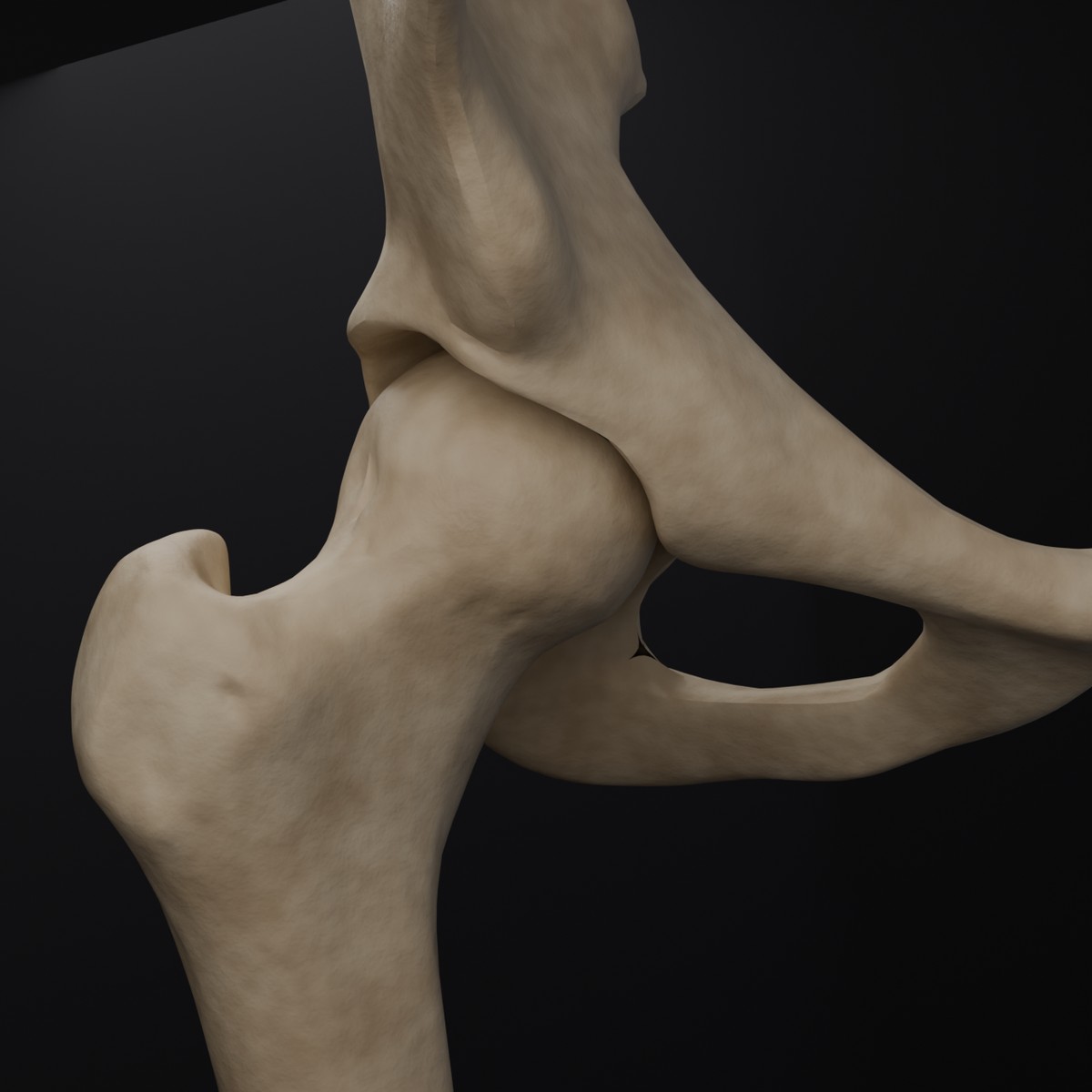
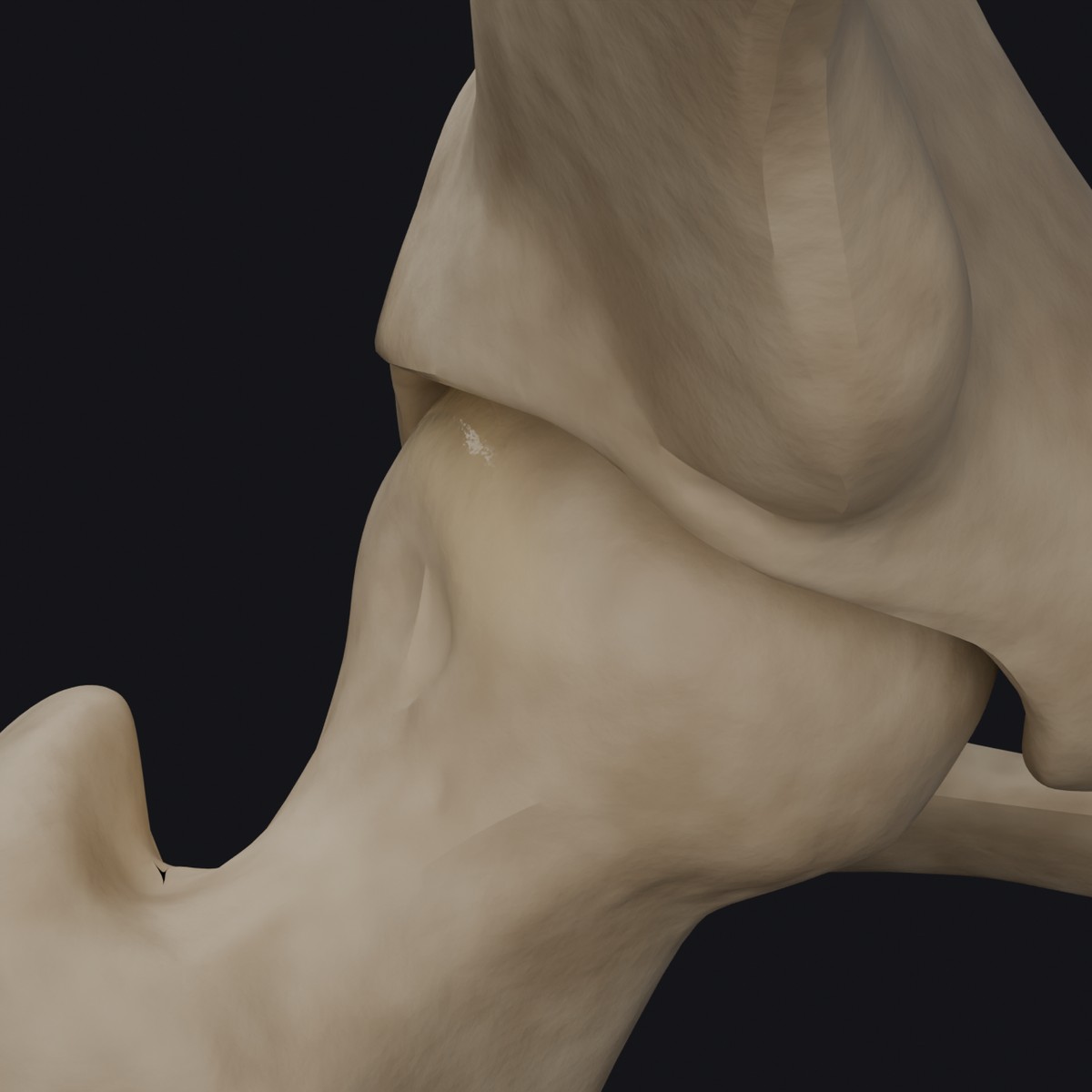
Specimen · Femoral head in its socket, 3D modelState: whole
Lifetime risk25.3%of people develop symptomatic hip osteoarthritis by age 85, per the Johnston County cohort. The definition sits in chapter one, where it belongs.
The humility number69%of painless hips in volunteers showed a torn labrum on high field MRI. Damage on a scan is common; pain is rarer. Chapter four keeps the two apart.
Chapter one · The Ball
A marble in a cup, fed by one thin road
The ball is the head of the femur, the thigh bone: close to a perfect sphere, about golf ball sized, sitting in a pelvic cup, the acetabulum. Smooth cartilage, a few millimeters thick, caps the ball and lines the cup, so the two glide almost without friction. A rim of tougher tissue, the labrum, seals the joint like a gasket. Every step sends roughly three to five times your body weight through this joint. A long life means tens of millions of them.
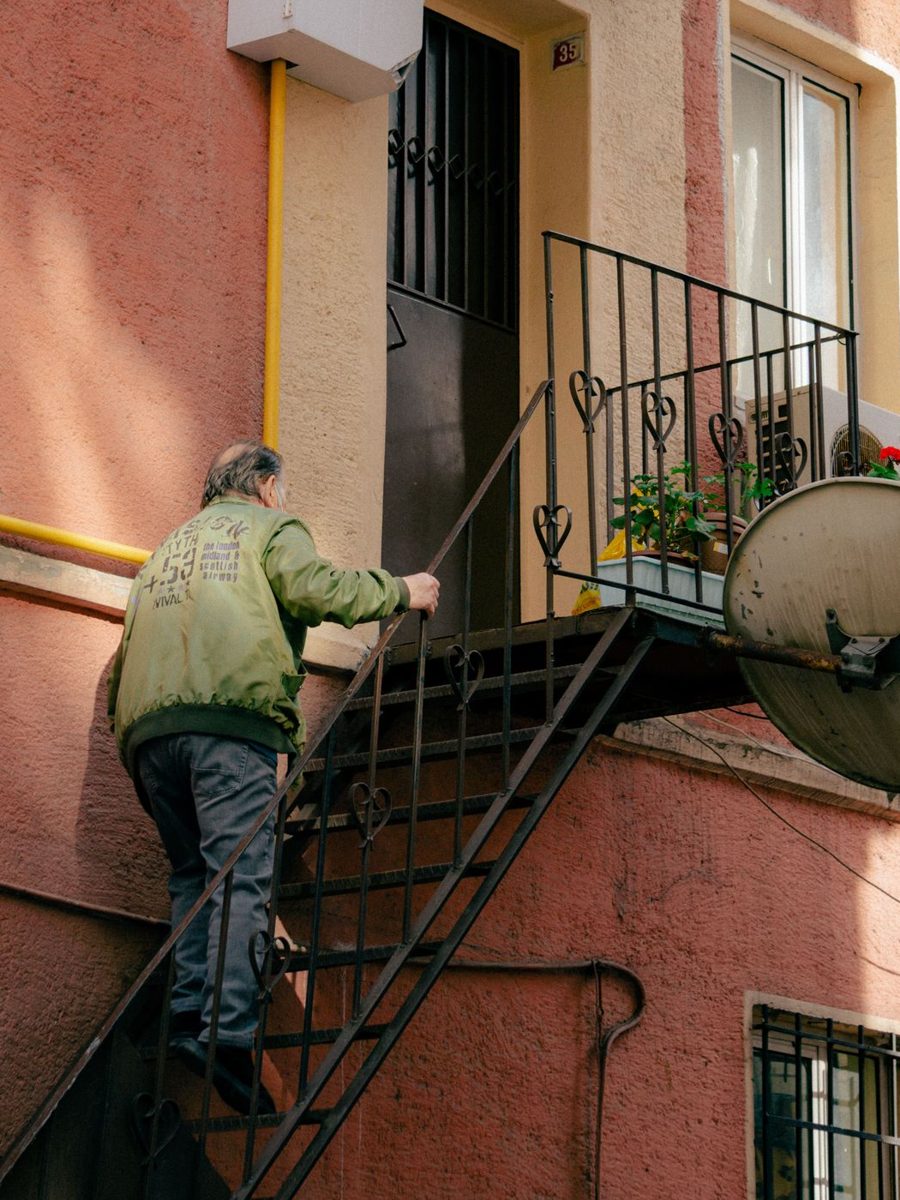
Daily life, loaded: an older man climbs the stairs to his home, hand on the rail. Every flight is hip work. Photo by Ersin Baştürk on Pexels (Pexels License).
The ball's weak point is not its strength but its supply line. Nearly all its blood arrives through small branches of one artery, the medial femoral circumflex artery, climbing the back of the neck in a delicate web into the bone near the top of the head. There is almost no backup route. Anything that cuts that road (a fracture, a dislocation, a clot of sickled cells, scarring from high dose steroids) threatens the whole ball.
So the head has three ways to die. Shape: ball or cup forms slightly wrong, and the wrongness grinds for decades. Blood: the supply line fails, the bone dies, and the sphere caves in. Wear: cartilage thins until bone meets bone, the commonest death of all. The chapters follow that order.
25.3%
Lifetime risk of symptomatic hip osteoarthritis by age 85Murphy and colleagues, Johnston County Osteoarthritis Project (Arthritis Care and Research, 2010): 3,068 adults, lifetime risk modeled. The estimate runs from 21.3% to 29.3%, conditional on living to 85. Symptomatic meant both at once: an x-ray showing at least moderate damage (Kellgren and Lawrence grade 2 or higher) and pain, aching, or stiffness on most days, or groin pain, in at least one hip. Change the definition and the number moves a lot, so it travels with the number.
One in four is the burden. The rest of this essay covers how unevenly it is earned, and how much of it medicine can change.
Chapter two · Shape
The bump, measured in degrees
Specimen · Head and neck junctionState: cam
In a textbook hip the ball meets the neck in a smooth waist, so the joint flexes and turns without the neck striking the cup's rim. In a cam hip, extra bone fills that waist in. The bump usually forms in the teen years, growth plate still open, in young athletes who load the hip hard. Each deep bend drives the bump into the rim, and the cartilage there takes the hit, thousands of times a season.
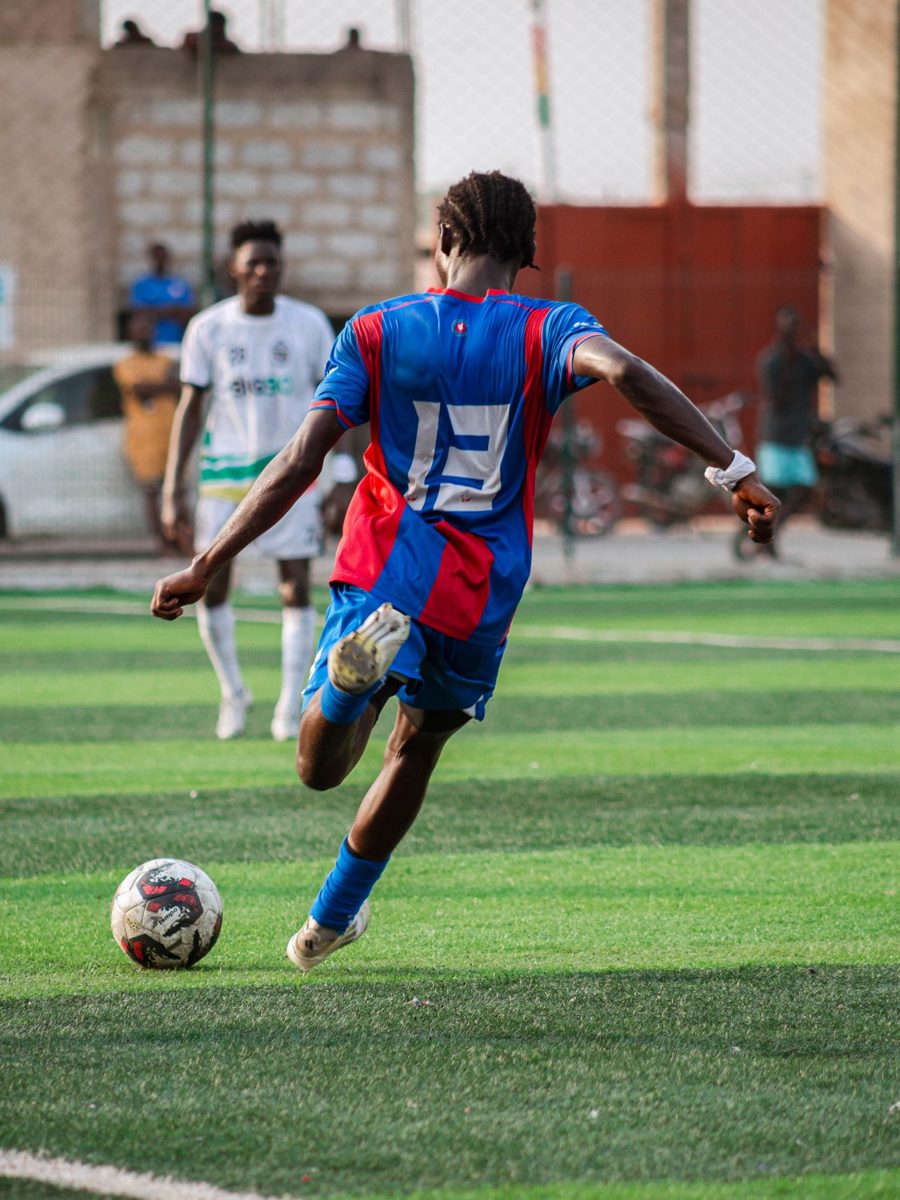
Where cam hips are made: a young player drives through the ball on turf, hip deep in bend and twist. Photo by Alfredo Dacosta on Pexels (Pexels License).
Surgeons measure the bump with the alpha angle: between the neck line and a line from the ball's center to where its surface stops being round. A rounder hip has a small angle; a bigger bump pushes that point farther around the head. Drag the angle below. The drawing is a schematic section, not a patient scan; risk figures appear only at published cohort stops.
The Alpha Angle ExplorerSchematic · Drag or tap a stop
Below the cam line · The common shape
The average painless hip measures 54.1 degrees.
Most hips live in this range, including most hips that never hurt. Cohort studies place the start of cam morphology at about 60 degrees, so a reading below that is the ordinary shape of a human hip, not a diagnosis.
How common is the bump? In a 2015 systematic review of 2,114 hips (Frank and colleagues), cam shape appeared in 37% of hips in people with no hip pain: 54.8% of athletes and 23.1% of the general population. Painless hips averaged 54.1 degrees. Pincer shape, extra bone on the cup side, was reported in 67% of painless hips, but defined so loosely that pincer gets no number here.
Read any single angle with care. The same hip measures differently across x-ray views. Values run higher in men, and two readers can disagree by several degrees. The stops are signposts, not cliffs. The largest risk estimate here comes from a cohort with early symptoms already.
When cam shape, groin pain, and limited motion all showed up together in the Chingford cohort, hips meeting the full picture had about seven times the odds of developing x-ray osteoarthritis over ten years. But only 21 hips met all the criteria, confidence intervals were very wide, and most bumpy hips never become that story. The bump is common; the disease is the exception.
The other shape · A shallow cup
Dysplasia: a big ratio, a small share
Dysplasia is the mirror problem: the cup is too shallow, so the ball sits partly uncovered and load concentrates on a small cartilage patch. A center edge angle under 25 degrees marks it. In the Rotterdam Study it carried an odds ratio of 4.3 (2.2 to 8.7) for later hip osteoarthritis. Yet the same work attributes only about 3.6% of cases in adults over 55 to dysplasia, because the shallow cup is rare: high risk for the few who have it, a small share of the total burden. It hides in plain sight: in one surgical series, 48.4% of hips replaced before age 51 for supposed plain osteoarthritis showed dysplasia features on review.
Shape in context · Who accounts for the cases?
Ratios are not shares
~20.0%
The share of new x-ray hip osteoarthritis cases in older Rotterdam adults attributed to being overweight, the largest single share measured. Cam shape accounted for about 7.9% and dysplasia about 3.6%. A shape can multiply one person's risk several times over yet explain few cases, if few people have it. Keep both ledgers in view: the ratio for the patient in front of you, the share for the population behind them. Chapter four returns to the weight number, and its complication.
Chapter three · Blood
When the road in fails, the ball dies quietly
Specimen · The weight bearing domeState: necrotic
Avascular necrosis, also called osteonecrosis, is the second death. The bone inside the head loses its blood, dies, and can no longer hold its shape. For a while nothing shows: dead bone still bears load, and early scans look calm. Then the dead segment, usually in the dome where the load lands, crumples. The ball flattens, the joint space follows, and a young hip becomes an arthritic one.
The causes are a short list. Trauma is the plainest: a femoral neck fracture or dislocation tears the vessels outright. Steroids are the commonest cause without trauma. Risk rides with dose, concentrated at high daily peaks, above roughly 40 milligrams of prednisone equivalent a day in pooled analyses. One small COVID era cohort from high dose steroid care found necrosis in 15% of those screened: a signal from a selected group, not a rate for every patient. Alcohol is the third classic cause; case control studies tie heavy drinking to higher risk, rising with dose; the studies support no tidy threshold, so this essay sets none. Sickle cell disease, decompression sickness, and cases with no cause found complete the list.
16%
Necrosis after a displaced femoral neck fracture, pinnedLu-Yao and colleagues (Journal of Bone and Joint Surgery, 1994): about 16% of displaced fractures fixed internally developed necrosis within roughly two years, and 33% failed to unite. In young patients, a 2015 meta analysis found 14.7% after displaced fractures against 6.4% after undisplaced ones; a 2022 meta analysis put the overall rate at 14.5%.
59%
Quiet lesions that declared themselvesHernigou and colleagues followed 105 hips with necrosis that had never hurt, in people treated for the other hip. Untreated, 59% became painful and collapsed. The other 41% stayed quiet for more than five years, over eight years on average. The lesions were large, about 53% of the head, part of why they failed. Size and location decide the odds. The staging systems below try to capture them.
80 to 85%
Symptomatic necrosis, untreated, that collapsesOnce a necrotic hip hurts and is left alone, natural history reviews put collapse at roughly 80 to 85% within about two years. Pain here is the sound of the structure starting to go.
Staging, in plain words. Doctors grade the damage for prognosis. The Ficat system reads plain x-rays: stage I looks normal while a scan shows death; stage II, density changes but a round head; stage III, the crescent and first flattening; stage IV, collapse with arthritis. The ARCO system, revised in 2019, starts from MRI and adds dead zone size and location. Steinberg bolts size classes onto the stages. All three say the same thing: how much of the dome is dead, and has it caved in yet? Treatment evidence makes sense only inside that frame.
Treatment · Core decompression
A drilled channel, a stage dependent answer
The operation drills a narrow tunnel into the dead zone, relieving pressure and inviting new blood vessels. The older literature (Castro and Barrack, 2000, pooling 688 hips) reads as a gradient. At stage I, decompression succeeded in 84% of hips against 61% with nonoperative care, a real gap. At stage II the advantage was no longer significant. At stage III, once flattening had begun, results were poor either way. Mont's 1995 pooling agrees in the precollapse stages, 71% success with surgery against 34.5% without. Read the fine print: nearly all these studies were not randomized, they span different eras and techniques, and success was defined study by study. Decompression looks best early, before collapse, on evidence weaker than its reputation.
Treatment · Alendronate, both trials
One glowing trial, one null trial
In 2005, Lai and colleagues reported a much quoted result: with alendronate, only 2 of 29 hips collapsed, against 19 of 25 without it, and total hip replacements ran 1 against 16. Then Chen and colleagues ran the stricter test in 2012, double blind, placebo controlled, and found nothing: a risk ratio of 1.15 (0.54 to 2.45) for progression, squarely null. The first trial was small, unblinded, placebo free, in patients with large lesions; the second removed those excuses and the effect vanished. A large Indian series (Agarwala) reports success, but with no control group it cannot separate the drug from who was chosen to receive it. Verdict: unproven, and a standing lesson in why the open label result is the trailer, not the film.
When the dome has collapsed, no drill or pill puts the sphere back. The conversation moves to chapter five, earlier in life than anyone planned.
Chapter four · Wear
The long grind, and what actually slows it
Specimen · Cartilage gone at the domeState: worn
Wear is the slow death: cartilage thins, bone beneath hardens, spurs grow, and the joint stiffens into its ache. Care is graded here the way the back pain essay graded its shelf, verdict first, numbers attached, weak evidence labeled as weak.
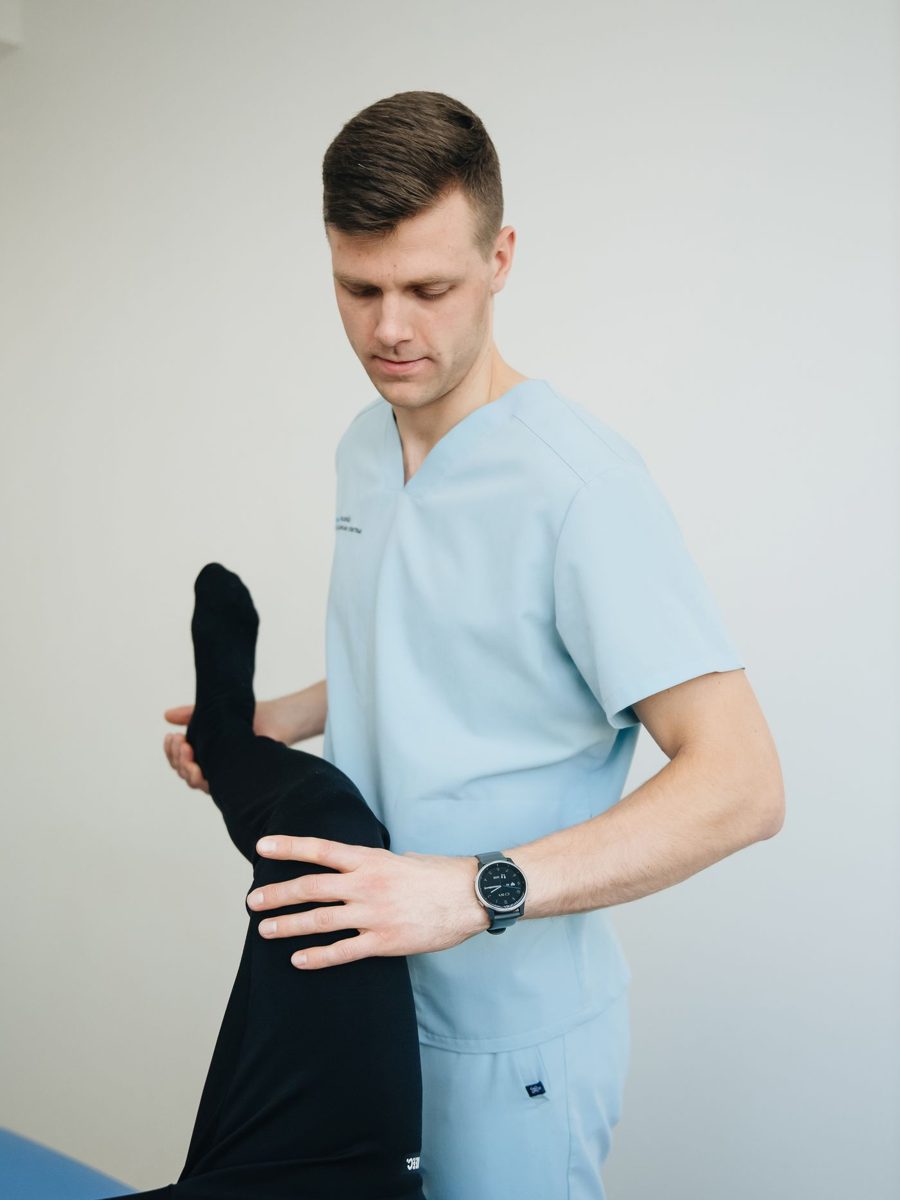
First line, hands on: a physiotherapist guides a patient through leg exercises on the treatment table. Photo by Funkcinės Terapijos Centras on Pexels (Pexels License).
Works · First line
Exercise therapy
The best supported treatment on this page. The 2026 Cochrane update puts the gain at about 7 points of pain relief and 9 points of function on 0 to 100 scales (7.19 and 8.79), moderate certainty. The older Cochrane pooling agrees (standardized effects near 0.30 for pain and 0.35 for function). Honest framing: reviewers call the gain minimally clinically meaningful, and it may shrink toward nothing against attention matched controls. Small, real, and the safest thing here still earns first place.
Honest box
Weight loss: believed, not proven, for hips
Population data say weight matters: about 20.0% of new x-ray hip osteoarthritis in the older Rotterdam cohort was attributable to overweight. But there is no randomized trial of weight loss for hip osteoarthritis. The flagship diet and exercise trials behind the confident advice are knee trials. The Johnston County lifetime risk study found no link between body mass index and symptomatic hip osteoarthritis risk. Weight care is good medicine for many reasons. As a proven hip treatment, it is an extrapolation, and this page labels it as one.
Works · Briefly
Steroid injection
A corticosteroid shot beats placebo at three months and not at six (2023 network meta analysis, 16 trials, 1,735 patients). Relief lasts up to about 12 weeks. A bridge, not a repair.
Guideline pills
Pills, in one line
Anti inflammatory painkillers (NSAIDs) are first line. Acetaminophen is a weak fallback. Opioids are discouraged. Everything stronger sits in the chapters either side of this one.
No better than placebo
Hyaluronic acid
The gel shot fails its tests. Leite (2018), pooling 8 randomized trials and 807 patients, found it not superior to placebo at three months; Brander (2019) found hylan no better than saline across 26 weeks. Guidelines have stopped favoring it; so does this ladder.
Not settled
Platelet rich plasma
PRP trials in the hip conflict, with no large definitive trial to settle them. Insufficient evidence is the accurate label, both directions.
And when pain sits in a young, active hip with a cam bump? Four randomized trials pit hip arthroscopy against physical therapy, and they read like a photo finish.
The FAI Trials · Surgery vs TherapyEach score on its own scale
UK FASHIoN · 2018
348 patients with FAI syndrome and no advanced arthritis. On iHOT-33 (0 to 100), surgery beat therapy by 6.8 points (1.7 to 12.0) at 12 months. The smallest worthwhile difference, preset, was 6.1. Both groups improved a lot (about 39 to 59 after surgery, 36 to 50 with therapy); surgery was not cost effective at 12 months.
+6.8vs bar of 6.1
Australian FASHIoN · 2021
99 patients analyzed, same iHOT-33 scale, larger gap: 14.2 points (5.6 to 23.9) for surgery at 12 months. A smaller trial with a wider interval, pointing the same way, louder.
+14.2iHOT-33
FAIT · 2019
222 patients, scored on the HOS activities of daily living scale: surgery ahead by 10.0 points at 8 months. A different ruler; its number is not interchangeable with the two above.
+10.0HOS ADL
Mansell · 2018
80 active duty military patients. No significant difference. Seventy percent of the therapy group crossed over to surgery anyway, blurring any verdict the trial could have given.
0null result
The photo finish, called fairly: surgery wins on points in three of four trials, by margins near the smallest difference patients can feel, in people with the syndrome, without advanced arthritis. No trial, and no pooling of them, shows that arthroscopy prevents osteoarthritis or a later hip replacement. Symptom relief is what the evidence supports. Prevention is not.
Imaging honesty · The scan is not the symptomRead before believing any MRI
Register and colleagues scanned 45 volunteers with no hip pain on a 3 Tesla MRI: 73% had some abnormality, and 69% had a labral tear. A pooled estimate puts labral tears in about 56% of painless hips. The Framingham data (Kim, BMJ, 2015) add: x-ray osteoarthritis appeared in 19.6% of hips, symptomatic osteoarthritis in only 4.2%, and frequent hip pain predicted x-ray damage weakly, a positive predictive value of 23.8%. In the Osteoarthritis Initiative, groin pain caught only 16.5% of hips with definite x-ray osteoarthritis. Treat the patient: the scan is a witness, and witnesses exaggerate.
Chapter five · The Replacement
The replacement has a life table
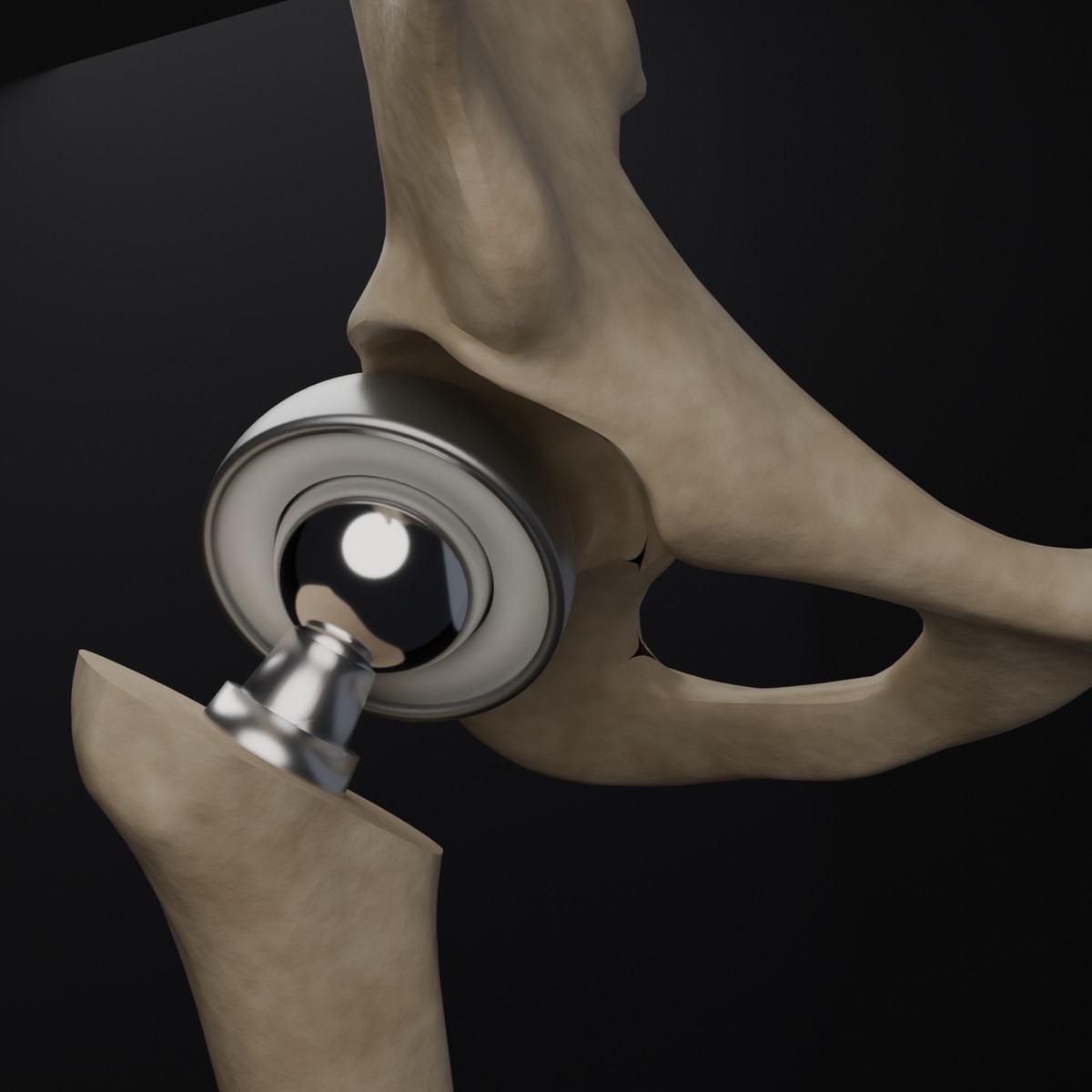
Specimen · Ball, replacedState: metal
"The operation of the century." The Lancet's name for total hip replacement in 2007 (Learmonth and colleagues). Registries have spent two decades checking the claim.
A hip replacement is followed like an actuarial life: a survival curve, anniversaries, and a hard dependence on starting age. This site has read such a table before, for the spinal cord, in Essay 18. The implant's table is kinder, governed by the same rule: the younger the start, the longer the exposure.
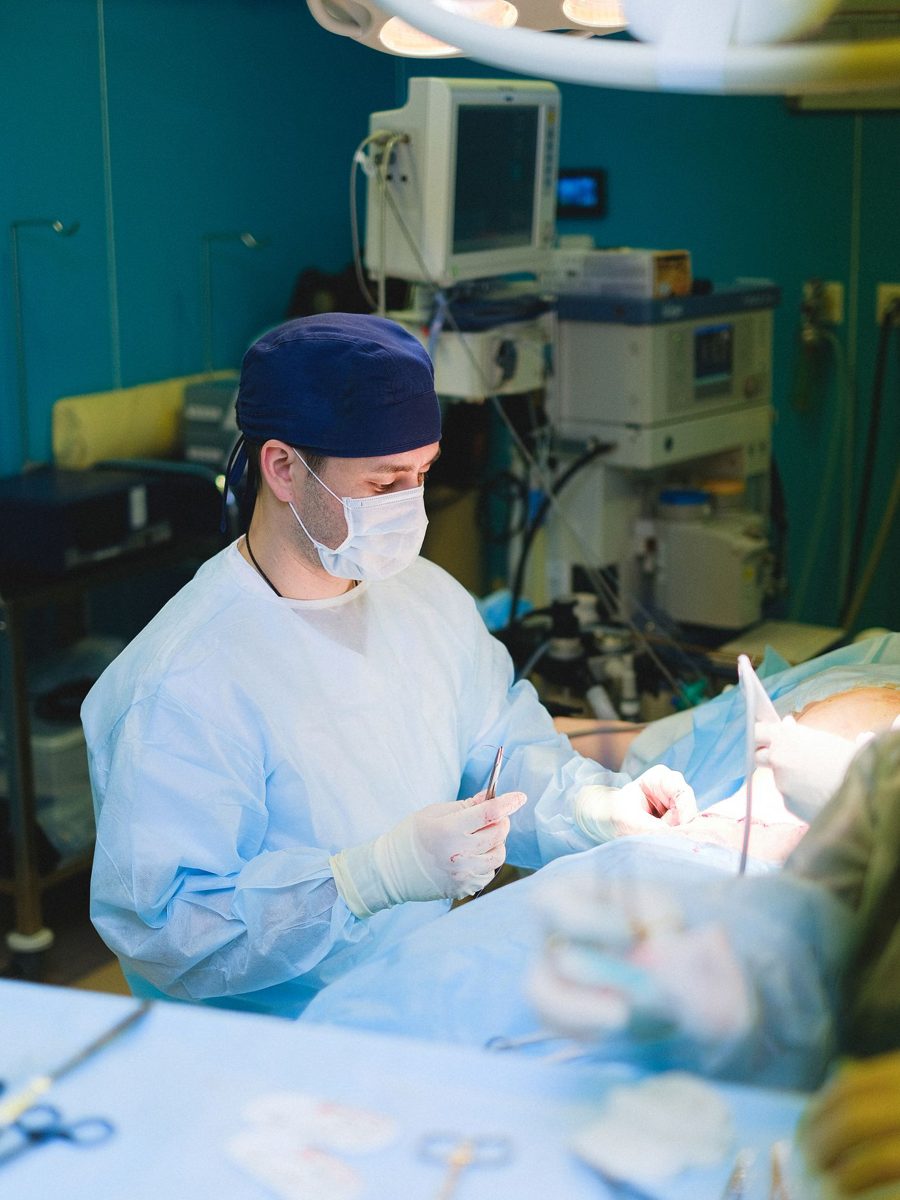
The replacement, underway: a surgeon sutures under the operating lights, the patient draped out of view. Photo by Anna Shvets on Pexels (Pexels License).
Implant survival · Still in place, no revisionBayliss 2017 · Evans 2019
The 10 and 20 year points are Bayliss (Lancet, 2017), 63,158 primary replacements in England and Wales, adjusted for patients dying with working hips. The 25 year point, 57.9% still in place, is a pooled estimate across registries from Evans (Lancet, 2019). The steeper last segment mixes sources. The modern anchor is kinder: for hips implanted in 2012, the UK National Joint Registry counts 3.0% revised by 10 years, below the 5% benchmark regulators set.
~5%
Lifetime risk of revision, replaced after age 70Bayliss 2017. Most recipients here will die with the original implant still working: usually a once in a lifetime purchase.
35%
Lifetime risk of revision, men replaced in their early 50sUp to 35% (30.9% to 39.1%). Women in the same age band run about 15 percentage points lower. Youth buys decades of use and spends them against the implant. For patients replaced before 60 who do need a revision, the median time to it is just 4.4 years.
21.3%
A revised hip that needs revising againWithin 15 years of a first revision, about one in five revised hips needs another. The failure modes behind the curve: joint infection, the most morbid at roughly 1 to 2% of replacements; dislocation, about 2%; late aseptic loosening, about 59% of Norwegian registry revisions. Each pass through the operating room starts a worse table.
None of this argues against the operation. It argues for timing it with open eyes: a rehabilitation conversation as much as a surgical one, starting in the next chapter.
Chapter six · The Rehab
Where PM&R earns its chapters
Specimen · Ball, replacedState: in rehab
For decades, patients replaced through the back of the joint went home with a ritual: never bend the hip past 90 degrees, never cross your legs, sleep with a pillow between your knees, sit on a raised toilet seat, use a reacher for your shoes. The rules guarded against dislocation and governed the first weeks after surgery. Then the trials added them up.
Walking again starts here: a patient in a hospital gown makes the corridor on crutches. Photo by Stéf -b. on Pexels (Pexels License).
2.2% vs 2.0%
Dislocation with precautions vs withoutCrompton and colleagues (Acta Orthopaedica, 2020), 7 studies and 6,900 patients after posterior approach replacement: 2.2% dislocated with the full ritual, 2.0% without it. A companion meta analysis of 9,599 hips found 2.2% in both arms (risk ratio 0.98). Pooling only the randomized trials changes nothing. Unrestricted patients gave up walking aids sooner, with better early function in several trials. The ritual is retiring, service by service. What replaces it: education, sensible load, and therapy aimed at strength, the point all along.
Prehab gets the same honest treatment. Exercising before surgery feels like it should pay off. A 2023 meta analysis of 22 randomized trials and 1,601 patients (Bone and Joint Open) found, for hip replacement, no measurable gain in pain after surgery (mean difference 0.19, p = 0.44) or in function (0.14, p = 0.68). Length of stay shrank significantly for knee replacements, by 0.43 days, and not for hips, 0.24 days at p = 0.12. Prepare the home, the help, and the plan. Do not promise a hip patient that prehab classes will move their scores. For hips, pooled trials say they do not.
The abductors are the real rehab story. The muscles holding the pelvis level, chiefly gluteus medius, are cut, split, or stretched by every approach, each differently. Weakness there is the Trendelenburg limp: the pelvis dips toward the swinging leg, the trunk leans to compensate, and gait spends energy it should save. Strength typically rebuilds across the first 6 to 12 months; a minority keep some limp. No pooled percentage is printed, because studies measure it too differently to pool honestly. The limp itself has its own chapter on this site: the gait cycle, Essay 07.
Return to running · The surveys
What surgeons advised
For years, surgeon surveys came back restrictive: running and other impact sports were commonly advised against after replacement, on a reasonable theory. Impact means load cycles, load cycles mean wear, wear means loosening, and a young runner has decades to spend. The advice was cautious, consistent, and for a long time almost entirely untested.
Return to running · The evidence
What the follow up found
Abe (2014) followed patients who jogged after replacement, about two hours a week at an average of five years: no loosening, no excess wear, no pain complaints. Streck, in 4,152 hips, found high activity at two years, jogging included, carried no increase in revision risk; adjusted analyses leaned lower. Polyethylene wear in one long study ran about 0.036 millimeters a year at a mean of 15 years and did not track with activity level. The caveats are printed, not buried: mid term results in self selected patients, and nobody has 25 year data on marathoners. The modern conversation is a shared decision with numbers attached.
Three deaths, one ball. Shape loads the dice early, blood decides suddenly, wear collects slowly, and the replacement restarts the clock under a table of its own. Rehabilitation is where all four stories are lived, one patient at a time.
Fine print
What would move these numbers
Definitions move the burden. The 25.3% lifetime risk rests on one definition (x-ray grade plus symptoms) in one North Carolina county cohort. Count x-rays alone and the number roughly quintuples; demand both and it falls. Every figure in this essay should be read with its definition attached.
Cohorts are not populations. The CHECK odds ratio of 9.7 comes from people aged 45 to 65 who already had early hip or knee symptoms. The Hernigou collapse rate comes from large lesions in people whose other hip had already failed. Both are the best data available and neither describes every hip.
The necrosis literature is old and uneven. Core decompression and alendronate were studied mostly without randomization, across decades of changing technique. Stage, lesion size, and cause differ between series, and so do definitions of success.
Shape is more than one angle. A 2024 statistical shape modeling study found that only one cam subtype, a flattened head and neck junction, predicted later osteoarthritis (odds ratio 1.14 per unit of the shape score), while other subtypes did not. The alpha angle is a blunt summary of a three dimensional shape, and future essays may need a better ruler.
Registry curves mix eras. Bayliss pools implants placed from 2003 onward; Evans pools further back. Modern bearings and techniques look better in the National Joint Registry's recent windows, which is why the 3.0% modern anchor is printed beside the older curve.
About the joint renders. Joint renders: built from BodyParts3D anatomical models (Database Center for Life Science), CC BY-SA 2.1 Japan. The cam and shallow socket plates are measured deformations of the model bones, shown as schematics; the replacement plate uses standard implant geometry seated on the model rotation center. Every plate is rendered from those same model bones, each from the angle that shows its change, and in the cam, shallow socket and worn plates the changed region carries a warm tint for visibility.
This essay explains published evidence. It is not medical advice for any one hip.
Sources
Murphy LB et al. Lifetime risk of symptomatic hip osteoarthritis, Johnston County Osteoarthritis Project. Arthritis Care and Research, 2010.
Kim C et al. Association of hip pain with radiographic evidence of hip osteoarthritis: Framingham and Osteoarthritis Initiative. BMJ, 2015.
Frank JM et al. Prevalence of femoroacetabular impingement imaging findings in asymptomatic volunteers. American Journal of Sports Medicine, 2015.
Agricola R et al. Cam impingement and osteoarthritis in the CHECK cohort: alpha angle above 83 degrees. Annals of the Rheumatic Diseases, 2013.
Agricola R et al. The threshold for cam morphology and the development of osteoarthritis. Osteoarthritis and Cartilage, 2012.
Nicholls AS et al. The Chingford cohort: alpha angle and the odds of later total hip replacement over 19 years. Arthritis and Rheumatism, 2011.
Agricola R et al. Femoroacetabular impingement syndrome and incident osteoarthritis at ten years. Osteoarthritis and Cartilage, 2013.
Reijman M et al. Acetabular dysplasia and incident hip osteoarthritis, Rotterdam Study. Arthritis and Rheumatism, 2005.
Rotterdam Study analysis of population attributable fractions for hip osteoarthritis risk factors, 2023.
Clohisy JC et al. Radiographic evaluation of hips replaced for idiopathic osteoarthritis before age 51. Clinical Orthopaedics and Related Research, 2009.
Register B et al. MRI findings in asymptomatic volunteers: labral tears in 69 percent. American Journal of Sports Medicine, 2012.
Reichenbach S et al. Prevalence of imaging findings in asymptomatic hips: systematic review. British Journal of Sports Medicine.
Lu-Yao GL et al. Outcomes after displaced fractures of the femoral neck. Journal of Bone and Joint Surgery, 1994.
Slobogean GP et al. Femoral neck fractures in young patients: meta analysis of avascular necrosis rates, 2015; and meta analysis of fixation outcomes, 2022.
Hernigou P et al. Fate of untreated asymptomatic osteonecrosis of the femoral head. Journal of Bone and Joint Surgery, 2002.
Untreated symptomatic osteonecrosis: natural history as reviewed in the Permanente Journal primer on femoral head avascular necrosis, 2019.
Zhao R et al. Glucocorticoid dose and osteonecrosis: pooled dose response analysis, 2016.
Fukushima W et al. Alcohol consumption and osteonecrosis of the femoral head: case control study, 2010.
Cohort of osteonecrosis after high dose steroid treatment for COVID 19. Diagnostics, 2026.
Castro FP, Barrack RL. Core decompression failures by Ficat stage: literature synthesis of 688 hips. Clinical Orthopaedics and Related Research, 2000.
Mont MA, Hungerford DS. Nonoperative management versus core decompression: meta analysis, 1995.
Lai KA et al. The use of alendronate to prevent early collapse of the femoral head in patients with nontraumatic osteonecrosis. Journal of Bone and Joint Surgery, 2005.
Chen CH et al. Alendronate in the prevention of collapse of the femoral head in nontraumatic osteonecrosis: a two year multicenter, prospective, randomized, double blind, placebo controlled study. Osteoarthritis and Cartilage, 2012.
Agarwala S et al. Alendronate in osteonecrosis of the femoral head: open label series. Indian Journal of Orthopaedics, 2022.
Ficat RP. Idiopathic bone necrosis of the femoral head: staging system. Journal of Bone and Joint Surgery, 1985; ARCO international staging revision, 2019; Steinberg ME et al., quantitative staging system.
Fransen M et al. Exercise for osteoarthritis of the hip. Cochrane Database of Systematic Reviews, 2014; update by Hall M et al., 2026.
Sabah SA et al. Intra articular therapies for hip osteoarthritis: network meta analysis of 16 randomized trials, 2023.
Leite VF et al. Viscosupplementation for hip osteoarthritis: systematic review of 8 randomized trials, 2018.
Brander VA et al. Randomized controlled trial of hylan G-F 20 for hip osteoarthritis, 2019.
Griffin DR et al. Hip arthroscopy versus physiotherapy for femoroacetabular impingement (UK FASHIoN). The Lancet, 2018.
Hunter DJ et al. Hip arthroscopy versus physiotherapy (Australian FASHIoN). JAMA Surgery, 2021.
Palmer AJR et al. Arthroscopic hip surgery compared with physiotherapy (FAIT). BMJ, 2019.
Mansell NS et al. Arthroscopic surgery or physical therapy for femoroacetabular impingement in active duty military. American Journal of Sports Medicine, 2018.
Learmonth ID, Young C, Rorabeck C. The operation of the century: total hip replacement. The Lancet, 2007.
Bayliss LE et al. The effect of patient age at intervention on risk of implant revision after total replacement of the hip or knee. The Lancet, 2017.
Evans JT et al. How long does a hip replacement last? Systematic review and meta analysis. The Lancet, 2019.
National Joint Registry for England, Wales, Northern Ireland and the Isle of Man, annual report data to December 2023.
Failure mode shares: Norwegian Arthroplasty Register component data; infection and dislocation ranges from registry reviews.
Crompton T et al. Hip precautions after posterior approach total hip arthroplasty: systematic review and meta analysis. Acta Orthopaedica, 2020; companion meta analysis of 9,599 hips; randomized trial only meta analysis.
Preoperative exercise before total joint replacement: meta analysis of 22 randomized trials. Bone and Joint Open, 2023.
Abe H et al. Jogging after total hip arthroplasty. International Orthopaedics, 2014.
Streck LE et al. Activity level and revision risk after total hip arthroplasty, 4,152 hips. Journal of Arthroplasty.
Long term wear of highly crosslinked polyethylene after total hip arthroplasty: mean 15 year follow up study.
Statistical shape modeling of the proximal femur and incident osteoarthritis, 2024.
About
Jonathan A. Byrne, DO
Physical Medicine and Rehabilitation resident physician at Memorial Healthcare System in South Florida.
Training
Dr. Byrne earned his B.S. in Business Computing and Data Science from the NYU Stern School of Business in 2018, on a pre-medicine track with a chemistry minor. He competed in Division III cross-country and studied abroad in Sydney, Australia. He received his Doctor of Osteopathic Medicine from Nova Southeastern University's KPCOM in May 2025, couples-matching into residency with his wife Sarah Lynch, an emergency medicine resident. He is a PGY-2 resident physician in Physical Medicine and Rehabilitation at Memorial Healthcare System as of 2026.
From data to medicine
Before medical school, he worked in the corporate world: first as a healthcare consulting analyst on the healthcare analytics team at Willis Towers Watson, then as an actuarial consulting intern. He went on to work in a physical therapy clinic (as a physical therapy aide at Performance Therapy Center and a volunteer at Body Logic Clinic) and as a therapy volunteer at Stay In Step, a brain and spinal cord injury recovery center, where he worked with patients including exoskeleton users.
Research
He has three peer-reviewed manuscripts: a training-regimen case study of an elite ultramarathon runner's 24-hour world-record run (with S. Lynch) in the International Journal of Sports Physiology and Performance (2024); a systematic review of wheelchair push-count fitness watches in Cureus (2023); and a scoping review of COVID-19 syringe service programs in Cureus (2023). He has also published four abstracts and authored multiple SOMA/AOA policy resolutions.
Outside the hospital
He is an ultramarathon finisher who took 2nd in his age group at the Clearwater Distance Classic 50k in February 2023, has finished three marathons (Honolulu, New York City, and one virtual) and fourteen half marathons. He works as a freelance travel and event photographer with 500+ stock photo sales, and his work has been featured on the Bolivia and Peru tourism boards. He has visited 31 of 63 U.S. national parks, and has been the general manager of his fantasy basketball league for more than a decade.
About this site
The PM&R Files is a collection of data-driven visual essays about bodies in motion. Every number is traceable to a published source. All essays are drafts under expert review. Educational content only, not medical advice.
The older the pain-free spine, the more “abnormal” its MRI looks.
96%of pain-free 80-year-olds were modeled to show disk degeneration.
Your scan
Say we scanned you today, with zero back pain. Here's what your MRI would probably say.
These aren't your personal odds. They're group averages: the share of pain-free people at each age who show each finding, modeled from 33 studies1.
Age-adjusted prevalence · scroll or drag
Among pain-free people your age
Drag the slider to your age. Every bar is the share of pain-free people your age who show that finding.
2080
35 YEARS
ASYMPTOMATIC COHORT SCROLL-SYNCED VIEW
AGE 20marks accumulate by decade
DATA DENSITY OVERLAY · visual emphasis only, not pathology localization. Same CC0 scan and attribution as above.
Model predictions from Brinjikji et al. 2015, AJNR. Values between decades are linearly interpolated by us. Hatched bars at ages 20 to 30: low data. Facet degeneration and spondylolisthesis are model extrapolations from zero direct observations in those age groups.
AGE 20
The first frame
Disk degeneration 37% · bulge 30% · protrusion 29% · annular fissure 19%. Even at 20, pain-free people already carry these words on their scans.
AGE 30
The vocabulary grows
Disk degeneration 52% · bulge 40% · protrusion 31% · annular fissure 20%. The words pile up a decade before most backs ever hurt.
AGE 40
“Abnormal” becomes ordinary
Disk degeneration 68% · bulge 50% · protrusion 33% · annular fissure 22%. Most of the bars climb together now. That is aging shifting the background, not injury.
AGE 50
The scan accumulates words
Disk degeneration 80% · bulge 60% · protrusion 36% · annular fissure 23%. A longer report still does not name the source of your pain.
AGE 60
Most discs look different
Disk degeneration 88% · bulge 69% · protrusion 38% · annular fissure 25%. The overlay tracks how common a finding is, not how much it hurts.
AGE 70
The base rate dominates
Disk degeneration 93% · bulge 77% · protrusion 40% · annular fissure 27%. A finding can be real and still need the history and exam to mean anything.
AGE 80
Near saturation
Disk degeneration 96% · bulge 84% · protrusion 43% · annular fissure 29%. The scan is detailed. What caused the pain still belongs to the history and the examination.
Watch the “abnormalities” arrive.
Each card is one line a radiologist might write. Flip it, and the scary vocabulary becomes a base rate: how often the same feature shows up in people with no back pain.
An “abnormal” MRI is the normal result.
NORMAL FOR AGE
The curve
The gray hair of the spine
Four model-predicted prevalence curves. Tap a label to isolate a finding. The source only reports decade values, so we joined them with straight lines.
Percent of asymptomatic individuals · Brinjikji et al., AJNR 2015, Table 2.
The words
“Degeneration” and “bulge” are descriptions.
Radiology needs words for shape, signal, and wear. Those words can be useful without being a verdict on pain. Brinjikji and colleagues concluded1: “Many imaging-based degenerative features are likely part of normal aging and unassociated with pain…”
Jensen’s 1994 echo2: among 98 people without back pain, 52% had a disk bulge at at least one level and 27% had a protrusion.
So don't toss the scan. Use it for a different question: does this finding fit the history, examination, and neurologic pattern?
Words vs. meaning
Decode the report
Three common phrases, translated in plain words.
Degenerative disc disease
Wear visible on scan
96% of pain-free 80-year-olds: disk degeneration
Disc bulge
The disc extends broadly beyond its usual margin
50% of pain-free 40-year-olds
Annular fissure
A line or separation in the disc’s outer ring
29% of pain-free 80-year-olds
Counterweight
Painful spines are not identical.
Most findings are common, but some still track with pain. A companion meta-analysis in adults 50 or younger found disc bulge, disc degeneration, extrusion and protrusion, Modic type 1 change, and spondylolysis enriched in painful spines. Annular fissure (OR 1.79, P=.06) and spondylolisthesis (OR 1.59, P=.20) missed statistical significance. The review is published as an abstract only, so this stays preliminary, awaiting expert verification.
The overuse stake
Early MRI travels with more care
In observational data on uncomplicated low back pain, an early MRI was associated with markedly higher costs and more surgery.
Total costs
Early MRI
$22,151
No early MRI
$6,640
Surgery
Early MRI
19.9%
No early MRI
2.5%
OBSERVATIONAL ASSOCIATION, NOT CAUSATION.
Red flags
Do not scan every back. Do not miss the dangerous one.
ACR guidance3: for uncomplicated acute low back pain, no imaging for the first six weeks. The timeline changes when any of these show up:
Suspicion of cancer
Suspicion of infection
Cauda equina syndrome or other severe neurologic compromise
Fracture
Severe or progressive neurologic deficits, and symptoms that persist despite appropriate management, also change the timeline and the imaging strategy.
Educational reference
Four reasons to change course
No quiz, score, or symptom checker, just plain-language reasons clinicians may image urgently.
Red flags are uncommon. That’s why they matter.
Educational only; talk to a clinician.
Reporting
What if the report carried its own context?
The LIRE trial4 (NCT02015455) tested a simple fix: print age-specific prevalence benchmarks for common findings right inside lumbar imaging reports. Instead of leaving “bulge” alone on the page, the report shows how often it appears in people without pain.
LIRENCT02015455
Some systems now print these age-expected numbers inside radiology reports, putting epidemiology beside anatomy at the moment decisions begin.
Your MRI isn’t lying about your spine. It’s just not telling you about your pain.
Notes
Superscript numbers in the essay point here.
Brinjikji W, et al. Systematic Literature Review of Imaging Features of Spinal Degeneration in Asymptomatic Populations. AJNR. 2015;36:811-816. Table 2 supplies the age-prevalence series; four of the eight findings are shown here. ↩
Jensen MC, et al. Magnetic Resonance Imaging of the Lumbar Spine in People Without Back Pain. NEJM. 1994;331:69-73. Among 98 people without back pain, 52% had a disk bulge at one or more levels. ↩
ACR Appropriateness Criteria: Low Back Pain. For uncomplicated acute low back pain, no imaging for the first six weeks absent red flags. ↩
Draft for expert medical review. Educational, not medical advice; talk to a clinician. Seek urgent care for new bladder or bowel dysfunction, saddle-area numbness, rapidly progressive weakness, or other concerning symptoms.
Why this essay: Spinal cord injury is the heart of physiatry, and its demographics shifted while nobody was looking.
Surviving the injury was only the first change. The patients got older, the causes tilted toward falls, and the rehab system built around the young trauma patient has not caught up.
In 1973, a spinal cord injury was a young man’s car crash.
28.7mean age at injury, 1972 to 79
46.9%caused by vehicular crashes
A man crosses a city bridge in his wheelchair, earbuds in, phone in hand, while other pedestrians stream past. The injury counts in this essay are about lives that mostly look like this: ordinary days in ordinary places. Photo by Tuğçe Açıkyürek on Pexels (Pexels License).
The hook
The patient moved fifteen years to the right.
You might be thinking that number sounds high for this injury. Across nine year-of-injury cohorts, mean age at injury rose to 43.2. A newer data-sheet window, “since 2015” through August 2025, puts the current anchor at 44.3. That anchor is related, but it is not a tenth point in the older cohort series.
The clinical version: a rehab system built around the young trauma patient increasingly meets a middle-aged or older adult, often after a fall.
The fifty-year morph
Fifty years of spinal cord injury, scrolling past.
The pinned dashboard moves through each published anchor. The slider and playback remain available as alternate controls.
Fifty-year dashboard · scroll synced01 / 11
Age at injury · mean exact, distribution shape stylized
age 1030507090
28.7 years
1972 to 79 · n=4,563
Cause of injury · exact share within era
Shares may total 99.9 to 100.1% because the published table rounds each category.
1972 to 79
1972 to 79’80 to 84’85 to 89’90 to 94’95 to 99’00 to 04’05 to 09’10 to 14’15 to 21since ’15
The baseline: mean age 28.7; vehicular crashes 46.9%.
NOW SHOWING1972 to 79cohort reel: the mean age drifts right
28.744.3
1973 - 28.7
2025 - 43.2
1972 to 79 · 01
A young-trauma baseline.
Mean age 28.7. Vehicular crashes account for 46.9%; falls, 16.5%; sports, 14.4%.
1980 to 84 · 02
Age crosses 30.
Mean age 30.5. Violence rises to 16.0% while crashes remain the dominant cause.
1985 to 89 · 03
Falls pass one in five.
Falls 20.7%. Sports decline to 10.1%; violence reaches 18.8%.
1990 to 94 · 04
The violence spike.
Violence peaks at 28.9%. It is the sharpest single-era break in the cause mix.
1995 to 99 · 05
The spike recedes.
Violence falls to 21.1%. Falls continue upward to 23.4%.
2000 to 04 · 06
Crashes rebound once.
Vehicular injuries return to 47.5%. The longer direction of travel still points down.
2005 to 09 · 07
The mean passes 40.
Mean age 40.5. Falls reach 27.7%; sports sit at 8.0%.
2010 to 14 · 08
The crossover approaches.
Falls cross 30%. The crash-fall gap narrows to 7.8 points.
2015 to 21 · 09
The last cohort point.
Mean age 43.2. Falls are 31.3%; vehicular injuries are 37.5%.
SINCE 2015 · 10
The current anchor.
Mean age 44.3. Falls reach 32.5%; crashes fall to 37.1%; sports are 7.6%; medical/surgical is 3.8%.
SURVIVAL LINES · 11
One line climbed. One stayed flat.
First-year survival improved since the 1970s. After the first year, life expectancy has not changed since the early 1980s. The dashboard draws direction only; it invents no intermediate points.
Etiology crossover
Falls nearly caught car crashes.
Falls kept climbing while crashes kept sliding. Crashes still lead, but a 30.4-point gap narrowed to just 4.6 points.
You would expect the aging to show up everywhere, and it nearly does: Chen and colleagues3 found it across sex, race, and every cause except violence. People injured through violence stayed young.
14.4 → 7.6%Sports declinedThe diving-heavy early mix faded.1.2 → 3.8%Medical/surgical roseAn iatrogenic category, with coding changes noted below.28.9%Violence peaked1990 to 94, nearly triple the 1970s share.
Nine cohorts · 35,675 people
The river of causes
Hover a band for the exact share in each era. Select a cause to isolate its trajectory.
All causes. Select a band to inspect its exact nine-era sequence.
Exact cohort percentages from NSCISC 2021 Annual Statistical Report, Table 361. The separate current anchor is not drawn into this nine-cohort stream.
Violence spike
One era broke the pattern.
Violence hit 28.9% of injuries in 1990 to 94, then fell back. These are cohort windows, not annual estimates; the inset does not invent values for 1988 to 1998.
The timing lines up with national gun-violence patterns, but that overlap is correlation only. This series can’t say why the spike rose or fell.
18.8%
1985 to 89
28.9%
1990 to 94
21.1%
1995 to 99
Where survival stalled
The first year improved. The years after it stalled.
Since the 1970s, first-year life expectancy for people with tSCI improved steadily. For those who survived that first year, life expectancy has not budged since the early 1980s, and it still sits below the general population.
No decade-by-decade life-expectancy series exists in the NSCISC source; the directions below come from its historical summary, not plotted points.
The missing years
You’re 20. You break your neck at C4.
Values per 2026 NSCISC Data Sheet2; awaiting expert cross-check.
Set the age and injury level. The chart shows how many years a spinal cord injury takes.
15Exact: 20 · 40 · 6075
Exact published data point.
No tSCI
59.2
High tetra
31.0
28.2 missing yearsRemaining years compared with the no-tSCI period estimate.
Persons surviving the first 24 hours. This is distinct from the ≥1-year-survivor estimate.
Life expectancy improved during the first year after injury since the 1970s; after the first year, it has been flat since the early 1980s. Figures here are period estimates, not individual prognoses.
What kills, when
Pneumonia and septicemia persist.
The source names the first-year leaders without ranking them by share. Beyond one year, exact shares are published.
First year
RespiratoryOther heartInfective / parasitic
Leading causes listed by NSCISC. Segment widths are not quantitative.
Beyond year one
Resp. 19.6%Infective 13.1%Cancer 12.1%HTN / ischemic 11.0%Other heart 7.2%Other 37.0%
Published categories sum to 63.0%; “Other” is the unenumerated remainder, not a single cause.
Back at work: a man in a manual wheelchair works on a laptop in a bright office. Photo by Ivan S on Pexels (Pexels License).
What rehab inherited
The patient changed while the stay compressed.
Roughly 18,482 new U.S. tSCI cases occur each year, excluding deaths at the scene. Within the Model Systems data through August 2025, 38,647 people were represented across 31 centers.
78.02%male among injuries since 2015
47.7%incomplete tetraplegia, the largest neurologic category
<1%complete neurologic recovery by discharge
44.3average age at injury since 2015
An older, often fall-injured population drags geriatric complexity into acute rehab: bone health, fall prevention, multimorbidity, respiratory reserve, skin integrity, and pressure-injury vigilance.
The compression of care
Fewer inpatient days, more complexity.
Only the published endpoints are shown. The display marks a definition break rather than drawing a false continuous series.
Acute care
~30days · 1970s
→
18.6days · since 2015
Inpatient rehabilitation
~110days · 1970s
→
36.3days · since 2015
Wheelchair basketball in a sports hall: four players watch a shot drop. For many people inside the statistics above, this is part of the long after. Photo by Kampus Production on Pexels (Pexels License).
The new profile
Incomplete tetraplegia is now the most common category.
47.7%Incomplete tetraplegia
20.4%Complete tetraplegia
19.6%Incomplete paraplegia
11.8%Complete paraplegia
0.4%Normal at discharge
The typical patient is now 15 years older than in 1973. Rehab built for the young trauma patient is treating someone else.
Notes
Superscript numbers in the essay point here.
NSCISC 2021 Annual Statistical Report, Table 36. Cohort percentages for 1972-79 through 2015-21. ↩
NSCISC 2026 Data Sheet (through August 2025). Life-expectancy period estimates and "since 2015" anchors; awaiting expert cross-check. ↩
Chen et al. Analysis of traumatic spinal cord injury by sex, race, and cause; the aging pattern held across groups except violence, which stayed young. ↩
National incidence: Jain et al. 2015. National prevalence: Lasfargues et al. 1995. Separate estimates, not Model Systems counts. ↩
Methodology & sources
What the database can and cannot say
Model Systems sample: these era trends describe patients treated at federally funded SCI Model Systems centers, not a complete national registry. The NSCISC database page currently estimates capture at roughly 6% of new SCI cases in the United States. Scene deaths are excluded.
Separate national estimates: incidence comes from Jain et al. 2015; prevalence from Lasfargues et al. 1995. They are not counts from the Model Systems database.
Cohort definitions changed over time: 1972-79 through 2015-21 cohorts come from the 2021 Annual Statistical Report. "Since 2015" anchors use a still-growing window through August 2025 and are shown separately.
Complication categories changed: medical/surgical complications were separated from "Other" in later reporting.
Life expectancy: period estimates from the 2026 Data Sheet, awaiting expert cross-check.
Stylized distribution: timeline means are exact; the histogram's shape is illustrative.
Chart data: era anchors and cause shares are in data/sci-cohort/.
Draft for expert medical review. Educational, not medical advice.
Essay 03 · Sports epidemiology
Draft pending expert review
Ispickleballactuallydangerous?
By Jonathan Byrne, DO · October 2026
Why this essay: Everyone suddenly plays pickleball, and the ER numbers looked scarier than they were.
Emergency visits nearly doubled. Admissions more than tripled. But the per-player line barely moved.
Pickleball grew from 3.46 million players to 19.81 million.
In 2019, pickleball was already shaking off the retirement-community stereotype. Five years later, the SFIA survey counted 19.81 million U.S. players, up 45.8% in a single year and the fastest-growing sport four years running.
And yes, that denominator is loose: SFIA counts anyone age six or older who played even once that year. These are survey estimates, not registrations or regular players.
Source: SFIA 2025 Topline Participation Report4. Annual series used here: 3.46M, 4.20M, 4.82M, 8.95M, 13.58M, 19.81M.A rally at the net in Hanoi, Vietnam: paddle up, ball live, feet set. Photo by Anh Lee on Pexels (Pexels License).
The curve
Divide by players and the scary line goes flat.
Two different scales, two lines rising together. Injury estimates are shown only for the verified Cheng endpoints.
Toggle between absolute growth and the per-player rate, and watch what happens to the scary line.
Nationally estimated ED injuries rose from 8,894 in 2020 to 16,997 in 2022, a 91% jump. The series dipped 14% in 2020, then climbed 41% into 2021. That dip is a pandemic closure artifact, not proof the sport briefly got safer.
Over the same endpoint years, SFIA’s player estimate more than doubled: 4.20 million to 8.95 million. The injury curve is real, and so is the growth curve underneath it.
SFIA survey series; Cheng NEISS estimates.
Divide by players.
Divide injuries by players and the explosion flattens to about two ED visits per 1,000 players per year: 2.1 in 2020, 1.9 in 2022.
Our derived calculation · not a published finding
Flat is not precise.
NEISS misses urgent care, office, PT, and self-managed injuries, while SFIA counts one-time players. The early injury estimates carry wide uncertainty. “Roughly flat” is the strongest claim these mismatched denominators can support.
The line the data supportsPickleball did not clearly become more dangerous per player. There were simply far more players available to get hurt.
Who gets hurt
Rally
The growth belongs to everyone. The ED curve skews older.
Cheng’s patients averaged 63.9 years old, and 73% of injuries fell in ages 60 through 79. A separate 10-year analysis put 61.1% between 65 and 80. Different bins, same signal.
ED injury age anchor
0 to 19
20 to 34
35 to 49
50 to 59
60 to 69
70 to 79
80+
60 to 79 combined = 73% · individual decade split not published here
The pale bars mark bins without published data, not values. The red span shows only the verified combined share.
The ready position on an outdoor court: paddle in front, knees soft, weight forward. Photo by Rodrigo Ortega on Pexels (Pexels License).
How it happens
Rally
First you lose your footing. Then your hand meets the court.
Falls caused 65.5% of injuries in Yu’s 2013 to 2022 series and 63.3% among seniors in Weiss’s 2010 to 2019 series. What follows is classic FOOSH: a fall onto an outstretched hand.
You might be thinking this is everyone’s injury, but 69.1% of all fractures happened in women. In Weiss’s senior-only study, women had 9.3× the odds of wrist fracture versus men (95% CI 3.6 to 23.9). Those are ED-presentation odds, not population risk.
In Yu’s series, the wrist was the single most injured body part: 12.7% of all injuries and 29.2% of all fractures. Fractures clustered in the upper body; sprains clustered below the waist.
12.7%
Wrist
The most frequently injured body part. It accounted for 29.2% of all fractures, the clearest trace of the FOOSH mechanism.
Visits nearly doubled. Admissions more than tripled.
Hospital admissions rose from an estimated 992 in 2020 to 3,541 in 2022. After adjusting for sex, injury type, and site, being 65 or older carried 2.48 times the odds of admission.
992
2020
3,541
2022 · +257%
2.48×odds of hospital admission, age ≥65 vs <65 95% CI 1.54 to 4.11 · P<.001
Most patients still went home: earlier series reported 83 to 88% treated and released.
1. Absolute admission counts are national estimates, not raw cases.
The whole kit: one composite paddle, one perforated plastic ball, and a net to argue with. Photo by Mason Tuttle on Pexels (Pexels License).
Match point
The fracture curve is a participation curve.
An active older population doesn’t need to go back to the couch. It needs safer entry into the sport: equipment that matches the court, preparation that matches the movement, and a health plan that matches the player.
One more case-definition trapAmong senior pickleball cases in Weiss et al., 11.1% were cardiovascular non-injuries. NEISS records medical events linked to the activity; not every case is a musculoskeletal injury.
So is pickleball dangerous? Sort of. Mostly it’s crowded.
Methodology & sources
What this curve can and cannot say
ED visits only: NEISS does not see urgent care, office, physical therapy, or self-managed injuries.
Weighted estimates: national numbers come from a probability sample; early pickleball years have wide confidence intervals.
Different studies, different case definitions: Yu excluded 11,629 nationally estimated cardiac, heat, and non-musculoskeletal cases from its mechanism analysis; Cheng and Weiss used different windows and classifications.
Survey denominator: SFIA participation is based on about 20,000 online interviews, ages 6+, and counts at least one play per year.
Derived rate: the 2.1 and 1.9 per 1,000 figures divide Cheng’s NEISS endpoints by SFIA participation. They are our calculations, not published incidence rates.
The 2020 dip: the 14% fall in 2020 reflects disrupted access and play, not a modeled safety improvement.
Player-base contrast: SFIA reported ages 25 to 34 as the largest 2023 cohort at 2.3M; a full comparable age distribution is not supplied, so only the reported cohort is shown.
Draft pending expert review. Educational, not medical advice. Data and citations checked October 7, 2026.
Did carbon-plate shoes really break the marathon?
By Jonathan Byrne, DO · October 2026
Why this essay: I’m a marathon runner who watched the record fall and wanted the lab numbers behind it.
One shoe made running four percent cheaper, metabolically speaking. Nine years later, the two-hour marathon fell in a real race. This is what the shoe actually did, and where the telling usually goes off the rails.
In 2019, Eliud Kipchoge ran 1:59:40.2 in the Ineos run, with rotating pacers and lab-like conditions. It proved a human could break two hours. It was not a ratified race, so it never entered the record books.
Seven years later, the barrier fell for real. Sabastian Sawe ran 1:59:30 in London on April 26, 2026, in legal shoes, in a real race: ten seconds faster than the run that did not count.1
One treadmill test made running 4% cheaper.
Picture the setup: 18 elite men on a Colorado treadmill, running 14, 16, and 18 km/h in three mass-matched racing shoes. The Vaporfly prototype burned 4.16% less energy than the Nike Streak 6 and 4.01% less than the adidas Adios Boost 2. Both gaps cleared statistical muster (p<0.001).2
Hoogkamer et al. (2018) was funded by Nike, and two co-authors worked at the Nike Sport Research Lab; later independent analyses found the same direction of benefit.
Every runner in the study improved, which is striking. But look at who they were: fast men in their twenties, all wearing size 10, all on a treadmill. “Four percent” is a lab average, not a guarantee stamped on your receipt.
Race day feet: thin, light, and built nothing like the trainers of a decade ago. Illustrative photo by RUN 4 FFWPU on Pexels (Pexels License).
Four percent cheaper in the lab. What is that on the clock?
Make it personal: move the slider to your marathon best and watch the lab number turn into clock time. The verdict line reads it back in plain words.
95.84 relative units
−4.16%energetic cost
≈2.6 to 3.4%modeled velocity gain
4:41modeled time saved at 2.6%
6:07modeled time saved at 3.4%
Model estimate, not a guarantee. Kipp et al. convert a 4% economy gain into roughly 2.6 to 3.4% faster velocity at marathon pace; air resistance and individual response matter.3
Running economy is fuel burn.
Here is what the lab actually measured: the energy needed to hold one fixed speed. The prototype just made that pace cheaper to run.
The clock moves less.
You might be thinking: 4% cheaper, so 4% faster? Not quite. Kipp’s models translate the economy gain into roughly 2.6 to 3.4% more marathon speed.
Move the personal best.
Use the slider. The display applies that velocity band to a finishing time. It is a modeled range, not a performance prediction.
The street test pointed the same way.
The New York Times Upshot dug through thousands of paired Strava race records, including runners who raced the same events in different shoes. Runners in the new shoes ran 4 to 5% faster than in average shoes, and 1.5 to 2.5% faster than in the next-best shoe.4
It is observational: it cannot fully control training, weather, the course, who reports which shoe, or who even uses Strava. But it pointed the same direction as the lab.5
A lead pack, late in a city marathon. Illustrative photo by Stephen Leonardi on Pexels (Pexels License).
The record line broke when the shoes arrived.
Drag the record-year slider (or just scroll) and watch the marks fall. Look for the hollow dot at 1:59:40: a run that happened but was never a record.6
Sabastian Sawe · London · April 26, 2026 · first sub-2:00 marathon in a ratified race
2003 to 2014
The line barely moved.
Paula Radcliffe’s 2:15:25 stood for 16 years. Dennis Kimetto ran 2:02:57 in Berlin in 2014, back when shoes were just shoes.
2018 to 2023
Then the curve broke.
Then Kipchoge chipped the men’s mark down to 2:01:39 (2018) and 2:01:09 (2022). Kiptum took it to 2:00:35 in 2023; he died in February 2024 at age 24.
2019 · ghost run
1:59:40.2 was not a record.
Kipchoge’s 2019 Ineos run used rotating pacers and lab-like conditions. It proved a human could do it, but it was not a ratified race.
APRIL 26, 2026
The barrier fell for real.
Sawe ran 1:59:30 in London, with Kejelcha (1:59:41) and Kiplimo (2:00:28) right behind him. Three men under the old record in a single race.
The shoe is not the whole story.
World Athletics stepped in in January 2020, effective April 30, with road-shoe limits: 40 mm maximum stack and no more than one rigid plate. That July it set track-spike limits at 20 mm for events up to 800 m and 25 mm above 800 m. Kipchoge’s Ineos shoe was reported at roughly 50 mm with multiple plates, which would fail today’s limits outright. Current models must also sit on retail shelves for at least four months, and approved shoes can be inspected during record ratification.7
The plate got the name, but the foam may do as much work. The original prototype changed foam, stack height, plate, and geometry all at once, so the plate’s solo contribution was never cleanly isolated; reviews suggest the foam may contribute as much as the plate, or more. The 2016-to-2026 change was a whole system: lower stack and conventional foam with no plate became 40 mm of resilient foam, one curved plate, and rocker geometry.8
Not everyone gets four percent. A September 2026 summary compared the top 50 road performances from 2009 to 2015 against 2017 to 2024, using throwing events as an era-wide control: women’s performances improved 4.51% against 2.62% for men, with throws near 1%. Possibly women’s records simply had more room to move; that is an interpretation, not a settled biological effect.9
The evidence on injury points both ways. Worth watching: lower cadence and more rearfoot eversion in advanced footwear; five case reports of navicular bone stress injuries in elite runners; surveys report ankle, Achilles, and plantar-fascia symptoms, though surveys cannot prove causation. Reassuring: lower ankle plantarflexion moments in the same 2026 PM&R study of 23 elite runners; a 2025 study found reduced muscle and joint forces; no increase in Achilles loading and no consistent plate effect on joint power or leg stiffness. No published study has measured actual injury rates in super-shoe versus conventional-shoe cohorts.10
The shoes are proven to make you faster. Nothing has proven they break you, or that they do not.
Coming home alone at the finish, with the crowd up. Illustrative photo by RUN 4 FFWPU on Pexels (Pexels License).
1:59:30
Legal shoes. A real race. The revolution won.
Sawe’s 1:59:30 needed no asterisks: legal shoes, a real race, and ten seconds faster than Kipchoge’s unofficial Ineos run.
Notes
Superscript numbers in the essay point here. Each note gives the source and says plainly where the figure comes from.
Record marks are from World-Athletics-recognized race reporting, current through October 2026. Kipchoge’s 1:59:40.2 (2019 Ineos run) used rotating pacers and is not a ratified record. Chepngetich’s 2:09:56 record stands; she was suspended in July 2025 after a failed drug test. Assefa’s women-only record is 2:15:41, London 2026. ↩
Hoogkamer W et al. Sports Medicine. 2018;48(4):1009 to 1019. DOI 10.1007/s40279-017-0811-2. n=18 elite men; mass-matched shoes; 14/16/18 km/h on a treadmill; all wore size 10. ↩
Kipp S, Kram R, Hoogkamer W. Frontiers in Physiology. 2019;10:79. DOI 10.3389/fphys.2019.00079. The 2.6 to 3.4% velocity band is model-dependent; air resistance and individual response matter. ↩
Quealy K, Katz J. NYT Upshot, July 2018 and Dec. 13, 2019. Paired Strava race records; observational, self-selected runners. ↩
Guinness J et al., arXiv:2002.06105 (2020). Independent analysis with photo-identified footwear. ↩
Timeline dots are ratified marks only; the hollow dot is Kipchoge’s unofficial 1:59:40.2. Shoes are era classifications; model-by-model footwear is not always officially documented. ↩
Jan. 31, 2020 amendment, effective Apr. 30; July 28, 2020 track amendment. Dates and dimensions are secondary-sourced from reporting of the World Athletics amendments; the current official rulebook was not checked. ↩
Mechanism synthesis: Hoogkamer W, Kipp S, Kram R. Sports Medicine. 2019;49:133 to 143. DOI 10.1007/s40279-018-1024-z. The plate’s solo contribution was never cleanly isolated in the original experiment. ↩
Sept. 2026 MarathonHandbook summary comparing top-50 road performances (2009 to 2015 vs 2017 to 2024) with throwing events as a control. The full paper has not been checked; preliminary. ↩
Concern: Bruneau MM, Gaudette LW, et al. PM&R. Apr. 23, 2026. DOI 10.1002/pmrj.70153. n=23 (11 women, 12 men); biomechanical proxies, not injuries. Counter-evidence: Scientific Reports. 2025;15:17828. DOI 10.1038/s41598-025-03029-0. No published study has measured actual injury rates in super-shoe versus conventional-shoe cohorts. ↩
Real professional runners at the 2025 Berlin Marathon, Wikimedia Commons; linked in the caption. No generated athlete or shoe imagery is used. ↩
Methods
Lab figures come from Hoogkamer et al. (2018): 18 elite men, treadmill, mass-matched shoes. The 2.6 to 3.4% velocity band is Kipp et al.’s model (2019), not a measurement. Street figures come from the NYT Upshot’s paired-Strava analysis (2018, 2019) and Guinness et al.’s photo-identified study (2020); both are observational. Records are World-Athletics-recognized marks through October 2026. Rules come from secondary reporting of the 2020 World Athletics amendments. The women’s 4.51% vs 2.62% figures come from a September 2026 MarathonHandbook summary whose full paper has not been checked. Injury evidence is biomechanical proxies, five case reports, and surveys; no cohort injury-rate study exists. The converter multiplies your entered time by the velocity band; it models a range, not a prediction. The record line connects ratified marks only, and the hollow dot is Kipchoge’s unofficial 1:59:40.2. Chart data: data/carbon-plate-revolution/. Draft pending expert review.
Full source list
Hoogkamer W et al. Sports Medicine. 2018;48(4):1009 to 1019. DOI 10.1007/s40279-017-0811-2. Nike-funded; n=18 elite men; 4.16% vs Nike Streak 6, 4.01% vs adidas Adios Boost 2; p<0.001.
Kipp S, Kram R, Hoogkamer W. Frontiers in Physiology. 2019;10:79. DOI 10.3389/fphys.2019.00079.
Quealy K, Katz J. NYT Upshot, July 2018 and Dec. 13, 2019.
Guinness J et al., arXiv:2002.06105 (2020).
Records: World-Athletics-recognized race reporting through Oct. 2026.
Hoogkamer W, Kipp S, Kram R. Sports Medicine. 2019;49:133 to 143. DOI 10.1007/s40279-018-1024-z.
MarathonHandbook summary, Sept. 2026; full paper not checked.
Bruneau MM, Gaudette LW, et al. PM&R. Apr. 23, 2026. DOI 10.1002/pmrj.70153.
Scientific Reports. 2025;15:17828. DOI 10.1038/s41598-025-03029-0.
Hero image: 2025 Berlin Marathon, Wikimedia Commons.
5DVZysELCzu5UllKbQd386mW91It0NzKn6VWQgI5IIapSiPeGJGaW32Mii0nmLRuVZXY9xTVIazXxCBz2qK8a4LRvhjTdrmPAOcUppjA8UqgFd5HtQnDmZB4mcHNNWbaMFM4pGkBkD4O6g7RawSHZi2fXPeiOzBSc+lRhLuP8X8u1E8YZwWyfvS2w1gbEzL6nnvRomAcjJ5pqkr3wfxRkEffsaW2EuhHQHOWNJEdvbmiHw2HfNIsf8AkoUHkVZcknFOMo24xmnKm702ikKDPcUpxCwmKs8RHKnNHS43cKuB70BUI+kKads2DIz+Kpp/sHVImxT+5FP8Rc+fn8VW+KqfVuz+Kerl+QGOO1DgssCYyPK7Kab5h/HuHuaAglfuIwPzzREVV+pv0qiwuSfalRM8buTSoIj2yaIqxhidxB/FDgsTwiOM0ZIdgwDTlUN3Bx704que/wCookizljPq1OVJFPlYbT3pDAx5jO4famiOQKdzgfmpgmR5jjU+Vsk96RrdWOd1NWEqp2HJ+9Na3YjJkAJq0AMliiwRkE1EMSEEUWSF0yFIJ981FcupPrRJlMBJbKWPNR3tlP8AHRX8RckrnNR3JVSWPPtRoUCe2IJw2RQnyoxxRVYMMk4qOdpY5OPvTECNLue5ppYj1pPKPo3H712SBzk/kURByvnuaUSkHgChYLdsUmG9qJEDli3cCuA49KAVemgOexogSUBn0FPA4xxUMLJ708K/+bmiRCQVGKQJx3oe2UexpMPk0SCHFDn0pCpI7rSZx6c/mmeIw4KgUWAcnbODkighCGNF3AZJIGKFuRj9Rol0UMZSWOcYoTR/ZaI2zJwxoZAPajQAMxcHkD8U3w+PqowTH1HAriB6dqYgQCxMez8Uvy7ewNEO0epB+1JkY7tRggxbdztXiu8An+EUTxCBwePxXCZsYAqgQXyuOxNOWIjvyKMHyORTc9zjirImMwo4K03YvtjNE3p2IpMDORQBZBGNMYA5pvhntuozEHt3pueKmAgOwnPnpBGWOWfG3tRQvORStFuwWxle1BgtdDE3AnAqOlrDbzPLCmHPJ/NTAokOWO1hTRGBk+pocF5EWR3wzKDXZzu3BqIIsjv2pPCIJy1VgvIJQg52sftXZTP0sKKIhz5qTwsnvTEgWB8uT9TV27/SR+aIYT6GkER96JADQR6VxbjtRPCwKQRn2omUDVuTkClZgR2FE2YpNg9aWWC4I5K1xwB3FEMJfsMCmGMrxt4qi0CwuaQqpNPZRngimkfcGiyDgaQNp8tDES47U89qbtyPbFEVgb4ae1JtVR2zTtvHemFVHqaNEYv7s9xzXccYFMIUepp4Hr3FUL+x4HP0iuTBzlWT81yhO7M1OURf5pD+RV4CQnkB5BakwpPA4p49k7H3rjF7yD9KKHRUu0DkAKMCOMVV2sEcMjlVxuqzMSc+ZiajiBdx25Oa01t4wZrFkjvsGRtwPSocmzJwKsvAUZB4qO9uhzWuCFSKOeEMxI74qJJAzLhhkVfPa99o4oItW7CtkXhGCceygmtQ0RGKrBZYft2rXy2zAds1EaxJyduK0KSFtZRnktQTyDRY7dVJ4NXQsse5/SiR2ca8uf6UWyRUIlKtmjcgHNOWz3HkYFaCOzRj5M8/api6dGO4ApTsHamVfTS442fyqM+khRyVB/FbRdGRznxMCiro1uvcg/mnxvaRnlUmzG2VkYWyv+1XCNIByWNaKO0hh4WNGo/hoR/goPxV+635LVevgzIjdznYTS+Af8pFaTw1A+kD80ipGeCFz9qOMynH9mZ+X9waRbUd+a0jxRD+EUNo0xwoxTVNiXFIpFt8D1p/y2R3x+atQiD+GkKKe6iiTYPSKoQKB3VjTtq4x4efxVhtjHZBmuBA7LiiUmVlfogCJR3RhThsA+lqllCTwaaYV9SarstMAjKPRqd4gP8AC1GEMY5ya7ag7E1WGHsiO2STtjOKaVcjiM1LQj1NGRkHeh1ZFIrArv8ARG4oirMODG+PerNbhM+VakpIvBI4pUlgbF5KiOOQn6XqZGtwOyNVitwi8hBRVvsDCoP1rBYzbW0QoYLt/pWiPpt7KpBWp66rLF2Raedamb+HP4FYJOX0bIqL8mZuuntQkOCmU96YvRvlzIrsfYVpW1m524VVz96bJq91tA/dL+tFCy1eAZV1md/uhH2e2dR75pD0xbJgZKYq+fUpQuJZlJP3qI9zGxO99x9a0xts+xMoxx0Vv7As0HmbfQJ9H0+OHyctVgzROSN6gfmorwQZ+sN+tbI3PBklWsi2VpZrHggA/epQitk5AU1EFnG2CHIp3gxp3kzQysZcYExWhXmNB+lHSaP3INVLTFBiM5oXzbA8qM/mkOWRsYl/4oP8RockiqOVLVUpfMB6AUOW9Zu279KVth9DsdEu5ukQErDzVDeqLoHMeKkyzytyqufyKBLNcKMmFv5U2NkhMoJmdutOwSPBVgfcVS3egQSMT4EJP3FbFjPKSfBYj8VCa2uZHOy3I/Sm9sXnUw03TsLZBiiHPoKrrnR4EZhGCpUeg4NbqfSrhy26I5H6VU3WmTEMSmSBQahRmec3OhqztnJWo8fTyg5MRatPqUcluhCxksD2qhuNT1FCAIDt7UOcDP5gToaK/lh7+9QNQskiAjliRGJ4NJPqmpCXO5FA9M1QaldXdzLm4lOPtRKWSe2kaGC5stHP78rKT2HtSal1ZaXEWx1DKMYUDtWNblsyM8hPrVrDpEPynzB+k+/enIHCiXln1p8u6Q2DvFGR6CrC71vV5ola2N5dlj/hpncBUbpWfTYmBlijdh2LivX+ntRszIktrb2rtgKcsR/1oJvCInGTPJb79qfs2SY6fchVUl85447mq3p86p1BqS6XZBJpzDvSMfxD7/evpHqzVLW36SvN0Nl4skMihY3yeVI968F+Fjz6L19a6rLEfk0iVZjjkD7fyrNKW0Wao4TNHH8MOo4NODXmlSi3ALT7fqjTHJ/lWk6T6W6NsdOXWtJu5Zb+BCLdZjgj3BFe4TfE/R2LvpyXE0Lxhdk6YDe4ryHrvpTSuqJDqPTQbTb0Z8URlgo/C5x/SudTa1LDNlkYuOUYLUOpYru/luXkiLn92+TwBnOKymoS9MPdPc36jH8SQjOagaT0za3vVC6XfzNIk1yUkYMQGOPtX0Bovwc6Z6caO4sYVublTnbIWYH9CSK7s7lFJM5FVXk8f0DqR9EWRukekTfQzDdvuY8hT2/2FS9b+Jct9pyrrmnSaZexHAhjGEYe5FfQU1xd+ERDollBEi7fIcEj3xXhHXljEqX1zIimTP0nnFZ4uNk08Gia+Bkk62uETwbCzkYSc7PRqZbltY1JINb0qO0ydwjIwWFD0nKrHJGFLowx74qw1m8c9UwXnPhpDjFauRJ+3JRFUKKki11TpeKzjuE0CafTpGKOVhchcfevROsZv2r0Xpequ/jS2/h2xJ+5AJrAahrQLyzEOitGob27Vt503/BeKcNlpNQhA98bx6VxOHKcblsbuVZ8Nc9HlnWIiOrdOwzoZYvGwUHqM1q+v+prWx1Lpt+n7GeKSxt7nySc7sxMOKx3xBlaz1PSZAdrRvlDT9c1e71PU9Ea8ZBII5lVh7FCK6fIr2uT/sI481p0egaG9tFZ6F1Dqdzbu164V7d/rjOa1vxM1W80vrSyvOltSurKGSyRRHGx2swOea8N1XUo5LDRLNbWWKaC8XdKx+vmvafiFEnzmhOoEY8HsCSM7PWubGmE5QUl9jbLJQi2n4Nn0P8AGLXLuC6j1xbe8jtY9xJXzHFbWx+IfRmsx6eNUt5bC8u13RleA3JH/SvnXovVhosOtzSxmdbhGRdoztqVPdyX+u9E6bdWqRW4gE3zLsVAJlcYOPxS+T6ZW5PToZx+fY/i/B9LXfSemawJG026tbtB9ccwBIrC9S/BHTb8uzWTW7HB3W54PFZLVNftOmrjqiFNYW0vsL4LwtvU/wDLuzk07pn4p9Y2Oq/JX+zVIVjUq0u1DgqDztA96w/ic2qDthPpD/yeNOXtyh5KDWfhBqds8n7Pvh4CJxFOuaxV30rrmkSGRtKEmP8AzbTIIr6ev/ihpWi9O22t9c6bLBp95L4CNaJ4jK/+rPpU7TtQ6M6riX9g6vZp4g/w532N/LNNp9Z5kY5srykBb6TxZd1zwz5Ys+r9T0UgG8vkOeY5skfj8VooPiIl7DjWtOsriI8FggD175q3wps7tTJBaw3Q2kbozuyf515xr3wWtQxk2SWxXkgqRg10KfW+Fy1rb8THPgcqhZj8kYgaf8P9ckzCL2yuT7PhQaevw51BUZ9C6rsmhJykEmC/4oeofCvULUGW0mEqNwozis/Lo+q6JMRHHcQSoM+JGu//AHzXZqvpcP6Fqa/uc63jz82Vv/ou7a5626UufHt9EXUAhwXz5WFZq71u6k1O5vLya80i7mOWihB2CrWz661qxZUuL95kHJinVVB/kBV0vxFju4WGtaFZeCTjxITuc/pWlbwjs4bf8CpqNnw21x+yq0jrPW7NcW2oi8TdnF1yf0+1dddVa7NO8ty0DowwFjHarBo+htYZg8t3ZzkD61KqPtxT0+HT3m4aFrdl4OMohcbv60yF9VbzYtf+RU6ZuOsHt/wROnuoQJTb6vE4Eh4kHpW1ttCmkLTafqtpKpGVjGNwrAXnTfUGlApd2M98o4LQKCPzxVRHeSaZOTFJcaTcH+Kde386uUlc/wClNA6ews2RZ7AtnfKfEa2lIH+VuKkPK6qvjF13HGF9K8y0zrLWoP8AA1lNQQ90O0Z/pWitOvb6HJ1PSd0PfcDnj3rHKu5T7WTTC2q6PxeP+TRSxx7mzcE8dvWoHzKRzxoUZg2efWoo6x6d1CQG+Nzak8EBDxTLe50zVNahsdIvTgqxWSfgcemaZGcoPEo4QuyHuL+m8sDqE0sVwwdQV9M9xUNr0s+FLfbBq41XpXVbe4n/AHsdwAuRsILY+wrH3NrqVqu2SzvI8kkOU7106J8exY2RyuQuRWs6krVJ3liHj263FsDl+ORWf6s1u3tdCay0vULu2gmO5rYsfDLepI/QVLGotCPCe4RAfqWQcmoOpadY6zeRSNHviijxhCeW59P1qp8TWW8USjnxlH27DERTzTKALt1GznJ7D2/FGt9Bmlhj1LS5isrLlkk5DfijXGiTxT5SFgC/nB9BWkso1tLL5dXDEDnbzWyqp3fzEXciNKzV/wBlDa6rFavKnVlq6xyLiF4xwDUs6FaanbmbR7uKOTG5Fk9vareSNLqBYpolnUngEdq85uiLK+nELvbOvKAHIH86w28Z0vJv4vKjemsdo9duOmNG0Wz0+R4CbmeHxJfF5ww9vtVXeQ6XNHhLSMN/Cir/APVVjG6t1u0e1fWwb+2MfDlRlV+2BWp6Q13ReptRFldzCxzEY0dzjzH1plVqksYJdxrZS2yehabb9DT6LaQSpfWOoRjL3FgdokP3/FV2o39vPZrb6drepTW0kmx1mc7xV4Phv1EnT+n6Ta2cdwlmzFby3biVW7ZNVVz8K9c0+4topVt7V3Od00h5/rWqucJdCLo2JdIzU9xpWn3Yms4L6a+h8oaZyVP3puqdfa3qPgvdvHFBbNhRjzMP8oqLr+h6zps0sbSG5kVj/gYYAUPpPoHUesrp1iknimtv3qwzqFaTHoBTk4wfwXYlV2SWZlrpGlw6vrP7R6106Sy0lEDQIhwWf0J+xrRNovTmpw3Eljpk4LgidojgD2pmsS32rQRaFfRx6Tex7SgviUVwOwB9e1YnrEdWaGZDY6hDBbOAri1CsCR75BqNt5c4hrt67YJWjfDHWde1Ge0steGjWSOdsUreYL6Vr9F/sw6fqReXXOoBdSK2HEb4496rujDpWpdPyyXepXo6m8IGfeoA3eoHpip11rEGj2ECRahPaluC74zI33+1ce3jzveK3j/k3rm/jLWXy/4LLr74Z9JfDnRE1HSLKaOSLkvJ5lf81qel7HQ/ir8Pxpdrp4tbOVD8xOibXL/aqM/EaPXtEa21g2VyrDZHG7ZJb8VcaN8TNF0q1stLs7aaK6jYRzrbRgIM+prg3emcyMMx7f8AY7NXqPHksz+L/uUTf2brFA8UGq3MVtuHljbDjFW1r8D+mtNgnd5b29nYAGWU+c/itxL1Tp0m3wpdySgHaG81QpeorI3MkC3Kxo443ud5/FYI0epSXyi+jW+VwX2rFk8o6h+EtjFp1vc9KwiC9eQq63POR71hrj4WXEtxJa6nc2auDkeDwoPufvXuGt67HHII08YO3CFgDmvPNR1Ddeu+wyMv1lQBXpOFTc44mjg8rkVqW0ZGCuvh7eLZR2baiTD4oEkYb92y+4HvWq0mW26QkUWsVtiBMB5VBz7Gkl1OSRyVjPHYPjt+Kqb2GO73LchwhwcH1rs18bDONP1BJ9doqNU+LGp3NzNCwhuVLHC7PKKrNB6rtf7yR3nU0BWzXJKRDgVffsqyMbL8sA38JC9qiz9PpcN5owqevHBorKLYvoZDmceUfBeal8Yre6ha00h5re1RvLax+WFh7496zE/Xd3dIsVnY2lusZwrRLipCdLabCQVXt3AHahnTC1zGLeFRCH8/GAPvVKFq6a8lO3jSWV/9jW0a91bbeapcRmX+BVOP51o9I6L0OKWy1Dq7XJbmAnc6Wz7WDDsD9qFKVUlV2tjjI/6VmuptPhe2xFbzNdv/AAxM2Mffmh5HGUY5Jwua7LNJPCPZup/ijBpthbiJ4pohhIRGeF4OP6V5jqHxE3RpI7TXMysWAuDkL/8ANWGazvpbeK2lt/lkj7F2Oc1L0vQbq6vLV52EkTONynscVirh7azFdnUt0fbl0bTpnqy/Juro2c/zTITE6AjP2FbXS9W+JHX+oW2kWfSUUF+sIKXUwwIl/wDiGltrkODJbWkcJihKIOw49asLj4o9R6P04upakrdNX0Q8FLi0Al8aL3IYEVi5DnKxKRoo0VbaWT0PXeptZ6A0Wwg6zbStT1SOPwYG2At5vVfvXkTyQ3d/GyWU+oan8wHXnyICe7fasprPxKl1zbJeTrrVyozDLcIqbR9goAq/6d+Idro9gs1vAJrqXibxDgD8V0aoxjHGTnXOUn46PoLW+oLjQelrU2snTUl+6KsiiMbwMcY+4rwXqpb++k+Y1HV4BqEh8xteECex+9Z3V+tdLGpwXU0Pmd2LspJ7n27VmtR6xt4roxaTAbsyNnLZGBRQrrqe2Rebbfgl8f7npC6JawNpg0W9j324E120pyrj/KK2GtQXlhPY6h0JdaZ/xQ3Xi3GDtGOy/rXg8Fpq91qMb2k7W0Eg3Sq2CAP1qXqGg9QaCrtp+rLDYzfvFU7XyfcbgSBSb1OT6Ro40aIv4tZPUNR0PVLvTLW5ubi11G4a/SSaAYKgA/wewr3fXuuFTRGhSKKMRRIfAT0G0jj+dfHugW3W9zdxR2d7cS3cwzHFBCjMf9QG3tXoHyXUWmxwjq3UFgdMNN4oVZHXPbAAwPxWWViTS+zdGL7x2br4TaJL1b8QYr7qGxFjpGlkyLLLwt7n+EVffFXre11XqQ6J0j0/bXaxMUcKgB5Oe/2rz7WfidcXF/baP0/ZT3F08arZw2o3B/c/mru86t6W6dtbU9Q2XUuk9QsQHdbQbc+vOPemcbkOybT8ibuOoxxjplVqHSWqXEjJrmieBoCjMhiPnBqmk6a6alWRei5LiyCqfFkuWztIq0b4mDVNKvza3us3NqJNiLPAikn9F7VkdB1HSBpd9/ea4kgmkuR+5t8s5XPf+VdKSnFbI5yqq/hnB778Euk7DTunLudjFealKSUuphlB+PtWF+LB6bj1mK0ZVXX4l8SSW1XEZ3ckn9a0Pw66vRem9el6W06/uNKssKglj5kP+ms5d6lb9QW93N1Fos2ltICYZimCT/q+1cXjXXyvlKUXg699NKpUVPB5wpRfHSa9jjKZdXb+L7CoxY+FHJOrBGG5GxywrUp0z8PryCAa3qDsUkBnMcjYUZ5xg+1TbeGS+1E3sdnbNoNvN4FksTFpHgzw5BP1Yrv08mSl2jzPI9PhGOynkx0M4aFled40Ptxn7VM066tUie2ntreIE7VdF8wq+/uJea11JdmPS9QXQwMxSLHycc8/yq0t+jUkuxb2On3Uk0o8niIQBQ8mUJwawN4nGtr+UGZvX7mRdCbQhIvylyAJiv1qvfj9cVim0CNYhBAix26LtLj6iP8AvXvkP9mjrDWYX1NZ40YL+7h45HtU/Qf7L/UHircdRXkVvpUIL3XiMFx+tc6uXBi8OWGdO2PqE1/Ho8U1exh1HoVNEtI4oLJJ1mklH1swH0n/AHqRpWuPHYx2VtrOv2bpF4SjxT4Sr2wB7U7qprez6ivdN0R1udLgl2RyJysp/wBJ7mp+naCt9cp4vjCDbhwCfKf+9HZwOPJfJmar1DmxlrFYMVH0ta6dJMGunae6JM7IxIPJIJ/Q1GtuldNtbg3pZkZDgENjJ969Xv4+jumNGv7YwanJrMzL8rIYyYSCOck/esTqPy08CRThVYcqU7Z9qfTVHOFF4QE77lJynJMpodKe8cT39w04BICk+meKtoYo7SHwoEEa5yTTEkwSVUIcAYH2oiuSSmASeTmu3CqKi2zzdl052dvo12nXAl06TBwwjxXlFzGWvrnP+b/rWvttRe1hmVCSCKzhhZ2lkfALHIJrh/hNWOaXk9FD1GLrUc9ogCAinLCcH0qb8s+3Jxz2xT2tiMUz8TbsB89LwVvgHccnvWn04LHaqh71UfJMSB2PvVvblYowDya6HE47hlpHL516viSyeMeU/mmEg8OkZHpxQy/Bz3pBJkgcZI4rof8ARyYJrwE3Rw5Kx5T12D1qxtdcvek5zq+gjdd+IgdW77PWqguH7sEYdlHrVzqUEcOmBpA+0FXL+pI9K8t6yq3HVRPV+h2SVnyZ9a6Lq2jdW6XZGzkC6tNEvF32Rz6rn1B7VCuulta0S7TUNKuYbi4gbczq3JPsftXg3TnxZ03VJrZtXhGjW2nxj97DzI+3nODx6Uaf4y21xZiz0rqDUY57y5KxOYUJ2k+uV7V824/5vHtknB65Po05ca2KzJJntGu9T61rl9YdQ9UWEsdzozE2cKt/w8pPBaQeuAcj7gVWabrHUvxW1PUbnqS9s9K0Fjh4GTa8gHrHUyy6e6mfp+wjn6k0PU7SaSN5Q86iWNAQWBUYGSOMU74n3tvKNMs49JvdPsICBDPFHjxvfJ9q9Px+TVL4+Gcie1cms9FXP0XYdV2uqy6U1zo3TmkxqsU07ee7m3EMB9sAH9aymkdL6NFO3zOkOWuT4a3EvZB7r9623TOlW2tXVynVuvnS+mLZFkWwZwp3k43ZHmJPtms/r3XHT11qZ6b0tdSFur4iufCyn25NXfJQeK+1+wqHFp9mC0nq286V6wt9Hui99pH7Wa2hW58zDyIeD7817zc9MQ3PUkWq6FqdrOEhcXFlJgzKMdk9q8I1XU7e16r0Cxh064u7U6xi6vHTJik2rkj7bdteh9PaLqHTfxy1/XJrSaLRL6zK2kkhP74gdwDwP0rjXznJNPtnUprUX0eRTdKwT/MJFbTx291JI5jI5bzsMfzFWV5oN2nTSWOjalqttboP+IhlkJgCe2KutH68k1nqKaw0+ztzJcCR7YTNjYoYgj+YJ/Wod8nVWn9K9UWS6dNevqsbRrMnPy/4Ht965T92WIz6NNag22RW0L5/o+1t765WMWbFnYfS49AtYCTRn1CS4uH2LpyAqm76z9q9H1OwX/wm0i1lmzewuPH8LlgPvWRh09Lzp66k065Ewgbd4ScsAO5ahnVZSVKPu9YMEmmW1tqBi2yMrnA44FbnS+hf25c22iR38QgnglmkUfUCi7hQRd22oabLZy26RBVyZ0+oEUDS9H1Oxu9O1SzvBCJFdFkUgttxggg+44pjukvmnjAuPGgmljJn+k/hlqWs3OqRtFItvp0xXfjGRnvWnh+H2s6Ppkl1d2013p7OwNwG8iqPQD35r6Z6QkstW0KOBI7exmjTMzN5TJ+a8B+L3WV/0zALGw1eO40v5pt1vDhlzxwTjIH61k4vqfJ5HK1h4NPJ9Mrqpy+jDfsu3jSO8eLwYfE8okHJ+9Xd1Y9Pw2sr3093OZRvVYiRtPt+OKserpoYujbDq3UTbKF2w/KW7buT64rC2vxHsbyVbG009D4g2+Iu4/7mvU0XTdDaRw/xa4TwSul+gL7qC9vLvT78afZRIWUH6gB/mNCttc6eFoI0zLcwZSf5lvKWBPavU+mDHeQxaQkZtRNbO8kuMBsD3r52aLpl7qVLxrgTCdkbbnBO4jNF6bdPkN7LwL5NMa/Btv7x6ZmBXIdN3lRf9hWvedL7oeHqDp4Na+ISvyynjg15jdw9N6NqMFtEt27bQ2VUt/LNXtxqc1n8JLT9kB42acqq927+xrsTlJLow11QT+RQayL7VzCXMiyn6yx8qL6102sPpVvFDDOhdeCVFWGjfNSdH3p1L/EGW3Pw3bsKyEuutcR/Lx2EYAbHjetN49lnfZLOPBrKWT0LTepC1ur3PPGD71vultAk6jgkuLLU4bK2jGZFk+o/ivHdIjL8OG9MEcrXoOgfPaXIj2EbXOSC8QGVkH570+/1CyiP7Qir0mm+Tx0zfWlvp2lTstrbSXTgf48x4/IomodS22iMdUivGub+JP3UI5Q/aq7rG6eHRIdamlWztT5Wii5GRjI5/NYjR+rrTW9VtLEaf4K3MgHiygjI964PIvXMqckjr8XiQ4k8SZ9L9Z2OpRfCqx6uh1L9mNPArXMfYJuz2rx+PQ+j5rSO71vUm1ScASmS4lzgn2rY/EH4lWXWP9m/qXTIkaKTTL1rGJx9LrHsOf13H+VfKvTuh2uuaas0skcBCBSHnfGftzSvSqY08duawy+fFzswj6D+R0e503VtT6Zu7mSfTwV8NGyhI9KwNhqw1ECaWWOzmbujHgmr34b2jaJ8NPickKsBbTMsUgJLjAH0g9/1zXkvUEM0HQOjX87gXE7k5Bw3fucetdWuSm3LyZ1D244N11DfvP0/cMEgmmKYDtyf0rzCdZrkW0UMUsjrGQzf5fvUm11XU7W2+YhVb6ALnw2xwKu9P6lsbl4ppbcwTyJhkIwo/WqnXl7YAc1KJVS6XHHbxmFR8yRkl/b1qVpc9s7j5kuEJ2oPRj6ireXS4dUzcWk6uIz2Q9/tV9onwyueqrOe5soZCLNgQV4APNcyy+HGxljY8d29JEWPRtERIpLl3tjI3EYOOatk023iQiISA/wsx7iq99BsdT+Xj1hpBcWkuFCkjJH4rSGwediTIo2YAQH0ro/nycY6sWuDX9xIjar0vp8QF5dSmZBkrH/mrAXM/wC0nu5LeR5YHYkCcZP4Fal+qOhbG6lhurLUJ9QibD+HCWUmhw3mna2069Mafe7h55BcRbQg9cVn5nInZhia+PGEzJ6Q1/oOnXF8LYXNqDt8/JT8VntTvJL1zO8MoRuTM/sa0iXWuqL2ysLCW+sbl/KWXAUjvirC16P1jV3QXlubSHkhG4/FKrt0itmOnUmzER3l4LI21pF40KnJwOWq7tem+oLm6jjzDbIi7zIfpVfarOy6C12SP9y6WqxzEMOOV/Wrm36R18TxpqOvwrblsTYCcr7dq1RsS7bFKt4MHN0zqUl4zXGI5JH/AHRY/UPegwaJdXeqS6VLcxRPBhmZzyyeor0u76Qj+e3Xmrr8nbkGAluVH29/1qAnTPTFzdz3MmrKZwdryM5BI9u+KtWqSfZSqaeWywi+Gmi2FpFdWfUDWtvdKP3UE3nU+uaFcdKdBWaSHVdY1iQrgs4cnmpVt0l8PL7UodOsL2X55k3jdPJsP67vvWruejW6fVGXQbrWIl5ie1BlU/8ANnNZ5Xxj5NsK5S/iY3WNR6DhEC6naSG3VRsBUncPQn70C26l6GxLFpHTy3LHHleM+b81qoNW6cupfEisreHWEyDZ6hGVz+B24qp1PqjqPSvmWj6Fs5LdV3Ca3TOB78UdUoS8/ZVsZxJup9TalHp9tHL0nDLZso8KLbxx2qDH1H1Xdq8Np0hFbQFPM4UcD2rJ3fxd1tkjb5eykUjiMvyn2qBL8VeqZ45TbYgU8EAjkewrVGrWDRllHbsuNO0zUrt9Q1+S0gtYtOz4kDjhjmrHT+nuprpI7206j03TvmfOkSAAhT71SaDrmqap01ruWk8YjDRlRhj/ACrJrDr11bDxrlowq4RdijH2yBSY0znF5GtwTWT0zXej5o9KNvouoz6hq0s2blrdseOM/Tn3qg1PpeD51Fu/GgkWMK0c7ZaM+35qRBr82ndK29jpzXFrrqyBlnAyrfbJp3W0ss1taXF9KRqhiDTAeprMlOvpjpKtrMWTWk0toLGDXIEuLO0OTg/Wte0dJDofqzR3j+F+rX2h3sY2y+MSEU45C59M4r59urdrCy02+upYxbhgSJOx+1bKy+INvBot9YWGimxurtQIbqFMGP747fzFYb+NLkJKMW2aaLkotSeC/uotWtDNd2V4l/cwSGOeEnPjY9awXXXV+rwpAjaJFpDucHyjnmi2Nxq1zfh9JvPBNsgMzTYHjN7njj9MULXtB6h6zu1bUL61iaNfICw2nn0PvxXdpjpBJrx+zm3KKn5zkxeoaxd3t7EL9o5FjA3Iq84rf6z8N21fSrG9kvBHhB4Kj0B96XpP4dz6Vq0+oaxNbXEBi2+GME7vetvr1p1JFpUC6fp1vPasQVKtzWe+6TliI6uEFHs82tfgrqM8gZNWhWHsAe+40W6+B2s6bdeFqGr2rMoDAAZxntmt5COpII9z2Me4kNx3BqeNZ12WTxdW04SSnAWVlA3Y7dhSnOyCzFkVdbWGYC5+GHVWm+IL0QwkIGESjuvof1qtXonqmONpo9CkNmeBdnsx/wAo+9evT9f3M0itrcYEwXYuFHI9qsJviZamxisJyxsozvCxdw/4p1HM5b6UciZ8bjPzLB4Dc9O9QQhfE6duXJOAUBO0/ep+m6Rqlol2t1o0qsg8vHrX0HoPxW0Hp95Zp4JNQa6QqVlGAmQRkU621PTZTFHbDx4bnMqyHkr9mqS9R5UMqUGDH0/iy8TTPI9B03S+m7WG81+J5b+5bAG3iMkE/wDSpN1qrNpctkksFxKzFosDlR7V6B1Nd6JcaeyIkLSDO7cfMDg9q8bNhLHHbm1ZQZ5TiReTj2PtWBStm3OWRk6q6/jDsymqG5mEg0S3unvbVt07pwFHuKq9P1e6csbuZ5zIfqkPNepx32nWsT29/J8rOwPiMh4de1eadQdK3GlwTarYEy6Uz5Dg5C06qULcxkgdJeUV+rTSLKuJ2aNu4BqKLu4jixbsWQnjNKxM8AIG7Azn7GpOl2m+8gEu5VTzcetbvbhFJITGTbwSLOzd4ZJb5xEDA+Ub0+9fYH9na1+X+E2jHcJN07nj2zXydr19A1zqE6qPD8FItmfcYr7R+D2mJpXw50a1jwFRFkx7Zrh+rzSpSX2dbgQ/rM9W0tQs1r6ZPJPavG/iPbzXXWcjr5IoSd0rDIAwRXtOmRc5YBdg3bT2Iqu6Uh0zWtc1MXJtLlxu3Wzt+8AwfTNcLiXS4tmyOtfUrqnE8HHUelaahGmob64DfvJD2P2UVm+tb6YbNWsJZYtKyBewL9SD/N/PAr3Tqb4B6ZqLtd9KTfIXkjEtDMzAA/YE4ry3WujOpOiJ5Idc0e41CwnBWZ4E3jb3zXpqecrVls4s+GoR6RjR8qyRykrciRNwyc+WnHUTEipCcBeQAPSpVn0/ol0jR9L6nDa5bPgagxSRW9gCaBdaDf6bIFurO5Yk4EsYBjP6126pwl5fZxpxnHPRS311LcO8scShvc1TPI5Zg+79OK08tq0UbGd0ttp7zjA/p6VVPJYvnZd2kpBx+7ZsH+tdmE1FYRx7qlY/BTqFLEDcxPoaXwiG5XFXXypnQCGHew53IaivpN2xP7mbA9eK0qz6Zl9lLrBB3Fc4IphnbaRipMljLDGWkQqfaohjYniNx+nFMjOP7EShj6I7HcTk80MhfUZqQ0PoxG77Uwxlf+v2pq/uZ5Qb+sAsA+lIQD2oxAJwVI4pu1RkcmmREODQPhByf1pxklZceJmP2pVVDkrk4OOafJEQoZuRTMlasAGQcJnFPZ1CkDtTcBc4UV3lxxgfmqyVgkXEYhlIjbcNoocbbTn7U1VCAsWLMaQcjtV/8AtZCMQ301yj70iBS4G4hfWnSmPxP3JxirWQNRo71w9a7IOSvFKpDD/eiAwzqTJ9KXg5P8PvSjgVCuxuTTgCaTJ9KcrHB47VH0TAmKSu3cE0vPtUKFDEDg0cbWiLE81GAOe2KUr5ft71CBVPHenggDg5oAU44ORSqcD2q0V58BcilDexoasD3PalDjB4olkW0EDsOM04SsO1DGAM8ml4IzhhVplaoKsp9aIrj3qIMt38o9KUFh2xgd81eQXBE4SH0NPFwRxVeJGAzzRBNnHlfP2FTZLyB7TfgmiYnvil3e+KiLIG7ZBHo1PDhCC0iAn0JpkZfoD22iUoU04bsHYuajrIvOCWC98UEXjyNstlZ2Y8Ljkj7UuUovtvBaqlJ4aDS3kcQJl3Db3CDJNXfSWkydU39xbWlwsBiiWQeJ2Oc8fnitP8LoLLR9QluOpbZbxXXEMRXLE/cVf6boVmdcvr622wS3bhESHkR4PY+3euLyfUp15gl/2el4fpCsSm+zEASCKaPcjAqa800JAusybmIXxT2rMQa5cxjyakxX2LGiWuqyRyF4JlEpOQ2aRvh+TZ+NOvrB9AxNKY1yofjyMO4q10+aZEZhKx4xjFeLaZ1rq8L2S/MxskkoVh9q9et9QAcBWU7sZ5xVuSf2V7coox3WHStpc6VqE6Q4ud27cBXlPSFnFf9QCzvBvXsA1e/azg6RfAAbiD614N0hug6zImGfPn+tI6yauO5ODyze3vw3sfGceEFOCRtry/WdCOnT3CRE+GsmCCOcV9VRRwB1Zoicx98V498RNMRI7qeJNo3Fs4qSjFi6bLIS8nmekaCupzBMHaTgD1rQyfC24MzJC77fxV18NYY7iKFnj8QrLnIr2S5Cgo0cG3mrjGvAbtt2fZ8r6loZ027e1uBuKH1q30noq4v4hMCRCWGB9quPidF4fUDybdu70r0HohY7np5PCi3MuM0j4pjPcscV2PXoHQEs0Q6XE85Rf3hPOa8WudFSLX5bLGIWn24HoM19H3t0I7ViEUMi14FfXH/wCOCkDzSPmhcoB1u1/ZrD8HmkhWXTp5FRvqBNQbjpPqXprprUrX5hF0923Mo5Jr1ew1O4FhEABkAA1RdX3803T94jHv7UCms9Bpzi+zwvRbr5fVLKVw3hxzr6cd6+u7vVppHiMDhIjbJhf0r5r6P02DU4ZoZFBl8XIz9sV7It74cUSOuAkYXO7Palzk8hyzNHkfxcVj1mkj8B7cLxW46MvcdMQKSGVRt4rFfE5op9UtZsnb2J+9WnQszfsZopGxtk8tU23EPVvBmfiWhm1OKUDCBMVuuirw/sC2VMsFTFZnreASJGWAORg1e9DOkOniDjAHJqop6hSylg0NyrSxHHtzXnelWKw65cD/ADMTivTPIyEqe1Yu3t2j16RiOCabFZRlcsGzstwtlU4AU1RdWWyyWPnGeTj81po0BA/FVHUdv48AX2PFFCvsp2fEzvTUIitZkdcbvqpml2Ji1KRsY81WmmxeECpB7VMtIF+ZL1rUOjIrejS28AEQ+4qm1i3DSrxk4q7tnJXAqNfwF+aCEPkSyY7RExCqHirC4QlGUjuKjabEFXmp8wGDzR64mAp9GSazxK+B61P0+AwSDPrRZF2yGpkIAAIwTTn4M0XmZYeCxAJ7GgNaDxPKasIH3Q+bik2Bm5pBraH28IxjJBoptsE5Y5p8Cgds1K8tK+xiRGtkZM7XYYqzhuCUKncSKirw3FTbeHHnc4FVIbBYGeE8gyRxSpHszUmS7RUKg/0qPFIBk5J/SlJhNDBGh/xWIo0UcY+hiRTQivRFjC9qhaWAhAJoRQEE96IWAHamllEZJFUECO7+Fakxxlk5FASRSOAaKko5XBoWFEftUenNHVSwwnGKGsgxjbRUlGMjvSw0h5hIUN60RSWXzelNWQMMmnb89hQMajmABwBmo0u3dyKkOQBk8VHfay7mfn8VECyDKm8sq0JlyNoJyKkmRAwJcgD7VGyAzEScfimIBnBOMHJxT9g9OM1HEqknDEmiq/sc1ZSDRqw4PNSoIWBLHtURJPMNzYNTY3I7Nn80qQyJKgjU5+1G2JswFyaBC3mJbAU+1GEgLfuzn88VmZoQ07fKuzODUjAKnam2gbjG2QBRRPuU+YClsKIuxxzxilgV9zGTGPSkWQehOfxThKIzmViP0pQ0d4RI5PNNYEZyM5GKRLkNna2fzSiUe4zQsNeAsSboc9uaMIuO+aCHHhYJ9aIsisOBu/WlsOIpAHrQ2jBG7JyaeJADzH/WmO+XI7ChDBYAHGc0ZASeTximqVJwDT0IyfE8vsRVPwWlgcN4bBGVNdIpB+1FSU9uGH3o3hhlySo/WkjEyukjJ+k05YnA71J8oPKgmlyo9B/OhLRGEbercCnKDkkkkVJCK3bH864CNDjc2fbFKYaAxw5kDZwewFGMMm4kHtSKgL5JP2owyrZDHFLY1eDisoA9x3Ark5yDlTR1lX+I/rXfumPlOaVgZFgVjKnIO+nEEggrj7UZYVX6XCf1rgGBPaQUGBmQMa4Byi1yLw2AF570eONZN2AA3sTSJFgNvABz70ASG5dU2bQVPrTdzwoQBuWis0gTHl20wyFY/NgA+1UiyBfSb7G4jx9SEVD6eeNNOWIyEGPjFWEzowdc/wAOO1RdOsUVfITknPamYBJDSbxjcTTYol/iLVKEOw42ZNOVW5yAtCi0JGqD6cGn7M0nhgjkj9KevA5NLfkYhfpUcmneKyrhWyaYATyGBpQnO6lsJHLK8eRIe9K0wjG5STTQ/fd2/FKGZQSFwPxmlhIPHOGTcCVPr96UyqeWTcfeow3NkhTj8UuT7kfpS2gkSvGwP8v2okcyEc1E8QMPp3felWVQOQR+lAET1mx2xj0pfmlHdSagq8T95ChFEVozx4m79KBhFktzG/8AFiiBY5B5Dn7VXKkOO38jRIlVT5ZCtCwsk0Kqf6acrZP8WKGk0aDzDefejJOrfSR+DQlnBo+d6k/fFOQqM5YhT6Uhkcny7aG3ibv3mMemKFkJS7O6KD980pfB4VSKhE89tv3zTwoIyrbjQBIl+LtGQcfikW8A4Ks33xUPMoPcAURfF9ED5++KhCat0uPrP4oiXICnafJ7Gq8ll5e2x+Gp4mKHiBvzQZIW1tOG/wDd22H2PrUt5Jxw0cbA+tUSz7iAV59AOKKtxIp8ox+WzRJkLPxANxbg+3pQjKo5ZMj3qIzzuDllb7VEeebBGzH61YJPMkO4knaT2HvQJdoBBBGfWoTXLbeYdxHsaG2pYfnLf6MdqJFMkHHOGziojrG+WY9qiyXsYJLMUJPYUOS+XZ9IK+/Y02IodK6sOBgDtUdZI5fKeMUyS9hCZlyFHYVGe8jmU+GNo9+1MwCTGynETcUPLj+Pd9qi/NoBt3f1pnzHh5Knj370zBWSZ4knogpplkA+kCoq3kYBLT4+2KT52Mjhs/eiSKJPiSHuKXxD74qF84f4XGKb83nJPNGkTJOExHrXGUZySc1B+cQ8bCKc13Go+nJolErJNM2ezGuFwy5GahG9jCDCE0ouosbnUqfSrwTJM8UnnNIXlP1AVE+djIztJpFu4z/EatIHJIMmPqUUMue4AoD3ihsA/wBKQ3QAPIokiZCtMwHkUE/egNcEfWMfim+MnJJofiBidpFGogtj/HUghWP60glKjvTQwz5mH8qQtycAGmJC8j/HY9mp6yso8zGozN/mXA+1NEgzyp20aRWSYLhfUU7eH+k1CaePsrHj0xXCf2NHqLyThkjvXA4zk8VBaQKc7jSbvUNmpqXknFkphkA9ah7j70o3N2ZTj3NVoWmSSwXmk3+1RTz9TAH80oAxzJQahZJOf9WKQDByZPxUbap7yUoC9g365oMFpkvbu5J5pN2TjNR923vJTkdP/if0qtQsh9xGQDTSzAZLZoZdfST+lNZ89n/pVakyFMhApPGIHeo5Ln+Pj8UirkHzZo1EHJI+YwO9NN0fegleOQCPTmhFgPtRag5JfzhFJ84RUVQGye9KFqalZJa3o9RmnfOqB2qF2z2pMlT6VWhaZPF3E38TCu8dVzgsfzVex9QRXeKQOWGKmhNif4qY+laZ4qH0FQfHQfxf0pRcx+/P4qtSbEoyLSGRcVG8aM9zTWuYwDiiUAXIkGRfak3AjgCoyzIwzmlM64wGApiiVsSd49cURZExzUHdnu4ogdAOXFTQpMmLIM9lIri8fo5P6VESaHPIL/iifNRL/h2pH5NRRC2DBxg+XIpMof4cVHa8Lc7No9qG122DtUCmRgLciUzMoO0fzFBLlclCM1DE824lmBQAkj7VT6d1Bb6sbxLOV3MJ2ncuNp+3vWqFZnlMvGl3N5jk01pFA4HNV3ilFHHOKRZ3INaoxM0pk3OQc8U3I96r3MzE45H5piuwyDkGnpC9kWuFYcHJpwXcMFaq43lT1JHpUlL2YDzDihcWHFpk5bcKcECjC0gX/EwCe1QhNI3YiuD5Pm5PpSJbFxwTflgAdmMfamBYxklvNQdwQeYf1pRJEwOE5/NUk2FlEgSKvYg1wmLfwj9ahmZEbnikaSM8+JinxTEvBLaVl/gBpjXWBlgVP2qKJQM4bNIZMj6sU+Iphjd7hwC3/NTBOfTy/YULfx9X9KaJVHfk0+KFvskiUn6q43AxUUz+woZm+5/lTooU0SzJmmFifWom8seCa7LdiaauheMEwHA7812R71EB2nkn+dOYpjk1WWUSBnPlal3EdyDUVZEA4yf1pwZPY1MsvBKD5HpXZPoBUbxCB5AP1pfGk28qo/WpllrAfIzyOaINoHIqH4jEDJp+7j66mWWkiXHtXk0VZM/j1quW5QjlzSm6UDy7j+BS5ZYawi18QAUolGORVSt47ej4/wCWirJM/CKSKxyiaoMs1uO+5Bimtc7QdmB9qr9tx2yfxinfISspZn2fg0jRD9g51IKdkiCokt+gLZVSMcHNKmkGUnNyT+RR4+nIyNztk/mhwkX20VQvFYkmPPtg0huJGB2R1eDTobccY4+1DnxEuVAx+KfCKYiUnEpCkzDOxRTlikHcgUy8vDkgVAF4SMkmuhChNGCV7yXSREjLSnHtRY4YB9T5NVFufHHd8+lWUSMqjIoZUxSCjZIsUhicYA/WpsOn2xGWQGoVsDt9DVpbkBPNgVzLVhdHRqeRPkLXGBCDTHt7eEEhAP0qWJI1H1BfxQZWRwQXz+lYFJp4Nbxgr3KE+QY++KFJk8ZB/SpTxKMgHIqHIu08Gt0JIyyTAMxXO0f0ockmxclsH8Urybc5ao7TK2d5GK0qSEJfsiyr4m5jISD7VTXMUEZzIz81etNAqEg7qrJ7mByd8O5fWj6fQDeDP3VtZOxeNGcY71m7jQI7h3LyMgPYCts9zGcrFace9QLiJmyWXYD7VXtZCU8GAl6RtlZiP3n5NVFzoFmm5Snr616LJZEqSFz+lVF1Ygg7o8Gl+0wlZl4MMuiQRniNSPTIqPfWiwwFGTKn0WtfJboqkYxiqq9eKENldze+KVrKLGppmdsVsohsFu5Ye9aCyuGt8GCHaBzgGob3qIisBj/0VEOr3DBhGpPPHlo8trALUUWWs3bXcRE2Yl/0tmoOg381tdhQ3iRngNVTqFzcPEfFYx/pQ9KW7mZTDcIyKfpPBNC1JRDi4tn0J05PabIpNQuTMF5KMuAOPStHL1Bpvysy2NuobBwMf714/pt+kSxC5/dkdzuz6VpoOq47a0kH7OW4LKQJc4xXGshJSTNyknHB5d05Fv8AiC2xdrG9MgU++DX00vz9zHhWhgA4JPevmLpyUHrdZS21jcFsj0+1e9SXVvKQrh7hz/lkIrZypNa4Ariuy3DQRpLA9wWlByWz/tXjHxBtspdGFsp6lq9JmawttxmjeGVuFIYnivL/AImyLBa7IJPGEnqPSn1TxFMzz8NGI0lQY89j7+9WWqRRSWZbJE2OCKrdEQeIEU7sAVa65lbBXBALHFdfVSizA24tYKi5s9cvY1t7LQ7+SSUKI5GQ7G4717M9tLp/wXhsdQAj1KO8iMq+qDcOKZ0/8Wda6YgsLS86ch6gNuimMrJtMa4GDj14rNfEr4g6Jc6j85YG5a5uRuurZlKqjfYdjiuTGeOQlg6dkE6slN1X0vea58td2kkbRwc7WrPw9L69e3NtIrW0MaPtJY8qp4JH4BNRW60w5ez0+bJHLtIcfyo9lHrHW0iJGTaQJncwYiurOp3SzEw1z9qOGb+z+F3QtvdxjWuqtQKI4kj3Ljc/t/Orbq/U7u7nt4j4YhtWPhOe7x7cAn71583w5tDvF5rNxlR5C0jHzVRa/p2pWTx217qjzRqo8PzHOPuaSuM6bIuwN8iNkGkbqbWYvAMAdbQMPNtH1VSal1RK2paPGzGeGJRAM8cbif8ArWUHS7vF4xuZXOP85qO1tJaTWaOGKJLuJJJorqt4uJVcop5TPUVubK9stXE9rGzpIvhZbJTnuDRdTv5ry5102MxjkMUccLA4I/dJk15pPq6W99dSQuQjAADPGafYavK2pQvcbm8VMtgnn0H9BQQl7Vej7GuKlPY+mvhrdnq/4P8AUehX03i3WnWbGJ2XcTLj/evExpmZYHRPBuEAUuj7SCO/H5rZ/wBnDqiSLrS50Xb+41CQKU9+aiapYra9SajEFASO6fP2Ac1zq6opyi/sbZYo4Zf9FdZ9QaDfT2r61KYltneFc5O8KSP64rcaR/aI1CDTZLvWdIGpWsDbJXZe9fNltLBH1BrMcsku0sJo2DnjbzgfbitPedRXGi9DXcNpAl9HcOC82foz9qJencW2iXxWQXzb4ciMU/j9n1Zo/XHSvVeitq9xapY2fG4j+Ak4H9an2vTuh67GZNFvo3ikXguua+d/g7cXutdA9UWWtPFII1ia2EagADcO9YWxhbRtO1i70+7v7a4t/of5p9qtn/LnGK8/xvRZ2WzjCWMHYu5+kE2so+nNc+EVjdqfGsobojuw4/Fed6z8DI0UvYeLZ3BPmIOVAqp6M+JvXdobRDrUN/bfKiQxPGMs3tk1vdN+PLwaE9/1LoKzSfM+C8aPyOe9aZ1eq8Kz24zbRmrv4nMi3KKR5Rf/AAv1y1Z0sLj5tF7+MuKz02k6xpJRrrT9smcB4Hr6k0j4gdFdSWlxcfONYQQzeBJvThJNoYrn8MKsz0zouuBTpN1bzIozucBd34qL13kQenIr2S6Kl6XQltVLs+WLDrvXNKxHFfTxoONjjOKvYviPbX+P2zpFtqjDu0qgV7PrHwjgaNxc2quXOS0QBrC6n8FkKptR7fz+c47rXQq9Y4F3xlHDMz9N5dfyzlf3MmB0Jrqst/Amit7W7c0OL4caRdnd0r1NezNnypPkqD6fpT9S+E9/ZP4kDpIB9HkBJrN3vT2racmWsrhgWxujkZefwDXWpvocf6VnZz7aLv8AdAu7voPrHTlk8SexvY8cAKN2KqrS3votctLfUtFmCrG7eOowgIHvUe11zVdGJWKe4tXHrIWkz/Or+0+JWutGYtQvINShT6V8IKV+xrWpXyjhyTRnUaq+kmmVt3rstrq88kd/LaNt2qWbtVra9darKAHvVvUVQMle9SrTqXRrjcdY6ZjuS/d1YGnzaZ0bqDfu7+bRs9kC5ANL96tfD2/+w1XL+W2SRD1fpVxEU1Tpm1lY8Gc8Go0uk9D6qu64v7jSnJ8ogPY0p6EE/Gha/Bfn/JJgcVDu+ieqNPjaSfSLW4hHZo3BJFNh7cHndi51ysWNEyVD8L4dSjL9Lay0xH0m59fzUK6+HHUljHvkeyYZ5EZ5NUVw3gf/AGwt9RsSP/gM+P6GpWn6ysHm03U54z7XRb/rWqF/KX+m8owWcPjS/nFplVqWk6nbRXCy6bcM/wDA0IryzUNHvoZHe8trmEk4/eDFfQkHVvUCJmLU7C4T/wCGuC1T/wC9lrdQ+HrXS3zr+sqkEUFs75d2djePXRTlQZ4Gkd9e2UKRNEFiXYd3erGPpOzubXddgxTY5dODmvZ2uOjb0GOewfSXPBfYDt+/aoz9EdMakSundU7HfsrpighbXjqDGSq5TfU1gh/D7ra/6a02HSdY1mWC0Y4iOclh6c16Vc6zfJbi5CQa7YKMjxjhv0ry+7+DmqqpeyubbUgv0BpcZ/FUs/SnXehMJNO08rKOw8cuo/TOKV+VCD84NcePZKPfZvLzW+nb9SmqRzaIzN9Sc4zUS00m1kuBedN9Q3DXURxFM4xgV5bq3V3VsMbR9SadJPsPJjthx/SqqPrOyKkzaVexE/xb2QZ/StVXLhN9CLeNLHk9p1vprqLrSI2t+9tqV1DzDcznYV/FYu6+FXXmhLGvzVlcQTSAshfdQ9H+KUdrbhRpiTRJjzG6O7/etrpXxO0W9hHz0stg5dQgA3gfqa1Oxt9yM1dbj0+zL9S6TdfMWNjdynT2hbd40K4Z/sftVPZaTG898+uXMt9p+7Cl+Cpr1nrNtC1va8GqMl1GAV8mMmvOr29g0eZmmZTDMMMjcnPuBXR48KbV2zmcm26FmIxKGLpnR9Khk1HTHkul3+UO30/cVpOl4LDUhcXGq3c+l3Eh2xxoufEH+b815dq3UN5p98Ro008tkTnYYOBUtPiOT4Talp0suzkMcoKyS5FdXUGbI8K63+pLvJ6Ew0rprUYTe6zP4k0u2AsfQmtb1LqsOgxDSoOnrnUpr8KINYIO2At61RfD7SLrraFtdtujmvba2UhI7h+JT7KTXvWk9STwdHMOqOjksFhB2ackniMMduawvk4fk118SH++PZ5FZfCfWLeaDUda6la68OPcqDsxPpVPN0dBa3EjdS6nNAJWJTwfavVNH1jp/q5zplno+p6RdnkzS7tifag9RfB3VY42ubK4jGFJhMz5BPvzWqm+Mn2zPfRKXUTx3UNG02zuUjsLy5mVuA8owatdO0DpuO4EuqatKwCFXVuwJ7Ue56E1gov96NbsUVDkrCwzj9Kqr3o+1t1kmtx+0oCuGBlIIz6/pXSzvHCOJpGmfzZOvukNChgWWz1achQWnUjsPSs9p2n2N+7w297KAhwpbsxqnnjh0DTZoLhLoIXyJVdn3j2/SqW66jtvl0jsn+bSMZ8JMq5H3x2pMb3BYkaY8X3nmK6NXe2xsJTFJKH/AMxFE0zStU1q6it9Dspb55GxhBwPuftWV0bUnvIJ5WRoI88b2LH8c17L8JuoL/pCGa/0i8ijnnXYYZFBOP1pnuy1zFmf8ZQt1kZ7U+gOpdGikuNRtI2VO8cfc/cVmoWk8R1W3nEnZ0C5YV63r/xlOWM9p81eR8NCB5ZOe32qHofUMJupNYl0OKS4uWH/AAYccL75pcbJVrM1kfLj1zl8Hg8skhimJ+at32r/ABScGjW8aW21IVXavKYr0jrjV9I6gnC2umR6PBxvYMCc4NYax0G5utvyKw3GX2wCSTYWH3q4aNOWBNtcpT1Uui20jDkncXBIylXWoWEGq2q2l8f+FHeFuRT7zonWNL6bOoJbwwTqecSZFZ7SNWv302SbXLYJOr7F2n6l965Lh702deuc6IJNgbro7RZleGS3SJVH7spxx9qzVz0ZavsjeeRYU5XFa2S8iltZ5/GKiL+HHNZ+fU/HJCFyuPLvG01pr4yf0ZORy5p+TKX+hzW8uIIklgUEZPNT9E0yG3tEa5t0FzuJBI9Ks1lYcFxk/amlhku+HA9jWyPGg/JmnzJTjohEBfxyrNuPBX7e34o5ctFGk8YmRRhVJ7faksYvmLgx5wzjvSOBFK6RkkqMHHOa0uMYIwqxxeSx0bVrzRb+K8tLmWwkgG2K5QZI/wBI+1U/Ujan1bqcs+t3klwoGDKThiM9sVPa+lNjFbELLGn+H7j81DUrzwVzxyc1jfDqtlvjs6EedbXHCZvfhn1vZfD+Mra2a3Opsu20uGXc8H3qFr3xk1zVr2SDW9S/aN3JMFhVrcYUn3NVfTuqafpa63Jqdt85czwbbMDjY/vXmZiubaaS81V3S5d92V5H2rnzrdLeiOtRbPkJe7P/AKPorTfgpqPUCCeTqmWCO4USTxrFjB9l+1Ei6T0Cea80oeFCumvGt5fKMylWAPb9a8X0rqS2usLPouqyTsNqyR6lKo/5sBqkHp62EFzGL+7ia4YMwE7bh+TnJ/WuPFcyyx9s6k/w60tvJ9eaJcafpdmdL6Y1NX09Ix4bGPBx6/k15J1prNobuRJ9WlkhR3WRGXAIBIx/SvIdK6e/ZUj3SapeeHGuVk+ZfC/pmqURXOsX00kl1Jdxl2JkZiARk11uDvGes0c/1CyE4fF/EsNa0226jZotAl+Utw+fLyCahy6zr/RyxxpIu5B+7aNs5+5FW9vbx2NsYol8n+QHBz70VLM3yti2aZUTLepAroyoSk5eDk1c59QSzE1PSH9o3XdJhWC+unII/eME4xXpVl8fdG1B7aSa5WN07sqgfzrxGxl0y2i2nThcq2QCfQ0yeWxwZtOsoYjGu2WN1A5rmXwlCLlI7HHuq2WD6+0n48dK3oggg1cpIOAEfnPar3qm4suu+nzolzr01vC4/fSRMQzIfSvjb4f6no2sXDWVzYotyGIVkUKAc+9eh9S6Iem9JGprHNdDPn8O5byr+hrxk4zU9oLJ6yq6E69ZMudT/s4z9LwLqHRerxXOjWRMkqXXLLn1X34rxe76gktOobiy+feGw3b/ABFH1tV7P14bux8HTYb1YbhSDK9y+FHYjbnFYqDTYoUmjl3OrvuUsMn+te39Pd99S948Zz7ePVY3W/JodT6+8C3W2fUDeRtwbdoxxntg1SKLiaVLi4VIo8+SIHsKDLplhFiSRFj2kHOc1KiKTs727mYDsfaupXLWWsn0jjWyi44giXHG8knhJtDN2JrpI2jdoWdTMpzketQDcKl1GpkK+Hywx3/WozT21vcve3VwV2fSuaw8r1L2Z4gsoLjenOxNyLTf3Ujbu7100L2YjeRBIhI2g+uarLTXrFpJXvbnMIG7cR61111DvkiEzskDkC3yv180HN57da0eGaOHwErPksoZ+1Wj1xrWWNRCB6elWdxe2FtDKDICwAKn9aykl1+y9Uu4r+1N94vKkHGP1qttr10luvHj8fGDCnouT2NYKuXb7fyZtnwanJv6N9DKs0aOOcin5zjA5HNUum3Qgt3V0JkUZCE8D9afYaz89dvCke4jy5JxzXo6uQnBfLBwXxZqUtV0XO4HzZzj0pjyIE8SYhB2BoCXEbT/AC6MviJ9eTWb6leWW48OS4KIvZRxmq5PIUK8pg8biOyesui8OuRfPpaW8aynuWrV9R6lDZ6UPCcytIgyrdl4rx+wuJYb6KSGIsIz5znlhWy646gg1uwt5NOt3t7RVVe3mLAYOR+a8rzL5chrbo9dxKKuPF69sqh1Et2YoYLVIplcAyH+IZ7Ee1WihGa3EhMbGTzyov0DPpWPihjSaEnKqxGWrU27MiAeLuz2/FB7TcWm8ocupKUket2OrdPXb2WmxxfLSOQjXguDuL/wkj/mxXvl/wBK6lr/AE/YWPUnVky2dgAUaNPO3tXxnbNbKtwt7EWRlKKy+U7jwDn0wfWvpb4ZJ0tq3wnvrDX73U9D1WGIpDczyuyE/wCbeTyP1rzfI4r4ticfs7vHujdF7R8BLj4XdNXmvPqWv9QXZ0vT41ZF3EeNIxxhvsBgj715N8VtZ6l6GLob2F9OuZQunCOMb/DPqxrVdP8AT+h63H8u/Wsl40K+HOy5KEKcq33ya8c+Jc+m6n1jHFYal+0LWxjKSu0pIRh24JrrS4+sk9un9GFciHtyxHDPWelOnNatVt9Q0bWmu0vYR40d2nCSHuR+mK1Gr9edU6TpL2Ovg620IMcMkI80YPtXlXwk6M1T4vWlxpE2uyGW2k2wRwzNGY1GDubB+9fR3WVvovw66WstE0FU1fqGKARyMX3CM45JY96tcSDn15Gw5TrSlN9Hjuj9CTpo1vqGluh1x0YymQ42uWYgfyIrY9CdU3Pw8ivR17etc3N4uwR4yuP+1efW8usWr3s4u7RZp5Q3hNPg7sD0zx2qPrd1r97l9Vhs3d02KwcNtFM5HpMrHmQqv1avDjBdtnrNrp+ndY6OmvaWsdoLgsogXkNgnvWNvulZ9BN1LbWiWl5dxPG3h/Q6kEZPtWTk6ouPhv04dQEvzYu5BGdMUkeF/qBrTS/FOLT+jl1zXZotfkeVYF0vGw20Td5Cw5JArm/jyr+E+0dWPIk8aPsw9tpccFldXepA2zxMQSPpY1Q6brMqJKyr4rLKGXacqvPFenW/Veg65pzIIZZ9Km8xR4sKh9t3rWW1vRLLQ9G1S50mUrFfNH8vE6443cjNZ7aKLPjFhR5M44Jlt1VcajtSC5MUvAlwcAj2o2n9K6PqnVMdld2yTaXGgmuCzZ3s3HP4x/WvN+l9CutR069uDeC1FueVY+v5q1i1q96NsmF/GY2uCm4KdwkQE4O7071gl6d7SftdM60OXG1pW9o2modJW1xrcujLbJDBuzawyNlHT3FXNl8MbK3fMdtZQsvbwx3rH/EbXtK6s0+xu4NUFtcW0ICRRPtYD15FZ/TtAbStG/bVz1BcQ2kmAH8dmIH4zVQ4d8qGoTwy5z4ysWEfTr6Bptz8NNW1W0VUvdLjMY2jvxXxk0d1aRyuNHMnnJWQJkkZJyfvX0lo3xa6QsfhNrHT76vKb2cBo28P/E/NeZ2/U2mzWrJFf71xynhgE1u9IpspTU32cT1LWyWImY0+3uNfsXmghFtdQJ5WZeRQuoOjtc0Do226h1qZk33AiFun0g++K9BS+0rStBTUVujKbtvD8IJgirnrvXLL4ofD9dJ0G4/4jTphdXbsu0Ii98e9dm2x/bMNVKbPBLvVLmPRr1ZG3ug4PouRxR9c0u3senILmx2vdXCruX7mi67fW1/ZXFr09ayXsNxH5rp02nco7AVpINLYdPWsU2nLHdZRllZ8gAd6dXeor5BuCx0edaTqWpdO3Jguf3iHaXjb0Br3f4T9V6Je3DfOzGJo8qUPYfavPdU6eGr6rd3VsiSqwjCkN6juMVK0rpm40601BGs1uTOBllbYYvxirvireO4oHiWSrvPWdavF1bT4+nktbeOFrqSWOR/pYHHf+VSrHpoaBdWuo64llLFZkMQFx+79axM1vp7aTpi3c7C4UFTaq5zgY5z9684ubCD+8dxBPqtyYJT+5iN07bD/AJSCeRXDjxlZS4SbWDpW8lKbeuT6n+I+i9Fx/Cq/u+iJg+mapc/NXSH6UkbAYD/5IrxiDTNDtrZI4bODwFiUjzf1qNZ61BpHwc13pq5Ei6lPqUksMBYkFCEwR9uDxWPfUkeyjS+06ZFeARr5iu4it/DhGuvDeTlXTm55PYNPu44+hurrrTZFktrfJuyO+fb814V1RqdleaVYLZSGSJo97Bjwv2/NarpnXdP0boXrDR7icxXGqt/w8ZYnA+5968912WA6TZWtpCoeCHErj1NaqJxWeipNvyNhubnS32zwSWoYcRP/ABCtVH/7VNslrpz3UYXMyxrzGnqTVrqmk3vxJv8ARLq3sIbB2Hg/L+J9R981G0fVdY6B1TWbWygSSSMmyuSfMCG4wK6cZSlHoxrXBQxpcPcuOm5NkEQJCKckt65r0zQuuupOg9P0+SCN7uG/RhNBGM8+5/H/AFrF9O2v7MupLm3t1VnYsVZu+a041mPp+E3N3eI7NkRxjnaG7j+lcvlcaE03KOToUcmUM6sK/Vri5me30tla6bcjMvO71ArousLq48QW9ksRGFfPcH1qiv8Aqe7kjjmjljRbY+JbPtHkJ7596Pdai1zoNveWdsUuJpCZXXsScZP61x7ZyUUoLAxcptPJudO1HTxAJIUhSYrl38IElqdedUpZaFeXOmsJ7pUZWRYwN1eW62NzQpA8zAKDuRivn9sCu0S4vdFtp3eDKsSWVnJJJ796uuSu7mxXvpdjf/EHV7S2sBZ2kilyzFdvY0O4616gvZYRc+Mqv9TAYxTx1WiRswswip39SKZH1JI8Eji0kliUZD+H2rs10VTjlCff2ZXXerdR3V7Igmlit8YznHHvRoJJI7Mk3Eku3zPubmluep5ng8OOBllxlWKcVTxPIUkabb4jnDRA9hS7qklhAbNlxcXktxYeNOGb1VM/w1QXl5b3Vu8UcCq2c5B5q1ju5JF3rGSyL4axgZ4rNzk+PIFjn35yyiLtSKasPsp7Y6L3R9Tli1C1uILNJnRPC49uOf6V6/pXXN/oMdsvSXVdxZ69qTbGsZV3RL+K8h6Qs9Q1DU/B09JhCVyS8eMHivTdM+H/AMxdvJ1DcJGoGI5E8pB/I5FFfGtfJrLNNE5r7wazr7qC20bo+DVus9J0/U+qy5iNxF5MA+orH6X1aJOkZbu41WW0u5W8I2w5XYa4/DaKPeLi4+YBbKCe5Lhh+pOKsYfh5pcEfzQeJ4lH73D5CH2xQ1wjFdvsu5yl9mGtoOlUciW1ikZ2OX39vvV3qEGhaRHbx6faC73jdkntVw9h0dbLua8t0JB4VQ2T7VXaZr/TFr45urjZsbCLszkVrzNxwn4MylFdNjbLVFOn6jLa2YjGwAoB9VVc0moXVtiGxVQyAnI5rRnrzpyG1mltrZpli/gC43VVz/FeyjOLbp4yBlyp3dqFe6uslN1TJVzFqN5bafp8dkqlZQzNt4zntmpfWPw/1JdTtP2xIqLMgMSr37Vnbj4n3yhf2fEIsEEqVzmpnU/xZn6nFkz2Nxa3NrGAHwSGIqKM5fKwBciuv/TWTYdAdAaXJrKr1g/zlhBaMUglPBkxwahQdMTW+8vIyRNI+zy9lzwP5Vg9N1jW+qNf063SWXwkcSSRtlNwHrn/AKV6zNLd308vyF017Bj94gTG0jjj/b9aTKcqe4GtSjbjKKFbDRbCKQ3d2jwTeWXccEUaw6l6I0VRaNLFc25PDyPytXV30zow0SCS80kveXT4uEEm4RD/ADVm5fhL09eCTbeSW07jEaeEDzniihyIzWJPsp8aVbbwT9Q6t0bQiV8FXacb4XLfWlU9j8Uri3kfy4gz5Bn0rT6t8ML1Y7GOWC3u1hg27nIDBfxVKOnLG28lzDLEy4Xyw7h/tWmHs/byImrProSb4rXj20jWtgztnh6qh1z1DdyYZGZX5CEfTWys+nIntNiBYY88PtHNWkei6fYrveX5t8AFQoGK0RnVHwgNJ47Zmen+p78W97aXGgpeS3alYZ3H+GcEZoEXRmsX4QS+HZ7IwpZeSxH8Rrc/OQQBBZwi3UDufeoU14LhJXnvRtxglDiq99pvQL2Iv+R5r1CkOjyBLi58YRJtcgcZ96pdJ6t1LTnkME+Y2Bx/y/etvq3T2jX7+NPfDaFOEY/Uazeq6DbrZ2r6ZIBP2nhx3X3rlysucntkN1VRWY9GF1LqG7k1X5iOaRoB23HufWotzr95GpNrdEQk5AB7GtxedM22oQwKMxbDnAXk1MXo7R4PBjkBO4c5Ud60xbxhoFV57TPLrq9lvUDtO8kg+lfTNWwvNXuNFOlwB2sm8zR9/N/2rZp0rZWkzFUV1dvL9vtV/p6abBbSpeSGzlj/AMMBM76tQTXRabX2eX2HSWs3a8hIIiuMVe6R0JLFdK1xcyOVXDBfStjNcvIkAMaqS3APGRmpWl3cmmw3yxWsdz4rcOZOUNP9rERea0857MLqnSNhbWt2wlkYm4jBJ/PavufpCzWx0CwhVVCiziwp9eBXx7faPc3CRwyMm24u43YBs+ua+05IltrKxjGd6WcQwB7AV5f1yekEjr+mqTk5GngXwLbU5SPotSwY9lOK+VvnLyHqC81mxnktrouQsqMcsQexHtX03f3UidF6reynzmHw1HuK+a7azyuU8u8klqw8LEobSRs5LnBYPUuk/juyeFp/XFskofAF4fKVr2vSNatNZtVk0fUPHgI+iRd1fIr6arKQSpK8gMu7B9+aBpfUWu6Jcv8AKIt/HH5vEWcxlRnttBrHbK1SzDwFCeI9s+n+pPhb0f1UrS6xoNsl0T/7zEdjg++BWG1L+zlYzRiGx6v1bws7liKkqPtmougfGq4tbC3uupFSe3lO0Ow2lfsa3tp8WtAuoFaGMRIRz4cu6i4/PcfnHphyprmebWHwE6m0Sd3tTZdRWT9o784P4qDqPw4vbYFbrovTIIcnPy5yR+K9fi+J3R0so8fW7qzk7bGjJFaDT+pNJ1AbtJ1vT7z/ADeMyrt9q6EfUb7HlTEPhVL6PlO7+HWlu58ey1ayfPIhU4qpl6A0uOYmPUdXiwPKJAcfrX21G13Op8NtOnJ/+GVORUG70e3m8T9paRBLkc421sj6nfHszS4FNnT6PiDVunTodoL2W9W5QtgKx5A+9VMS2Vx5fmkR27L6V9sXvQvS9zE/j9PHkcYAIz+Kpj8KeipYiP2PJAT9R8McH7cV16vX69cTXZzrvSI5+LPkc9M6gqGSKGCaNsEEdzUGbSZ13ibTJHLdyg7V9gP8IunygSx1KSwX/K6VAn+D4Cs1j1XEiHsrwijXrkm+vAD9FR8fXOmszAHTbtQox9PpUCWCG1JKxyofZq+vrn4Oa3/9L69a3YI7bAOKobz4F67MSX0q2v8A7hwM1rr9dgv5GOfoh8qqyebOBk8U/I7OePSvofWvgXr726rB0tDBtP8AiiUd/aqCb4E9Vovm6bUluxEneulX61xpLOTn2ejWJ9I8UICM2Nv600tE3ErJ+le2x/BHqCIN+0emdg/0yZqNcfB69QcaHIMemKP/ADnjJ+RX+T3YPGtsTfTIDXJFExOCdw7V6k/wmuo1JbT54OfRM1Ran8Nb+1dWtILt+ecRHin1+q0S/wB2DPP0i6P0YoDeGBwCKaAMcY+9aR+kL9SWe2vQBwcQGgP068PDxaiP/wDmP/atX+Ycd/7jI/Tb/GCiyAwx2o0BVLkORuUenvVkdMjUEtHqWR/+Sn/tUm30GK52ssmoxsT62p/7VX51Ef8AcUuBfHrBRSMs0jnHhqvO2kyMZxkHtWvboGTIYXV4d/8A+T//ADUSP4bTNk/M3Z//AABpL9UoXmQ1el3z7wYoMPfFPDHGBzmtr/4aTg58S7P/AOANSE+F9wxQme6RSO3gmr/zTjP/AHFP0m/9GB4QENTf1rVzdBavDLKi6fdSqPofwzzXJ0NrR8iaNdMR7oadH1LjNfyES9L5EfCMpn75pyMOcnP2rXr8Puo3+np+b84IqVbfDDqq4zt6aZvYliKt+p8Zf7io+l8mX+0wolADc7aeRsQNL9Jr1XSvgr1FcxsL/RBET2G+rxPgXrVxGsUmlxhR/rrLP1njx6TNkfRORJZweGNIjNiLaMe9OJbgbSfxX0HH/Z/u5IJIpLOOBmAAbdn3oNp/ZomgJNxqoi+w5xS/86ox5LXoXIz4PBNr5wkcjH8U4R3DceDLn8V9KWHwChtW3PrIYf8ALV1B8HtPjyZtUUn0/diky9cgvBoj6FN/yPlWO2uXVswspQ/xUe5sL2ytxc3kaLA/Yk19WL8LtGRStxdiTee+wVNHw+0BoVguIhexR9l2CkP12P6Hf5BD7PjhHWb/AA45Zf8Alq2ttDubpA0FrdAjtxX19D0Z03ap+50VQf8AkA/6VITT9PtBmGyhiVeeccUEvXd+ooKHoGn8mfJ9r0JqN3IrCyuPuWFabQfhnqgvVa60+KWHBH7z0+9fREupRQKQjjH+URCoh1Ge4XbFbKFyDvPFY5eqWPvJ0YelUrpo8UuvgVeazqQaO6+StW+oJ3rMvpFl0zdz2Ni/zU8TbDNJ9SY9v/o9K+gGuoUn/wCL1F4Ccjw1FY+L4f2D6lNe3lyXiZywXGS1bOP6g7FmRlv9LjF/AyvTXT0+pl1iZ4o373H8f6V6tpHS8enWKQ26rGpOXlblnPqTXQ3Fvp0KR6fbBgv0+hqFeanczFsOU45Aobp+68IfRD2Vg+HrnoG+txnazHGfpNUMthJDMYpMq6mvqOW2hDbWjDgKOa8P+IVilj1CyxjargNxXQsrSZy6OTObwzO6dpl2ZLaVQ7IkoOQD719IpoqNaWc0WTmMMcnGDWR6H061m6cTxYN0hbOa2wuyiKgBUKMAUKSSF2zlOWH4I17Y40+58xBx2JrwrRpVHWbiTyuGwv35r3i7uRLbyiTjy14BdylOrP3WFwwOfXuaRKWGaaYrB9N2sjtBDuI+j1rz/wCIybdKuMjIYEVf6ffymwgCA7toyxrPddzNLpMoYhsdyKkZMBwxPKMj8K8LE48TaQ2MZr2IyKhRnlyMV4d8PbgWskh7jdnFeptfGUKy8ihcmhuucs8x+LCxtqUUkbbiT2rT9BXJTQ2EeVbjtWT+JKmW4R8bR61YdA3DfJNGCcYqvKCiusG6nuQYpN3Pl5Oa8T1ku3UYaPht/lNerzszI4B4xivMNZjddVWREPkbvSVDLDTwj1LSL8/Ix72O/AzULXro3On3UarwR3qLoYZ4FJbuBxVhqka/ISJGvnI5o1W9gMnnvRUcsV3cFSxAc+lbhpLhj5FYYPfvVD0/bGyupCf4jmtvZINhZV3E+lMdTYDsPOetLV5/lw4Jw+ScVN6QtJDbuGYgb+K0PUdmJwp8MA7s49qDoEItkww43ZxWhU5jgUr2myi1zT5ZJmim5bPlGeSKtulbA2+VwSAastSt45bhZ3H7xUwKfoa+E+Dx60causAyvbLsWipG2D6VnhCFvd5HrWkZsowqleA+KT96OFaSETsbLm3YbCah6rlowVHajW+NoBNJcpmNgeatRwwHJ6sqrYnLHGOKPCuHyaVIxjAqVEnbcP1rRhYMqyWFq2E4rpdzZzT7fYF8vJojqSO2M0l9PI9vIO1JXIqdjcDzUeC3BkGWxUwR4LYoX5yEukVUiZk7etSrePaMmjNGp7jB96fBFhhk5FTPQMY4eSXCgkXb2xzT/DKt5eRT1QH6fL96eAE+k5NJNKWSVFMhjwVwR9qacHkGggsfSnEkKcChxhjsDlkOQB71cxri283HFUttu3ZZc81elt9tnHYUMuwokPCANlhSxyIgPOf0pnjBRyAP0pFlz2A/lQYCyHRlZztpwJG7FCiAclgMCniIEnDce1C0WmEJO3tXB/KQQKGRnjmkZlUcgihyWG3hVG3GacrMuW2ionjKeAMfeioykY8XP5qMJExMty2BmlA8N+2QaBHKD5d44oxcSAANz70pjIkgAbhjtRC2zsM0EHYuO5prA4zu/SgGoLJlx6CgOwVfNihmV24zQpd3ZqiBZ0ro3bAoLRRkcHmn4THfn2qMYpS3BwtMSFjGQLw5G3PFEUJ6c1zQKBl3xTAoPCHP4qyIlIOMr6fapESF15XNQ0gKjLFgD96PGAPoLN+tBINEiMAHgEEVJR0kOxjz/KooVYyC7FKdlGyUJ/NZmh8WSygjH1FqXCg5HNRowcfUTRVVl7ClNBLJJjYOO+PuRTsBuWkViKjq27vwPc9qfvjHdfE+60vAxPJIVQByoIpjLGvIXaffNDMkIGX3ge1DJRuYSQPXdVYGImKUbjBxjvinKqKuVPPtmoKui8YfPv6U47hyHzmga6CTwTdykcgim+IgHNAjD925FH5ZfpAHvQYDiweVJyoNKrOQduAo/WneJsHlw1FSUkZIRR7ULGDIgZD5csaP8se7ZH605Ap8xX/5NKTntkfmkNYCQxRjgLn9aJHGp7qT+KQZ9ZFAppLE/u2ocBoN8ugOVJU04GQHAcMP+WmxuACJB5veixyIQeaW0GmcNxB7LTgRjDN/Sgs+Dxk05FzzzQajEwgRF5zuPtTsIw82I/1rkZAPN3pfI31ciltMOLESEKcoxI/nXMcNzmn4UriNttNPixocbXGKDAwE0cYJbeQx+9NCkA53EGkbc4BZMUodg4GMj2pbQSHopwd5OPzTQAMgHj+dGCbhkqRQ9isSFyvuaosaQgRyTk/ihQOFLFZNuDRWt1QE79x9qHCCxICKBn1qyIMX3g+bJ980xNwz4jDH5rmj2HzkBftTT4XdSSKmAkSY1Vl8jYP3NcweMeYBvxQNsbpu3FaVd/pIGFKwWiRFIGB8uKeHO05BH6UFSSp5AP4okdywBHDfpS8BoKjKE5OPvilD4QnfsHuRTULupIAJ9qcmGQqYzn70GAhUbKHZICfU+9MzIM85H4pFjiHDBlP2pSxjP7s8feltBIRXOcbQx+xpSzA44FPBEnI2q3uKWOKRFJ4kpbQQMBWP+ZvXiiiIMP8AKfxTQ6/xqVY98U9YlPIDH9aEtDgBGfKP604lG538j0FMMbxjAkUH701MkEhlJHc0tlkgOAvBxSLIueQaHGZGz5lIH2p6yHB3KMD1FCEgu5c8Z/nRVldc7T/1oCtGwIPFIqqG+s/ahYRJV1lOGG0++aOLX1WXP61CdWI+tWHsO9OiGMqA4/JoC0StsgJ/iFPRSecE/YGgxnbkNu5+9FjICnDGoWEwzcAlP1qQjzbSEYOP51GidBncTRluIw2B5j7LVNEHxsFyGXdnvRFETHAGD+aEbhQcxkI/sfWirIrjdIVz9qpEEaDdnzYH5oUkOUIZsfrR1SPklj/OhlEbPejwUQmgYDBfaPQ5qK0DMDuYcevqanGEZbe2B6c0BlKkhHBHuatIErVt3JZgAuPUjNQ/CEsp38keoNWcmI8nxMk+vpUV5UwQAGJ9VpsRRXzou8q3IBoMoDDYgwPtU5iiAl1/nUdZIyTxinIAgtbhHPNNCyANtcYqa4SRyGkC00WUQzicFj2FNQJELOvDoG/IppfH/lHH4qYbZi3mfgdqRomXjIqyivyjHgEGnOfDAyQKkvEw+nH5pnhKyksQ5HpRIHIBXc53cD3xSKQoYls5qR8uW80jbVHYUJxnsnFGiDI5HVTgE5+1ducEl8n7YpWQ4B8Nz+DTW2xDLRuSfvRFjRIxbJO0e1K7ODycfpTN2eQhxXBUC4JdD/qokgRWbcpBPJ+1CZhGRk5pzbihAIx/m9qYtu55LBhRpAjHl5yM0wykDIJP4p8kL5xsyKGkeCdyHbTEgWxFnYHKtim/POpP8VL4aFiB5VpAqqxwMgU1IW2cLxmyTkD2pPmpQCcnFKJODsCgfekdyUG4rRJA5HftCVFzwR+K6O+eTOU/pTQWCYUoaIjsEPKKavBRw1DnDJk/in/tAHuu0CgjnklWP2ph9cwnPvRJA7EoX8X8WaQ3UD/SjNUUZP1FQvtikbwR2gkP3Bq2glImG4Ujypj9aY10o4AqIBGezFft60/ZDjA3Z9c0GpeSQLxAv05pqahH2ePA9yaAFiQdzSMqkA5AX0BFCol5JK6hGp8hFO+eX0xk1GVIz/Eo/SuMcfcmh1JsSPnT9v5V3zrA8YqPlP4eaVURuSdtTUtSJBvpNp5x98UP53IIOTTNgB75X1rgqelWkVkcsxbO3+ppPmGHGQKYYjn7U0xr6ozUeAch/HIHLih+JnvIRTPCwcCFgPvRAoAwRioolZE3j0kz+tLww/xD/Ol8NSp2gGmqNuQVq8EyKMEHzE0m5efNSg8YWM4p/hLtBCHNCQECB3cU1nUg4OaLsA7rS+ULwnNXgnYASKO4ppkU5wDRyPNwlI0T5J2VaA7ArIAvalUqfuaeI3/yVwjYckBaIoaJCM5HFKkqvwFya7w5AecEU4xuudiD81eCs4HKxj5A2/ilE/f0/JoJEwB3L/WkXaD51Jo1ErYPvJzkmm5z/F/WhySZ4jUgUAh+4pqiA2TLcqkpMpBXafX7VlelNPmtb7XJbq5WeKRi0KquPD+1Xu5gHIIDbT3rHdKzXceqakk7l4mY4FbIR6M8mbQRnYpA25XnNDKn3H86BvwuQzBewBNN8XnvmmJCtlgORjkcn80hLDk4FCaQbTzg0EM3q3FHgS2ierDu3mFLkHv2qIkgAIJrhIRnnihaYUXgsFKqPKacrrzuqvUkDk0QOCvelahpkkqsh7n+dKrJEcf9ajDaRnkVw25yc/mooh7YJDmOQ/8AeuVFOcKDj71GbB+k00K5zyf0p0YsU5ElyBwFx+KQLn+LH6VH2n/Ua7B9Q3860RiKbJGBn6v6U1iBnBFR8gdw386a0yjjtT0hLYUkntimhyf4hQGfP0tQtz9yQKYkJcmTDKRkZGabvYc5qIJXIPbHv7U3xyP4waYkDsTRIO7U3xENQ/mM9yDTfGABolBFbFgJYznBxTfFRc+eqt5A3v8ApQT3824j80aggHJlu10nrgr75pnzsQ+jLH81UsydwG/6U1nB+/8AyijVcWJdki5N3uHm8orhdwKPM4/nVMHPba360Rdx7Kv6iqdcQo2SLQ39vn92aLHqu3hCAffFUuGB4QCjRW8jnLDj1xQ+3ENWSL6PUnYfvJlI/FGivQzYWXbx3qjitZN+V7ferKPaq7XCn8VmnCJphORaC7wOLgP9qctw31E4H5zVdG6D+HFOaeOPkNn7VjlFGuMmXMUofzJKMD0xRvmFKk7TntWf/aeOduFHtSHVI5RiHfWd1jlZgtTck7gDioU0hIbcc5qKLotwY2z70m4nODn7GnQWgqb2AvYB2LE0wWSoeGB/SpQDN9fArvBGfqrQ72lgzqnvI+FQg4xx9qkLOg+sUBIQOd3airEp+9ZZWNmmFeCRHcRjO0E8Uon38KrUiKqjlc04OFzhDWGcmzZDoNCSAcnH5o/7wjy4qsa4YnAG2mTXEoA2tikqAzJPdJmBJIqFIuw+dh/Oq2a5uQTiQ4qJLLMRksTT4xFOZNuZEzwf60gjSRB5sfrVVhnzuzTNq5ILuPwa2RijNKWSxeCMNtLgios0Fquf3g/+UKglAD55H/nUea0h5O9v505RM+ScVtQOJcfrQnnhRSIsE+5NVZhjBwCx/Wnrap33EfmnIFsdLdqVIKj9KqJZYy2MHmrPwI+cHNAMMZYnZk/ir1AyVDxo2fJkfiq65hRuPBBPvitO0S4OFquuLUgnatXpktTwUXyUYHnQf/JoM1pDjKKqfpVy9uQPPwKjTRgEjbkYofaCVpmNSso5UwVDAeuKp4bC2SQELjHqDitPdxuwZY14qkuLKfnAx+Ky2KSNVbiydHNb28ZJ835OcUYahDNayGAPgemeKzU9pNtPLZ9qW3R7SFldm81Ymvl2a1jHTIOl6kLXWTI/7vEmRXpEPU8DbWe4WM++8D/rXmy2UQl8TkknkGrWGa3K4W3G4erdqlsVPslbcDfwdQRXZMcFwr5OWywbmsd1zI85j8Bs8+YULx22gERRKB3j4qj1a9K5Ch3/ANRPehrg10XJrDQzQJVt7wNKMCrvVzDeQRbGACvkjNZe0vJ/Fj3xDb71ZXU6bvYHviuurcLBzp1tvJFvNQurbVoL2J5Tc2xAj2vgMPvWh16Rr7RUvrsxPceIpyqYxk81kSivI0nnKZ9TzWo1SZP7uxQxHjcp5HPeky032Q7aTjhlEunSXCl1YsCeAPStx0hbNZwsrscn2FZrS+Yu+BW10dv3QBxjHcV2eIklk5HMnKXgsZLaJ2Y7QeR3FYb4jME1ONVA/wAJfT71uvEQnaCcjivP/iGynW1CtnEK/wC9TnYerEemKXyUjQ2VijaZE2zJIFJNpMLZDRA896Lpvk0yLZJv3KM/ajMcLjJOD3rrV11zjtg4lnJtrm+8GZu+kYbiVzs2oRkYrP3PTl5Bs8At5TgHB7Zr0ZuRjJqbpPSmt9QRzvoGkS6vFbnZM0Zx4ZPOP61i5HD46e7ev/Jv43qN8nqlsyr+AmlXNj8YtBDuSJplBb1BzWo6ugSPqjqCPecpLKSf/W1a3oXofUeh9e6f6t6sdNN0mC7UPEVzIvPY1luqdY0i76t1CZLz5nTrmVyVCYbBYn/rXllKt8h6PKPWv3FTGU1hniEmpxDVrmRHXY0LxlsjGSCKSwutVurY2dnYXcqu42sImMbfcnGK3mp9JdK6heO2nGWC2dCpj9dxHeruD4v2XQmjJommaZBIIl2hpUy7frV/OMMQXY/NU8uXRqvgvoOsaNofUY6jgSxju41+WVT/AIuDkn9KyKaVFq1tq9pPciyLsRyw8wqsHx2TqmaODrdJbaytVZbUWI2Fcj+LHes1qHWmiwXMi6VHdTIOULdz+aHhQthNyn5YPK1tilDwjQw6qItOuIIZds1vGIImxtJ2k81E0uXxbW3kluWYeOGmUycZrLS9calKHSytIIkK+bxF5H3qrOqSJokg8QCdpcnbxXUlc1NtowV8eSr0PWdO6zs7Lp/XOlWs3mvdT1l7mG5WPKIGjjUDd27of51edX9TX0190fp+mvPpb6dFi7K5RZz6YPrXk3T+tPZdD6nPtV5kvmcSN9S+RBx/Kra/6gnil6f1CWbxvGi/eCQ52Viqrpn/ADj9mi33oRWj+sHrXTnxf6o0q8trJ71JVO4tvcE9z/0rTr/afghRZdY024mhExiDRwFhuH6V896dq0EvU0OoFgYnVs+2e3FAv9Wtbe+sLCeVliW88eYZ425pHI9M4Vk5OMcDKOZy1XFSeT7Rl+IfRsiQzajJDpbS42vPKsYGf+YirOHSOnNW2S2t/FMkxARlkUhyewGDzXyhr2oS9Rm7h6gjt2soI/FtQo5JHbNevxTQ9df2c4ryzDafqFgzIrWfldQAcHj1rznM9IXH1lCb7OxxedZapKcV0eiaj8KI5N8626LxjLx+nvWD1L4L2sxYRAB1OSUGN9eM9P8AWPWOhTxnSOobucKCCt7IWHH5r0Dpz+0l1TJbkaza2N8sTlW8FQCaOPC9Tg/6Usoq27g//lWGwOp/Bi8gO6wWaBSORknNZ2boXWrCOTDCRV7q8RJ/Q17Ppfx06e1m6jsL/TJ7K9mxuZj5VzW2v9Q6Zt7+PT9Su4LG5kiV0MvAZTVv1b1HiPScMlf5fw7o7wl0fJ5tdRgxiCRXHcoCuRR7bqG/tSdkl1GBxtdzj+tfUN10lomsKhsL62nUNndGBg/bNUWqfCKG6lMp0/Mb8jae1Oq9ersf9WGDNL0ucHmqZ4hZ9e3tvkM0Mi/xB4wxqWepdB1gt+2tI+Zz3KRFK1uq/CaGKZpGhdl7ARjGKzt98LLmLMlv4yj+EZrr1+qcK1YUsGOfC5MH8lkgJo3Q922bGD9kSH+J5wP9zT/7kWUoB0vqgq3pEsytn+tQZehtXtScxo4H+YZNVkunanaH97ZOjDuYhg1trlCx5hajHZW4fyqf/ReXXRfU9uN1lEl8g7NIlVNzp2qWnGr6ckTj1RCKjjV722wHudRgTPq5IFWNt1hqMH03UMo9DcLmtsp34xFpozuNOek0QPmgQMvdRbfZytWNprF7AytaX0h443yZq1HW93cRLHfWWm3AP8UaAUKSfp244vdIuRIe5hbApOIrqdef+B3yiswmHs+uNZtSyzpazA8HMIaot1rulXoYaxpMdyGPm8OLFETRunpubO5ubFj3MrZxRR0tcsDJpnUVgYx/C6jJoNqH0ouIxq5LOyZSLoXw+vizQ6FJaze5mwCfxQJPhl03qFtutOpYtMCzq3y+9W3HPbOas7rpzWk3MYINSPGBDgcVVXWlaiixtc9MSIPGXDoe3Peo6apf/kF+/OTx7ZYda/DGXVdUiGm68bQKo2qi53H3onTHwUGk6h+0Navn1lol3JG/8B98etL1dNH+2NgnubYCMedAcA4qmS+TdmLXLwtjD5JFEoXYxXIY7qV/OOD135e1h06ezt9PtQZF7m3GR+uKoeoOk9G1PRYbW6s4rhyuGVV2H+dZuy6m1qyg8HT7mCWD/wC7Hz1NPWGuBQLqO0ZR224zWL8HlqW0uzRHlUNNRIz/ABeuejbuTQL/AEu7fT7VQLU2sbAfzAqzsvj5oLzpC1ld20p+p7onDfqaq5te0rU5d3UWj3E2ON8JqJNovQ18dw0+8iJ7eKe1Pc5wWJRYvRSeVI9StPiro+prui13S7Z28vhCaIN/vmreXWLXUF8GS+N7FtB8NJQf5YNeEH4bdMzMXsL23spScqXUZFJd/DW8mdfkusPDK9hE2KzKeZZSaGSr1Wco9duundHuUdo9FmD5yzsxOax+tWdvbxMYLCTyfSqkisPJ0H11ZBjZateXqA8N4xwazetdPfEGXcZLG+kVcDKSHmu1Ry3Wu5HGv4EeR212aO/6kj0ghZrZYlY/RIu7y+uM1nNY6v6F3Z0LR3sdTd/+Jnc4Vx64HpWYuNN1+2uFj13Tbx4+2TkkU296c0yC38WR5beVj2kTP6Vqd7ueU0DXQuLHWecf2NP+1On7t5JIZ4beMIAi+KoJP4zWggihha3+TuwzyR9gc4NeSxdL21zCZor5EOcKGTGaPF0xqrqHs79mwPSTBP4q/esX+0D8SmT2jPD/ALnqUOg65qsjxaPD402cOSpyc/el06yS0fUtN1GV7e+sV2kGXBUmvJlj6qsJC1pc3qbT/wCXMc0afqXXXWQmHM7j/iZW8zNj3NT8rD+UWE+En/GSPQEsJJXh06ffG3f5tmyDmp/RumpLq+ry9YPstrWPZZETCMOf8wyea8sTrDqJY1HdV7bk5oqdb9QBla4ijmjU8q0dW+SmsJMkOFKGWsP/ALPcb7UhplgIbDUH1OzYgiIzB8e/Y1Raomo21lGYo9vjNvUk9h7V5f8A3+11FkMMFvHF7BBxW06t6y6g07SNDmHy7tLDuK7c1l/IjU8pB/h22Rbm0TLea/tvE8WFTNMQY2xxxUqe5e+umg1S2V7p0/dui7Qtect8RdfZZd8UbSuBh9vCj7CnxfEnqC3gCxxQ+J/E7pkmtcOZq28GSXp05LyjVtbXhlMMMO5t57j0pBY3yvKzWuEXv7Vl0+KfUsQYiO35xn91lqk3Xxa6glCxx28EaEDOY+Wpn5qZX+WWRXTR6J0Lp0s+szm7t91sbU447NjvTrboK8v7S8v1nazsYmIY7fUnA5/JFZLTPijq6wGS303I24kdRgAVRdR9Y6x1IsEWlreWlsrfvBG5COc8Z/Wsk+U/CRqhwVrmzBv+poNF6V061t4LpL2/zi6CyAshPuAciqLI27RznkZrJw6PfxpdT6hIJLmWVTIW5JFacnJ3FhjA4/SulxZz1y0crnV1xa0YQuAdx8zKMZ7Uyfw5YjHOq7f55/WkWVckltp/HemSXUVoN80nhBvXZuFaun/IwRUm+h0UEFsoEAZfvv8A6VMWcIcuQxOBk1WrrNmn1XhYeh8E+WjLcLMFeN/EjJ4JXBNDFVrKQdis8zyWEMyGG4Qnco9+38qBEVWPw4VHh+wGKjrMVaQDCg+9NluRb2887ciLCkjsCe1KrUY5ClKy1KKJHjZ+gFsHv7VYaTqc1t838s+wlMEH1Fet6L8Kb2x+G9te3t/Y2uoXQ3/KyqN4Ruxz+tZnpnpey1CyuIp7qOLULK4MIOOCR7/as9vMrrg3M2V+m27JRXbPNjOiQM8n7vnPB9aSG7tNUGxLV2dVxM3YE/mtl1V0VJbm4e+vYVLkIlvEvMpJxx/v+ledumo6XfDTljW2ltB/H/GD715/mc53/wBOPg6/G4MqW5TJl7eafpNutvpDi0uTy53gE1IstV1C2sCt5qkk8TDlHk4rGX4eW8mYRh7lRuJ7jGatNNmGp6cEIOYmBfI5qcXKWr8jeT/T+cXhCL1DeQXTRXUTfLgEwMq8EZ9aWDrd4p5fGiLDbgqFzW71HRILjpJ7u/McKqAsWweYHHevL7fTfl7ctMrSz78iP/OvvTPyprMMkXE49j9xoBNqlxdpI0asCSSRnOParjSdWmsrYszYkxxHjvVt0L0Dfdea8w0PS7q6062jzeThSqwHH0k+pP8A1qF1HqOmxag+k6TaNbfKsYmMnJD+xqe7OUemH7EX4jgrptT1e5LGOJQ1xwoIqovZLm3l2XTGRx3THANamwtbyBUjvovBMPmRT9RJ9ac2kRy3TyyHyHlkbuT9qNcOycNjMuTCEtDHx7rnMUoLCY4UAetW1zc3utNaWeqOtmunjbblV7/mjXHTV00b3NujSRo3kZDjb9vzU99KurlbG3EGLi6cLEc87s9jQPjPKcjUr044h5I2taHfvEt9vaXao3qPQe+aozdO2InOzK5yO+K9svPg71VPaCzPT97NqLoPDMUnkA+9YjV/hne6deS2l5E1te2sPiXETHtj2+1VLRPECVRm4v3PJm9L1KXULMaZKcqrZMnYqPcmluNNmspF+QufmgOS4PrWi034ZXGpdMwdQQXiWUdzMYmRjjGPWtToPw6u7uwnjOtWVvFbTFo9yj97hAe9aKY5g5MXYnj4Hl9pNcWly13dbmjzyCec027uby91GSYrvD43AjsMD/pXpfTXQjdbdN6jqS6zZ6dZQ3RgeKQDfvB7j7VB1Xo+XpeJrYX1vfLcYaOZefKOP+lNhHdYb6EvMI7tGYsdEcr49mxkA5Ax616FJp4fpEXt7brBeONrHbwQPtWdtZxZWTR+GcS8Bx6VrNVnSXoG1FyHeAN+7ZDyT96VzKVXSpE4FqsscTzhbSN4ovGAK58pq8vdDurKSzt4hk3ChlOOwqy6a6M1PrO1vrjSJIhHpttJPJBjzbUUsf1wKuenby96v6ch1PWbIRG1m+V8ZPKBGOMn71gcmku+jpqO2Ysx82iePFd28t3iRUIZAwyB717DoXxa1QfB266b6u6fW502wg8KCWG3LPJH7swHesJrXw9mtriW66fuxq1u2GijQ+cEcncfUCrbRtT0fW/h/wBRWOofN9P60i+HGJHOyRv8wHtS+VBtqSWRlVurcV0V2k/FDQ+l7rR00zQZ4LJEBmiNu2XjJ5OSOcd69xvPhp8FeoZo+p9KmtLW3lhEkkK30eJJTyf4u+fSvlbS9FiFxZ22pajI8oXDsckFc84+2K9Vv7bpPpzS1OjyGRGTHgdwreprkepQ5EHF1p/9eDVROuWYzwenaT0Np/w7e/1j4fXKy3OsWxDiOQNtBJHGO3avO5k1TRGlm1h3lklzku2C32yaz8WgdSdQ9PS6l0le3MsVoxV4o3wQAM4/+qrHaboetanOtx1Pqd5bQBiqwyMSa6HCnyOnIxcmuDn56PddH6M6Q1D4dnqm+s3vNStyWulS45VtxwCoOQcAd6qn1rp2eSyWHp28QSgGIPu5NZPSVv8ApzpjqLSendRE8WryByJV5jAAGfzxTdF0eXS4bG9lubu+voBxKSfCz7YpWvMjGeZN9vBqjHjuUdUksGq13ULDULJ4f2FI7niEGIna3uTiss/TN/1ZoWoaZpeleJPa20sk7bSmMKT3rbXev21pFFF01pNyu/mY3BJJPrj9ajWmv6jBa3lvb6fLBDOCrlDh2zwcn2pldVsoqa8hu+uFmF4IXwr650+30u46O6/s4ba1tkzHI6CIOw7DecA1d9adFXHUPTY1Hpy5S/iBG2BOfDUHjtWQnt7uSJt+heLzkGXn9avOmL25siXS4ezmQ7ltyf3bY9CK5XO9KuUvyIef0Oq5FVj0keaFZtM0q8sL6Ga2N4uzxXjKDd9ie9SembsRaRqlrq8fz8UVukcCt5mVstuOfxiveusdX0P4idO22l61psVlqkLA293bgBFf3avCOv8Ao3X+kdcitNNmj1aKSIObm34Rye6/pU4dl9kvbnFiORXZx3lS6MLqa6baoPlLVzI4O/BJAHtWkjtluPh1Jqg8VvlpzDHbspOQApyF9fqrhpd7DaeJd28WCPMoHOa1d51DDD0farZWCxzxNtZSOD25r0sOFGMVlmB8qcn10eceNqQhhkawijhZAeYjzQ76XWbS2N1FZxra4yJPDIJFStR6pvb69RruFVjjA2pGMCh6hr8+qNAr27p+/AZQcJj8Uz8RQXx7J+ROUsMgS611BDptrcXtoRp8rYhxEck1pugdTuZ9G125LhS1u2Vxt5/61ub/AKk0pLDRrPUbWKHEgCMR5RV1b9I6FH0bf6pZQvbq0LSTODlJVHdV+9YOTGKaTRsrlJro8NtL26uLeyJO8BWyI02hamG7u7ljDO8giA9Wxx9quNB1rQIo1nstEuEtbiJ41DtnHvUfVNR+fkHylmtpFH2DdzXXXFpik2cqV90Z6sk9PWtrDOcymDxQcEvjFbaytLG9kCxzfMHG1tko4/PNebx+I4dkkQk98+lBeDUYWEmnXwt3Y+bB7fmlWcVOOsWaqeRKLbwejtPollc7UVZbiFiCN4JxVJqWm9OaxeSXdhbG0vQuFZmxz/1qt0bVokMq3l1AtyoG4hNwbvzmhvqNsolkCkgtwMcsftWKPGhKLTeGavelF5wVt7ot47D5+92hBgE9yPQ5o+rw2t7FpaTasm22Uhl3gbv60Z9WSVGhkjfnvvXkCsjqOnSPeu+n2kkkJ7MRxTauIksJmSd8/wBlh8lpSj97cJckdvOOKbu0WDfvtXkz6DnNTdItpiqg6SCe24rwfvV/FDqO9o0srWM/wllFRww3FIFScu8lbZa9bWkytpVncAd48scqff7U6TfdGSZsh3O+Qk/UfvVtbWWrAsBJZQ4OPpFFbS76Unx54EZe4UcEU6ElGPaBda/ZmRD4qeIockHGQakPoZuYgZIi65BAPNaSCx8AElo3QemPWjkQQbTMDuPICmidsIxaaJGucfBnJukjcWyK6tGo9MHAq5j6UaHQrexS/MMQYkt3xnFGuNXtbONmmjlYEZzngVWwdVQXYYtJtXsqf9a4lihZLGDbCKim2JqeiT6GIrqxnGpWoG0yAZ2N7ECspLb3Evj3U7spJwV3cVvtD6qhiv5rV41ktbiIoyEcK3+astqyRx3zLJKvysPcr/FWRV+3PEQpJNFTovRd7q2rwpJK0MMnn3+9erLo0OmWbW88sfhyKMjaBmsMvU9nDFGIZH7YUrwQKHH1JDM5i3Tys58pY5xXSUHhJCE1HyjbGHSQqBYI5SBtHArKdSaBYXETrpFt4FwDvMmf4akMl2YPEFzFbqf8PPvQ16X1u5Dn5oeHIvMnstFKrAef7Ga6enltzK4Cu+7agYVt7XMRilZoVuGGWDRjy/mse2i2un5FxqWCreXB7mpWm6fZ3wlVtVkiaPli7fUPzRqOF10Kdn6NZJrUgfwor23jfPGwBSahT3iCP/jL0uwOdgf1rIXbfO3HhaddJIkByNo83FXFhdW9xGWktHlaMbXO3uaXBfPDBbysiXF/Z7j4sspZuCBL6UbRNWjh1m1jtoJmtrs+BcwliQU96LFp3iqxtdOO885cVY6NplxBf20rWuyGNv3jHvW+ddMV15EJzfRS65ommQatc2+j2bJHG2FVju/Whp08GIeS1VAeCGWtbeade3Oo3k0KxGFiNqr9X605dEnMIM8jRAepOcUyLqUesDPYk+8Gbi0K1ts7kUHHIHapVvotjHuIt/F2jPer6DRI5SoF0HJ75HerC36et5pwklxsJ4OOKXKdf2PjxW/BQRaXYxBWjtVBI9R2qZCiovh/uif4RsBxVsukW0dzLEqyFF4ViakT9NxXiDwNTitNq85HNK92DfYxcb2wvSKQJr8Jv7dJUW2bJRMHdjioEWq3ukzzw2ciAXDtu8uCoqIek7ezkMv7XuLh88NG+B+KcthptqsreNPLIfN5jyprLYkk9fsZUlGSR6d0frnSVhb6VbdRlIXd2a7lnnVB9iSxwKzWq63pT6/eTaNrNp4ETk2qB1YMM+hB5rL3sNpqcC2+ook8OMpgct9jUZdP0+1ylvbRpsHBx9J+1c6jiYbcn5OjyuRGWNfo3Wt67LLf2dxqNtLLLJBw6Egfyodp1NdLO0O6FbVoiSrIC3FUE15dPdWBiYPtTgMeKXUL9pNRSdxFE8URDIP4q2xphB+TBZbmJXT6xqU+TY/4LscCoQv9cH+LKq542gciiWwkeFfl5Q0jMW2D0oV1cm1YG8fEhHArqVxXWEc55znIK51DVY7aS3DeKz/xDnGaprLTNSVSst+/J5BGM1PW9lk3GIhT3yTWh02FurL1VbZBLaQ7pCnZlpUoShPP0aY2xaw+yJoNtpQjkHUBWYdkBcLk+n9aEYvALvCvc4XI5x9qH1DpN3GrTW1kbwxruRV48vv+aw8PUes3l8sbxNEIlI7djWdcmMpPViZ/xwk0bdEWGcG7uVtpByAeMioc2pafDPuudQimdTnAccf1rHXMPUOrzLHcIyA85xyf1p0HQupqT8ztj8Q/S3JIqOTl9oKuL1Ly+6z0xbgGFCxXjKnIqJH1vBcXMaRxl23dimaLafD2NCfmCSvqR6VotM6J06yw6DLn1Iq4x89kUPoq9G0HrX4k65NZdF2KXLwJuw3G0Y70HqH4b/ErpVFfWdOQK5/8uTJJ/ArWpposoZF0++vtLlZwxuLNyjHH8PHpWni+IvVUcIjku7K9gVQga5XcwH/elRlbtjHRo9qpLx2eV9JfNap1J0/p9zuE89yN4BztKnnP8q+8Lia0EsCfNos0cSxspI5wK+Tvh1pVi/xF0GWBTPNPdyzNJjyozOSR+Mk4r3H42/DbU9ZsrfXOi7i4h1O3uB40CPgNGDlv5gGuP6wo8iyMPB0PTto1tnoPV7Gy+GzOXB+Ym2r+K8PgiCRbQvGe9et9es9v8LOmrUEo8oDSJJ9QNeVCAMNjsSAR9PGKw1VqFWMjeTN2PB0MYd9kAUkjy+uTWL1DTruwuJ31HTpWkZj4dxEThPyBW1jhWOK9myybFwCPT7iqLTustVsbZhcvbdR24k2+Eq4dAeOf9q40rLd3GH0aIqtVxyS9TFvF0tpcd5a/tIufMg43fpWUme1iYwaYJdCVcPskbknPpmvQNcPTF8lpZ69c3Gh3DKHjVM4XP3qr/wDDrUIpEuuntVstXtGYB1mIZwO+R+lZaba1Vq0zRKrM/j9FrdT30z2dvbvBNi2DMRDkvxVDcar03aFYtY065trqeQIzI5jDN2H9MUvXFu/z9objTdQe3hjCm4sWKgH74rM6fqiEiLTtUhjCXaxvDqMW5+ecAn15plVEHBzjP/4BlO2Lw0a276XjVnh0/ra60G4lwYojdAnB9hnNWehWvXfTdtcnSOobjqeWQYt3mY4DVmur7NJeqoBLpbX5hVQPDfDKfeo1xp0VtDepaftnTJ4m3LiUlVJOc1tjC6Nalt1/cW7oqWrWTZaT8VfjBpeoG16ss7W3sM4aVHBNXmi/2ieq7ue4t7/TxDBbvticxHzj3rEanq2p6D0pbyQ6nC99uU+NdjcHGfp59T2osvVupPfNb32gQ39tFZiYSWzBTuI9az73XLaMUv8Agc7Koo9K0P8AtMQazqVxpraJcz3MA/eObVtpx7HFW8H9ojpy5u2tZdPLXEX+JF4ZBX814vaa1ol5LaJPo97pl7dc5iYjkUWLRenLDXbiPTbx7fV5PNJ44yCKCzkKEtdXnBI4Xeej3a2+NvR9yWAKWpB5QyBT/U1axfEvpK5UFNTWIn/8sQf9a+c7/pBNYu7e8bVdO3WzlhHGAN5Ixg0fV9A1KTT3js9LtTegeWRMYxUjy28JR7/uHmDeMn0XJ1t0tMiEa/GPPgg36Y/+uqcnU2iOxaPqKIJjAHziHP8AWvkKDpW6gsl+f0Ge6vs/vJI28gNZDq3RuptUkgt4bO5sbZWwJIsjA9zWqm2M5YlJIBxTXSPvKHUbJseDqgkx2zOrZ/rUhLl33PDMs2PTivgWb4f6rFFaiLrTUIyi4YAtnvSQ9GdUw3QksuqtXvI0OWCzsMj+dbtKH4sATlHpxPv1H1Axbo4Y2BP/AMPNOY6mgDfL25HrmH/5q+ArdevbG5ka3vdamjGdqm5OP96l2vWvxJ0tWZbu9EmeFlkLYqml/wCQEp5+j7xL3cfDwWig88wChm4kcFmSxI9vlxXyT0b8SviBNoUl/qerRQkSlP3gzVwnxs6zjUx22qWF7ID9AixS5XSreqZSVb+j6aF0QD+6sMf/AOqP+1De6Rsb47LaP/yUD/pXzxbfF34p3WPktMsZfYlQM1dW/X/xkmTKadpEB9nUGiXJljtlaQz/ABPaWvItwZfkyB6eCK755O6i0Gf/ALkK8jtutPjU5wx6cjHsY1zU+Lqr4vZzLP04P/wa0t3x8tjFGK8I9OF+p9bUf/ghXC+Bzg23/wDKFefxdU/FD/zrrp4D7RipUPVfXO/F7e6Go9dsYofyYf3L0i/o2y3pL5/4fPp5BXfPycuDASfZBWWTqjWFObrVNLB/0xinDq1hu+c1SyAPbYlX+ZFeEyKhS8Gj+clY4/d/yFME0xJDKftg4qsi1aS7ts2WoWrk9/LyaddalPbRx/uvHc9ytHHkqX0yOhrxgns7vw28nv8AVQkYuSWMn6PUCTVr8rm3gVCRjzCo8U2tSJzNbxj2xzT1LPgUlKHkuxE4JIZ8fd6Y8exSd38+aqGgvZDma4z/AMtMNov/AJsk7H7GmqTQLbZYl4YwfElGPxihNeWyA/vEf2A5qKtvCg8oc/8AMc0XjHEca/fFTZlYSAPqBLFYoN+eQdlLJPeNgpGIM9yBSyoDzyv3Wg7DjiR2/JpibFtx/QhSaRT412WHsDUd0t1/8p5XHYlqKex4oWcA8U1d+Re36GGYrxEqofutR5Wdslhk/Y0VmzQGbnFaIQRnk2/LIxhQ9wr+uSuSKjy4LjBwBn0qSzgFsdqhO/1ex7Vvrjkyyk4/YF+Oc7X9GzUKaQZbnmpDnvzuNQrgtzkAVvgsIyTfWTyn9ojad3BPFeRfEpzNqscpXgYBOa3gnYnz+9ecdezs93gnK8cCunKeTg0Q1kb7oO7Y6ONh+k8DNaZtWbY4MXmHrXmvR96kWlgKWVq0T3LMPM7kemKVnodqti0vdRJhkGeSK8V1VnTXTLnzZ4/ma9NecBHyWPHrXmepIZNULntkf7ml4bNEJJHsHTuoSyaZExfORjBNROqpjJYyxqchhxUfRGIs1VTwFGKdrCmSIA1FFi5SWTGdG5tr2RScr6/mvTl3MBsO3FYDQ7Twb9zjgtW+UhlJzTPbyU5rBi+vozNGmOTQOjY50RlQ4z96uOpoDJGDjIqHoEfhygdqfGvoR72C3aC8VmywwfuKyWsadObhj4gGT716BIABxzWd1O3LyE7ciijUC7xugWsyxg+Ju4HrWmeBvBbcPT3qr0YbEwox2q6kclSCKLT5CvdyjOQW3hXbMTnJ7VpLOB9u5W2j0qn8MifI7Vo7Vl8EA+1MwKU22VmoI24mQ7iah2KHexAyKt7+PfEStQLEPGTkUUfAqcsSYzUlIZHIxmjWCgyj3pmvs0UEOe+8Ci2ZXxNw9xiog2uky08DynFV0qYkPGatQ2AKgzLucgd6iWCpMLAi4zinTgEYpsWVUZp785qET6IoiA7UaLB+r+VD2ZJ5o1vCoc5NE/Av7JdvtJwnFSXHI5z+lBgVQ/AqYuMnIpY6KyCiXM3GanqCGPHFBjUE5AqQjkjOKWxyQJwGbBH5pY1wT6UTPJbFcrKck1SLQ9GbsO1L2PlPNCWbGQO1L4oBz70A2LJkIY0RhjkGosc+O1I10GBBNCw8k6AkNnirKFztIJGPbNUSSgfxUdJiOVbNAEizlQH2/lTFBUeXB/SoXzDfxGpEV4FHGDVYCyPSXb5MURBk47Z780hlglBKcGhZUZO6hwWmFI25wST+aGe3IJpyMuM5zSeJkkD0oCDVjz9XAoqQKMlf60HxhnGKNngYNCwkFRQhzkUVVWTswBqMjp/HRQ8efJmgYxMlRhlODyPenuxUHauaCkh20vjMnfmgwMTGfUfao8m4secijyXAx6CgG5ODwtWkRgvX704CRuF5oQuWLYAUUGSZ1bO8D8UzAskSJKg86Z/rXISU+gj9KAl8+4gMTxTo7qR2IJOKmC0SEUkAsWxUy22k4Xge9VyO+4gknnjNE8SSM+bt9qBoOJdoluvN0QR796UT2sTEwqZF9gpqoQpKM7mJ9j2pynacFnjH+ms7Q9dFq93G30RlfyMU+EtJ/p/PFVgmOPLukA9W70qTKSQ7ufsfSl4DTRav4IH705f7dqGpGcBlUVGTagzG2780huWfKtGmPeq1CTJDOiHz+emibecIAooazheNik0okZseUKPtQtBJkkYA8xoiun8QH8qishIzmk8TaMN39KU0EmTWZceRqZubsTlfzUXxFI8xxTVzt3I2QarULOCSrRqeGwaX5jZyy+IPsKjbn53BB+aMu5V4cEetL1DjIPHJu80bkf6aKkm8kbsmo0cqxH90oZvv2o3zQY/vIlU/6KU0NTD42nORmmE57NiubdwY8Y+9M2ljztocB5HCXuMljTlEvcA7aQKAOBz9qeHO3AcigcS0yRGxUevPuKKszDtgioqSEjhix+9GVuPOVB+1KfQ1MLuDcyZH3xXeJGBhXH6nFC35yNzfg1yvsPEMb/8ANQZCC58QU8eQevFRzI47YH2pVnI+qhaQaYYyls5IH5OKeoXbyQD9jmo5mDd0V/zTlYMfo2/jtSmhikFyv+cmk3I/C5zQzGr/AEtzXeHKoxF3qtQkxGbaSCDn8UxSWPmBH3p4aVQRKwzTAcnCPz/ShwXkefKOD4n2zQ+SfMpjH3FP8y9gob3FJiU5LnxD7GhLG7gn8QYfmuV3z+6HH4p2WPEsUar9qQSDB8A4WgaCTCid4xjG734pwncjy7V981EZ058759acrAxnYC35pbDTLAOcDEifowFLvI+pi/4qB4TMo8kY++aTzpx4jD8UGCywDnncDj0pyzIg83P6ZqAviN/Hx96PGzx/SFkpbQaDiSNySBz7AV27nyybPsTQjNniZBH/AKlp6tARjb4n+o96DASD5fHmGR6YrtuR9TJQfBz9ErovoPakZblB+6bxfzQYCQVD4ZzkEf6qNGyISzbct7VD8eULiaIEfan74ivCge9CyErJZto2gH2NOBMWQBuFRx4RKlWINO3OpJU5ocdBIP8AMqO8Z/lSieEkYIB9c0xJTjzkUoFu2cpuNLwESAqPypB/5eaftMfZj+pqJ8sh5jlMP2Wk8OVSQp8RvQ0GCybywyxIpFcgEKwNRVuLiI4mhytGS7LfTEi/moXkOrtg7iP50+OQZyi4PuKGtwceZIzT+JOF8o91oWTIUBVyX8x9/auZU2bi2PxTBA0akq4b/mpWjkCZwH/FDgmRRtwOWpSrSAhNwx96YmHGSSpHoaViqjAkYZo0UNWALlpnZwPQHNAZPGJEAZV+4Io6oqgl5QM9ttDY98TMw9qJAkCa3RRgyfpQnCmPanDe/apTxoH8q5P3qPIFBJkQn7LRoWyG1uzLlpAcfeozIzeWPBI+9TGCTAbYmQD39aA04z4duqBh6mnoAhPE/PiHDj0ApieIOSvbsanE+HIQxDE+tMWbD4mGV+1MRRGLSSockrim75R2OaM0jPkJtVPvQWmiRthBzjv6U1IEbunHdl/Gab4rjI4yfUGiAoOcjP3pMqAWfbt/00SQIJhLIpDNkj2NIHkQeY0VcjzRcIfeuMTE4idP1qygYmn75O37Gk8TuWyT9zSspTgOC/2pQGC/vQvPrRIoapfup4podmc+XJ+9KfDTPmb9KTKKQVZjRkEErFyHXgdwBQ5ZN3CqQPsKIyIdxLsDSIviZCPt+5o0gcgCvHDtk0JiVyhJNSZPJ5SQ5HtQWw3J4NMihbYDkHCqaQsykjBGakhnIwFH5oXih2Kk5IpqQANUOCc96awzwcUQncSD5RSgJjBPHvVpA5AiHI8vH60hjx2O40bckYOeRTV2yE7TtpmoOQO18+XijiOV1yJO3pmnqjqPK6GkCyAEttx7irwVhAmhduAMn3xTljkjGGZgPbNELMo4lx9hQSN3JLsferwQXYQSQMn3pQpxyQaaTgYUk0zMf8TODU1ImEwwPAzXeE7nLJhfxQw6j6Wanblf65ZF+woMYDTyKwA4EZI/FPVAoywJHtimLIFGEkbHuRSlx6yFqHsmRyhXPlUj9KdsH+XJoRcH6Cw964MDwHbNWkRMOqYHIP4AzXBVX0I/IoIynJdx+KQvG3d5CfvV4KyG8Vs4UcfilI3ckkGhrKEXG7A96b4qH/zeaJIHIXLKMDcR71wIxkcn7ig/MMAQCWFJlXGWkZavUrYMruGJ28fal37m7H+VRgV/gd2+9OEZPLO4qYLUiR4gAIwa4MvBJNCSBdpKysT96YxlHAZSKrUmxLEmaQy7fQVE5xzuBpiqWPdv1qaFbk0uG5BArvEPOHzULO04pckjy1NCbErxiPWmEiT66CrKvLcmka5U8BGJ9xVqBWSQrhQeCRQmLE5G4LQDK2OSQKYWJzh3wfSmRiA2SGnQcEsTTRLFjzFv5VGyQfpz+aTcfTgU1RF7EnxYz9JNNMrD04qM8iIOeW9KY00rL5e1MUewHMJOxKk+lVtrbLFM8gADt3IqS8hZCr5z9qjhjk7c/rWyEXgzSkSTIqggnc3vUdpeeOKR+43EfpTGbmmKGRLlkJu9+9cHwKGzYOfTFcD6rzTVADIUNkcjFOEuV24qOJnJORS5bvVOBEyVFNvXBFHVlA81QkJzxUhCFGW5+1IaHKQdWiI5JFcZE7JzQTOPRFrg/rtUVEimwofHcV3iEdvX2oJeRuBtxXef0x+lOiA2E3nP1EVxdv8AMT96H4rD0X9aYZGYeYD9KcgR7c58x/nQmx60niKPpHNMZi/6U2IlilSBkCmEbe+W/Wuabwxg80MyqFJz+lMQljySOFGBTQ47EDP4oS3O88eUUwylScc0QPkMzewH6U3Oe1CSYnORzXZJ+1EmVgICvrXbfXvTBjnmuBJHFTYrDHrjHlGftSs3sgH3oIJXj+tLkn+LdVqZWo/uef8Aenpx2IoSg+y08Nj+BaFzCUApkjxz3/FFSRMcNUfxXH8CmnKd3dVFLch8YonpIFXI5/Wio+5chAD75qCsi42/7Uqtg8FsUlvI5YJgb3NJvjycrmo5faOK7xSBwKTjLDTJOU9FwKeoixnAU+4qF4xxzXGT70LiF0T/ABV7bxj7mlXw+SHwftVfuDdkU/mk8THGMfiqwWngshOucHLD8UvjqBkqf5VXb2xxJino7AYLmlyQakThcKR9J/lThcDsKhKxPZiaer47ikYGJkvxzjk0xrhh7/zoIcbuxrmODQNINNj2uGxwDn71xuWPdSaA8zDhMZ+9KkV1MOT4Y9xQZSCw2sjZZhk5Uj9Kji7XJBX+lSl03zEzzuzeuKJ4FsvHLH70yLQpplccOxKA0L5aRpCVBx+atn2Iu0BcVGcmQbQGC+4rREUyAbLJPiPj9aYLGLB8WYAfmpMgGGH1VGMMQXMiGtUfAljks7RP/MBp/gW3PmyKjZUcRxChO0o/gVRTEA2S2jto1OwZNBfwFXOMH8VHw3vn8UwxZGdx/Wi8CvIsjJ3UcUJ2RuAucfansi4HNJmP0NMjIpxIl1apOnHFVUtuVBGM44FXrsoBANQ5yMdqLORbjgzU0B59DURrcYOBWgmiBBOKgyW4HIVsVHGMi4ylEpGss5O2oE9psJJUNWhmXyng4qvnT2FJfGjLsfHkNGelgUtkRH8AUH5ASAkq6Vf+GcHkp+KE8TYIDE/mssuPg0w5OTOzwBI8Ekgegqmuo9vK7mHsTWtmtGYHgVXXFipHmFZ9JRZojOMjPxyHtjinuzEfarB9OU5K7qgzac5U7WYVWRiaI6hy+FPqKv8AW51GmQxxgByBk4qqsrSbxlH8IIzmpvUDDdFGnYDJoXjJGlgdosyKpSVS34Fayyu44gBGpXj1Fed2t21sS0bso+9X1pqMkihmJOB3roVX6LBzbadzbQXDbs4GcZrzfqO4a71K4dzkjCj7YNaOLVpI4y79wOKxt1M891I7D6m7UNtzsSCqqVUejc6BcLLYIuQpGOM96tzICWxhR3rI9O3YwVMaqR2JrQfNMMmcIV9hXf4nJ+OEee5/E+fSJQYuxw2fbFTtP1jqLToGj6T119FkY5uEAIE33/lxVPHeRyHIQxhfUUUSLLjzFvQE+grTbXXza3Cw5tN1nAtU4dG+g+MfWWj2UVvrmgwa7phOPFllRsn3xnk15r1t8SE1LVCui6JEgYeYCIxkH9RWj0C4e41KysZJ3ktFlBWIjjOaweqzseq5QX3KJWG7HbzGvKV8D8TkKEfB7ePqP5XHdmMtEI/3hv8AnwPks/QdwzVxp2hxRwk6wFub7vvYZ/rV48m/GXZvL5SR60AkyZMn1CvUU8CCeZPJ5S31W2zKXQf5HTbvTpZ7qyhRrIYj8NO+7g7vesX05Zx3t3cM0aABztHHArcIwj0LVJF/0AD9axfSZVLudpD5nJAx6VytK1ynFLB2oXWPiKaJdxolsgk3rl9x5x6VUXHTscqMoUqO+QK2Rj2EoWB5zn3oDRI4k3lgQOMVvlw4y7OXV6jcpYZkP2bPDpE2noMpK5ds+vAH/Sqq6trwxQR3GZFtxhOfSt54QAABPb+KhT2SPEx4zWSXBSXR1KfUnnEjD21xLAkSld4iGABx6k1E1i5a9uJLgrgmPYBWzj0xGjJCgtUWfQlfzHAb2rN+JLLZqhzohdX1yd7S3HugVsd8Yr3j+y3rKatZdTdIyEmGPT57qMevCE5r5/n0ZpRwzsUj4x/1r13+yvDJp/xY1ROE8Xp+6XBPvGRXJ5tD9nE/KZ1OHZCyT1/RTW1uEur0TAnw5ZQN3PvWB6X1VF+ZgLbZPmH+kH9Oa9T6mt30+515IomlkDthEHmOfavMvhl0Jcda6hd2NreDT5oHJkSUYYZ4pqtVFewn2VyViSLL9ptH1E0kkzjPhqhPOTmvbv7RNhBd6z05KrNltJh3MpwdwFN6f+BfSWl3iJ1dq80k+QQwPAI7VV/FnqnUOqtTgktdDe5tNOUWsElqM5VMYZq4r5MubyIqCwkdNUR4vGaMvq3xE1rROhf2BpkbaawmEkWon6sj+H3ovSvxp66srbxrm/fUpA3nQsF4wOOap+oLmXqazgtNY220EOGZRwdw96xmpSWGhgtpl/LNM5y6t2H4+3FdynicdRashk5N3Jtk0qumfS/T/wDaUkksLyfq7S47BoceDsYSGT9FzVrb/wBpnonVSseoR3EEyd0FjN/0WvmfQ5YNb6e1S5vNrPaMGTBqFJ1VCtw000aYlAAIHb71zZej8PkSeFg3/nciuCz2faWj9YdE9R3iJot7AbicZSKbKOx9grYJP2qxTQtJu/GjW6tncnaUWRS4P3HcV8S6JqUF/r0Eun262uqjC2c4fGxv8wHvQ7K51XR7+91G61u5iuDJtlKuck1zLfQlGaVU8GyHqk9MzifYM/wujkWURQvIobBZl4/nWbvvhRFGMrBHknzb8V4lp3xb6q06Qi26kuJ14xHL9OK29v8A2mNejktYJ9Jhlfb55JRgSD7UFnA9S43+nLJK+XxOT/MstT+E0ccu6FxjviNwQDVFL0Dq0c5jgkuCWHkfIxW103+0dpNzFG+q6RDZrkhinvWks/ix8Pr7/wB41CS3kk7IKi5/qvFXyTAlxeBc8I8WHTWswJIkkbTsp8xYjmoghvoYjM9mEjQ4OK+lLIdL6yudL1CMbuQzsKtG6OtriAxxvYNHjtuHnp0fX713ZDIM/Sq8pVzwfLaa3d28ZaGWeNc8lFPFWdt1JeLJ576ViF4jkbAP3ya921H4bW17aNDBbRqM/vPCGcVltV+EcMwQR20ikDDEitMPWuJZJbwxkGXp19X8Jnnx6rkRNjWttc44LsysaE2r2Ny7Lc6dEpxkmOOtJdfCCZSq2TCHH+J+KrLn4aatEw+TmZ484GB2row9Q4DnhTwY5cXmQ7kslW1n0zcqBPHcofTEbD+uKInTmkT4+QvhFjsJZMH+tMuOlNdhkMMXiOB/mFVU2l6lEzJLpvisvc5rXG6l/wALTK6rPusuR05cxc2mpQsAe3iqf+tRp9G1LJaVTMc8bCCD/KqZZnhbZLYTRkd9uakRavJFkR3dzCR/CR2rTGcv/LIiUF9rAZ9KvchpNKlZP85Q0B0aNjmFoAD3wRU236m1URmMatI8fswqXb9R3QUpJBb3anuXxRu276SYtV0/+TRXw6hdohEWqyRoDwA9Hj1/UYCf/ac0yH0DVKfWbOSMrcaVbIfdTUaO50WXie1li/5O1Iag+5RHxnOPUZA9T6x1jwRBY6SL0OMPK7rlf5mqaw6i1XT5Wi1DpuC8gn4aWRQ3h/fFaRIdAYEpe3kB+wpVtLGQ7LPVpmB+rxBQR9iL8NG+fJnbDVpFVLrOiXTf+09LigQDaFjtmwPvwKiCH4ezyFtl/Ex4O2KQD9OK0g0ScA/LXNrKn+vFBm0m+U7DBZSf6lxT4yjP+M8HLnGa71TKeDpLo66geXS726hGefGkKHP61Dj+GGnu0j2es2sfinP724T/AL1YS6LJLIyXOmCXacgoaAdAtdp3aHIzD13Gme02/wDUF7yis6EK6+Gl1HiWPXdLYeiCVD/1qpvenLtSyE204xj93g5q/wD2JZDBfTHiI7eY96fFp0EMm9JXt3HYd60xi4rG+REvk9tTz286XmCzn5R2Ij4VV+9bTqfSZ7TSen0jsTdB7TLkp9FSLu3WeK4EeqTQyeGcsF9M1rOpY7ldL6fW2u2Km0wxxyw96TZJpr7H1NODz0eOPGkLo8+n+FEo5LLgGgLcWIeR9kIB7Kwr1fTrye0ceJZ2upoAPJOBjFTrnU7a6Pk6V0047kY4pvvWRfcehDop8qZ5PpmrWdheQXIt7SdockxsB5wfQ0x4re7vGnEcAeZy4A7IPavSbqLSrlMPoFrbvnzFO5qAmg9PsXSe3lt0bsyelF+RF+Yk/HyvjMyk0cdnYPaJtJuDlvDGQKr7SBrW3MKBwueBit1/cvpOWJ3a/v41Q9lzUE9D9OSMzQ6vqC4HJINRchLz0R8NyWu5mfDk8VjhnaTlsjNOCurEtGc+uRjir5Oh9Pfcq6xdLjs3rT4vh5PNk6dre/H/AMY4zWiPOiukZPwJLPeSv03UFs9PuUezWXxuEkYfSav+ipb7pZ2u7jQI9XjmGAsyh1/QVWf3C16I4GqWrkHITPFWA0vre1dPB1y1XaPLGMYAo/zM/QMeHJPt4NePiDbLJGJOlNLjZG8yGId/uKx/Uml6v1Hq02o2Wji2hm27IoVCqMDHA/SgNZdRxq3jm0ndn3NIDy1FOrdWkxpb6kYQmQigdveqjyVkfZxoOOFLLKpej9ekLf8As2cc45Wq7X9B1KxsZYdVs5bcTurRFhjeVrSNqvVzqT+1rhdp52r3NEuZ9S1S2tl1i4uNQmgbcgcYCfirs5EVHoXTxGpZ/R6rYa1/ffpjSbuBlmaFI7d7ftMApGcr37Cs50fo+udLar1DfdRaPJB0/eXbfJySrk4zxkdx+tUvSmvXnSmoHUdKsP8Ai3Ybi32PfFbPqH4rdQ9WaA+maqoMDTbxtXBFcKyHv/CXhnpIy9uv3E+0JfdRWVulxfwWMd5fRDZbo6HA3eXIJ4yN2f0rzJei764FzJ1Esgmlcv4rcbgfvV0HuJIvDCvwcg47Y/8AsVG1aXVNbgEFxd3RK8DAwAKwriONja+i/d38/Zib3oeXTJXNncB45McMwJ5Pf8U9OiLvp29uo5r+G8MyK8Zi5C59DV1LoF2oIillkk24Ofaqe6ttR0+T/wBnRzTqGG4tzzW6DdWJZ7RlsjGxOH0afWLCVdGht7vhniBC+/Peqvpzpe01ae4OtXtvZRRx+UyzLGePYk/0rTa4l7J0zDez27S3Ii2qoHpXmkunapqzJ8zohu9oyqOSAPzQK2F9WPsGNEqLO/B7QfjDpsfRcPSXRMv7H1YuUluo4GjSVdx5ZyAGOOxzXl/91tP0fUrpru4W8muD4jTM27L+p4qqvrbWLuzW0n0oweCwMe0YwPbNEWDXp0wNL2pgAH1xQ1QUPLNVk9uoskvp0mmQm41G6FzJdOdmTkhc8D+VRPmEDkDDuPp55pRpnUd00Uc2nlhFypPtUm10vX7S+iuotKjl2MCVYcHB7V1ocyMIYRw5cL3bMpEzp+S2vLifSZrpLZtviyMzhVx7AnjNHstLszrNssN0cW8yvE7PjgHnB/GaoJOl+o7m7uLyTS4SJZS8cPYKfb8VJk0TquUpv06GMoQV29hWWzl7xal9myniOqe2D2PrTrrX9bu7eD4ddQ3GnTQoFlkfgEAdua8qludVWbUX6h1ddT1Sb92zhxkjOcGgx6d1ZC7eHbqjy8Ej0oNn0Rr8VzLJcwo00p87E+np/WsleKl0bb07cJLA7TLO91W1u7bU7wppEA3iCM8r969U+Ctx091np2u9MXTRCO0s2vLaZshyQNu3J/5e1YGy6N6mt4bqPMCi4Uow/wBNWPw56OuOiOoRcSzQvBMnhuN3IJPf8UFnI9utuIyHHxYnLwC0OXSNO02/0iZHF+ZWYKImIxnvkDGay08L20dzDGZbmKAFkO0nZnnH8zXpfxB+GVxqznVtGvWsyv8AieF/5grEj4b3gRoxq9zD4yY245H3Na+HzISj/czcriSziX2dJ03dR9NW+tS3SeBKM+DkZH6d6I2qBumNP0qQFQ8hZ3x9AzkV6F03oSLpVroN4scwhGPHlON/3/NebnomwuL68j1u51HYkjhTbg7GG44FFO38mLi/o4nBmlfJL6GaZ13d9LdSW930vKiwW42XURUgTr6gnscjI/WvQdUutH6h6Zl1Cwkl0/SZX3XcSqY1Eh796wp6I6WiRSbTWnXttRT/ADrUzad0zZ9NDREfUprKX940bggk+xrn2SxJJHpKs5ZlbbquHpfUduiT+OoiYQKXwCGUgkseOAc1mOo+oXlaKS7YOzHPDh+fuB6Vomk0G3jWK36avHWM4DEHzY9KsLfUtPaLFt0gI3PfxR3rY+RBRaj5M1lT3yzEW3XaWsM6PYxzPOgjEhXlcHPHtVeeoriWNkgtiY3P1M3/AEr0c6rcFibboyAJjHmX29ak2B1rVZ0Ft05p9mr+VS4Awfelvl4WM4QEaIyeUssz/SnXusaBpVxYadHPEk7l38PnPAGP6Vq+nOtLhgo1fRpJHU+UPGWJ+/FSrHT5zqj6fry29k0S7/EthkN/89VPUWs6zpF5s6a065v4DwzmPzCs8eRBS68ml1SjH5I28PUFttLQ6Ox8Tk4gbg+3arTR+pi9xFZ3OlOkF0wUDwiFX714+vUHW0iBmk+Ri7sjL5lHsastC1rXbvW9PVtVMySSAbSPWmTsk4uSYuvXfVI16dTX9jcTwXunTCRWYISueMnHbtUyx1PUdXnhiitJYFlIiRzxvkJwFH3JNRrrqTSpNZuItSvJt+cMVHavQtP636Ksel9HsZ7ppLy01m2vIpMeYBJFbn+Vcvlcz2q9ovs6lPHhZPVo8x17VNa0lJ7bUoJbbJ2iRiOK8/1HUtYeJltmYeGPJLnhx616B17rOpfEX4iXNj0mDO0YzmVcRHNYXVNE6ls9TvNLv41jurTb4xT/AAsE8bTXW4E530Kc2YORinkOKWTMw3vVEL+N+0SU9YyePxVzoup9SCSb5/UBcxhQyRqcbM5zxUvQ7eTTtXil1pYri0UEeHn1qtk066tXubxriNPFuGKAN9KegrSp11yyDO33000Hi1HU9XuJLbTEaeUNjYByTTLttTs3aHUnjt5AMNE7jj9KorgT6Xq8N10hqNxE+A08p/8Aifb7VY9UazfdX+Ab+C2jvYoVSafOC5BPm/PNCudCbwhCp17CRRpebkHhw5/iJAz+KLPoUcYg+auAg8UEeYAVnrW1kCeHNdK8a9ueR+KtoFs54o4r6dpIY3DEued1Iu50YxLhVvLs0XVFrp099p1jeSDZhWU54rW9L6iuj/DS3tLy48XTJS0cpdsgISe1ea9RDTddvoiTNHZ2yDa8f1bqtRqWhW3w4tNGb5q6uRMTJEwwRk0iUo3VGuEfbfTKuG/0b9ptp9jcOlpE2LffkDae/Jq2+X0lpMNeRscdy4qjt/2BAhRtFu7jDDzYParBtd0yBVS06QllA9WzW3aGNcipJuTJvg6Q3PzEIZOwDjk+9Ogj0ZipD5QNl+DyPX81W3GvQNIk8fS8Nmqd2k7VW6j1i9zNG8en20MEZy3h/wC9VbNRWEwI7KR9G/svoCL4e/tjob5KW02sJ7e6XbcrKB5jsbDY54455xXjFpf2c9xA9nYSSO77lzCQAP1HFZm86rtYVe50qz8O9uABKznCsF7cfqaqYesNXaYtAzYIwwjX6BWOi2UYNYyNsy3k9F1rqS2W6HzOnrHgcMIiQf5VVHqZBIotbcSDOAFHArGXF+04bw9RmuJGHmjccAUzRUgkvSlxqRgVv4UHJptdr+xTxjs9Fiu7/a0ZKKoGQQw/2rPXXWr2V4sd0mdvdsE1cRdO2VzCptb24liIyrrnP61krjpW+TV4bVo5blbl8JKR5QPvRzm8vVEUV9Gmsr++1RD+yrM3Cn+IDI/OatL3p3WLG6s7Z7+G4S4AdpFYfufs3t+KqOkp9V0G6msfAntNzY3bfID9q0oskjSZvHPiSyYkUtw7e4pdNihF7sBxl9GS1ma+sL97aSdGhUZEiMCpP5qtgv57mbwo5zLLgkgHsKXqaK+tJ3g2xSRHlYlPI+5qu6S1k6Cty7wxStKfM7/UD7ClT/qfxYcdvstLv5iOzka4ZjA3Ay3DH7VRQ3MNmuOSc44BOM1rNN+Q1oy3/Ud0IIkz8vaxfSp/zH71B1HS+n5dC/4WS4Oo+KXyg4bnilwolntjF39k9YF0vSTfMpLyL9W0kfjNYzT9SM+oTPcP+67Dd2J9q2drOmoWywSw3RZIcNDj92fv+arILJfkJLaDTcuzlgWH9KbGnLyXLCXkpbp5ry3kFnAhaI+YoRwKP0vcjTboz6nGWQZCgjNa20t9WsNPkFhY2SRyYV93enfsG+umRJo4OOfL6CmatdsBNsxeu6hLeTCOykkMKvv+kgr+lehW2oXl9phnbULaxhSM/unlVS36E1Uz9F2sCQ3M2oMlrK5Wc/xJ+Kqzpek2erxAI2oaX6tK2CppGyk8DnTYlnJR36TavE1yGVUVyirnlvvU7Srm1Fv8nrsMgjDA7o0LMR+lbC7i0VVjNrEqgnGfYUdbi1gZfDs0kXGM4rfClSXgySsUfJEh1bRLSRJNFs2KgYG63ZSR65yKmpql4boT6fpmIW+pSu0Z/Wo11q1vFLGUMcRX+DbyasrK61+/bGmaZcOjfSxTy0X4mXlIFcmCRJ+c1W8UbY4bc5zjxVH/AFommW+ow6k731yJInX6QQQKsbXonr2+UAWenQbjwXODj71bx/CvqWaHFxe20E2cMVPGPtTFxZfaJHkwX2VlhprtdTeBMUJGTk9xR1Nrtdo7lTtOGV27n8VZn4RaqjKI9YJI7kHvSn4LaiWP/Fw47li3JpUeLLbwP/NS+yja7jhB2xpyeCB2oQ1S0eUxtIsbAfVnmtPH8ItaiIlhvYZwnZCeKjX/AEDrZJeaysmOMeQ80V3FjKLa8gw5EcmIuOsYo9T+SjJkjXlnqfp+o/tneLRAzK304OcfcVR6v8OepNOnmmm043Ns48otxlwao9LvrrSNTWebS9S0maJcSSSIdjj71xYK5Sw10N92Mj0ZNLupVeQKYkXgYYAH71FlsyvlDhmXuc9/vVJN8STqWVspUuXHlCRjAUe5q16bn/vB4qtIiLEcM2eTW6qyCfyA/eEMEZZpPEcQkcDPGKkJLZROizTAjI3Dkk1dfsKzRll3NKBxiTtVY/U2k6ZM8d7p8DMv8Y9BWmVtQuCs7UkVHVGq/N3unLoEEzeE2JCEIAH61l9c/bdzqbTWkEyogxv9D+lbiL4i9PeKUmxZlzjAHpV5Bq9pc2clzY4mjQHaODurmWJSeYjlXnyzybStA6omu1lE7LsOSF5rVjpjU751kvy4Pblag3/xLuHmeDQ9MuJ3h4cwofIfvTNA1/qXUtXi+e0PWJrSXIxGjYBHf0rbXOUI9IXKEH1ku7fpNVmJuxMwHcKDWh02KDRS72UckJK7SXQjI9qobvWLyLTXls+luoxK0jIA8ZyMev4rz6/1PU55jJf2vUEDKOFeMhc0Nts3XgbGt1PMT3NdTs4LcnVC8W4ZyqnkZrza/wCqLGzv7+SyhicM37vK4H/zVlbPqh7yPwddkvY4CdgYxnyj71b2Ol9DXUd0LvqUxSL9KMh71yo8eOcpmmVtln0XVl8Sba2s5ba7s43achfEQbynPuKmx9R6fqOpNLYv4tvbxgMHBBz+tYSzsdCurmS2OvQxwRn6o15YZq8XSNFsrpp+n9SWeNgBIH4ya111ZeMGWdriuzXTaqPlROsBEDHahA7k1FbUbplASAwsOPMMUuo6/Jqei2+lWgt4zDIJPEXGePSq2f5u6y80rtnAwDxXVr46x1Ex/kRi3ksI3kkybqUhQeVVqektokkKjw2bxBuz/lqpFvNggxM3/q70+O1IZT8sQR67qfLiZXXQpcmLeT1j4fiw1D4y6LDoqYtbS38TyqQC2Of619GaV1bok+pTWI1GBbkStmFpQGz7Yr5p+A8sdp8S7eedTF+7KqfQfmvT/iD8H1HxA0brHp6zxGZQJ40bhyW5Y/715D1Ghq9bHpfT7pOGImu+NDAPplm4yVjEiKvbH5ry6SRTgsyD1GOK3vxinE3U+nxRuQkNiA2PevNJHSNF2Kj7l7nuOazRg1VmIyU5O3EiV4T3NpNFaMGuHPlFYy40e8sLwDWLXwEeQYe2GM8+uKsNTlDaRdmKea3VX4kh+sUPpvqzW4HhtJJbfV7B2CkSj96Pua8/m2qUp+cm+OjxFln1vGZPDj/4aWMQjCysPGx9h3rOaCiR6vpZsDeWMsk4R0ljdVcY9MjFa3XR0lqWpva9QTvp+pKoPzXrj0Ap1h0PfWWqWF5aa+utaYku/wDekbkXHp96H3qo0OM/sijL3sp9EfWOt9Z0XVbi2sbT9o2scmGgjdSw/K5zTrTq3RNbv4bfVenY7LUCd0Yks3BZvfdjGazfUxurfXb2WfTb+zt5Jcrd2iku49zS9KXi6h1JBbrqFzdqqlx80mHGPamOmmrjNpYbRStnKesu0abUOm+ntX1eSe51p7bV9uD4dwF2j2IoZ6G16ynvrnSNTfUYJ1T927huAO+c1mtZ0qDU73VpbvT4nL5UT2z+YD7/AHqsTTprKaNtM1vVtPNx4ahXztIAAwP5VFVJUqW30DKUJW64NV1tYXFxFp1tHpwu4Q8fjx47eYZYfisneSWVpFf3JOp2s7nwd8cb7Svt2rc631J1FpHUGl2ehyWbRTxos5nA3HkZIqBD8T7q5s3k1vpk3EYvTbbIU44ON9OpXJjBaR6Dm6q09iv0mAXOraCtrdmVI43MiO438IT2PNOu7m+j6yurq3t4btEhKgYDMPyO9aTStX6c1jV5I9P0ZtP1SANvkb0Xacn+WajWGkdJz3d5cWHUctvfzkpKfQUr8pQubcWVOl21dGYs5bdLO1a50+8hnur0qSttIQCBnuBjFX2jaxpmp9T6hFod7d+JZqFuYpEdQD9sjn9Kkj4eXRksTpnWE9xawTtJMG7MCuAB+tdoPSWtaBqGs3Gsi0miuji1mgx4jj/VR8myi3jycX2Kpodcu+iPpN4dW6iv7a218QRwMWmha4C4bH3PbGKsNGm1K6t79p9UtPl4HPhM1wmG+2c1mV6Y1i212+nuOnLUWr2h2zo3nlbJ4b71ndXtYrroa6tdY6b1O1f5gELaA7u/cVVXD40pLJmts5CfxZ6A+v6rZafp0zaFHdvdOUcpGG2ruI3cfYUPqrX9L6TWCXUo7mIXDDi3iZ8D/wBIOKzbajZWk/Tml2+p61YyAIDG6HLfZvtR/ivq8UGo29tDqdvZz4G1ZhkSH2q/xIRsUYrJroldjM2Tx1R0jdpAY72/iMp8m5HXP8xUqW2025kLWN5vk29pJAc1UpaX02oWaFdFkREUspIDDI9K2Flp91FDcP8As3SmQRthkcbux5rkc9OqXxyFHkZ8osPhjo9lcdZXFlci3urEQhjERuAb3wK9hn+H/S7XBKafaxYGd0cJBP8ASvM/g7D4PVV872iW5eIYkBzmva5GxMxIwxHNbODJzh2+hylt9FCvRuhxjbF4ifdQRin/AN09IwR485P3zVvk5NMycmuhrFlPGSmPSGkZ/wAV/wD5LU1ukNI/+M3/AMlquyTih5OD9P61ekfomcFSOk9JAwHLf+lqY3Sej/xDt6lTVud3/wBimE1I1omxVjp3Soz5YY2H3Q04aDpI4+UgKj1KGpxOB2ofI7Gr9pAuWQCWFlDnwII09sKRii4C+v8AKuLEA0MtTIxUQGxQRzn+tISPZf5UPdTS1N8gDt2PT+VDdyT3OKTdxTN3ejKHhv5feh7iM9qbuobMeaKKKFZ/c80Ev75NKW4oLNinJCHgVm+9BY8HmkLEmgyPgjFOjEW2IzYqO7DPenu9RmOWUehYA1shEzykDeQAkKykH1zUQuTuVSrY9mrEdffEDWultVtbHQemG1bxDgyoMqPzWauOpPivq4ZdJ0bTtPYngyegrbWjJPB6oVlAP7mT8hTVTf3dtaIzX19DbD/7rIE/3ry7+5PxU1lieouq1sYz3S1Pb+VBb4I2V2+7qPqDUNUI7q7ECt0EZZYMc96xOFkHf2rF9XYmulYE5rUwpucl8LVTrtt4nJUEDHNbY158nJU9XkTpCX92yNnA961BdvDYRkg1munYhGx9jWoCBSSvrR+2A7OyAfFaJw5JrMzWBa73MOBW3lXdGcCqWWMZORzmjVaA9xrwW+kDZaoM9u9Sb4bo6jadwoU1LuiGTAolWgJWZRU2qbZSR3zWkgOVxVHEm18mri1JkHlpmmAPcyiPqib4tvFQNOhVJDmrS9XCnPfFV0Cnxc0aRnc+y4CBl5JqvuoQCSDxVlCuY6jyx7s1MdlbZA2Qxj7VanIHbvVbbxYbGasgMr37VPstPogP5pcEEVb25CoAOarnG1ye9TrPLDmraKg8MJcAMh5qFGu2XOeKsHi3kioRiJZh7Va6RUll5IWst4yoCeAc0W1BMSlSK68gE0H3ounxBIQrVMBuT6J8bbgKC4IlODyalRoqjNNkQO2e1AymDjBbjvijeH6j9adFGEY80TaB696EteCMYs80a3C8g96fjHYZp8Y2qxK81Ckgka47UcAjk9qjod44OKOmcYY5FCPiFR9zeU4qUAVUjINQwgz5TRACBg5pYeR7TELjvQwQQTSEKoJwaYrAVZYRTkHFOKlgMelIjLjNEWUA0DLXkRQwJyKZtBJGCPvUjxBmk4LcUA5CIg28miL5R5TTMc05Vx3NVgPsIXUgBiScU0MM4ViPyKXf2AIpBktywH6VRaJOwoxwaaPXdnmmqpO4q+a5WJRs9xQ4CJCuF9TRPFXBzx96jqoI8xp7BCMUOCxYp1ZyM/0qUUOMpyPXJqHH+7ORtp7TZIyhYfmhwWgwbAOSAfau8VtnlIDfihAIw3Iu00hkXGH4NA0EskmOaXGGOfuKIJWPeo8bKIzsbJokTHYTJQ4Gods3k5YUKVsDAXP3ppZeSGoTTEjAq0imxu4KTkA0hZXPAxQ2lC5zyaD4ozxTEgckrGQcHGPWlibIOxvNQBL/AJuBTGZd+YWqi8lnCWAJc8+lSEy4JPIH3qqEnGHG771IiZQPLkn80LCiyfHOACAuCKL4rEcLioKJtOTwTRQzHjdjFIaG+SQbmVeFXJrkklk5kXOKEjsM5INKJD7mlYCRMjcnun9aVn4PkA+9RAfYmuDc8k0IaZIByeVrvF2H6wM+lAyffik2A5IO5qFoJMk+Mx/8wD804OT3cH2qF2PnFKVLDynigUey8tEoeYnxHAApxYhf3HOPSoYXeeCSRRv3q+ZUAHvQsJPI75mRvI8fNPVypw5wKECp5MmGpyQHBMjZJ5FU0GiUm1u5xRMrGOM7vsM1By6DtkUaO4kTnfs/SkNBxbJMV1KD51yv8qkxzrJ2QqfcmoBm3eZm3YpRI/dO1BgcmWRcAcuB+K5ZQvuaiR3OeGTJohIPY4qmgkyQJR3Bwfanrhxk9/cVGUNjyYJ9qXcU/wAXg+wpOoxMlCXaxBbefb1pd65yyEfk1FSVWz5dp96crMrf5xQaDFIP48Q7vj9KUXKAEhWcD1AoSTMc7o1FL4jc7ZhH+lL1CRIjninH07T9+KXDjjeAn86iEBuWbxvv2pytt7YQfc0GCySMgeTJP8qVLmRdw3gH7g1GLgniYsfalMz8qWGPQYqsBqRIMinmXk+4NdmFh5X2+/FRQ6jJMeT70omWTg4FC0WmSOAOHBH2FKhYDyMSPvQMsowmDTcy5O6TA9valtBpksKc/Rk/81IRk/RtH2qICh+vc34NESRjwhwv3pbQaDMiH6GP3po8nrmuxGB5myftSAwj6iaS0EmOY7hkIDj0zSpJJ2EZA/IpPDRh+7JzTV4OCxFVjoNBfHK8PERmnIz/APlgD80ESrkgyEkfanhiw5Qke9DgJBwWAzKmfuDSgxsDtyh98UBcK3kLK3ue1Pwx5aTefxS2gwm5gOJs/kU9ZnUctQozIzECNcDsacXcHDRrQYCDC5xwcY/FKvhk5A5oYAJ5IpTKF8qkc+tLZAxhJXcBx9qUhTjaxIoKOp4E5z6ineKM+UZx3FD9BIOtsp/iGfu1EMDKpAKnP3qKWtmP7y2bPuGp6LBnKh/xntQMIPHC8H1ng+3NL47ZPhZA96RZmJ/dHt70X5hlOXjVmxS2WhY7xwf3jBv0owmt5D54ufU5pguVkH72FAPtSg27jCqQaEg7bGc+EoH5NECEHG7avuBQFiQE4JFPSKRfNDJkexqyIMoAJ8PMn3Ip6uytl22D7DNBJucZDBAPtTleVTnxAp9yM0JYVHMm7b5x7nj/AHpGjyuTjj03Ch/vJC3iIJR7jihiONgcoUP5oihWJU5MPH2NDmnUACMbT+KcWCDCuRSGR8gkqR+KNIEjtOF4c+Y/agr4iMzryD6lqlNK5J2bSPuKiHwXdj4ZaT2zxRJAEeWR5WO7kDvihb4wf8L9amZdVIKqoPoPSohYuxSPA/NPigCOypgBZMn3pGh9VOTRRGGz5cUMAAne3HtTUgATxJjD5J+ymmGIHGOVHpjFEFy5JWCUJj3Gab4bNlpbsFvamIEbsh3ZdD+KRhGclI+PbNNDzMSu8Mv4pNkYzvJJNMRQo3OMMVVPbNMYKvljTcffNd8vbuCTuH600RKn+DmrSKHiMqMlNp/NC8Pc/JJpz+IP8QkimGSRuB2HbijUSh7fuzgjimIy/wCYDHuKGAwYlv6mmNIoPK0aRQ8kOxy4AppKN5Qc/g4ppkTBAXGfWmLLCpwyljRpAhAjJyqA/wDqoLozNlsfjNO3K5OxCn3zQ3IT6V3H80cULbBOsrfQdoH3pduF4XDerU7ft+qHg+uaZ5mPkOR7GnpAZECoozK+T9qTxEbIVuPuMU/fsP8AhAH370xy0owQD/SrSFtnO+0eUBv1pFwwJYYP5puxY+8Z/nTGjT/4bH7Z70xIAV2VuCp/9JzXFiFwCQvqTxXKmMiH/hB7HmmlQD+8PzH37UWqK2Hr2yWFK0zAYSQ49eKGCW4jj2CuO9Bgnd9qJQJsEUZyVlAPsa7DepU/fNRjDuOShJ/NKLdsZEJ/nV6FbElc/anrtXLOT+KhbJV+kbf1rlSZs7zkUOhamTGYOD/lpFeCP6Sc/cVFXxEyDyKcGU92P4xU9sLcmGZMdwc+lOUnGVTB/wCYVAIQ9+RXBYlGV3n9apwLyTMzE9gP1FcRlTvcA1EWQN2Rj+tIQq5bac/mqUAch/3YB5301XTJCQnPuTQBLxynHpXeLkHnI9qNVgZJG1lOXZQPZTSGVPUkfkVDDKuSsBB980vjsRywI9sUftlbEvxSeIWCmlxOw/esce4qF8xkeWLDe9KshXl7g/iq0IpEwEqMBia4GUchQfvmo/ihx/iU1ZQcg5I/NBqFkl+MQCZG/lQ/Fd/8IH9aHuCjCLj803xNoJL5+wq8F5DK0h4ZcH80h8X0Ax+aEJ93Gz+tLvUdyfxmrwC2xfOT5SM0uXA+tc+woXjKOI48j3pDIg5XhvaiSKH7jnmTn2IprO+SFYn7AUwuX5ZcGuExAwcD70SjkDYd58eY4/JppdMcuCftQ3uIh9bE/ih/MRj6YuaZGLAbHmTaCShx70JriM9ic+2K57rnDtt+2KGZ4j2Pm/FaowM0pNHNK2PUD3xQjOoHc/ypGlfnzj+VAeScggbcfitkYdGaUghmQ8k5phuVPrgVH86jLkN9qVmVk5XmjURW4X5hc4LcYpFuQpJVsj2qL4yYxsyaXcP4VotUDsSvn0JPcfpTxeoRjJH6UOFkKjKjP4o67P8AKP5UEkhkW2PiuEbs/wDSpAYevIoKhV4AXNcz+GMP61la7HIIWU9kP86csgAPGftUbAbkPiu3YGM4+9QsMZ1BPkOaaZ2PYkAfahKx/wDifzFc8zr9Min34o0CGEmR2DH70hkYdlC1GM5wexNBMzdzx9qYiyYHZickfihvKckA7SPtUdnxyp5pGnJGGyPvijiKYhZix3Nu/SkIDHLNz+K5Cw5Q7v0rhvPJYfypqYloXysPM4H/AKTSKyRk/vAf0NO37gexNJ4hUf4SmiKxg7xc5wM1xLN24oZuc8FB+KaZB32f1q8MrIdVZQfWnKzAHymoouCOAuM0viSDkkYqasrZBSx3Gl8XHeoxuBk00TlmxjirUSbInKVxnPNJvz2FRCzA8dqUzsBgVWpNiUJFJwrZP4oykqMsBj81XG6cDJ2lvtTobkyHE0ZB9DQ6hKRYiVPQCnhj33VA8QZ4oysCv1c0DiEpEoSsfWlMrEYqL4mOKVSTnBxQYDUmSBJxyKXxPtxQASPvTlcnuMVTQSbDBx6Ln9aUOT/B/WmgDHfFcF9s0GBkWFRyM5jzREbJ82RQQWH8YFEXaRycmkyDTDpgZxzRFlAOAhJoMUgUH296J4/HlP64rM0PiSUtZpfMuFH3FFGnyd5CMVDErEczkfalWVxw0xI/NZ5JjotFnHYwINzAE06XwolzuGPaqsurA5kPFBNzGuQH3/mlqtsZuksE+W9Q+WMHHvUV5FPYc+9Rzcq6nGFPtQ1d2BDMFrRGtiJTQVnVTh1z96jG4ldiseQlAmEZkwZ2++KaUSJS0czE1shEzykFLFd2SAaA7EpljkfmmF8LmYbs0F5FBwsRH3zWmCEbBBIMYXimO57AbjTGuJEHAUCg+Nv5yQ32piQpsOdwB420MpxkPn3BoTtJ9Qk/Q129mXDENmjwDkWWFlGSwwfY0P5fIBDZFN5U427fvmiJuOcvmpgmRWtVI5fFD8MEEbhxx2ookUA55oRZXPlfbVdkI8ngxnzn+lCldHXCHI/FSJWC48yv+lNkeIrtKj9KuOURlVcwg8LVXLGFJ3CrudVjORwKrp9pORzT08iGiqdMnjNCePHvVg/AG1aiyKzE8UTWQU8eCAw5wajPAGJyKmPG2SajndmlOtMbGxkZrbAIHaorWgOQSasm3dh2poX3rHOhGuFzIMNugm8w4qFqtsJ5/KM4FXaxDBLVFmi82R61jlx2maVbkzwsByHXJ9qL8u6KAgK4/h96thFhvc+9OKHPI/8AVS5ZiMi8lS0pMQEgINUdzvMzMnH6Vqp7ON0OXO7PtVReafukJVyFA74oI2pdMN15IljeLG37w7SPf1qZJre1+RhR61G+UhVDk7m9zVVNGN52yZQd1HvWuu/H8WInSpPLRexa+SH8SYJ/lGO9TbTXpim+WLEZ/i3Dn9KyiYPHp9xzUuFfJtyzAcnmnx5k45M8uDXPyj0bpHVEm1e1IJOyQHj81ktRnRupZpCePFbv/wAxq16CiZru5vBlYoFzWZvZBNfTSDglyf6mkfkytsTf0MXGUIuK+zbNcrIAVk4AAwaJ4yqx2jIIrH2d0xyC5JBFXdncO4YMM4ruw9QjjH2edt9Lbn/Yt9VnFpoE/IzIV/3rH9Nyqk7Ke7HvVzrs5uLER+2KzmlBlnVgMYNcj3M8ndndjVpxlD9G3UrjCqeD3NcQC+WOBTInUxgscE9qQyg5HevQQ5GVg89bxvOAknhkjkMcYqPIQFby8U9WjJz7U9tpHGDmtHTWcmWMZLpkONSMhB/SluIoo4XnmfhBkkCpCuD2BzjjApA6MmFXco+tGHemRw/srMoz78Homj/2euo9Rtob67uIF06YDHgyZfB5ya9K6Q+HeifCNbvr0SXWoXsdu+ntbqhGVdcFsGvn+xl1Own+a0fqa9shn/AaQsv6CtRD8UfiTp8ZmSa21LSgwjWSRAcsfQivB898t3PP8T33pseLjOfkRta6yVup77WbOzuXkmP+D4eOPtnihxdaRLmXTemHs72bzNd+Mikkf5qi/Eb4t6nqGm21uul29nqr/wDmQxDDV5k9l1BrSE6jMYInGRtOM1q41C5MVtEXdZ+NL+XRc9Q6t1j1DetZyagHRjuzCSCg9s07Q+t+u+l7CbT9OuI44gcMJF8zffmnaNp7aRAkSTM8wYHcTyeaT4pui6zY+GGD+CpfYcDmtF1EeN7aa8iKuW+U54f8TNXaa1rUkkmo3OwyHcwQEc1HXpyRR4jO0nHG41sIIUNrEVzhlAOaU2yphQMqveuwuJ8MI5EvVPl4M1Z+PpdndwxJ/j/UAcCqsWpmLCUYxW5kt4mkdhFkEUBrKL6WQLms64Dg8oevUoNdmY6dtpdN6n067YM0cDhuf+lJrV7dXV9qCxZWN33DPJNacWoQELyV7GoUlhvwyryvf70ifCmpJ4NUfUK5xwYyaS6WCTfI+CnP2rbdZXedC6Xa2cExIN+O5P3qI2nLtPipuUnkfanXtt8zbxxMMLH9I9qVZRbkOPJqS+JSNqkgTGFPmzg9qJBOmqXDtc7oyi4XwzjFJLp/7sYXdg0kVu8DEom3I70ThJJKSyWrK30TNLnmgciPUL+JdwGRLx61veiusdTsepNHtr/WZE02e7WImRizHJrzeBGUPlicc8+hptxdNawx3MYLzWsizJnsGzSLqVbCS1WP+BsXpZF7H2t8Y9b6k+HHyV70PqMMlvMczLKjEtx6VhY/7S/U+lrbftrQpbx7nljHMij8c1sPipM2u/BLpnW3QRzSWMMk7j1LZ4/pXgGvdMdQdRw2EfTNsZLe3jDXM5b6M+teW43DovhKVq8PH6O3dfZt/TPeukf7SNh1Pry6Le9OT6fcuuVMlxGxJ+4AzWkX41dDSXM9lcXxsruF9k0ZhLbfvkd68u+EnwytbZ5tZgs/ntT01CLu8kf6sDnANYLqfXNLGt3V5bW/hlpTvTws4rOvTuLbyXGrr/sbLmXQp2n2fVdr1T0Vq8anTdZimkPoyFf96c2j6ZduzWsls7MPpMqhjXxedMn1Npn06/ktzJ/Djb+orP6lcX2h3a+Fr13dXC+UyiUgD/TimP0C1LLngCPqUH/KJ9u3nRMTwSt4UWM/Wrg1mL/4dQk7Sjc8bhGTXynafFjqnTI2Wz1CWRAR9bk1pLL+0v1xatGk0kTxcAZGTSl6Zzq/9OeQ/wArjy8xPb7n4WQKJCjyJgdmQ81UXvw0eCLxImJZRnHNZmD+05qNskba/aiZX7bFrRWH9q3pQbfn9JmaTtnHA+9XH/N6PDyTXg2+UV110VceMlqqj5pk8RRzgj81En6c1WzUfujgAHGK9F0344dCavOJZI47dWHALebPvV+OvOh7t136vbBtuCrMASKavVPUK/5w/wDoT+DxZv4M8RazvAoYxOyn1VaDKjQOnixTbnOAAMV77Yv0tckR6dfQyDORyKkzdNWN46GPwZ9hz6U2H+IrIf6lf/0C/R4S/jI+eU3RF1eNl9svilSZ0BKy7SexL17zdfDzT9QcyGxRwD3D45qovPhTZXE+9rMxovYK1Oj/AIiom+4YEf5PZDxM8pi1K/Qgi5RQB7Hmpcet6hGoIkV95zjFbS4+FyzSnwxLDGOBxUO4+F08a+IlxLtT7Vsh6xwbP5dCn6fyYdrszra3I/M1mZCfVSKEdTjYEHTyT7kir6b4aaiqh7W7ZM98+1QJOgNdDyiCRZdgzz609eo8BvCkZpcTkp5aKs3trOpRrPYOznI7VI1HVILpIV3FYok2Rn2HtSx9L69buVNkrsRlh7ios1pfwMQ9iNvoMeta1yOPOOYzF+3bHMZQBw/IkfvZcHsAVPNFC2TNtt5VHvwRUaWSeDCSWLiQ/SwTOKFJPHHgTRy7m74THNa1YpLPuIQ4pLuss/ko94ELRuzDkk0smnyqNpKbfbcKqWe0jwkiTB5ORjPFNxATgGXJ45arTf1JClKv/wAWiyNhKpBDKMDHBFILVmGzaTz6Y5qIscMa/WwJ7ZaiCJ1XMU+G/NPipr9MDWtvId7NIidyOCPWgmCDc21JuO9NY3RCkXQyaMjXgVv+JU/+mrc5+NURRinnJFaxhfLESj7AmmCzU4ClwB3OTR/GvVzlw36Uqz3BB3qD+KHMvtF/H6kDFim8ssnP5PFMfTN0hZLjBOM1LEsxQ4tgR+aGszIcm15P3q89eAYp5y2BS1ulYkXoGOAMUnhXx5julY/8vai/MlWJa0yPzSxXqFirQmCPufvU3g45kio7tvsfG17BEWYrJM3HiBcj+VN2angIQCv2I5NdfN8xbGSxumsnj5CEZ345x+tRtP1+1mT/ANoK9ldH6wx4/SijrOIG0oPV9ksvqsQG2IE/YgUM3us7wNm3/TxUmS/t12kSSSRn1FNa8t2bdGzhqqMI9sa3YhJtSvF2mKEmQfV2xUGfVruCN2S0bO8AnIxU83lsibhI2QfNmh3E1tcDZby/UQSKBQrk+ngL3JxWGXXVGuzWNvp0MMDES224Djg7qpodauIbcyiLfMBjwyO9W+s69p958jAuA1vBsZiPXNVI1Kz8XiZd34rJRVHRt/THWXTfaAXPUdxPEomtXUg+gFMHV8kUQT5ZuD3C+lWC6hZspVblCB7imC+tgpHiwn8itXtRx0Kd0n9EdOs3WTasDhW9StNk6xe3JV4SUJ48tHhvrVgVknhB98UpNrMCqXMLn8VSqgumErZ+URk64kBL+ASe2COKavXDkEG3bjkDFGhgVnKvLCf0rpLSNX5MRH4oHx4Z8l/lWAV64nEZdrRmT1AIzSH4itg5sWJA9SM0g05QTiaPb7UyTToFYOjxb/Y9jVrjwz58lfkT/RF1H4jTQt+9tGHiDyKCAazV71lc3blU0+cP9WdwBrTX+mwavaNC5jE6cxMP4TUDTY57tntdQ8IXdqNu9R9a980pcOpJpsZ+XYu8AdK+K+vadB8vdWU15b/womFK/qar7v4l6rLeXepizniXwtxiOMrjjJPb0rRgQSFY0u4XlzhYgOSaNJpWreHdLb6dHNL4BCxFe7eg/GMUmHEppl7i8hS5Nl+FNF//AHm05OhdB1bXi9umqttM6jJU/gc1itS+JeoW5Fvo9jO9tEx2uAuHGeD+vf8AWtv1FZzQ/DvpOCW2hi1Xx/8AiLYjKxnPYCqC4s7ld0ZENtz9AAoqadpN5wIfGhVZtBFB/wCJ3WEMHjLbPFA7DBKDOfaquXrfqS4d2urZjvOeEArdWkzuiWd7LC9o7BCcD92Scbv071HuLcWdxLALqKaIHySEDmmyphOOByskpNmQTrnqHaU+WcjGB5OFqP8A3m6nmBRtuSfKWiPFbSO5jjwHuYdo4ZQO9H+YskGRfwMp78DikQ4lcM4CldOXko7Hr7Xba1S3utJlvHX6njwoI/WiS/EHWmTnQJUQd8OpOP0qyfULFMgatCyn+H1FOg1DS/lJMavDHJ6A80M+FTb/AC//AGNjyrY+ClTrq/aQEdO3W4cod69/c5qTJ111iI2FlZG3mfs7AEAVKl1eExIG1JXA9VXmo661YIW36kx+xFD/AJfQvr/7LfKtZmrt+tdUuJZ7p4Q8nLgIeeMf9KsuhenNZPV+ktMCf3w8o981cDXtLPIvX+/FXHRuu2EvWGlrbTSuwlX0+9MlTDVxiSFknPJjtf0HWrvqC9uIFCKzsMZ7cmqxekNYWQTyMC69ueK1+qdQ2NveXkhE8o8V/Iv/ADGq3++WnEhorO8QAZYMDSquNGSxgGc5Ke2R2nR9X6NOtzpFzbWr45Mqls/yol1H1NqRkk1XU4GkuP8AF8NGAwO2KLpmv22tiT5a1ngZO7SHGamZQDLs5X+tbYUKK/QuXJy/JmD0QLhv+M1NwB9BGf60Gb4d2scD3E2ozsMjAGSP5Vro7wFfDMRZQeN3eh3rXMiqtmy25H1MeRis19TUG4sGLinkyHix27x29hE00w4C7cZ+9TdO6UstUeaTU2FveiQgxFsZGBz/AL/yqY+jvbXS+JdhriTzeIBRxYyXd0Gvbb97CB4cobG77mubx65Rl2jTK2Kj0iNc9G2KxSSwn96gwoPA/nWIfp66actJvbcc4Azx9q9Kvraa+EcTSbYD9cY4Mh/NEghaF0QMIRtwikZwPatz46z2IU910is6d0dbe2DhRNF/5n+YfpVwNOhPa2DP/nIGaFDbxwSPLbb45AfNn6WqQqnBPjOf0p0ePCIKlPPgeEkHlWEfjgZpd0jExptWQd84xQ9g/i8Rs/emHYWBVWOeCua0axzkFzkn2gGqeC9jIbyFJhkLs77ie1Yp+jGeeF2hWGCVvMvPlFeiSxWUqg2x8G4i/wDLbkN96BcR3OJPGC42g5BoJ1qbyWpN9mO1npeNPl44YElTJBYHnHHpQ7nRIdF0iW40xWlmk8hRRytbmCW2iZCtoGYoMuW9aS1cTGbHhB92QDQxpUUTZvyYDS7nT9Nsij6fJd3EoKkhMEMfzRbCSOx8Nn6cklmjJ8+0DcD+a11/J8uAXngV9+QQo4qytdTh1KFlvtYhR4gAkSoPNQuqKCTZmLTUtXCslhpD227tl17V1xJ1K0sA2JAQfLnkZ/SrvU4zpqb3kd485idT9Vef6v1JqFqqGIzOBJkNj19qXZZGDwWk89Gpu49fkt/G1W+iVA2VWNDVLqSyuI5dMuJbmdXDFdhQA/rUfpjWdYkkczxi7Rx5C5+n9Kk671FeLG0ZeIhUPMa4INce6yUpY+jTFxS7RC07TbzWb3xbsLFsGCWPLVbL07axwsZLTxecEqucVVRWsctpBcS6qzXhYbUBxj7VuNL12204RxSXUcQbCSxsM72PrW7jWVx8mexSfgoU0+xt7R1jtgSB5ge3/wBmkhmsbeOMMiQO30rwSatdan0rSbqaCS48cSASRgep9qymu67pDgR2+mTyXTJ/iIMgV0HyKn1EzKM31knL1tHbXZshGwUna7DGFFWSPK58SIbov4Wx3FeerZymFZ/l5yiNuAZeT+avOndd1tIp0022WdC5yX9Pt+lZ67mm8LoN1PHk1ElpczhQsZAc5A5q40Wwv7fU45hD4nBBBHArNNe9bz2irHa2yQhwd4I3KKsruXqC7hih0a8aW6bAdlXgCn+57ixEkVp22W+sdBXNygm3p8tdSHIDcqahXXQ1laWxOqXNsip3HjDcf0qX0/8ADHqS8ivv29qs1ol0uI/MfJ9xWu6e+DPSWihH1f5nWp1OfmGlOP5UFdT38DHeseTz630HR7kRx6PLLeSFsBBC2Afz2ra6f8Jbi/RX1GVbSE8rjIJr0m3ls9LiEWkW9tZxdh+7GSPzT4Y7rU7hUsk8e5I8iFsKTXVris4bOfObXeOjM2vw90DStrSW8d+4/iYZIrQwXD2yeHYKLeEDhSoqk1jVtY0C4a21bpy6guE+poULKR71UjrkhizwPGAMZmUqBXTrqzDMWv8A5OVbyIx/a/6Nh41y+TKqP7HJo0Mj7gHUbcc81jE63Lx+UW7YPo1S06ylKgrBCfwab7Mv0Z48yn9mz3xepII9c0KSaJdrFsnPqazKdZ7hhrRf0on96beXCvaVFRL/AMRy5kP2aVtQhiDFSQCOwNR1uE8xidQw57GqU9RWchYLCRt7jFPOvWJBKDYxHtVey11gtcqEu8l/BezWwYrKqEjhtuaDKkV+o/acH7RQn/DIUbvzVAdeMhHmCqPeuTUXZm/f4/y4pUuFkOHPw+iv6k+DXTPU+1tBji0LV0QmKCEELJ/zHtXiF10v1T01qkllDb+FcRkkOFO1xmvfXmaUELK/iA5DLwSffNC1qO41u3QSXH/FJ9EwHOQK5z9KU7M+DX/mTx0zxG+fre4g8KeFdh4yqmqyborqaQr81AJVbsQp5r1bT7++jvjp0xAvm4iibs/3FTp9cfT5DDdwXUM69vEjIVW9xRy9Npz2+xa9Wsl/OLa/seR6f8Nbq8sWOsxhLsy7R5SMJW06c+Htp07P4y6nK7EEeCxJX/7NaFdSmviZLi+gdj3TsWqztoYUCttEiA5Zc5rRVwK4r9iZeozm8R6IsR07SrZrhLOTTYycyzxRbxIfdiO1XGkfFDTdMGLPqOCPAB2NgEfpV3ofXVj0pa3VvrenveaLdHLxLDv3fr6VEvNT+AusMZj01DY3cn1tNLtPP2pM/g3FQTRqrgpfLZ5J8fxkWU7k1iK5Z+MBk5pYuqF1e9ht7i0+Ze4b92C8e1vsT6Vk7/QfhZONnTVlHIe48KbIqHa6VZ2aeDbLILXdu8Pf5s+4NVDh1Wr5R/8AsCXOvpnhPKPRdYlk0CNhe/DI6jFn/wAmeFt354rMT9bdIxyeHqnwbez3HEjv4ZyffgVI0nqC70wYtNRngYekrb8j2qwu+pNV1GILd3cM8cnvEM0mPAqrfg2fm2y7csFYLHoG+k+Zt+krWxDjkKgz+tSv7mdBXa/4EVoG7hYzTF8NTkKMjuQvepSToRyEx/y0UqIL+AK5Dk+5ZB/+EXw+vIip1Q2xb1jjbP5qMPgJ0MM/L9UXhPoCrAGrNJe+0IAfdam2t6iXMJuBFJEvEkZGAw/NZ5Quim4sfF1zeJIzY/s66XJua26kjKen/GLn+Xeo039nG4QbrDWFmB7Hxq3OqfDz4b9Ts94Le70O9kxukS7O0kcZAz9qy+ofCPS9MJfQesr64YDIiMxwKzxlZJfKbT/4HNQiuoL/AOSR0V8JL3pPVLm61G7UsyAId+RXtPTWuX+nSRQ3/g3Nrxz4o8o/WvE7CxuLaNYLrUJ5tvcs+c1ZRLaqGBkmU+/iVkv4sr3tJ9mvjcmFS+Jf9fWOsa/1TPdaVDFJBt2qTKBxWFvOlerASq2EDgDgiUVaybMkRSzMh7YkxQCJFOVmnQjt+8NYXwpKLSZrjyU57Mppenupn0w28VnHbXLnzOXBFVek6XdaZ1JbWWtaXJZzgbmuANyyfjH8601xdXDx7DLKVbud3Iqz0rrXUdIVY7mKHUoYxhTIuWA/NcS3hTh0dCN1cvlkxnUEYu9YnmNhFqSfSjiZVZMfY80DooWsur3AsdTuWliy0ltPEyqhx/C3atVedPdHdXSm4aK40bUozu8VZMLn8Umj9IXmktqMydRQ6/CYSIYvDCFG9ifXisttEVU1gOFuZ5RU2nXfU+nXUiatFFc6c0u3xYJEZkT7r3rV/wDsrxRqdvbERywkLdtHtKD14/Oa8ruNKl0O8Z9T0W60h7oEi7icyKT7kelazpl3/ZF3EvUH7YiWJt6SJt2cny1n5PFj7UWn2VG6fuNfo6z6T0m+SZ+n9dt0Mjkv++5J/FDbpPqa3udKF/cJfWsLktsXhVzxz+KiaP0H0v1BGimxl0HVWyySQznDnPfFd07Zal03r1rotzrd1cEM5nglBw65OMH8VJ0WVw/llY8AVciFtv8AHDAdS6r4HVUAn0maWCNCz3o5WPHOAO57VRadrltBa29vBrTQTS3xlSJ4GGQT61rm636i0+/1SA2Flc6VZpI6FwC2ApOD/KgTfEPQtQuLSHqLpkC6aESB4Iv4TR8a6+qtJwGTohJtuQTo9riTVtbv7tYpVAIWWNgc5GMYrHpFGdH1hr3TZLHxbvCyRSLISM9xtr0PSoumH0m+n6eWXS7OddtxNK2dm44/61RWHw302303wulurVjhM3iM8jb9zZ9PtQUcqtWWO37H3Qmox08FLa/suy1+zhHUF/A9tbGXwGt3KHjuTV10XrF1NoWqakuoR3oZ3Fs5VkwR77qsbvpbqpb65nt9Usr2JrPw4h4Iyz+nPsarLLS9Y0joWa01nS0m1aYuLi3g4Uqe2MVJqm5OMQVuvljsgaD1b1uNMvrzUYrG7WInwRHcr5vye1XmqfFfXunItJOoaTPN88ow8G1/CP39680uNLstI6IFtedLanZyy3W3w4pmYqeDk/aru8gD6loEdrrl3pkdvCMpJGXDfY10/wAPjyzPr/5MsrbJSxn/AOjdQ/EXTtc6qXR7nS7o6qEEiXEkAUAYB74qNrerdCtqjQdVwQXGpgZVZUJ2j7H0qF0neXWo9e6k79Rw6rCkPNuIArKQo5zWYvLiXU+tHtUtLLUoCCCr43g/msT4+eXiv9fs012NV5mbiG16Iu9SSS0kg+bRB5fF5Ax60lv0xolu189rriL8yrbl8bOzIPYZrK9MabEmv6jNP0xDGFXG9Zs9qGlhpcLX93Jo0lt4hKK/i5HPGaTfxbpTak+kv0Y3bBeEex/Bq3XTepbu0OoLqEQjBUgHj+de5Tkbzg54714r8ILWK26nmjtI9im0ViTz6V7K7ZZsHPHNY+FiXbOjFpxyhpPBpmaaW70m7y102RuI4tTSftTd1IzVEkRNDt3HBIppbim7uKGxq0imx7NkUE49M1xbih76JIDJzNTC1IzUMtRJAscTTC1ML0wvRoEeW4ND3cGmF6Hvo0gWwmcZobPTC9MLUyKFtilu9CZqUtQHatEYiWxS2BQGbvmnM/FAZu9PihTY125NRpH70925NAc59M1sgjJJsb4ksaFYWCj8VGkd3XEqoQPXmnsw9QRQHIHYmttcejNORGk8oIQ7PxVdcEkEFiamTMear5yTmttcTFOTwfPcK7hkgGo+ow+IvA4qXCCEA9K65HlwBXYUMHn3cV+lRBCVPvWhiUAc5qmsoyZc+mavUwQKvUFTbGSDIIFVs0WX7VcbQc4qI8fmqsB5OtgeMCjyRn70sQAxipRYbORVryLciuEZJqzslIHFQ8eap1udo71JAxbHXMbMpJGagxxjxDnirGWXy89qhFgWyKuILXZYwJ5CAaDLBsySTXW8mF706R94IY1T8hY6A26gyd6sAgCnFVioQ2QanR58PvV4LizpYiQDxUi2G0gCgscKOaPFyR6UASXZIkVg3p2qFjk5B5NTW8j5znio7kt9OKIjGmLcMY4p0cO3tXFnFcs2OCOahZLSJcDJNKyJQhISOKRm4oPIRJjCgk4zTmaMenNRUm296kpcRkEYyaBkFb7Ukbb2YHimNOBk+lMM6seBj71EWiQkbKTnGKKMkHGciowb1DZp6z4b1qmNQYOAvJw1HjdmyGdail1U5CbqfHty20ULQRIXIzyGFDOVY7gOfakWQqp4rhKGB3d/ShRB6BgewrmKgnbnNDU8l93b0pRIznIGKFl/YaNhjk4P3oqAHneKi4YnzDPtSgqvDLQ4HolMjcspBFMEobIbg0POxfIcA1wwo3Oc1QaYdDg8mnFgT3oAZWHBpcD3oSIPu2k7exrvEYA4GaCspIIIpytz7VWAshw7n+AiiCRiMYwaANzeprgoBO7caAJEjZ6kc/mm4fndwKECD7j9afudFO0bh65oSfYRVI/w2J+xo27YB4sZb8VCG5zkNsNSQ8qf+YGqg0yQDEw8qOjUSMOQVZSo929aiGSVfqYHPqKIJ9ijYSSe+aHAwI2zaR5SftURpCq4NOlZjzxz7VEaUk4IqJECeKgOMFiaCXBY4XFML5OCD+lMEmzOAf1pmBeQ/igjadppu5V7DFDDGT0A/FcWAOKooPHL9sipDMOCAQftUbAIB7UQgkDD0LQcSdG7AA5yPv3qRHIrZz3qAjYGCd1SI1ZxxxSMGlIkK4UnEbGnbi3ZWFMCyRjnmnB1X6wwoCxwkkUZ8M4+9Kkyt9Rx9sUoVnGYpOPY0zBwdxXP4peC8hNxY425X7U/awztVl+5NR8bgdzHH2pyOi8edqrASYYRkcyMMfenrLEh4Jb8dqjtKR2X+dKHkP0IoocF5JDyRHsdp+1N3Hcdrlvsaju5zgx+b3p+ZVH7xRj3HehwWmEdgnLIVNNSbDja24femLIQcqT/AOqu3u58wVPvQ4yGpEwXUYOJHA/SlWdC3BDj7CoW4xnO0S05ZyRgRhfxQuAyLJjyceWEmh77juqhVoOH7mQgU4SqqEFmY0vUNMIJ3Hbg+5oq3Sn/ABp4k/ANCikDoVwF/PrTwsajBiRj70DQaZKSRWG6K4DH7U9Z5uzIp+7VCCKQTlQfZaRWZT5Sx/NJaGR7LEOW5Lp+MGlUyHiPH6GoS3xi4mhDAeoFKJoJiSGeOlNMYTSJV78/g0sbHByuMep9KjKq4/dyMfya4OynByRQyGpkoHdn94D+KXy7fMpYe+aBt3DygD8VwaRBwDS0shZJPjDI3IQKTh2JRgv5oO6SVfM4UVHbA43FjTY15Aciww3q6n8V2xiPpGPeq9AB9WV+9PUuD+6lLfmlyrwEpErAQ5MuPtT1niIOGOR6kVHV5P4gmfel8Sb1MbZ9MUpxGRkSY3DZ2upP4pWaQHDRH9KiAS58jpGaelwVyBvP3NLcRmQ/nUfQRSByP/Kb8mkW5i/82Q59qIr7+QSUpWoSY3dMRwFx9qeryLzJH4Y/zMcimmSJThMj71yi2PIlcv7OeKpxGJ9BhdKP8rn/AEiirNNIpxGVHvUZWLHAKbftXNDjlZHP2zSXENMOu4kr4iD7GuE5RtviCQ/5QKBtOPT8+tKJbgDCxpt9wOaU4hZJW4kncxh91Jp4nhUYCyMfc9qiiTjDoWP3pwlIHlOftQYCTJGVb6iSf9NKGKdomI9zUZWlf6FCGnrLcIfPLke3vQakTJCurNmOI7venFJQeUYZ9iKAZ9zYdtn4p+FJG2ZyfzxS2gkyQIZ+5UY+5pUdgxBCigiJieZiR7Zp4AZsRtsI7k+tU0Fkkjd/CMfilDEjEu78g1H3SoeTuH2rluQO8TbqU4l5JIMA7M4P+qjJKi8BxURbh2PMagfensy4/hzQ4LRMO/GQ6YpWkkUckH8VFjbYMlgR7UZbwAYCiqCRJW7UJh1c/wC1Oa4hYDnafbFRnlLrkkBfWlSdduAqt+RVFktWZgdu7HvmhYVSS5z9hQc+Xdlk5/SipcbV82GH4qJlMQzhgVW2f80Iy5+r91j3pWuxziKQ/ihF0bl0I/5qNMA4zgDl1b7gUAyRhihILt6inSlDwhVPeg7F+lGHPc02LFnPaHPluUP+kHtXPCyLym4+4NRLmzXJ3sSAe6nmgRjwv8F5P/Ua0RQBJ3yD6cZPuKFIqJ5pSSfUAUMT3P1STx/pTGubg95EI/FNUQWP8dFUrFExz6gUFYQuWMcpJ9yKX5iVhhWVT70JrhV4ldmb7U5RF5Fw7HCL4X3amlJVOZJI3A9q55lYebJH5oXjrxsjPFMUSshCzY+jP4oZ+Yb6U2j7UniyqScgA+lNyW+qQv8A6QaYoA5HBZAcvJuP+Wuadl7MI/seaaWGNqoR/vSLAdpPC/8ANRqIOwR2LJloXf754oYnxwYT+TTNiqDmV2/B4oHi4G3DH7miUMlOZIe4RR+8UAeu3vQhJb5yQR+aD4yxg5G4+maa2AN8gDL7CnRrFOwMzI/+HIgH3oZQIMiVCaDuifkR7BSAhT5QDTFUL3yGWTPLMGHtTHJdseE6r7ihNdOTsRFFD8O5J3Cfbj0NGoAbhQzJ9CMR96XdPIcCLj7UCSWUcGUM3sKEbmQ8Hev4pigDsSy5iH71+fb2pvzQxnuKjeIG+tScepp3iErhVAolArYN4+Rztb9Kas6KfoYn80D5iXONi4+1c0qY/fKQPXFGoA5Qd5z/AAKw/JpqzO3ZlB9c0DxojnZu/WmGVSeTgUaigNkSTIc8yA/ZaRrjAI/eR/djQgU/+Mg/FJvjAO5y/wCavUtNBVIIJN7CD7EGnpK5yIpo5D7c1F3QMPojP6UisgBCbVH271WhWyJQlaPPi8H+lcrvKc+NDGPZgajo1uQQ+8n7079w3CFc+7UOpakgx3Nkblb7gd6YGlzgKB+aQWwIy10mPYVxCjtPmh1YewRjKBxsFBBYZ35/SkKlj5Wz+tJvZQR4gFRQYLkOMispAkA/Ipm9VHJz+KTLuuC0f5rhCgTzTqT7CmKILl0IzsBkHA+5pPECc7wT7CmNFHt5lz9qYEgxwMfej1YrYOZN3aNj9xXeIFXi3kJ+9CVVJPhzEGnjxlPml4qsBphV5GXiZfxS+IMHCEY9c1H875/eGk2H/wCKaDQNMkq27uSfwaY0noq5/NCPy6giQs5/00MSRD/CVwfvVKBWcEnxN3Gxsf6TSGSNPRmz6Z5FBLgfQzD3obtCCdpbd6mr1JsSVucA+HG2PvQxOnO6Nw3uKjiXHCbsUoORuJIq1ErYJ8wWJGSg/wBVNLqPqlU/gGhPIVHkw5+9MEkp+pEA9sUaiLyHymMgZpniqPoFBMzsSCAPxSovBINNjFguQQzDB3qSfxTBJu+lB+SKGZ3TI4NIHMg5IWnqLEt5HlgM7uT7ChtPtGGV4x7mmkBTw3NMaVE9Gc/6qcm0JeDmPGV7e/vTcsRypoZSNvM25ft6U1pQOE3UxMS0gwLeiL+tPB2g5xn7VFEpx3NODqASWyaIiSJKTbe9FjkZjnBI+1QVuFJIccCnb/E4hlKUtoYieF2ZLggfmkMytwuT/wA1RQQvDK7N+acHI+rC+1Z2hiYfyfxOFpPFA4Vs/fFA8zdtrU5eOGZRVeSZH7ie5z+K5UJyQP50zxQvbzfimG4B4OUpkYgZCb4uVfKtSbEVcmQH7UJrho/p2t+aYsrMS0gX80xIrIfeJOy4A9a4zqRtXkj+VRXuJFyocbT9qGzMBhSM+9MjEU2TfGkUeXaKYJxIfKyj9KgmWQZ3GuMhLfugBTFEXsSZJSDjcP0ofiMRxITjvQN8mTv24pryqnYc+uKNRAcw/jgHgH8mkMjnsKAZ+MKcimGc85OKNLAGxJaXaORz6UDexOSzfjNC3qcncX/6Uxnz2U1YGSSZB25pTPtGADUQvnG0lWp7MQvnfNEkVkkCU+7fzrkLFifN/OoQZcnO7mibwo8u6qwWmTBnOSrA/mnmVsckioqle+Xz9zRFc/xdhQdDESI5T680dSW7VBDDPFFEnHqaWw4kxXb+IUZW9gSfzUEPkcK1OWQDOQwpLQ5MnqzfxsqilV1ceWQZqKACuQ2fzTg3sgP3oGMQcMVPfdRRKcck/ioqtjnODTgxfPNAXkkrIp7jNEXuRg1B3mPPrSrKvPLUmSGRZORZGJ2/oM0vjTx+UpxUONgDuEjD9aeZ/uTSmhiZKQh2O7Ip4nwcFG/NQ/FCrkZzTo5SxO6XA9qVrkZtgPIzHlSAPWo6uAz5UcetDlmXOA3rQ9xUPt5pkY4AcgjOHHl8v39aHIrHjeaGq+UEnFNdueGpiQtyDbvBGWG7igGctnHA+9cWIUnINRPmsEiUcfatEV0KbyHa5G0K/JHqKjvI5fO7C/amBwwyvC/egM287VyB602KF5JLSI31MSvvSeMIM+GVP5qGiOrFe6/ekLHncgGPWmIBsktcO5y7AD2FNkmi2jBJNQyWYcDiuD4GAoogcktZwR605JgCTkkntUMOfau8TaBxmqImTBIyZ8TGD2xTJGz2PBqOxOOTurgfUmoEGwn8TGmMQPo4FD8RSxGaazgcUJY2485G41Fk2AY3CpDun8RxUaQIc7SpokxTI5I58y/yoLkc5YfyoxzyCFAoTnj+E09MXghSqBko2aiON2c8fipzruznA/FRZYzg4NWuyZSIbtt4BzTBNg84opgOea424JotMg+6kM8YHsCaawaT+E1KVAnoKUzFewFL9l/ZFfgiLbM3DcU8W5j4HI+9HVzJz2pc4PfNZreNsjZVycEdYV3bmHb0oqrC3kZUAJ7kURVDd6aY1zzjH3ri3en2PtHSr5kCNLpVm8hOzj1x61Gm6dsTmS0jZD6gkZz/ACqyZcYMvP8Al20qKN27cVYcYNYvx7qzVG6uRkrnpqUsXjIX81El0m5SNjtGAMZHrW0lQyvlzkUhSMMAqkkeh7ZoVbbHrA34PwRNJn+Q6XvFj/dTyJtQY5JrDGGcnLIyynuD2r0O8iWaMM22JohuA9Cap5IDM5kkxn2FaKNtmxMoL9mdtoGiZvEzkjPFWsF94SjyPn8VY2sSqp3RAt6E1K2Ps+mP+VP9xqQpQ2fZnLy6abt5R7Go0eYtpyOD6Vb3luxYkhT9hSwWkDgCRcGqja85YyUFjCB2934jgLuOO+e1TBMUclsAfehXFmsIJtm59ajx3BKlZVLEVur5GDBKgkvcA7lDd/ahpfLCcMZDihx3cLBlMZQg96JBNGCdrq35Fao8tP7Ms+L2sInWV9HMCVmVMdwRzUh7iIBiJUJb7VXFRnxA0Yx3AHeo16xePMSjJpq5SX2Ls4m7wkWHzCrwhGe+a1HR04vtQurG7nd7UWjzbR6MASK83inniz5gRitR0DNMNQ1C5DDy2cg/+pNK5XMjKCC43BlW9kymlvH/ALz3cbSNJArYTeASKuXk3EhiQBjCisg9wf2ncTE+cyn/AHq2TUOclvMxHNaeFyI8ePYnm8ad76ZfWaGW/gxE3cZJqm+JEwbXo9hD7YwPxVvpF2IJxLcXAYKM7axfUN4b/VppE4UsefcVi5nIV9scfRt4ND49U8mh0m48XTlTeCwOamN5s54J71QaFcRpDtdcHPerY3seTg5r0PG5EdMM89yaJuxvBJU4BHHNNYA9zmhLcxt604SRnODWxTizCqpDsd8Ac13HGR29vWmiQZ4NLux35o9osijNHFFbPHegywhgckc0Xd/Ku8relLcVIKLnEiJaIRgkYpTYLg8gEDj2qSFRc5GBXNt2koMAUCjH7He7POUQTpkZ3bR4gK+Y7goX+fej23Rt71JbXtvots8/7oAMF4B9/wAVpeibTom61e4/8V5bsafH4Z0/5Q4Bbzbw/wBuE/rX0T091j0hpEfg6BJZQWuRnJGSteW9V50uNFxhDyeq9L4SvSslM7qfSZrb+y7FBqCbbmxtIYThSQzKe4Hf1rzDoxpodOcnVrKyt2t0aRJtwd/+Xn/evUPiTc3nxHsrO06G6r03QrNf/eop2BWb7AV4nrXwtv8ARYJ77Xtetb6BD5jG2AR7CvOcWCuocJvDl3g9ByN6rNoLKSIXXvxYi0NprLo9rwXUpJuJo/8ABl98gc/1rG9N/Fy2tSB1LpRusNljbrg//VZqPfdcW1m/yeh2cd2x8rkrkEe9Z+2nCarEjIoSVtzgD+ldejhVxioryYLOVKS2aLDqLrC96lvH/YdubGzHKMRiT+Y4/pWbksLuQMZEmaRj5i5zmtz4Mf8A5aBB7Y5pWgVfU5PYGvRw4CS8nnZ+qZ+jz5tOnjH+GcUqWkgI3K2R2retAG4IFDezj9VFW+FkuPqKMfcPcMsYkJKr24oBtmYkhQxz6iti9lEQcgGo7aemwso5NL/BwGvUMmTg08JPCxhHkky2CeRUrXTb3d4rQW5iIGC0ZPOPzV+LQxsSoB8tR3s/pJAzikPhzTyaY89PyyisdV1KxA+Tv7yHB42vWg0jq/qiDULcrrt8ibjnMlA/Z42KFPPenJb7WDY7etIl6ft/JIcvUGvDLtPip1hYXTpb6v40aSEjxWbn84Iq/tf7Q/XFkNifsycj/MJTn/6usB8n52PlwxzSLZBSSApH2pL9Nqf+1Br1Kafk9j0b+1N1TG+NV0exmUH/AMhJM/1c1pLf+1zZqrpqvT9zk9xHx/vXz3ChiY7C6/igyRMSxLSHNYbPQ6J9uJqh6rP9n1Bp39q3oy6/d32janbqe7EqQP6VpLT4+9AaoNtvLJBM5CqjDmT7D718d29uNwyC2fRhxVr00sFv1b01LIkHgxXI8Uv2zmsF3oXHhFzS+jVX6nKTSbPtmfqfp22jjudQm/ZUEgH72ccCrIQdM3FmbhdUs3SQZSXICsPtWb+LtrBcfDedbi1gcyW7bAV7ZwQRXzvJrtpL0ZYWzRTJLZxmMyAlVrznG4LujiL+zr3clR7wfUUGn6PKjC0vrO6I5UDHFCm6YtpWDmGKVj2CFa+MrVteiAl0/qJIY5PKqB+V/ND1PrPqnT547XTtauJJ4x+8kVyRXUXoPIxmMzF/mNKeJRPsKfou3mZppNPORxwV4/pVLP8AD+zd3doXUH7jj+lfKcXxI68t2y2tXEiDuC3erqx+NfV1jzIGux9zV/5T6hX4kT87iT8I+g5vh7ZS4AEq7fUY/wC1Vp6BhknJS5eNR7j/AOavLLT+0t1RbKVOjxyZ96nL/am1sLtl6cgOPqIFOjxfUoeBbs4kvo269AzSSBUvQioe5FMk6G1FZMQXiGP/ADYrPW/9py1kYG+09LfcPMoTtV9bf2kek9gW4jIGOcJUc/VYf7SlVxJArjpDU0dUhnSXPfig3HTOrQMscKCZyM8dhVtF/aE+H24FzMp9cRmpafG34bXr/wDDXVwk59wRRR5fqUf5QYL4vDZmo9K1dpPCW0dnH1KGpZ9L1KIqGsJc+qhhmtzZdc9B3p3215Is5+ol8VcRar0fdurW+pBZMclpRTl6nzY/7MAy4PFkvizyiS2v4lZ5NOmAHoajzTOI4hLZyKzHsV4r2yNOnLlCF1i3LE/xSinSaNotwu5dY07ycYMi0UfV+TGPyiB/l1P0zxAXsSsPFjIbsAUOKjXk2l3UDC+jPDbQyocg17ivSunyMzLqmnN6jJFNk6ZthEzJNpsxbgYAP60a9clr3HAp+kQn0jweDUFsEZLkRvYKP8ZUbKj/AFc1ZWt/p11ZLLbzxNEx/wAYKcD7Ed69cm6XjaErtsJVAG9Rja3PrWP1X4YzrenV+mvl7abP7+zb/Cl/5RT6vWo2eTPP0uUOkZiSXTJYtzTx7c47d6Qppj4ktJUYgeYLxW30uy0bUpJLO/0qLTNbRMvbOeHGcZH64qRcdDWiAv8Asnws8NsNFL1euL7iHXwXLpM8+Ntp7xySAhztz3FcNN02SNWjw3lycMM1tE6GsInbbaybWXBGaq5ejNPi3Rw2VyGPchquv1uqX1gF+n2fTM2ukWLACONgMEk71/7UxtHs9u4ZPuA4rQxdGaerFfl7zAwD5jTJOjtLt94t4bvf92NPXqkPLRS9PnjyZ39iWL4OJAT6b1/7Vy6JaxElI5VBOM71PH8quj0hYW6kxm5JPJBbsait0na2pEsEt2zN3VmJAov80pYt8GxfZBGiwklo3lBB4G8f9qWTSDI+ZHlRB2Icc/0qeOmrdCzm5mDuOBmgJ0tHtYz38wYZIGaNc6lsH8S0CenFdWCGdSP4jIuP9qjHpnCNullKnudw/wC1TLPptGIka/uVf1DNxUb9hXCymSPUJGIfAU9sUb5lQv8AGtTBwdPRqCWnlHor7hx/Suu+j5Liyn/ZNx4V7syJXYcj2qTD0pNLK8zX7jw/MVzwaWPpeWVhP8/NiVspGCeDTPzOMumX+PczMaHo1vczKxaS11ey5lilYeY+/btWsg6v1qxumm8C3aRcIQQ2CMfmoE3RWofOmRLeWRj3kz5j+ftVBqdpeaNfzQPI5DYMeT2GOf65pNvJoisgKFqeGT9Xv9W1G/N/cSMjqPKiHyL+M5Of1qmns7y7m3y3s657jcMf7Vl9U6qvlmaCJiIR3P3pNP1y7voXWV8N6fence+Nq8AyUs5yaCbT5I9wF1cOPYkY/PanR2atGFlnuXb7sOP6VUxXuo3A8IIRjjd710x1ZV2iJsjsfetbcU2sAbS+2XsWm25G0PcE+pJH/ajpo1h9JSZCe5yOf6Vllv8AVseH4LBvU06S81qBOI2mH+1BKUUvAccv7NgOkNKdN3gSFvfcPN/SlXo/SFO5rR/E9i4rCXHWF34BglMsUqcgD3pLXUNau4w2J19mJ5NZYT2l0MaePJ6E2h29vx8tIOOPMO38qGdN09WDTWZJ+5FYl3118bmnHHBJ71zJrBH7+d0T3JrS4vAtN/s3CWelqeLdBnkZ9K0HQ3ylv1TaSJBEmxwV9+/rXk4tL+YAW934ijuQfWpNnqNzoNyLy+nfxo+yj1FA0tXFLsKEmuz0C2MV/ra2Nqtubm6lcxlh/qPejawp0e9ay1BbdLgKSrbeOK8uhtdVu7kX1tI8UwYtE6nG0E5qU+naxqU5mv71nmUfU59KzwrsjJST6Gu1Yyzbm9tG5M8AfH8HFTNKv7J9ZtY3u4ZdsbkoPxXmg6cvvOZJhuzkEHvQYbc2cjzSTBJEBHB5p08z89C4uMn5PSNQ1mwOo3J+chiC9kIqA3UGnFSPnIz78c1h7eyi1ANOsqnnzM9GNlZwDD4O/gkDOaD4KOMhvKNt+3NNcC6e4BMa4WgL1dpnhu7RzSR55deefbArFSWtssfhWiSPnuCKtuhb6/6T15pG0dZ7C/XwZWnXcqL6kffmlqca/CCjmXRdHrjTprZjDZ3cpU4zxj/anN1fF+z3ufkp9+OEJAP86pusdC1LRNajTp23N1Yanl7W3A5Q+pP2qVoGm2w0iSPridhFeAsI42w8WMjb+cipK2EhqrwAHXxlVVjtJGI5dT6Uybru6jO35YRnPlyC2f5GsNa3Ec2qrZeLN8oLjw1kUc+Hn1+9eg2k9v0fcSno/SpNZlkGZnuxuVB/ppyl10hWuH5Af3w1iQf+4qFP09wf15qO+v62DuMEIz2Ck8f1pthDfa1qFzc6pYT28kzbo0ThQKsl0QRln/Z12QDgsTxQbv7Quaa8Fcuo6l4QeWSBZXPdM5H9akW15fSxTRS6nA+R7HcP61YxdNOGJa2ZFPIBqVa9JPcudxhgT096D5vwBGxoyLSyzEImoyIV4ODzXO0sTjF3cFvfI5/pW/h+HzJlnnhP3FJN0i8ByskcoHrirVdjfkjmmYIxXEhG8XdwD9x/2pDZXCgsbeeN/RiwyP6V6DBowkBjUsWA52+lFh0jTkjZbnx2lz6nirdbX2XHL8FN0wuqXei6lbXMfimAlLd5OeB61QnXGhD2mpwx7z5VKIeG969T0GytLS21HwmlfLEke1UFnYWYnnmktwZW+lZF7feuTfVtPydCvOPB5RFqF9BeEJmCNu0m04FaO16fneCKdme5jmkG5uMVu7WON0fNrDIxGCGTiuS1WziRbZCI2fIHoDU1rfTYGspMxzdGSS3BljLIw+kHHFSbbo93uoWvg8m2ZDnI+9bMLIwYhMkfeu8J2ePMgX94vGaZGNcI5A1kjtX6b0xtVt1uLcl1QEHijQ6dY2gJt7VYlB+pwDk1K15oxqG2a5DMsIxt70Ppd47nqfR7N1aWzlL+Nu7emP8ArTa+RSl/Et1SayR3E0pYRJayo4wwC8gVWR6Za6flbUBS7Esvrk1cdTtb2XVGoR2Nu8dtG+1QOxqHaGGfVdPla1fdHcDIPZhn1rW45qbihEViWJMs+oLbTNMHTrad40xdwdSjHdV9eK9u6d6M6V60tTL8N9ZskumQeJYSL+9jb1U/cV5F1hqhueqJ2sraOJkjVQFXg/mvTf7NWmKOptWuZYbdZY5nO+MYJ/P3rjTd1ENkdSqqm34sbqvw36xsXYC1kvkj8u6M/wBKyd3Beaa23VLG5sj/AKlJH9K+sQJVncx3EyRs5ZUB7mubZMCt1aW0/wB5kBoKPXpwWJoK70dSXxPlGK6huyqwSeIx42lcf71c2sF7byo9qCrDzbxIOD/2r3666L6f1QP83YRREj/yFwf0rPTfBnQn8Z9PlvIQI2lbc/AxziujV6vVb56Zjl6XbWuuyi0n4gdSzxCzm0/Sb2TachYnLMAO+S3/ANGaxw+Lvwz1uCWDrjpfUrKRZ2icGNVUEHls47UPpHX4+r7y+0/pK5bTnsJWimmlXBDDPY+xqm13q1rDpeGD4k9OpFp6XTxNdxxbnkXnL8e9cyfLbubibK+PF162I31n0Z8HeptKt9Y0G+jtNPuHMULSSKA7juBx3FCu/gt0ZdwNeaR1NbRW8b+G43glX9u1ebtpfwy6h+H+g2XTj3lppH7VaaLcSjFwef0OanR/D9R0FcxaN1Fa2+/XlkEryZyM/R+adX6nyV4m0Z/8s4kl8ompb4E2UsjCz6qtsAfSCM1XS/BWNAvg9VWjOTjORtqn6W6G1rT+sddvLjq2yureSzmVbYPzE2Pqx6VgdM6D6nWXQYj1rZyxLPJJLGJMlxk9vet8PV+al1Myz9G4D8wPSp/hS1gWN31NYxKANzE+nvVBqnT1ppNw6HXbG5IUEAHkD3NY/q/pW+vdavZpOq7c2LQxoIRJyrDuSPvVLr2maRHr8q3Vy7EWSIRG3qP4q61Hqd8l82ce/wBK4sH8Ym2maxsmCS6hFKzjIUVGm1G2iZfCn3H2ArEReBdXSRxSrbRIMeJKea0un9NpcOyR69ZoyruPmBrtcbmqXc2cLk8SyD/oro0EOq5UbWAA74o8eoMoLBSwP8SkDAqlstMsUk2yazBJIeAFcc1o9C6c0LV4Z5DfySLCcSCN+Aabby6YrbYqjg8mzOYkYxWM2qaPe6jG0T6fMHV0ceYZ9a+o5p+gOt7e0gvbywe6EQC28ZVXyfuc14lY/CLSrq0W7jmuWtJQcB2zWLuB8L72aTQ/E1FNZtJx4T2zkOko7ZPtXkPUuZTyu6ZeD2fpPFnRFxvR73qnwA6V1Ul9LtJbaXOC/ipz/Ssbqn9m+7tn36fryoinPhMwPPtwK+YuofiZ1p031RdQ6brd09tCdphZz+hrSaL/AGq+tNEUCbR01JdvLuckmstUufGOa59GqzjenTn8o9ntml9Jda9Ex3Nr+zLfXdOuW3Sr4ZaX/wBJzgfyrOa7onQ9xMbjqf4Va9JcuSHkDqFB9TwtROnf7acT+GOqbSXTmP1iJckV6XoH9qb4c9RSizF3eSXBUE+NHxn1pX5XLjLNsWPjxqcYgz59vNN6Qs74Dp7Tbrp+LJ3R3AJq1057PY6wXYuAP4t23n9a+podZ6E6jgWRm0Vlk9ZSu6qnUPg98PupMsYwXJ8rWcmFH8q6tPrkKlrOLRxrfRrbJue2TwZIwhRjFu8TA3K4apGuxdS9N2y3H93L26sXXMdwi5Rh+lel3X9mCyjLN0xqN1YknO6eXcpH2otv0Z8TejInWy12PX7FBiHT5FyBT5eqUWvaMhFXp1leVOJ87y/FuK1kMd7ZXFoexDwMf0qVa/FTTrobAsoJ7HwiK9S1P4r31pdPp3UvSGlWl8o5Wa3HP3BrM6lrtrqxHiaXp1vn/wCFEBXU49nvRykc3kwrqlhPDIlv1CbqNTHKuxh2IPer/Q77TLqSW014Tm2dcJLHgBW++RVHbWtoCXiRNwOVHpVxY29xczPDZWy3Nwq7xCOzfamTUoxeCuPOWf2Hb4EWGplrrTfiLEM8pBJJnb9uBVNefCDXNILNadTpOBzuDd6o9c+IU3SspTqHpltEbdg7Iy2fv+veoNt8b9InkWNWulDcbWiPNcyCtWXk6rjFr+LNEqanZRx2zyfN3OcMyA7akoFVS19diyb1SUHJ/B7UOz63s52VbfEUki+UsuK1Ft1V0/qGkHSetLJJ7Ykgyxr+85471UsxXSyHGEH5eCija0Xay6jBMvpi5UGjS3McIBlZWB7FJQ3+1VV18I/gxeu0mnp1DG7HPExC1XL8OundAnLdLXuoRhu3zkhYClQe38lgZKKrWYvJpobtbjxBbWs146Llo4z5sVjrn4sdO2U8kF5Fd2csbbSksDZzWo0qym0O4iuLbUE8Yc7lbv8AY1uT11Y3Vuqa7oGiXO08ymFdzfesPIhJP4rJp484y/n0eMj4qdLzYJWTI/j2kVb2PWVhqce3Rr4uC3KKAuPzWvv3+HF7NJJJpESSY5WNMDNZLWrfpjp6wfV00qWDTs7TNbqSQfbA+1ZI1fcoGqU4+K5Gm0frWfTYntru0S/gJ80rAsSPbk4rQWWo9GavaXsK20ulXd0MzOQoVsDAxx7AV41p/wAVOh5h8tazX+72eEirmLrPp69cRW75PcM4xj7Um/iU2NJeQ6rbIPsvX6AhFwl30/1HFFJbndCs7E/7YrT2FhrepRM+o6Yl7e2S7v2ha8IQfTnJrHJdwTIGhkt3D9tv8NTrDXNQ0x86beXEY/jhDeRqyXenzmuglfS3lmF1m/tYI9aOpW+q6U2HRridQY2JBHAA7VLsdWt0vW+Q6h0e5kh0tcxSwuGHHvmvSR1xdyRmPU9Ls9QgJy6zxgg1Euv7j9QJPDrmh2toJlwz2qbXx7ZoHTKEdTRmMpJqRlYxMvw11GW70s3ElwgJt7SUDxV3jlc5rOQaRaWkOgwW9jqmhCaEvh3Vwv2by969Q6k6K6Fv+jI9J6dvdTs4ztAYS+cEMDx9uKyl701L07Pp1za9RJeWtpbmPwbpgxJ+9ZKuLKMWmvs0W8jOFH6MzaatNZWut3Fh1qkjRxIiQSxnELb/ALep7VqtZ6k1/Q+ibK90tLXU9WkwW8UsE2//ACgc/rVBep1HZ9OTHT9D0fXjeXA3+Cg3Imc5NTPiBPpUmj2VprtveLEqoXFlkFW9v0pHIrrjdBNLsZXdZiRpNC6m1+908XV/oEFqdoZxIxYOP9IznNX2m/OayslymghU28uUzx7V5ReXnTSa3oNnpt9rUVx4SyrHMTsIyRz/ACq60X+8a63qt5adYJb2DArFbucBTWSfp7nLKeBMuTclk0ukXXT4vtVbRoDbajbnZqAMYGxiAQO3sRVVaaN0g+otdiS4tb8tl2JC/wDSndLRXsHTesXmoXlne3c8+fmYgPORwN3v2x+lUUWq6vr9lfR6xokTx25xHJBwz1dVVqk9JBztT+My+tuh9HmTU10vqR/+KBBl+ZTyZ9uKr5/hTeHpgaZZ68k0iybvHeZSzD744rFW3Smk2fTKzzaXqUMtxMcqsp9zSaxplrZjTLPTZ9RtJppEGHc9icVtnTcsvcFOnbET6O+DUD2fUdzbSv4ssFmI2kXnOBXrZfLHPLL3NeUfBaAQa9dorFwloAxPcnFeqgHbz39aw8ZYhk2fF5Gn1pueMVzUlPwVg7NNJ4pDQyatIEfnimFqTPFM3USRQjGh5pWahZq0VkcT3oTGlJoLGmJFHE0zNNzTN1GkA2KzYpm4UjHNMNGkKyKWwDimFq5jgGglu9OigGxS3ehM3ekLd6ETWmMRLYrHigE4zTmfFAZ8g1pjATJ4GMcmhMxHbiuL8mhM9bIQ6MspDXJ96jOxokj96js/FaYReDNNoBOducVW3D49QKmTPnNV9x5hjGa21xx2YZST6PCogWHHApXAIIPeugziiNEG5JruI8tsCt0EZNWEKq1QlQDsanW5UgA0DDiw+xfSo0kZBOakPwfKaA2TnNANUh0MY71IIBHNR4iQcVJ2+XvVYKZGZBu47VJhAGPWhGHIJzT1VkAxVlxCzgHgcVFIx2ozAseaYUxURGLG+0dqISGPJ/Smx4B83aiNGpOc0L8hLwD3Ddj0qSnMJweaAMBsd6ejEMRjioUg+AEBLGjxuu3OSai+KGXbx3oyuQMDFQIkeKG/hzjjNNIXHfFIhODkUpQMp5oSxyFefNTdy5O7mhmNVbg09Cqn3q0UESVe3NP8jZxmkEpH0oKfv3KcgCqCBb+CAtPhymSwzmmiQqDgU1pGYe2KAJEobHyGGKYFCggbSPc1FMmB705Sedw4xVrwEybDsC53L/OpCPH/ABBCMVWKgC7guRRQA6ghcUDCj4JW9udrKBT4ThTnvUYqFA4oiAr3NCEEZlwec/amqwz5xkelNLoPzTS/mqIvIdBvDNngelEWTcmOwHpUMM4BC9qLGcg+1C0RMlRyr79q53UnIPNRPCcHKcr61IUptG4c0LHJ9BC+7GTkU0uAxATNIGG4DFduxIaAOPY5SOSRtNPjbk8b6HvBzkZpVT/KdtUwg4cjklGH3pRtcHOT9h2oSiR/LFGp/NEJaNSJTtP2qi8jl3R52kgUhmPfIpqyqwwDn80qlgThFoS0zg7N9RTH55ogyB5S369qEybuSir9xTBsPDSt+KrBF5JXncHLRk/nmmpG4zuYn8UEKufIFH3zRMSLwsmfxVYDTJCSBFIcNilE0bDCbqCsxXiU0ocEnZlfuaHAaYY+IeQVx96C0qHuwRqRmK98P+tRyzSyHfGKiI2EEmDgYf70wzKjHeCftTRJsJwAKX5hz/CuPvRIEcGLcqAi/ekwVbLDf+KE0qnuQftXLMVPfFXgmSbHNu4MbYowaJhh4+fvmoK3D87WJoytNwcA/mgaCiS4Rj/KF9Md6Okzo21lYL/mIqLEX/ijAb3FSRclV2ytu+xpLQ9MkCVouXOR6baIsj3HYAD/AF8VHEsSAFzgkcV3iLIOXwPvQ4DTDeFKudjw8ezUwT5VvE9P8tDAiZsKAx+xp/hS97dQCKHBeBwlTHlV/wBaIr5GEBB+9RsSD/Gk2/anK20nDE0OC0ELup5G6lLZHLsD6YpniE/TzXCVOxbFDgtBtzAYaYqP0rvNjMcu9fvQVdcnwwH/ADSlpAS+1Rn0FC0Eh/iydtqj70vnCkuyPQHut4wY+aagGeFIFDgJEvc4QN4mwewFdvYgkylh+BQA0q8FAy08AqNzrj7UDQ1NBQzH03D3p2I3/wAPJb1AocbtJ/h+Ue1KA6ZHKn3FDgvITww3fxAR7UqO0Oc7z+RQ1ZEPluGL+opxeRhzllpbQSYRbpecBSc+tEExIyCo+1AUwspBUA+9cAiDG0H70prsapYJqXDbRkoT7UQr4qYZUz71V+Cc70OaIJXP1DAFC4hbkxY1HEJ3v7E09/FRcKw3eqrzioiXcP0Odp/zCjwz2yZ+VYu/qTS5VjYzHCYoPOXz+KaLpwfI8v4wMUQSxyn94ea4pKP8KRQv3FC4YGbJipKSpNyMD3HeiJNGRiBefc1FMRAJLbj/AEoeWXt/SlNtFlg0crDcyKR+aYGJ8jIf/TUVJHP1SHHtXfOKjYVm3e/pVrsHwSmUoOQQPc10cgH04x7mgpeKT+8Jc0538T+AFftQOIxMMXRjyyg/akWZxwHZh+KCkkWMJGM/enKWOQML+KBrBaZJWON+ShDe5pRHMPocbfaorW6N/i3TJn0pA2zyROSo9c0tjYsl+KE4mUZ96VVjfmJZJD9+1CRwwxt8Q+9KXYf4spjX2FAxgVkc8A7PstORhCOGJb70JWjIO2Qk+lPAk2/vBlaW0Gg4klPnPhn7Z5pEmaQkMWjoO1AfIuPvXbVAJkdiPalNF5JY8gx4hk/FckoT6Y1B93qAkkOfI5Qijjz87xIPvS9S8kgyXEpyuQKKsjKOV8Q1F3qBgTMFpURGP7q4OffPahaDySd9u/EviF/8oHAoiLgYhMeP9ZqMZQowCxYevvSAifh1AP3NKcS8k4wOBuVoSfsxpi+MCfEXA91NAWzjiG9m2/rTll3HCyEge1DqEmS1kiTkzsG9iKeL0jgSIw9vWopJUZKBvzSxzKe1ugb3oGsl5Jfll5ZzHTsRrwk4l+3tUZ5R/wDTBAX2pQ1qebXG71oNS0yUoQ/SRn2p6CP/AMohhUaOYNxtCn3p/jMRtjiGPcUtxCyS9u4cbifYU9Sy8BHUfYVBjE0QLBmWii6l3YDt96mAkySjHzNGskjD+BhxXG9Yp+8gERHt3oYuHALJISR6YpnzBmG6TCsKHUrIcX6YIjE+71yBihnfN/jsEx/OhySRniW4ZM+woPylo2XmumIbsc0UYg5DyIgGMFz6ChGO4C+aFYk980ARIhPh3Dtj6TQZVlTL3Nwz+y5pih2AzpJzE5G1m5/g5ocjr9UnjAH0YUkdzMrZSPaPTAoVxdPK3/FSMo+4rVFYAADwWPlxtHoxOaIHhbja6ge9PUgIWggV29zUSRZZj/xDlPtjinxQDZIKbgSzBU+3c1GYlspDEMe570M23qspLDsM0w/Nc7eGHr9qfGIphBthzuSQP9u1NFyxPJI/Sgb7hSTK7H7YpA8pJbaAK0RiLch01zHAdzlnz6U1bpJRlAYgf4vWuF2kefGjDe2aZJeq4OYgq/amKAOw5pPN/wC8yEfYCuLnB8N3l/5qDFBbSZfx2B/y0jNHkqrNj3pigLcgpEuRnYB+aSS4SI7TIx/5eajCCNgSJjn7mljj8Nv3JDH70aiA3kN40Un0+Jn3IoY8NWz4pB+9NllkjOJAefQChI8bN5gc/emKLBbQWS4TtkMfehgozf4u0+tczBTxGuBQjlmyIhg+tMUXgDKCknd+4kUt96HJCV80xG4+xphjMYPAGaYwkK8fTRJC2wmZTnw4kz7k09lmRQxeMt/lU1GLhYyMkn2JqN46f5dp9waakLyTPFlJIlTaPtQ5XhHeSVfwKQXMZGGkphuoQe5b8Cr1L2F8ba37pnx7sKfvDHJWSQ/btQmubcnljn2NNMiE5Sdoh9qaoi9gniliVWF4/uaURnPmwfzUczhuPmGalCtg+Yke5otAchHQq3lhib9TSCRhnfbpj7E0ERqBuMmT7ZpyuTxGDmool5Hm6XGBDikSZO23Yfv2phkuEOXQMPxSG5dyQYQR7GrcMIHOQ+/byJImH2p3iIfrSgq0Z+qBEP2pp8MHJcke1LaDiEYRt9EJP3yabuiTuGB9q7f4g/csw96Tei53Es1DgaghJkX92XUUquiLhmOfvQUZ5DwxA9hSNIFJGzcfc1MAtjnnix51IHuvrTBcWpBUxTfkCl+YZP8Ay1pVvmUHGB+lXgBsYotFBKmcfYiioyEeVGI+9Ca9kkyNpP3xSqzkct/SrwUP3xL3XH4pDKH4jyaGZMEhsE+1cJJD9CgULiHkKkqDIkBX8UwzRK3l8Uj8cUglOfPg00uXbCNjntjvQqLJk75zzYjtnf7inFnY5fag9vWkLXaHEb7fsBQpJJk5lhDN/motGC3kMJQRtAX9TSELHy5QA+xzUYt4g5jx+KauyMnjJPcE1aiBnBKW5P8A5Cq/5pkkrvw4VT9jQWkJHlUIPtTQ5b6FBb3pkYAbhg0SjzyPn2ArvH/yMSPTNAbcP8UjPsKZvCZJ4pmgO5JNzngjNCDA5zIVHtQxIp7UzcM8jijSAcmwylSxx5h70jBSfWgB0ydp20xmQHlzTF2DkOzhFO1STQBNKc70ZV98UMv/AJGNd4swU73LLV4BYUyqBlg2PSgtNITmPwwv55oZMhB3McHsKRImIJEYP3o4oW2K84bjb5vtSA7Rnw2JpV8ucABvakaRwcs5H4osApj0dymdqr9m70+IlgdxAP2oalZOX8xPeiiUqNttEM/eqwFkdDMytw2RUoN4mdyk1HVmRctEFpDMQMhiKTJDEw5YZ2pGQfeu4H1Z/FCEg2cOQxpqu6A5BbPvQqOCskjcAOFphIbuR+tBLE+uK7xMD6N1MRAmQPp20m8tw5Whbwf4QKRmOPIozRpgj2ZcYYK1CK9zHsyfQmu3OO6DNDKqzHeMfijTFs4rcfxKmPsaQMR9Jwa4ts4i5/NIGZuXXFGmBrkYxc53c59aRWVM5/pTyQexA/NJvI9FP3FEmC4DdqnJUH9aZ58+VAfzSsN2cSEH2oYAHdyaJMW1gViezoF/FICAO5/FIMAkjJ/NcZc8bKIHAocdsYNJnB+nJ96ac4470isR3ODV5BwEE0eSH3BvXAp4l/8Ahgn80EPtJLHNKZIn/jK1WS0iWCMcnn70hB7sSR9qDkquYf3n/NXGRmHnOw/altDUyQAMZG6npIBngn81GEgVcbzRFY7chv50IcSQk59MrRN7ODht3vmogkkPAwacF9ZCR7YoBiZJSQrxwPxRQ7EZBzUQFVHlz+tOSU55BIoGg0SFZifoBP5omXAz5R+tR1lXPfFEBDHil4DQXJK/xZ+1OO5BglP50ElhwHIpUWNvqG8/mltETwEUwniR+ftS741PlkOPahNhOAgFNVSTkgCl4GJkjdvB2vjAzzXbuQWIYfaosjlc7lDLTRdqGXKlVxUUS9g5KclVP4NOMhIUjCA9x71FWZWZtjcexppZXwckEUaiDkkNcICQSxPtikBV/TB+9B8RlPG0getDl3S8ltuParUQA7lY8iVh9sGohlTdgl2H4ocjRoQWJYihCcZyNwFOiugMh3mUsQAf1pqyvztVMfehLIrk7moTuFJ24Ye1HEXkfukbOSoGfSmuWI854+1MWQbCSoBpDOxGMDFGgWJvA4DkVysV5yTQywJzxml3SH2q/oEIZh2JNIJyAQgH5NDKOe5FN8NQfOf5VRXgIJSgOFB/Wm+I7fwgfrS+AhGVY0qqoyCTVlqQPBzkEKaY0mCf3hejMkQ75poiiBOKHyFsRWny3nTIobFXPGVqSytuO3kUN0YfUAKNRyA5AdiAHDHNDO0A+v5p0jqo8pGahyXXBBGa0Qqf2Z52pBGIPbFAbPptpDID9CfmmFc8kAVpjFIzObkIVb1xQ2z9qUhckE0xlQdyaJ4FrKG7hzmuGDyD2rhjHau79hQt5GoUtntXBsU3tXDn70toNPARXBNIWO7txQx2OOKRSfegwEpB1fHp3pS+fShDOO9JyKROtS+jZCxof+KT15pM+9dmsz48f0Pjc19jJjuXaeRUWOMZJIzUmTFMjFKdCXhDle2OAx9qRlG3micUxgMUidHY2N5AkQbqLBErfUAac0YNEhUD1rPKhodG4ILRCTsUBj96GbRYgf3Ssx9akgLySe1JjdlsmkOtoarEyta0LKVECAk5zmoz23gKQtuhf3yauSqkEuT+aj/LqzZBJFLaa7GxakU0atES88a5p0ly0qEJGuKtXijYlXUECmm3Ei7EjCiglfqgowy8mfcbAviLyT3rVdLeHZ6HqV7L5WYMi59iKiHSiygMN3PFW2p2Sv0+be3XZkc496y2XKTSH1wwmeXvKXmnfG0FzwPWplmyPEc+/aludAu4tu5SOePvSR2FxEoB9e4rqKyLrRgVbU22S1uIrfJVfMRjOTUF1Eshb0NHNrMo8y8U0QyKc7e9DGSzka1lYFt5REhXHFEN075CHaKAA4DeWmxqzg5BFaoclrpCJURkuySl1IDtPP3oyTsDwxJ9RUSGJ+cKTRQrAYAwfetMeXMyy4sPoli5f04p4uJFB/fEuey8VDXMfMhzSGUbcqP3i+tPjy39md8SP0T1uwRyckdxT0uC2ceWqszllxt2t3J965Zmwcd6YuX/AHFvhr9Fyk4GdzBj96XxlySp3E1SJOyZLDOPeni/LZO3Zj1FOjzlEX+DGTaLtZLWZDFeweMn+U8Y/lTP2F09KEUxG3LtjIkfj+tUZvJGJMLEe+fWotxfO1tOrsS7ALGfvWG+2NqcjZRXZTFRibLqPomx6XjtLmG/vEgmAIliYlUz6nNRNWTVtU0uO1XqG41Cw9Y3VVGPyBmtV1dcSp8L7O1mJ8V7eMMMdzznNebWk8sahLdmESxgBD/0rmcSUJycpLwdXkSs1UU8MtrPS7TTbNltQHlx9WOc1mbjP7RRgQZFOc1po70SQsFAVsYJ96ylypF1Ied2a2O9TsTXSMShJQabybXJIjIZTkc4NcrHknJ/FZ6PUjFGNy4wKKNVICbWIJr0NXNgonAs4k2/BeYzyMj812SPVf51TrqUh+o5p37SUfwgmmR5sH5Ffh2fotBxnJXmmY/1D9KgLqIk42infOAdkzVrk1P7B/GtX0TPD49KG0Qb2oIuC3dSBS+Io7N+lX7tb8MtU2L6HiEKc55rjEMEZ4NDEw9Oa7xanuRLULV9HeDgYGMU0xCnb8+tIGHvVbQDUJvyIIx9PHNNEHm2k9vqz6UTI9MZpUbkg4xuzn3/ADU3hguMJNiWthJqF9DYWaNLPOwHhqCW25+ofbt/Ova9V+A2hWelRRXk8zazujlZYs4A9h96xHwx690b4cajearr1nHdXJOLdnGWVe+B9uK9Mi/tP9OyTGY2StOH8QHGf0rxHrt3Mc1Dj+D1vpXHpUd7PJ6t8XIIYvhzDbSzRwTR6cigOecAD+tfIHVvWMPUmjWOk6XHDaW1tFsmmQY3v7mvY+r/AIzdIfE6GKLW7xdPt07kHB/H9Kz8Ft8JFbeuq2+5BnZnyn81i9NS49a9yL2Ohy5qx4geF/3TurS0E8N0FDgYGeWqfp1l8lE5lw7yDJbOasdf1GDVOp7iXRpEbSLVVEW3sTjn+tQ2nUBhkd88V7jhVwa2keV5k7E9ciyOqp2HNRNoHPofvSSS7u9D3kVqcouWDIk8EmNM+nA+9HEYPIqCs7Dg0RbgjvU2iA9ySLdQuMIR91BpPlIv/hx//IFD+YpRchee9XmIObF9iyWcJH+FH/8AIFCbTbZhzAmR6gY/2onzy+op3zyHjGKn9NlqdyIqaPa8nwefs7f9646VbqTtjYfiRv8AvUg3gB4pfm/bFA4Uy8jI2357bI6aXB67x/8AhG/71x0i3beqXM0UgGRiRuf61I+bx3wajPchp4jkA5oHXx98YQyFt6beWam1Es9tY20OrT2jsyh3354z96kajquu9N9TyaXp3UVzcQXcX7goqMxPsMg1mP2isUylsNz/ACrU6d0+9rL0r1Y0pljh1MCX12qGyBXA9Rrog9sLB3fT7bbPh2U7dZdX2N3LaP1Df29zEPNFJEgYc+22pcHXvXgYyJ1Le4Q8OIYyF/PlrdfG3Q4Y+s9O1qFBnWZDyBjyhCe36VSaLfabpbzx3G0xy8PGRxXJU4Kr3PbXf9jrOGs9JSZnrnVuttX1W31a91C7l1GMYj1AIo8oGQMBcf0r0foDrjq6br7pyDrvXruLpu54vZXijEfGe5Cgj+dWPT3UVhczrpsUSNbsP3fHAOcf7Vota0S1t2ghtgt5pkfmnjkHGfsa5FvqGJaOHRoXFgltBs0fXkzQ2msXvTerFrOHMlnINpDoPXtXzPH/AGgeqQ7AJBK6HG7jBrV9Saimi6mLTpu5e90/URie1ZsiJ84Cr9sc1kT0xa6trUWnwWcVndE42KeP1rrcHiQde2M5OZdyXB9kpf7QXU6SEtZWpJwSrZGaOf7RGvg7X0fT9x7kluf61SapoNn09r1zpmqwxy3tttJOeCGUMP6EVIsP2K8zvPZQMvZMt611Vx6X5RmjypT7ROf+0JrKylDoViZPUMXz/vRB/aC1aPDt05ZEe5L/APeiMuiRaRcN+zIrjVJBtGT5kX7VT6dBpWjWoNztuUc5dXP0n2pcqKI+EhqulPyWr/H3VGkDHpWwDYyOZP596d/446vcP/8AslaNx/D4mT/Woo1Xp+5t4ItPEcl5PLshHrn/AC/itxZ/DLVFmtZ+ub+HTum2YMJLUfvI8c4b7ZwP1pahVnwNXuMxT/G3VZZSD0rabx9Qy+f96L/4z6yTtXpKzUntjfn/AHqT1wminVp5uhJ11GxtcAyD6mNYk9Vkv4hjwQdpB7qa0RppkInOVb7NpF8bdZU7ZOkbI7eDkuG/3r2HoW41zW7BdYj0LTGt3kEfmdvI2Affvg182p1MrvIzQBpJBjPritT018ZrrpbSLrSYbKSaOdt6uG4RsAZ/pXP5XDVi/phcflYmm0fQ8nU+mftO402WcW93En71P4FP2NeIdYwTya1etDcfNwyMPBf7bRn+uaydrr13NdS3uolpfF5Mmf6Zq4bW/FjhjhQAxg4J9ec1odMFCMZHOlO2dkmv2ZW96R1S8vFQKkcZ7nNWem9JvCY3xJlTg/erFepvDDpdphzwGob9STxgbnJHoBWuqUK10KlCb8lsLSWOJgLdzg8bRzRytwwXdG4AHG8Yasx/erVUl/cK+0ng0WTWdXvAHmZlOe5p75mP9uRTpk/s0AhKtlY2DN3JFERPDViAC33qhS71YsAJN4x60CWLVXkJRjz3xQS5myxoFGiS+y6h0SzuJJJp4oPE92NF8OK2zskiAH3qlTRb6SLc0rbz3GaEnTV3KT4kjY/NZ43SzlRD9nPWS1ku4wQGnjAJ457mouoy2l5Yy28lztkxwy+lBHR2/G9yTn37fepY6VigXbIGYk4z70133tdFx46XllDodrFpEHiTXErl/YZ9TU27vLO8eOQwyTtFz5lq/HS0VsAkcjOg5UmpUej2693A3cHApalyc5yO9qt/Zmm126jjC2ttEqjkhuK4apqF1ljFaA44AJrXQaPZqW8aNZQ3bdR00zS4cYtY1IPoaWrb8NOQa48TCK2p3M37wPF6ZiAPFNfpFppdwaclxzketejxxxBsW8OB7ipaWs7IxjjZiOwxVbTfljoUw/RhP7nzy2EFvZwrFJG2Zn5ywq507QrW0B8S28eUYG1hxWutdMv7hQYEKsR5qmp0/MGIncx4AJbFAmk8jHTFLKMpHDEWeOHS4VB7tzx/Wra00aK7RIZJ440GSA3p+Ktf2TYozpPcsjkcc96ENKtBLbrE5Z2fbkntVzsz0kMhXp2xOq9CeG46bu7O8hT5VWUrKcFvxWNn6C0XVHE2vXrtMxJ2gkKvJ7Yr0LqOOOTUNNhht1vpLZfMHOMVTyaPqU9tcRQWAbfkoB/BS1ZCuWZMOVfuR+JUWnTnTlvaJb2dskyFtobBzn3JzVhbwW1rE0VpaJAnYnJ5/maxtnBq2nahcW/eMDzH7/ar2zsry+XMs7IDwqj1roxslLDgYmtXhou4INjqgjjDMfKxaqbqvrc9NW8ely2gb5xvLcjnZU5+kIjZTrqupTQQLGXEqnkEDtWA6m6cuntgum3D6hbd8yclAPWuNyr5wuW8xyhDHSNbH1Da3MMHiXsCSMuNueQRSmSNvrl3H3T1rG9KW+j20K3GqojTZ2Lub+ZrfQXelL5LJRKWGRj0rqcblwmnF+TBZHHhEe2uZ4iVHizx+q47VZxIZIy8CltvLI3rQ4plDnwz4ZbgnFSrceLIscMhbacs3vXRerSMySbwyumCrJvgZraZuCFHGParjQukLm8eSS5kt2jxuxuNXGgvpEsclpdPG2oNM2Fb/Lxj/rV9c6eLKCaFYRGkyFGdTyM1lvXT1N1ajEwkvUWg9OT3dvPmS4J8vh8ocehqg1/4j2upXrXUGkxW+IRF4XO0f6u+ar9b+Heo6K9xLprNd2EpLHxOWJrLWmmX+qXUNlZWzfOXTeHCH+kt7V5ayF8Z57Grk5jhIvZes5gPGhtbdSOKrbvqi+8B5X2xhDvIT2pknTesLMbOW1jR4z5iai3HTV1cKthjEt3IItw525NMjTZJ5aFe7LpGrk0DXV02C9utaj09LsAxRuBucfbio7WM9vIonOqXL+rxoChP24r6r6Z1zofW+ndK6a6x0K2N1bWYEd2/DqFHLChaR8IdI6hsmvvh91FPc27swRDHuQYPIB/lT6MRX9R9Gqynf+LPmKC2ury43GNHlI25nyGxWk0fSdRsJo57aFFljOQQc4/nXs+qfCbqbSFkOo6ZbXigZEkYw1Ya90KeyOJI5rV2yCCeK6kJcbGEZXXfWsmVudNup7iae8n3yStuK4FSbaAEqGfw3Bzgjvipxt71eAgZU43etAeCcY3xbznj7VvUlj+xkjGUm8hp2YLLcmFbqaQeXb3YjsDXq/8AZjuNT1IdRzatpiaXNDcMIgo4dc9/zXldnZ3PiL3twWCv9gfUV9D/AAZ6XbpTR9amivZNQF4zyRtJ/ATzgfiuH6jb8cLwdbgwcZNnovhSBAXgmUPzyO33oYjYYBO7Bzg+1eIaFrfxDteq9PmOrx6hoE10yTQMPNjPYV7s8kbBlU4eQcn/AC15dpNHoVJ47Bq+SQQNueMDsKbduV0vUJEIJW1faMnk4p0Kb3BVhuUYZT7e9V/UbrF0rrEkTCPNuw3Z7HFXCCUkwsxwzwX4ZXF5e6DrY6v0m36aka4dbO7hGDKuT5m/pVR1VqXXXR/SVpJLpNr1tDDd5AdQ+YyeMBcZq66W+e6c+HF0/Vkw1WwunYiZ/wD6WQk9zVBfdN9S2/TFq/wg6jWayE6zM10d3c8gfatdEG+Q5PBhnKOuCN1n1d0q2m6bbdbdL3WitIyzMltEypHkd+KrYIfhRJ8N9MFnqt3Fpja+JIWkL7jPn89q1fxA6r1/R7uCHqTps9RbLNZJBHFkE45H6/8ASs7qfWWgnpfphJvh6sInvPFFoUx8sf8AORWqKx0xSy+kM0vRehItX6r1nTtemFxJBPFdFicY7H/6BWV6I6a6L/bPTCWOvtcXi2s7wIrE+TnPc1pzq/SUXSnU+pzaXFbQ+NLG57A5PP8AOqjoW+6Q/vXo9poumwR3Eemu8bKclVIOa21wTE2RaMOdM+H1xr14LXVrme9aUpIpLZBB/P2psl1pMnUV5JpdrNcSwwiOQSg4IHtU7S9T0Z+oWjtOmVhn+dmQz45bax8x+xqHbazNqGrXrppzWXgzlNxXAYe9dCK18nFuWxRa48N1azvrMRtrLOMR53BvYVE6UTpFpbuS1N2QISr+IW9vzUrWPGhZmnjN5JLJlIgOwo+la0LfSLuZenthViChTBanLvwKreqwV3SUXSMuu23gLcu213Qsz+fH617B8ErfRrvQeo7rSrORYzc4fxmbzHPpzWV6GsrzUbuPUNO0OKOKGzkKQFPMDjsPzXoHwuv4pOlrj5u2bS7oSsGtSuCMuBz/ADoX88xNEdm+j2y0Kaf0lerIUVUt9ygMeOK+VvhQILnrTrC6kh+Y2zqVYDJHkb1r6C6s64gsrPqXpiGy3PZaasz3ePryPpFfLfwj1a/0rqnVHt4ykF1KhkLDjaVavPVQjrYn12v/ANnoZSi4xM11JNHcdT3wnaWJS5IIGQeexNRY4Y04EjBTyMMas7/QtT1XVNYdSFgN4SpxyRmhR9K5EivLIpTJ/QV6nh8qqmvEjznJ4c7JZi8EHxbeJmzKuSOfEQH/AKVN0LWNP0l7iSS0tr3xUK4Klf6jFaDQumdKYRtdkT+JyN32rQTab05a7NttAqtxiqu9QhJfBBUcOUGm2eTpZwyFpobZoSX3IIJpPLz/AM1bHQOqOvLBVTQeqtRs0J8yFIyQP1WrHVbCwsrXxNMj8OUnjHIqltNR1S2hefCyAEqGx2NcmfJU08o6kKnB9t9nrfSnxp+JOg6bKut3D65dIxMbT7QpT0HlArddM/2tb2zSMdaaGmnYGZZbQliB9s5ry7RdfW7+DepaDYRJN1LNMGS4fvH51J59sAj9a82uLS8N7FZ9RTmCBR+8ePkF/t9q5UIxlJyeEdJ2KMFCJ919QaR038bulbfVtPkRbtl8S2uE5kDYIAf+dfOeqaVf9K6tJpHUaC1vV+h8fu5F9Cp96z/w06t1L4Szvc6HNcarpcrbri0bJJ5/h9hgV9YmDpf45dIxXaCOSVk/duv1Qv8A5QfcV3fTfVJcG1VzeYs896n6THl1+5Hpo+dIS6Sv4YIZBkqfWr7R9WuLa4jubN3tbleVbA3H7c8VSdS6Fqnw/wBSGmdQbmtiS1pe+4zja33oENyzth5SG7q3rmvdx15NblHs8Kp3cazWXWD2Cy+Jk1wfC1rpvS9ckYbQ9yB4n/biomoax09dk/M9Iafazr6Iowf61lNL0PpHrPRbrSOudXuNAuZZVeK7tWxKuPQD2NNb+znb2Erz9HdY6rfxvjw2u8kYrgTSrk1JM9TTKVleVJEfWNJ0vUryOeKxSzCHgrkY/rSxJZ2yssZVz2y60l90fr3TlpKNVv1nYfTx6VVQW2ozxKJWi2n1ArVx3GXhmG2H2WjTWvdUBftwSAP61daHZdJ6lDNp/WlxdWySfTPb5OPX/pWZW1aFiQwzjDA+tOhkggRo1lYg8kYzipdx/dz2XVyY19NGi1L4JdOXUJfo7rCWJfe5b/vWU1T4aazoKpJD1NDqMYONqbTk/wAqudG0e46o1P8AZ+gEG8VN6LISFNZrqr++vSVw0d30u+qEsR/wZyF+9c5L2Xhs6al78cKIS2s74IfmVQFuDwOa2XTPUU2hx+BLp1tq9mWy1vdKPDDdv9q8kg+IGtxuV1PozULcE8SMDgVf2/UAu41LAxnuY81s0V0cJmCU5cZ9o9U1DUehddUprnTcWmSn6vlIPL+hrMX/AEX8M7gsLWK/MrcqGUgZ/Q1SxahIf8OVwT6EZxRf2+LRj48zOw7HZWVenNS2ND9SWuMAo+ltNspGSweSNQfLHyc/zq0itoQo2kEDuWOCKz/98xb3Znt7Y3bKecCs7r2vz3Er3k8hto5M/uxxim+0638pCo8mEl0sm7utb0/T1IkuRgcFRg5rO3nW8c8bpp1ksqA4WSVQOa8y/vZbz3Zt9JtX1d05facnPtQ9V6kt7+wWIiTSL5n2G1fhh96yX38aL8ZZrpo5Fiylg1Wo6+Yoy1/eLbg/wRPzWG1fqOyu4LmzsEuDKw8lw7MRn9TWant7U3ohurmRvDYHO7Oa0snROv3EHjWlzb/LyYeJCMYFBPk0uPySQyPGui85ySenOt+rul7W0/Z+qx3KPIFe3mCjy+w4zXpep/Fx7G6t0bQYr9J1BkGMsjeuK8pmsLm1SFtX05WdWwrg4OfcUS+vJjq1rlJoU2jM47Ae1cifD4/Js2S8HRq5F9P8l0eywfEDpzUL8Q3vTdy0sUXiNIqHKrzwDUca18NNb0+4vXSaztfE8OZ5C42n74NeX6b1NcWF9qVyt9L4SwbcleMZP9av7ERXPQ8jLZRXIuJA+xk+vnuaw2+nKqWYt/8Aya4c7d41PT9P0bRLHpQ6b07qMceizvuW6ZjlQST6/cmmWnRj29pdWeg9bsGuQNsvkO3+Yqg6mRLH4fWVpHbpD40O5o19OT2rHnQ4LTpVFlu5oDeKRvVjuSudx67cS/5DusqazNHoV98PesbjRrOz0rqf5i4hl3ySSeGAwz2+mpF3oPVT9S6Ub3SdOuLGAJ8xcO53KQeSMGsiLJbW60zTrbWLtpGjBbL9+O5qy6cvNbuetINPnvDPpKuokVn8zc/7UyceTDOzWMFVvjbZij274LvJc9Ua2+xVVUKg/wAP6V6qn0ZwwOSDn1ryb4ATtdX+vgAeDHOyLnv3r1kZEZzuxuOM1i40fgsm6TTXxQPvnPNJnilB703NasIr6GsaYacaGTVpA5OyMUInvTiwxQi+c1eCsjWNMzXMwoe6okUKTjNCY0jP3oe+mJAsU8CmZzSF+9M3UxIU2c3fvTCcUhY85obNTVEUxWahE0jHihluKfGIpsRjyaGxPvSlu9AfPpWmMRLkMdiyl1wR/loDONpKb2OOVIor4f8AefQvuKhXV1bwqWvLswoB3CmtUUZptjgWAJYE/wDShSPg7cqM8/pVDqHXvRuj7jfa0Ic8YY9zVLqnxg6P0pYt99G7SjdHznIp6lgRpJ+DYNIvOWUge3ehSLIEBMMjOf4UGRj3rzvT/jfYa58w2laYJIochpB/Eaxsvxo6p1a6kh0XTJrAl9hkkHBFM/ISyU6JSfZ7a1vJgZxCCfqlOKpdW1fStHgkn1jUIIFXjETZJFePdT6tr2rzpHd6u8dkY8TBThg32qk1v5fSYLGC6BvGdF2CRsl+/Jpivb6Qn8eMctstlUqvBrlzzk0i4Xg0mATwcV6c8QkOi4JzUmN1xzUVUIzmpEQTHmFCHHySFfjik75JpVKDgA1zOooMDUInepG7A4oSlQMineMB6VQQ5ixFKpkAxiuDhxjgUqykH3qFju45oTd8elE3hs+lNJGMVC/oRWKn7U8FiMikDADBpUfKHFR+SkIA+c0VXOcbcUNX2jzHvRHlOOAKploXyqDuI3U9NrD6qBlCcuea4IoOQcVQSJS8Z2nmlE236xUeM4LkZzmneJlTnBNCQd4q7vJH/WngsckqB+tBxvB24B/NIqle7f1q0WSEkPP2p4fep9TQkO0HjNd4qjjOM0LDRJjbcu0rSumzG0d+9AZgoGGrhIC4y5NUXkMrLk7htrm2YxuzTWYn0yKF4fqOPtUI30TFwFpQR/COaiCX0PFGDuPo5H2qsETC8t9XFOdvfmhncV55/FcMgeX+tUGmGLZXC4piKQ2ScUmVZfMwB+xrgYwPLl/xzUCDeOFyGkwPsKIjqV8jFv0oCsoUkDafuKdFKQDgrQFkpJGQccZpRIT3xQVJJO/9Ka4HcHigYSJJk2dhk0okDDzjFAjkVRy6/qaR0Y87hj80CHRYbdsOVY8/anibjzMR+lRvFdMDIIFEaRnXuBVBpjvGDZMYY81IWZgfNgDFQw+9WzIi89gaeAvPZ+O4OaplhwCckDNMGN2XhL/bOKYjg5UPt+2aTcqk7pAfsTiqIG2qzZVPD/WmjcHOGDUJZAD5SG/XNPWQZORtPvUwQdEVbcJuCO1OjO0ZTIPuaA7BuAwz+aUXBQbXGR9hVYLyT1EhGXnX8Yrm3AjEmRj2qIGiKkrwfucUeM70+oH8ULQxMKrNGpxJk/ihjkne1IrojYY5prON/wBNUkTJzbFJwc1GkxnnNFcsG+nigtMoPmWiSIxyuhGMAke9OVU+qV8D7UMTRkHMZP6UwzKvCoSf51eAUw4RSSYpGA/FPG4fUWYCmQXU44ZQi/cUXxXdsF0P4NDgZkKknmGMgfmp6TKcAjNVnIbgZH2qQrSKMgH+VLaDiyYY+coP50wHB81uD9800Sykgycj0xT3ckcrx75peByCoY2yN4X/AE00RuhPhymJffuajeCH5QEn3FPBeJhmQA+maHASYYPbnIdpLh/xiuHhrkhMY7LmmiafPKce4XvS7lb642B/zVWC0xVfOSW8Ee3vXCVcnbGx+59abs/De2TSeLKDtPb04ocBZDjDj6SK5YB3C5/9VB87eppF3qScE/fNDgsMQQf8M/pSA4BzuFM8eX+Hil8WRzhnWqSISEncLhW4+9KZ2DD92JV/NRdxyRkn9KXK8bCUb80LRaZKYeM3ki8I/c13hSoTjB/Wopdt2ZGJ/FPWUgnAbFDgLIUNMeBGM+9O/wCJAx5ZD7ZxQkm9C2zPuaVorbOZJWD/AOk8UtoOLDqxAw0QJ9QDRVdcfQF+2agAQ8/vCo991KCB/hMJP1yaW0NUiyVSy5CiNffNMKWpBAdmf7VA8Y5xIshA9MGjR3ILYiUR/ciqUSbBJFt0jYtGZGoPzrqRsgCKBRN5O7JDH7UKS68ORd8OR701QTAc2gyahHJ5dhVvepEcqYw7Hd6c1D8QT/QgX9KcP3Q5XcaCytDITZYrHI5yJRt9qcZVU7c4Pv71WeIJDgh0/SjrE0Y3B9wPfNYpQNCmTMooyyjPvmlSeTacSKY/baM1C8aM8bGB9zSo5wfBBJ/HFVoFsSP3jL5H2r+KXxPDH1biDUNjeAedlUe1cZGI83BB7+9X7YPuE3xQzM0o2U4sAMQtuzUeKRbjIYenrxThEkIyWx+DS3AYp5HqoVz4zHHr60/5q2UFI2kz7baEs9yHxDAXU8btuakDxe7qB/6KS4DoyE3zvgQ2wYf5s4ogeaL/ABECf1oAYy7h4wjPvuxTfChAPjX8ZPt4gzStRikSC6yHPiAn+WKeHVRjIb7bqhKIBnYd/uc0q/K+jEN7ZoXEamTldwPINg9qIk0g7f7VEjSaUHwMmn+Hew/WhYfYUpoMkG5QZ+ZBI/0rTUltpyRBcsv2ZcUNLiZeZV8NfutPaeGUedV/IGKXggZYoY/8OYu/ovpTWe7U4kiWJfcUNYJGGYQ0ae5X/rRRHdRrnaXj9SfagwEGSSZQNoD0rGV+ZCEHriopMz9pFhX7nFEXxV5RxMfsc0DQSCp8oT5Z5RJ7EcVJDSsNqqGHv2qP40sg2t4cf6c05Y9wOJfMPvS2gkF8R422yQ5++af40pO3wAB70Jd2dszjj1Jp8t0kYGSWx6A0prAQQsmADCXb809IC5zFbhD+ajpPJPkxIVT3xTtr/wAUmwH1LYoGy0SjYgjdcHb+DREiliJSCXn2NRAi4w1wrD/mzT4wyk7J0lHvuGaHyEiSGvVJElsrj/MGpyzovllyjH0oSMY1YxEs2PVu1PWeOQYmAMntS2Ggyrap5nUH/Vup8VzbklTK2PYLQUtvE8y2zH70KZ5rfIhhMZ/1JUSyUya86p/hsQD/AKc1FQC5ZmlBYDsSMVHgnut53sFPsRwaSW9mkUoQG/5B3piiAGe4ySsDgMvYYoSfOcyTyoB6ZFCWYpwLV145O00xpJJiVVHOPTBpiiCPlu5B3uAw9QFoE08Ei8yurf8ALTw0yjLWpiH+ZkIzUW4vCvAxn/lpsYsWwci2r/W8mftmhOkCjkyBfc0viXAX6U/NAknlI87ofsK0RQtHbmZytrK0v2YYpMXsefHdQmfpBpjTYPmlX8Dimb2BJVHkH2ya0JgMI9wQMJC0re9BLXBU7ZPD/wBNOa4ZwefCFCE6EEbiT70yMmLwB/fKSYlWd/uacZrsjZLaRxj3DUsgikUfvFQ+p3gUCWC3x5Lsb/vIK1QeRTQ6QKvbv7UNpPDXDP4YPqOaBJp9zJzHKJB/pOaYtneIp/dMee+0mtUUsCHkkl4eNkjSn8Uha65EEAH3JpkcN3G24oT9thrmkueTJEyqPYGmKKBGCW9hzuhDMezA5xSNc3bDzXHhfbZTBfDcQrGMj/OcUx9Ui+mW4gb7bxmmJIW8il5hzNIrj0we9FS6nZcLpglX/NvxQkuLDG7aWJ9Qcila8ibi1Dr+tWUh37nfuktWib23E07xLaJSTMyN7UxYjMMmZR/6hSOttG3nYOw9uarBGOWfxDlb0qvsUohnhQ/vJvG/C1GNxExwU8v/AC0wyW5b90QD96NQYsL83aFyDbMWzwaXxJM5WIBfSgskrnyyRgfkUzw5MkNOP50xQFtkkS3Cks8UbA+tDbY2WZVz7BqjSCAja02APZ6YDaxjEeZG9CGzRKLB2RMAjUZ3LHQ3mhI2tcN3/hFCAjk+iN2P2BNPBkhB8KHDeoKc0WCZFSMDO19w+9KQME5K4oO6R8tLGY/vjFcPDHmM4OPTNEugcj4XWQtuuHiI+1EO7blLwsfUbaj+I05xEVAH2pytLHnKj87aqT6Dih5SHGZWLvTkkiB5gLfrUfxkLclWPsDT1u3zhY8D3NK8h+AonZmIhtf60799/FCI/wBaEpdyf3ypn/UKR7VxnN2G/wDUKmCnPA8tMPpuxCffb2rmmXb+8vfFb/lqP9HG4N/Wu8MDzFf5LRqIG4TxWUZjzz3OK7ezAls/yoRkcfQ2388U8G6xlSGH2FX7eQdxRcLnDFx+BTcQuT+4Zv8AUSRSqb7B8LYfsRQszkn5nAPsOKJVl7hEiiTJ5H65pxl4OxmqOZEjB3vs/wBOaaLwsCIWVjVOJFMkrcBVI8Fs0iSt5t0R5oX/ABcvIIH6UxjcHIZwMferjApyCtJGOCxjP5ro2cHySlx7Go6xsTl1DfrRxHu4U7T7CqkiJj3lk7NKoHtimrs7+JtPv70FlCZ3DJoJfOQQcUKLb6JGQCxNxkH7UgKnhXLGhEwKoIILeopvzG44VMffFMQtsMxjQcg7vfNNV0/8zmmeKFHB3P7UqtK4zJFgfiiQOR5lX0XimjcQfCOV9aY0ePUkewpjyY4IKn7CiwU5IeGRc7TsPrTC8efqJ/Sh7G+po3I99pphlK9htH3GKNIW5BXZiDtbI9sUPJRSZF2j3pjS8E7hQfFDgjcX+1MSF7BQzMp2cD396YN4zyf51GBwTl8ewp25zwTge9ElgHIZCoJMsnm9h7UolG/yFv5UJFjTncGb+dPEjHhSuKplokGRW7zsD6gL2rlmC52uW/Sho7YwXQfkVwfaTllNBkslh5SM4Cj80nj7sgSgY9MUAyOe2Mfmuxu+lcH8UthxCGVRy0n8hSb1fkSuftimg7B5o/6V3zEg4jUfyqZLHiUngSEfpS+Zvqm7fam5YLlwBQg24n0/AqyZChgCQZCf0poiTJPjEU0SBSQOf0pCxwcDn8VChzNCOPFbNIOwAOR70LxSfKEGffFd5vUjP2o0AOdSBnNduJ/jK/pQndsYNOBcA7fN+RRIrI9jgZ3bv0pnjAd1oZkcZ3cfpXB3YHbirRMj96t2Q0xm/wAkZzTGeXBGRj7UPxZl4Bz+KNCmgoaQAnIWmh5Rzw1C2s58zd/elw3YtgUQGAhZ/VePaml1DYMZ5rgueRJuYe1IXLHzen2qskwPGFzmIEenNcJckgQL/Ohsiy88j9acqxoMZ5/5qmS0hysp7U7c3YDcPameU9uKcFYepxUyEoj1A/iQKfzTh/zhRQwqfxEk/muAUHiMkUGS8EhScf4gYU4EDOVagJgcqhB/FF8dxxkL+aDIaCK6t7iiqjH6GGPvUfDEZ3ik8Tbnd5h75ochomhmThtrUhYZ7bffFRVMbcqrZpC7g5Cnb+KAYiYssSnyysD+KcbrH0v/AEqCJmP0jH3xTRcJEfMwoSietyp+tz/KkaVWPkkOKimZGGRimmZF/iFCQlm4VchnJ/Shic8424pgeFgDnmudYcZSNifcVaIcZcZ285+1cJG28ihFuM88e4xQ/mCeBVogTYXJYyFR7U0gMfLKaYJCCRnimM+0+U0aBHkDvv7fammWXH7s5/SmeIV7ng0hnY8Rsp/FFEocbaSTBlZVx7GhlIoc4JZvShtIoB35zTVn8vlB/UUURYfxFZcYxQjGo5IJ+1Dacj6gBQzOfQ0zAIbOO0fFOzuHkXHvQFlkwe+PxTWlOfqINFgAIRgnLYpCBjBJP3oYYDlhmnrO78RqoWpgpjsELwCaTMgHCgfrSEN/FIF/WhPJ4XO4MR7Gr1yVnAUSZzuyp/FcJWH04zUVrx5hhyqL7nigmYDhZVY+4YUSgU5k5pCMmSQIah3F9GqkGQt+KiSx+IfPJnPsaatvsB8w/WmxjgTKWQPiKxJRzz71yo78iUU8qGGMZ/Apqwqp8qt/KtCkZtXJjx2w7Cl8oHfIppUKQZFIH4pWZCPKpAodglHA07P4e1DYZp52/wANDIPoamcl4yJ27pmkwT9I2ilIcDhqYQf4m5+1QiQpQ45NNBwDzSdhyc00EfrVZIOB8ppqsOd1cG4NJ5QPNQsJIcGB7Uu7nmmAj0pQRnmgGJ4HEkdqUHPemFs1xOBnNCOTEc0ik00ye9Ip+9A1kvYNgkU0nAIpNx9xSEcZzQSiMUgZbBo8ZytR2INFjcBaBxGKRIA8tJ2pofI9q7xMVndSYxTY7JHNNLE8jApC4akBA4pUqExsbWhDg/VXLgfTSFgO/ahmfH0iky4G6Gx5WGTUneJMRkZ+9GF3IEy2Ce4qt37u5IrmYlSA3Fc+XpjUjbHmrUNeTveEbwMLUIxKxOR2p/O36u1KSSPQUceJJZRT5CwRWiUUzwkb6lzijsD7ikAPvVqhxA91MF8tFj6KZ8tFgjYc1MA470mQv3q1W0RT/YBI1QYVMUKSBPVOTU3juc0xgG98USjIraLK6SzTGdpoTQIvCRkt71ZuARjJpBjHl4qYf2VlfRSy280vEicDtiuWyO3GCDVuEKZIbOaXwywzkVeWi0Z97Bwec4pHtSMYGa0IiU/XzXeBGc4FDvlYGRaTyZtoXY/RkcUe3sS8saYwC49M1d/KBsZHFSbK0K3ETrjAbmsc7mouI+ME+yy64kT+7KW28k7VHNed2bkuFIyFUc1vOtla+hjihAwMZIrF/suSMZVsntxRcaS9poli2eSQJ1IKgAUFxHK2TjimPYzxeYBm/ShiCXBznJ+1OXcdRa7i34DCGLkPzRPDjUKEHPvQkt5G5AJ/Su8CfzZ4X8ValJfZHEIYt+Q2MUI2yKxxThFIBgBv5U9YZCMYP8qLeX7I4jYokAPNEVVTO05Ncls27zZxRhanOUyaJWY+wdExpncrjbxTcKyknvRDHLyCpx+KasDnOQf5U6N7+mKdYwEKtO8SkaA49aXwD7GjV0v2LdaE8QVxm5+1NNsx96YYGPFF70v2D7SY5rshhtAP2pyXIbug/nQflygPrSKnfKmiVsseSvZSZIaeLcpuIFmQHkHmhxSaf81Yx3NqFimm2sVHYE0M2249mIodpaN+0bBGGVEu6QnsBmslk8p5NtPxNn130ZpfTZtWt4fGSaMyFsfTyMf7155PHY7+LcHIyK9T68vjdaONrBlSIrkn+QryBcuiEAghec0nif6fyDtafgLalgzeGPDTP01MDgdzk1XxuEGeacr8lq7MJy8JnPsipE/xgv60hnOMVAMu7nGMV29iM0x2CPayTjP964T+9QefenKWIOKD3WGq0TTN7V3jMT3qDlgDk0gdh2zmq95k9pE8ynPNNMoGajKWY80pGDzQu4ONWQ63AzzTjPzxUXPsKUKc57UHvjfYWCT4zEUNiW7/AKUxSQaIMnvzS/cz3kNVxSXQNUJOc1630Hpmqda/DvUen9FtRcXEc4lVi2CgB715UI2KkAYyK9V/s8a3No3xIjAlWK2v4PlyjOFDNjHGe5rmeobTocovtdnS4Uo1XdLo9D65trLqbp/piztJDJrWgIqyRMcBmHDc/jNZi/03TFhlk1O2Fs07DdjuMe1eidV9Aa71Bq2pt0RBvltwA7qpODuGckfas91L8MOtHsdOgurBvHC/4nht5v6UHChO6pPPQ3kz0y4+WZdD0xpjxyJqhSQEFJGGCv6VZw3cF/DeCDqT5oQrvWPHc/esX1v00NNkXSdXtz+31jEiHaVCqTgEj81bdPfBPrvcbnTbXEtxGCF8NsMP5VcuJXZJtCp8i+mG0/sy83V8OiakLm4ga8vAcIVXhD7f9aXUuq7fwGv7Z5IdULbkdVzhq1tx/Zp66naWa6SaGWRgSiwNgH7cVHl/s39SaavhXV3NFE/mZ2hbg/yrq1wjDCgzmytUvkjNLrEOoQx33UbNeapcj96+0Ddjyr/9SAKVNU0suFewLKnIAHatRafBFTcRw6rrvhxRIT4jkLz39asbT4fdN2WY73qO0QKMDxLlFLfzNPdcZryZfy1BtYKmDW9P8EJGitIy+VdoyBVfeWumajbyrBAPGYENn3xWk/u50XaTG6fqTTxKowFN7GP+tZDqW80u21q2i6dnS9tWQ+LJBIJFDemSMisk6lD7ybaJrk/FdFGvTOqKyPYafDAYTmOXdyD71I1GLqvUbcw61qfzcXGEVjxg/wDzUaKe/mYpFHP+Bk5qbbab1O5/c2R8I+pQ5rIpT2fR0K+NKEu5Gh+DHw41LWerlsrW2j2TwM5ZzgHArzy66fjsr3qD5uQie11OSHwwMgYB5rf29v1XC0UqXz6Pcou0SRErgVUR9HPBJdGXUfmXum3zOx5Zvem8VWSbyL5UYxXXkx1npxuGASJQCfrJq6TQLNYnMt0IXPp71bjpNcYM5RR98GpEPTFvFkTSeIvuTXWhVCEMyOHGU5NplVbR2tuqJPeCVB6AVNtNItLx3mt5yhHoaltpOnQAnaGx2xzUUTxwBltvWjjpZHtBRhJeGTE0i3LBrgrKaP8As+2jO7YoFVYndhyDkegqXFbtcJ4hYhR35pbUF4Q6MH9smRvbRHIwCO3FOluI5u4LAey1OsrDTriECS4RHH+ZgKsPlNMt1Ae9gT8uopLnFDlBfRQx3CE+SF9w7cVIR3GT4JLHtxVwlxpCAeDqNqzD0Eq/96mnX+nbaMLeXVuJPvKo/wCtId0UMVf9igjS5cY8Aox9QO9SIbC/dXCxAZ9as2666et8pHJE5x3VwahyfFLQ4T4UNpNI/wDmRSRS5cqOPJahFeRItDvn8247hx2pX0S9hG59230GKsNB+Imnanqr2nhPaolv4iySjYu/JGMn7AVnrr4oNFqt/ayPCfCH7tiww3496qvk1y8klqX9j0zf3cAaNlaNeD7irOLoqZspcTRqGH1ZHFYW0+I1xaxzG3kjcSjBAcHn7Vnv726/IZIZJiUZs5DdhR+9FN9iYySfg9li6Q0+GN5r+6R4o/qIapEFt0laIJZrhZARkDNeESaprE6yK1xKI24Zeeaii11IAtcPIFAyg5rN+VSk02N9yS8I+gp+q+kdP017y2lDFG2+EACfzVXL8UtAtl/4O3R1VclicZJrxE2bJFuhfdI31oec10WiRO6rOh8MAk84yTSPy+OvATtl9I9cvPjJbtbKdI0+MlT5zurNa58QZtZjzLZeE3ByjnisdFosaFhDGY4h383epMemBQrRFgeeM5zSv8wpj4QG835Lu6631jURbixdVaPA8yjgVCn6p6gkd9+qogjPKiMd6i/LSxsCrqNw4btinmy2ITKQ2RycdzWeXqLT6XRWNvs1/wAG+ptH6f6mudT6unkuGuFIOSSB+hr6C6f+IvQdzceNDqC2c4BRVYA9/tXyU1ku3yJvDew+n8+1DbTkMpeEBJ8cMD6VxeTWuTJy3aOjRzZUrXXJ9iaX0z0tew3Bt2iv3kmMskpYAkH0FHm6F05rO7+S0+KWSaMiNd/KN718cfNakAIrPW7qzPYurEVf6f8AELq3pmINY351DbyDLJyfzWT8blKK9q7s2x5/Gn/qRPZ9X+E9xFokY1PUGEMJMskSjOWHIGfavH7bSOoWvb2+tFkj0C2bw3Z0wzfYCpq/2oOp5YXs+pNPgaBhtb5cbyV9c49avtF+POmahb41CzePSx5GZ49uHPbNXCj1GnMrVt/9jHbxLF8Dy7UYLR2urS0jlSbO4xsvf7iqvR5tT0aYuswRU/ibuB7Yr2XqHQLayutOvb64iWPVPNDcnCqoPZd3bmqrrX4Yax0ibPW9RgNz07IwIughwc/ftiulxeXJNbLBzLqFP+LMNF1SzShNwuJ5CfOp4FaO46nGlaGlnbTrFqNw+WkXksn+X7VnusumNN07UobzpK5jns5EDuIZBIFZvTI7fioFvp5tx4uqL4N83+Cx9vsPb716Cr1BbpvwcuziyXX2Xa6tA7FZVfA4ABIP8+9aHROvdV0dzFAovrIjAgkOSv6msFJrkCyeCEBnQ7cD39xUiK+DndMrRTei9i1egp5NXIykjmzjOv8A6PSF6z1jUZQLKOOz77YzyDROnrzXtN6r0W9kEaG1n8Ro9gINYK31VZMmIFZEPIU5was4Ou7qGVBqKllXhSgzgfc1pspjKOcARnJy6L/WNQv73Wby5muF3TNkqF4AqPYROdQt3tXWW5WVSyryWHtV5o0endSRmSA7HHBX1P5q+6W0Wzs9eXU0g2y2xCmPvk++KW4RhAalNzKqH4hR6PrEsd9pKNGluYn3HzR5HevNrTTI7XVY5+l9TuLaczNIMXTqnJzjaDivY9T6e0jWNav9Qu41je5ABy2BxUP+4vTpw8SqobGAJBwR61zp8eLj0dWvkuHk9M0L4ndbaFoEG24hvZkUZA8+f51IP9oXTNVVNP8AiP0i2WPNzEgGB6nj9K85s9KudEZm0q7/AHePods0y66nlW2li1/TTNHjyyxxlv1OK4c6rIP4+Dqw5FUllnpsvQFn1Hot31B8MtZTV7eM75NKcAGNPU575+1YaKR5AwzuYHDxOuCp+9Y7pXqqbozqi21rQL82ltC26800ttEyH+LHr+K9P+JXTF6sEHWWggy6VqiLNceGufDB/HatislFLJicIzbcTMalaPeQMhYQ7hhgp7fetH8NutJfhzpd7pq2T6m1xuxO8hOM/msKJriFBLHJutW7S9wftmpkRnkjBD8MOcH0rPf/AFEOobh4Nd0Z/d/T+p9K1a7ury3+SuWuJYZiwjyfYng17ZH130reTlV1gxM5yEZcZr561/UbjqfStM0y+8KC009s+RdrSfk+tdHFDgeKniMo8pVa5EqXg6KtT8n1HZ7L5C+nyQzoT3D84qt6tsorrpDVbPUGaC1mgYTSr/5a+pFfN895rEe0dPXslkCMOzPhf51q7P4l65a6WdK1kLqVqYTFIYvOWB98UpVtLsdusfErzp1l8O/hordOzSdV9KyZN2GJaTbnkqD3x2/WsL1d090f1dpNvNoXUsnR9yTHJBZzyMjRjPqua2d3q08HTNm/Rtt4cWnybZ7eRe4Y5OF9TwOKoOrL3ojqfqkWfVuhSJrzW8cjXIQxxEew9M/atFSUXsn2YrJtTxg0/V9r8SbbUE/udf2t1bR6VGMuQTIwHDc+/NU/VvUPXumXPTUEnTttqqNZmS9kAA2v9qD1h0taajqrvpXXA04LYKiwx3S8jjAPPGOf51YdU6F1PBrGh/sW9N9Fb6IQTvyGbHc+9aU3LrAEZJmRfrO5i+E/UOo6r0ivji98M2ipkPluG7eveqvQtW6ha/hu7LoW20hjZgfNkjcoI+gj0rQpb/EVPhfdfMabA2rteJ4ESjcrxlvqb74qus7X4g3Woa+uo2Sxxx26LDsYkO2OeK6nH+HbRmuWxl7e46yTqi3t9T0G10uwWSRjLGwYv3waz9p+35WvJ9dnjiUXTbIxjGz0Naaz6Z6wtruKbqRnt7WGaUqzOTvUk4zntWL0+C1sba7S41YakgvGfasgYj7d62tbeDlTeCDH89bTGbp5FuLt5SzvK3G32GavNKj6z1DRrklbeG7a4wp4wErFaq8l3LbR2Uj20fil8A7Wx+K0PTFzPB0nPZS3Un7Qa/DnL+YRfjviijFpCcZ8HqHwln1fQeoJTrgRyqcbDnJ98V6l1B0JoHxCsm8d2s75/wDz4nK8/fFeG9DajFZdd6jeatfLHpwszHbl5AAz49Ce5q40HqfXemnZ9QSSexmlPhNgk4J4/SvL+o/kUT3gz0XCkmlBodr3w517oyVxd20us6Uq83iyMX2j0x61M+GmqdOonUN3ruli4j+X/wCCiJ2yFgCMEfnFew6d1dDci3hvypZ0DIrEZx/y1VdS/C3Q+pHe80aRLC+k+tlcLu/9PpWOrlxsWsvLN0qXlo+a7eTU9RlmkOleBC7MViZsFBnipEWjX95bSC3CQ3CAuId3EijvzXo+q/DvX9NYrbI+oQqdviIpJb7cVmLyxudOZzf201kU8rEqR+ma3xv18meVWDKWGmT6tEZIZfCOdvh+qn1xVvF0y0ZgW8iErIc7t3c06CW3gnDWr/vccY7D8/epBXUd0M8MUsqDO8FTz966UZqcPBm0mv4kHULl7m8EGoutlEPLtiUHI9Krryyj06TZNAY0kGUmRt2R9xU5LRoLeV8YuZXJO/kgfYUBDdQKpkjMiw4ZhjcX+2KwzTNC26bI3yCSxLJDK8Z9AOCa69W8vvDimCztEu2JWGNq/er7UbaC7ntLqyuohPgO0AYZX7Ee9SfD05vFa9kUStgudwUD7CkqD7Dc08rHZjYbiTQZUMShZDkKu7IJ+9ei6D1fqfQ50TWreY6fKXJvraIZW5T8dhVRLoukTRI0jKDK6rCrOMu2eAPep3xF0TqLpiTTo57P5ZJIlaFZIzh1/UUmcfkkkMqeq+R9W2Nxofxl6LD3sMcltNwUbG+J/R/fivKda+AHU+lSu3TtxHr9uB5Ul8hK+1eIdO9Ya701qJ1TTb35ae1XcLKV9kTn3OePtXtnTf8AbF0aWGKPq7SdQa6P+JJbxERBvsR6feunxOXy+D/DtHP5PB4/MXy6MjfdNdS6WM630u1uE7GHzniq9dTEeRdQ6xbO30RqH219I6d8duiNVsRetqum6fbjysby8jXBPp5j3op+I3QOpRO1t1N09cKDj93dwPgn7huK6y9clOGbYHJXoireK5niGhaZ0n1TZ3Vj1DrOq9PXiKDFcFWYZP5qp1T4IyKC/TvX76mndTIuw19BfO9HXke39p6ZLuOch42x+uacLDpGdx4U8JmbhUVgv/Ws8vU6m8w6NcfT5xWGfK2o9G9UdOMrz9SRvEO+FyTRLK/kfIlZpW9XZcZr6p/u50lM+Zoknkz2LA1JXojpS6XclgJcfwqtb6fWaksSRzr/AEeyx5R8wQtA7oyX7xOvI2koQfyK3uk/EnqrTLYRWeuRPAq8B4gxA/Jr0/WugukI4GY2QSXvuPlC14N1THYaVqknyNynyw7rkfyro1XU8p51OfZx7+H9l9qfxN1jUoXW9uYJ88EiJf8AtWIkuYTPJKIi0sn8W3Aqmk1tZzINMtJHYH6ghK/zquF7qrzYuHRIT3Xsa1rWv+KM2J3rMpF5fakltHm8uo4FHOAeax2sdc6fZDda20t/I35o91pNtd3DTXheRh9K5zUhLGICMLZjgceTtUUeRZ/wCnx6v5dswv8AfPq+/uwuhQfJQZ4VkH9TWg06w1F5pF1iBXYjf4m7IJPJ4/NaRLOd12+GAfTC4qVHpW0MzOxK/Rz/ADoJ8FS/lLsbHn6fwjgx3Ta6l0Vq99qOjRpfXNx5oAUGI2HY/wA60nxJ6l0vqLTLaNems6qYg13eoOfEPfFWsOngMNhwT6j0NTIbGJjIvhbQ38R9T71z7fS03lPBur9Vt8Hm+hfD7QupZY9PuNRaxkMRlkuZOPCCgsf6DH61Y650dZ9F6bZN0z1mLuC8lBUnzE/YCty3T2nyKwlTdM6lWKjGQeD/AEqqfoHT50URqI4oOIs9k+4rHZ6fY/j9G6PPfmRkmvNYu+rrKx1C+jvtLRPEGFAbdioHUfWmrQyyRRaREltG5US8ZK/itfa9BS2OqLf2Nx8xPgoG7/0rPan8LuopJ5roPLJI5JVGU4/lQw4rqnj6Hy5NdkOiqTqNIdFF/e2oNrM/hMiqM9s5/rQo9d6auo44prWaJc+T94y5P4zUa76Z6ssrFrO7tMIzbidhwB/L7VWLok11PClzbO1wmFTCkYrQqc576MUbNfLNrq+qQ67p1rpWsah8paRJstyWxtXJOCffJNL4+2xsrDRuqvCitPKHjiEuR7Ghx/C+fUXt7nWXZoV+m35G7716DofTuk9OwFNKsltGPLtIm4E/k0EODFx6Qc+V112U9tB1o+tWuqi/t72xjUKbdo1BIx37Vb9GT63Z9TX971XpcdtG7f8ADSxn0zV7Z3UEspSEiV17bDxmpr2E8zpszuXkgtkUN3AU14F1cpp9mu/suTyX+ja/dyW7wg6i67z3IzXtjHyu3mxvIBIrw3ojV9Y6NtpodDt1lilcu67fWtcnxO1pRm90qZwx/ggY4/pXFl6e620jsVc1NYyb4eYnaf5imtnOPLx35rEj4qqF/wCJ0a9XHc/LsP8ApSj4s6McLLpV2GPqYmArNLiOJsjemjYswx3X9KEdi8tyh4/Ws3F8SNBkyPBaI+u44xRout9CuSUjuoOe48Vcj+tJ9loZCxMusDzAsQPQ0IcqSvJPvVfJ1LoaxDxtYs7eLPBe4Ref1NAu+rNBtRHJLqdq4lOEZbhMMftzVe0ynYkWOQ+d3kK+tDYinDbNCJrc+JE/qOaGwcDkY/Sp7bRXuJjCw5pmaRiee1MBxRqIDkOJ4NCLYpS1CYmmxiL2O3ZzQ2am7iM8d6YWNPjEU5HM1DZqR25oTHNaIxFSYpkAbGKDK2cgGnZznOMCosx8jn1HtWiMTNk8v/tA3d7b/D2GLTGeK7luRGzoxUlP0rwduh73UI4hDczoqKocvdPyT39a9f8A7QV6ZNV0vRoZ1R2kEixFgCR+K8c1i83XzrHdSJhlXYjd621QyIst1D2Pw701Lu3N9qvjXAfHy7Nu3H9a02tx6BbTxxa2u5rNMJAkYyAfeqnonTl1HqxCySyNaYkJIPah9XXYu+ouoLkMiIY9sLN2/nSpxxIpXPGTT2D20/S+papo+nfs6G1A8nbxqjdNf3m1DqHSV1ZItP0q5Rj4C4JI4wan3UosPhtp8ZIJ1EBSynhjSaVfLp2opeX0mwWsMaxb34PBzj+lZ1DZSGK5yfZjNeiXUviH8tGGaOCTwCA2M1N64njm6k0ixUELZBYmwO2M+v61Eh02d9fvdXsmaaae58WJVGfWtcvSWs9QytI9k8LzSFnlaIjBPfnFblU9kkZpzj2V44+og044JqN4LkctRY12+ua9UeIQRTnjNEiOG45ofHoKfggZHFAESFY7icVzMMkEUJNwHJpS5HfmqDQVG5xRlCjJPJFRlO4cd6cpZc5oQsEgSr3ApQy57cVGMuTgAYorSYXFQJIMdjdqGTGvcmhqcKTmuxuGSaheB3lY+UmnpJhSAM0EcgjNKrOoOBmoTAVQW7+lPJI4occpI5GKLncOKosbwe/ejAjaKF71ytkYqi0SScDyjvScbe3NDXk53j8U/LA+UbqosbGzKSdlEQsVyUFN8WRgcLjNJmUDGcVZAipuB8237U3wyoPG6mpuBO4UVZB2yf5ULCAhpGPI4FE3EYwuD604qPRj/Kk8NyDjkVX0COErHgCl8Yp3xUYiRTzTx4cv+Jvz9lJFWH9EnKy9mGaNGBGAMZz96gL4KtiPd+oxUlHUfXu+1DkkQxBJwoI/WlyAODxQw8J7sRSqI3yEfOPeq8jEKGX+Hk0VJETjGCajPEU7Ec+uaaJguQ2CaoiJrK7fSARXbHwO1RYpZGyVcY9s0YOQMA5P5qiyQUX3bOKVJAileD+ajF33ctSAgqfehwEiZsif615+1NMaq44bb+ajpLtGGoyuG96W0HEIHwTsXIHauEm4+cbabLIyLhVwaB+8I7E1EhjkHWQOcZUfpTlQ85lAH2qKJhu5XH6UZGkY/u1X9TQskZBGcx/Tz98UiOzZIKk/cUjCROZWX8ZpFlVsgbQftUwGP8Y542j8Ck8c8kDdj0pilUB5GaGJNwIxn8VMF5wS/EDrkgKafHOykkbS3tUYThEwU3feujkVjkHb+lDgmSSZdxPiYX7Yp4K7gEbHFJ4q8BVRz75pkj5OWUKe3BocBJjid2SDyK6WUKBkHNA3EZ8wC/mkeYDHm3EfaoRBDcpzndmmM5PYZFMN0xOPDUj81zTtu+g9vaiRGxVnHpwR3zTmkdh5U/UUHxQ6kSIF54NJHK65CHirAyE8TcRvLDHpUhJSDiMDP3qL5m/NduAPdgfsKDASZOWR1yWIDHv7UeOZXwN5yP5VWrOgUeISw/HNSY5oVUsMkH0xQYGxZObYRkSk+4FLGzDzK3H3qGk4XzRx4P3p6TMTukQn7AZFC4DlIllUYbpJC+fRDihGRIhjwZHPpml8SJlzEo3ewNO8eRBgLu/XNBgLYVZnbkxOF9s0VXz3RgPTJqJl8kyOy/akDZz+9NVgtMsQpZeFI/WmBFGTIzKahRGVDne5H4owuA31hsD7VWAshAFJJWRsUq5I8rFh+aYJIyCFP8xSRyRx5Hc0LQSY87dpAV8/ml3Ki7pPKfSnBiy5U4/WkUgZ3DxR9uaHARwuC48q8U/aJFyQc0IzSZxDEQPuMUwSsX85A/Wh1LyGEe0HysD7k0q+X6n4ponQHlif1pgnttx3MSfwavBMhhGv1LKB9jT1dCPK4Zqj7rVzgPjPuMUvyRHmhlUj2BpbiEmTNz4wxjGftTl8oyMH8VXl5ojgrke+KUXePqOP0pegxMscykcEAH3oTRyK24yKKAkzycxsCKfuJP708fYZodQth4Eagg7pG+xpyyyDhI9uOctzTBz2VgPfGKY12VOxlODxk1O0XqiZ45fmWRAf9IpAzg70dcfeoqsu07goH5p4eArgNzS22HFJE0s+3LlW/FBCMzkiTw/z61HV4g2Vdz9tpo5ktmGJN6n7oaVKIzIYyFBiSRCPtXf8Ox3LI+fsaB4cDZ2uc/cYppVVVgzAj/TzQ4YxPJJeOWUDwJgP+au+TulGWdWPrioLGLw8LJIG/wCQ00zeCfPO+38Gq7K1RMe1uJFOJNh+1KhuQu2aZZcewqOuqwIPIzSf+k1IW6S4ySgiq9Wy1hBFeN8+N4oA/wArUqLbsT4aXA/5moBkEI3Dc578DNNXUDcHAhuEx/8AczSpVMYrEiar2n0lHB+5ogVY3BiRGH3FRUZJuFVg33GKKLWYcqwz9zWedbSGxkmSTPLI2AqKB7CuMcoOQEH6VGO6L/FlUH0A5pnzbk4KyMvuENZnF4G7E3fJ3kfb90NKk8ecPJIw980BJogOVkP22mnEhx+6jI/IpOrDjImBrFwfEmk/FDaO0IOxnxUUSSJx8urH3J70SPU5osrJbIMfcVNWM2CBLdhgvOi+2adHbtGd0M0jr6KWprakh/xIs/gZpf2laDgllP2Hah0KciQkzwZa42sv+WkM4lOY7KTb7qcU6GWwn7TAv7MMU6aKReYJsL7K1A4BxkN8SJeZbGfHvmlMlg/K21wp/NAW/eHInlJH3NE+ejZf3cignv5qU0GmSNyceDE+fTcaJHPcplTGgX0JFQDdRowMkxP4GaKuqK2FCM6Z9QaHXJalgsPFvHAG6NFHoKQ/NyE7EDEH17VCyGYlGkB/5DxTw9yoGZGC++MUpwD2J6z3iDa9vGcewpMsrBlVYM+9BRJtu5JWcn25pgjDZS4Ev2JU1arKUiwjMwkz+0IEA9CO9SGuZThPnbcsfZeapoYrNAcq8pB58hOKsY1tndSFij443HFC4BqQtwwVsPdP7kqeKhR69FaMyySNIfQtzRWkjVnIj8RPXbzVfK9lJlTbygejGI1ddaYMpFh+3kmQeJIijOM0xtXgjfw4bZ7gYyWWqe5063eIeE4z7UyKO5t0DQyRJt7hpQM1rVSaFb4LuPUbZ1J+VuFYnsT2oct6XGLNHRl7k0C01e5mfb4cRPY+cGpTCXdkJhffFLdWC1Mhyi+nwZGfa3OM9qYfCgGCjyPUmTxVcMJOD6ZoU9wyZIVOO53CrjHALeQD30W3DRSA/wCUUz5kBSBamMH1anpfXDRnbBEB77wTQJBJNxJKq+43CtEYyAckKbh2yqImPxQiHY8Qvn1waX5cK+75hFX81GllVCQt3g596aoyFboKbaEbjKXQ/c0HdAMhAzGo3zKhz8xKGH2Oac2sWkYACnj1CGnKEmhbsD7IMZeNs+1M+YVAVSBQPuOajftNJT+7Bb8jFHW6cggxZ+9GoTSB3TFjknYHYwQfamOkrg/8Sw55xSmWdlIjVR+TTPl7gIWZ0UHnlhRxi/sFtAZogp5mlY/Y0F47V1xJdSg+2akeBcfUrRuP+cUOWwEjGSfYo+zCtkOhEv7EZm02NSqxSzt75osN3ZW67o7NSf8AUM0EtBbkiJSxqO127k4QKv8AOtkVlGZtlh+1LR1LPbY+yihi608hitnKGPrmoBunC4WMH74pgumB8yyAf8po1WBsycZEcgxRsvFM8FACZcj9arnv5txWJSxJ44xRY0uJvNOCB+aNQwC5MlhoF+iXYfc01jEeTfRk+wFCWK3YkNwf9XahGOxjfBKE/aiSwCpMKkYLcTZohRlJw4amiO3b6ZFUemDQJLWRyfl33D81YHeQySTYOyWEOfQiieFcFP8AiI0IPqnFQ00+ZMmR0U+5NK0BAxNeYb0weKIoPIc4XxCo9l4NPQFQRHcZPqGPNMWFFA8WVCP8wYZoci2vdJdx+1DjISCtMRwz7jXCQ7SRAHPpigoY/wCAE/kYpzs2NqyJFn3cVaiVnBIEjunmiEZ+1DEcpPmVsemTUYjAJEpkYexzQy1xKoCzhV/1NihlXkNTwWJnuLf6II8e5FCMtxPncyJUJo7iLBN0kg9t9C8aUsRxnPvVqvALnksPCGD48gA+1NCQoMqrhfcmoBjmPOXb7BTXASN5JRMF9tholFA+Sd8wQD4DLj3NNEicm4uM/YUBIoIs7TJn2KGmBY0fJhdvvtNF0igjXUKk+EGP3NCMkrnyyMo+1GIQnyoefTHanCJkHkUGpkpIAGjAxJJMf+U0aJ2RT8urAf5pDmnKJAfNGo++RSPEGOWk49iaFss5WldvPsce9GE6xc+CP0FDBhIIVwD75pnjLGcF1b9apEQ4ztI/lDIKfvZTw4PvmgrKTnaAf1pviEFspnjtirIGaVD9Tn9KGGjY4LOR7A80iyYGTEEH5rtysDtQ59wKFovI5WhJI8OQ/cmneKiHCxfzNB8XuJVZB70I3EAbjxH/AApqlEFskq0jFvDiUfmuaSdR50XFRRcS5Ph5QH3FJmZuGff9hRqIOQ4eVgSiL+aQGV8hpMUPwH2ktJ4Y+5xQ1QbSBIGHuDmiwDkMVVQcTc/mg5HqS33piwouTksaTeqAgIw+9EkUI+1uGldfwaQhAuFZn/NNCpyS2TSBSM4biiAHAEjgj8UNthBAHP2pGO0HOf0oalSDhGz74o0CPXaqn92Qfc+tIrlu44rjMVXABPvmmB+e1TPZAo28+lNU4JxSeIM8CuEm3up/lVMgVPP60VQvZqj+Nt7Kf5UomL/wnP4pZaJB2J2JNIG3di1NEjJ9SH+VNadvRcUOA0FMmz6lYim/MKRgRtTEknP8KY+7ika4eP6VXP2YVepMhky+SVYD71xlPKhSMVGDzSHz7gD7U/aUBw3f3NWkTIRZAuSQaRp2b6MAfeo+5wTkjFdlS2WJJ+wq8FBlYAEyE0niZ4XgUIyAnAzj8VzFSO5A/FWugAhGRy1DDKe7laaNn+Yn9KXbjvg0RBd4HAJb7mmuyr3zz7Uhl4IwMUg3nkbVH5q0QaWUMAd2K7bHuO3d/Oukkdedoc/mhs2WJI2/rRIBj8KBnDZ/NPVwQd0ZxUZZI2BBkAP3NcN2eJAR/wA1QFB98S/Tla792nIdmJoRVQM5BNKrj0HIocBIMNr9iQRSMXAwgB+9AZi5O5wtPHbG4fzqFhyW28kUm8YAJNAUjPeibsDvQlphlKH3Jp4kK+hxQAfZgKaZCCQzcVEWGMoB4cg09WkwSMEexqKHjPfvSqzZ4cKPuarBaJG+PPO5H/PFPSWT6XZSPxURpk3YILt796MjM4wuzP3OKmCw4PB7n8U5TJsOTx6UBcjKlhu+zU9QdmC+DS2gkEA8uCGNcVSQYKc03LBgVlXA+9NXxA2WYGhLyEEe0fUAKdvkC4XwyPuKFtEjZJxSHapI71RY/arDzuD9hTGEa/SzfzrtqkZX+lLuVRjYTVpEBbh/EGNOSROQsTE07cSc7TTGkkT6UoisnebBIiNNwBy6H+dNM0nPiNtHtmgs2Tw5IokDkITCpOVbmhlo15RSKGXJyAGbHsKG0gH1o4/Io0si84H5d+wzQnQk4ZiB7CuMzN9OV/Iphmw3mwT+aYo4FuQoTPAVj+TTlXZnimrcgepP6U43Ge0Zz7kUWAdhDtb6kkP4pAgXmNCB67jXFpz24FNJbByWzVorIvjSE7QlKWlA2+GQfehbm584BppLsNrykfiiKyOaJxy2f501ZNoIC5P3pphUfVOxpnlUcvkffirXRXkWRm9VB/FM8LdkyMifgVwXLHw3zTTGBw7ZNEmVhHNsXID7qaTGRyjE13hADuuPbNJ5l+kjH5q8k1F8UBcLERSKWbspFMLk9wP50hJ/hIH/AKqmQMDjvJ8/am78ggCmntguP50wyIgwr5NVkiQu/wC2KYSTTTKOcc0gy1TJNRdrDuaafWuOfem0WStThzmk7Gu7dqbnPbvUyDqPDfakLA8EU3J96QNg+9Wi0hwTHOaVSOaGTS7gKEvATAzSMQBTM+1cWyMVWA0ISuO1IcCkHNdwfWoQcDxSE0gxSE5ocBJiGlVselcMYpc0OAkwiyewpd/utDHrjiuz96HUNSH7ue1NLfemk8d6aTx2zUUSOXQjtxQPE5pzHIoP5rTBGScyQH+9LnI71Hz96fxgjNSUMlwsaCluO+aXOeKjg7T3pTMCcCs8qsmmFoV8AUwHPahsxPamrJtzSXTgerCSM132oAmzXGbIx60DpCVgfkDvmm7uKErFeSad4gIoPZDUxxwabkCkyK7cD2oHSMVguftSZ9jiuD0h5NA6QlYOD+hGacrcHAof27Vw44zS3RkONqDocjmpMDbORUEMRgZoqyEVhs4mTTHkJEu5lEg84zUTbCBwuDTZJvQDNM8TPcYpP4s00kM9+LQYRgjsMelC8CPP0ik8TuPQU0yqPeo6J7Fe9EcLdEB2qOaH4KkEMtP8UjHNIWznmjVMiveQzwI/amiFOafnFMLUSqkT3Ed4S4rhHgeWuDDaea4Hir9ple4NKn3poXHencnsaYSQKpVtE3EKZpNgxThnFdRasmyBlPau8Me1PyaTJx2q8MtSQIoCe1cIwP4afznmu596rVlpoQJnsKlWsKJMruOaCvbvRkYZBY9qRZFtYGRkiR1LIbrT/CTgVjf2YwBwe4rUXkwkAXPGKgFD6dqdSnCIE5JspV04BcHk0nyIFW3h4z60hQVpTbRnZU/JDNcbOrPZjNN2VeWUis+R45NctptB5qxKj2pNn2qZZTZXG2Jrha1Yba4Lmq7IiGlvTjbA96lBSKUg1XY1NEZbUU75ZfapGKUD3ocMZssEcWy+1EFuvpRwOK7HegwytxiwjI+xq16Ucaf1n03dvKIks70Syt6BdwNVwzg/iuvBmxvNp2t4abWHfIpVkZSg4/vobVL5o+rfjML+ynsta0LUJ7KHUnEg+XcqrLj1xWc07VtSuII2mv724ePGNzk8Vs7iOLqz4M6NcHMh07T0U+mWBFYPpW8eSxVsAMuV8xwcU70SW1bqf10ZfV5yVycS76o6V0zqnpu91FbeZtYjhAiuCeeDnH44rxK517qaaBI21u9jjT93mKQgjHpX0z0pcJOj2szIqsrZDMB3r5v6ws5en+prq1zvi8UtGingZPesPKc6r5JPo0e8rqUmQvnddV45f7x6wSpGFadv+9EfUdWunZrrW9SfJ4Qymo8RlaVPFLDLep71Nkj2zB0J3A8qe1ZePHkcmWqfRksdVSWCvmtryXDT3l3I3rmQ/pQLPRUvroRXHiynPGTVtexbYvEu5dvifwxtuI/lTLRp2T/gAwT0c8GvQ1cN1x+byKcfcJqdEaXbc3lv47N2B9Ku7XT7KxtvCtbSBV742jNUXy2ouMXFwfEP0vu7fpV3o9jNEudSk8Vv4WHJ/WntRUfisGmFeEWVj5fNHbxr98VPPiSIxMhX7LTA/hqFwM1xZvp3YB71lxlmyPSwVtxuLf4jMR6E1DkOc5OT7YqzukAyV4+9QWGW9wB3xT1+hMuiMSWHmHahsrSA54GalgbicipMfhMu1+B74pzePAnJSXYEFq7Km7iskL+UhAgC7yTyO3Jr0z5WIqY5ANjjg1lOouljCguLbiJDjI9ay8i2cFkOKyZxr6aUuscqqCMbqhqZkPhTXT5Jz5WqTc6MxUeAW2jk4FVstg0Xmjc7ifN5s1yfyHJ4bDwW0cAOfEuZNuPQ80q2KDLC6kK+zHNV0du0S7hNuHrzz/KnW8r7m3k49CRSH56ZaeA4t4tzAhwc53g+1WFsYZ0YeGsxXuW5NVEkodgDI24ngKMimmeNLpUs5TGceehlBsJMvJbiJV8sUQC8DjnNQ0wwLrGN2fSo+5drqSDg5Bz3Nc9wYFJAPakutroBpPsmI6gnKsjt2YVMFsj23iSJFJID3281Srd+LEPAI8c8AE4q90XT73aZpQJI/wCNUO4j9KTNOpZBw/odGyIQvgxLkeg9ac8iqMSBVPqQPSkuLu0lMiW6SKsfdmjK4NVMusxeDIgAkJ4yBmlKNk3kncSzN4k4IVlRF7muNyoJUy+IiruB9/tWc0qzbUrp4ml2RKfNk4rXXdhZ2VvHboeFXeJT2JHpmjsUYSx9lrsgx6igBBjAz2z3py6kzZQquBz96r5poJMsWG9exFQjfxeICrZbnmr9rZEWUy+jvmkbO3GP4aIzS8yxkD3X2qtikeaAlRg+jUCC6lVypbPuc8Ur2cFSl+y1+YZsicgo/wBIHoaNJLJKqq5A2DAx61DtIRenZADuJwD96Ots0bOjK++M4bC5zS3BMrqXgM8pQLsOFP1UM4AIQls8kj0+1LsjI2biFP1ZHarOG3bToVuo4lliddw3kLu/GaRlJjYxaXZSsM/wlVPAJrmf93+9GE96JPc3E9pNe3dv8vCzbUH3+wqVd2gsljLKzwuB5tvFOccMFLBmtTsBcRl7VQhx3rMT3F3a2MunyjbA7bmGOT+K3bAxyloQWh9iMCueG11BAJkVZFHt/wBa6NXJ9vpoS8p5RltO6q1JLaLR7q4lu7WWVFh8VsmLnuPavT7XqTVo7O/6Y1PVpLqwkhGx523LEPt968q1fR3snFxbnCZyuT2Poai22t39vM1xcMLzI2srHAxW6dFfKjtHpmmrk6vDPX9U0K0tumLFuiYpJLuZikqyHIbbjLD85od7ot5bTxW2tRjT8226MSnzPx3WsPBr97dWaHS7z5NrMGZRuzn3X+gr2K3uofivoS9WdSxx6fNo9gY7WHxhmQgfURXMs4tkEnL/AOfs3e7GfaPJ5tIuot82iTxTvs86sMn1pdIsMWXzF3LmcNzuPapfTTXcGjz6ikQbx3fPGRt9efSmW2i213IQ16stpcguhjfI3j0z71v43Knx5Nfo5llHuJuROdJIgj29t82XHaIUWC9MKhGhjKk4II5B9qmfDfVvl9Rl+Xha68Eumx1244+/es1bXpmh1OVDllvmO1hgg57V6Lgcx2Jxs6OXdS6l8TT2QvryQjRpDHPF5ndOFQff3rU2HVN3Ywlp7hJn7ZXu596p9YuYNB0i20nSLqH5iQ5MkbgsV9mqhDxAsWY7u3lGQD7104wUlldmf3crEj0+y6k+djBIUv6irPTtQhj1W3ubtMwpGwMY7Z45rx+0vrjS5xJbr46t7tjFW9v1Q/ir4oJfsR6c/ei9vPTCViiuj1G71azn1GWYXaRQOMBPanNrPT8cRFzN4hPYZ4NeaKYrsnJG9jkjPai29laG9ty4LxknfzkDGKW+NFoi5TNNq+pdMzxyfKxh9wwzY5/FXPwp+OUvQEkmg62V1TpS6ckQXA3NGW+ofjgYrHdS6fp76xbppcZNn4G6TAxh6yN7YsrpNAEZkIOGP1faufZw19G6nlM+o5Ph1pvWU91rHwg12DTg/mbT7oh93uAvpWO1npjW9CuHTqLRp9OdWIEyZKv/AKse1eNaZqupWc51PpDVn0DWEYEpNkowH8I9Oa9q6W/tZavpirafE/ptb62VADdp/wAQWHr5V5rm2UOB0K7oz+yHZ6dNebTFqcU2DxGRt3farAaRdkHc5hHvW3sesPhD8RbdrjTbt9KnzmASWj2+H9R5vT71YL8ObvXHWTQtc024giXJjS8RmP5Gc1mxnyjR0/8AcecNp0u3a90Cf8uP60xdKV87brb+DWv1DoLqbTlaSfTnmjY48SLDgj9Kzd6LTT3eLVIZ7GXOE8WMoD+CaXitPsZrLHxYC30w2cqTW0zpg5dWOVY1bSS2V/qdpqOu6dHPc242koO49KzGmt4U9/v1KGWPcNi+KCR+lFnmuEZ9izSHaM+Uhce+aD2a7H08FSViXyLPqzQ9G6l02a2EZsrmQHE0fBUEgj/aqjrDpiTVNft77SdeuLW3s9C+RCK5AaTGN1DnknZci7tgAudvjLuP2xVXLdTQqQ8Vw8bckrGWp0eG4vqWTL7yh4RV6h07f2/QVppEXVV1858xC8sviHIC/UKbomn6naQ9au+sXLSXrxLYSNIfKB3NSn1vTkJWSNskch0IqLJqFvfpH8hKRt4A7Z/StX49sOkkyo3Rk/kx+q6ffOliZdWlvDbszMm7h8+hrztOk9Q08ywJEJFuJzKxA5UH0rdzxthBvkWVechTipkXVDpEImswwXhpMcmnwhbFGez2pMyFj8OUiUNdztKSuAfUVdW/RNnAMsrsQv1DuauJOqFRMTwLGv8AnAzmuGstcKDa7SPzSJq+THwdMUQIek7eTIigIjHo3vV9psM1got9ShF3YZHf6l5qEL+5kDKpVSO53ihtJdTk75GOPauffxpTXZuptgvBo+rOnG1swah0zdlXgQBYFbDVD0n4i6lok3yOvxHMeOcc/wA6y15qR0VkuBfmzcnhWON5/wClPk+KXTWr2r2XVULxXG3CyQQNJk+5YcCuDPgvPRuXJWT2rRuvLXVrKWONlMR5EQPnDe9T2vLKaFI7mzg8Pu5lGST6V84rrGhz3Sv0zqZtXkTw0aQFCX/BpNU6513pK5s01D/j0KkF92QTVQ41zl8cskr4fZ77eaD0/eQsbm3t5J5WwVgUDatU158KdAle7ewa9jhhjRj+8OHY+gryrSvjPHNqUNnNaGHdGXlcA8GtXb/FeySPTBLdTI2pymJIyh/hOMn2H5p0pcyt6uJadMl5LC6+EupRzuLLV4Iv3Ych1ycegqgvOgeobdWdo01KPO1TEMb39q3fTvVLdSNeSaLLA62zGOR5TtHHoM96tLLqKT5iG3uXSNk/eiFGG4/6se1KfLaWskOjTBrqR4jcabJYuyalbHTZRw8RXnP5qElpDeNMsoMaRLhAe7mvqBNB0vra0v8AT7iBRJJCzpNKu1y2MjBPfkCvm1FlhmvLHUEC3mlzNHJnjjPH5rdRbnteDNOtL7KmSwUpbb4pRqNvIHt+fKSKlfEHU9S+IOo293q13PbvBCsKRqxwMe1TZY5ioaMncvcn0/Wo8l7Cx8OYx7vQbhuB/FOh3MGckomai0CG1jVmlkuix8ysecVO0yyhvbaS3u4UhuBJiOTHl2+1WSwtOWEFpdSN/mWE4/nRbfp3ULq7t9hEKo25lkYKT+hrX+JyZ/xjlGR8uiHcpdlf1tpC6V0YNLVIGgvbtHcY8+B7Go+o9JaXaQQP0840yRkXxg5yD7/rW/174c3HVsVqk90kEVuwcgSAEkdqubTobRLW3eHURcTzTY3MULAY9jWrjem8lU4n+zLL1Lj/APJ4XHdxwSyQyXV7JKzlVWMnGM8VcDRNamtme3j1RI2GFk8Y5r2q36S060h8OO1idRyrkANVTd2z27jwrmVAONucgVvh6JGXbkYbfWXFfGJ5QnQnUbqwXqLUrNAoO1pjnNXUfQp8OJX6m18uFBk2XLDJ/nW0ljkwPFd5B7mgfuIzlXcE98NXcr9Moj57ORZ6tfPw8EA26W1qtv8AO6zOFGN8kzGony6ldolaRPaTk/rVy12hQqrMw+5qOsYxkKMH3FdCrj1VfxRyreVdZ/KRESzjVfq2D2Snmyi2+UZPuaOYE5ZThvalWIqOPX71pXT8COmuwK2kKDzICffFL8tExPcGpDKVAyM09dqL5h278UOS0kRlsVJ4cik+VcZCODUtSr/Q6/jNOMGRkqyH3FKw+wukRIopkYhwNvrUq2KbyCjYpflyozuJNSLeFR+aVqzRBoU+GQdqlW9DTlQgZJwvt70XwgQQBSmExod3NJ1NCkBtVzdKRlVzwBWlQMZ0w5YD0NU+nQsZg2AffJq8PlcHb/KsdsOzVXMPdxwnHiRREEfxCs/qvTuj36E3FoN3+aHg1d3Xh4VnDnjH0moUqrGCyElGHpS4QwxspdGHk6GsmlL2VzexuPpDyEgURdA6j05h8jqkEqHusozWgWMxzb1Zhn/MeKFcXqQlsyKzn/Sa0N4M6cvopzq+v2cirPpcNwq/W0K4zVpY9SRzzIl5p81k7sFXJ9ScUBtUmmXCt4anuc4qquddgtMXlxKJVRwoBPrms+/Y6O0j0JdUgsIQzK5A9VPNCj6/6fZHL3s9uQcbWB71i7n4ndL6RCDqF0JXYZCQoZSP0FZKf45wNPONN6Rtr2zjI8GSXyM3uSp5FKn+zZCKXk930/U7TW9Plv7BJH0+D/Fmc/T+aodT+IvSWkzQQXTLcGckbw3HAzXijfEHq/W9Ov8AStO06PSdN1L/ABfDlGB+KrdK+FDXMcX7UumeIZ8njDcPvWd1OfbHO2MOke1S/Fzo6TV7PS7KJQ87eZjyB+tY/wCIvxHv36oFl0ZYQTW8dqsTNGO77myf5EVUR9B6LoVnPJDEzsIz5m5K/fNO+HOm745HUb90pIfOTjAoo8eD8ipcmSXRQ2XSvVer3Yu724ktfNuEbnK1uY+gJdduYZupL6Y+G4kjS3OFGP8A7FbOK3KyBDuYY9RVhEhjA2559AMcVoXGqwZvybGXmn381raJbQyyeEgAUFuasV1y7/z/AMzWdjG1BtDDJqQjN96XLjVDI8ixF+uv3YGN6fqKeNeuceYof0rPFmHfn9KVXJHlU0r8WsauTM0K69L6gGubXc/UtUIlbB8pP6V3iE/wkfpVfjQRa5MvsvRrUZHmQ039sQngo2apgWx2J/Smhd8ijBBzVOmCIr22aJJRKu5QQPvSM2BTI8KAuQCBzk00yx5wXUfk0iUEjRGeRSxx9u9MVPmZViHl38E0jyREEePHkem6lWTZ5kKkgeUhqKK6FuWGfM3xv6ktJPivYXM0zhbSHaWSPIrALPe6xdXH7OiN0GYsn7nBNfZK9NaU8zTzaRDdzHkmS23VMi0+1hw1voVtbkdsRBMj/pW2EksGe5bI+VOi9J6j0+/ubq06UvLtpo9jPuIAq80/4UdR3UskkdkLIzMSwuOQufevpFp47SBnNxDZR583/EKgFUl91holidl3rdtLv7FJRJ/tVpxc3kU1lJHntl8JuoZ7eOLXtdsngg/w0ReFH2FWtn8IemLeTdfm71CbOeGO3NM1742dLaLK9tEJ7mcLkbLKRlY/nFZl/jjq2tROmjaCyBcBZGPh5z68/ijjol0iOMkj0610Oy0mPbY6dDaxr2eUDgVT6t1NpOmttu71JmOf3cJxk15TqXUPUEoeTWtU8G3fgxBs4+3FZrVrm3tLEXNoslxNvxvYEY/nTFfq3hClQ5/ZbY4pEGTXV1dxnlUFBxxiiFRszXV1LLG/w0jHiurqstDEkIzRFkOTXV1AN+h4UOeaQuU7c11dULQ/eWUU8Hy11dULEzgHFIrHB5rq6oQVScGjRng11dVAjlXLd6JsGDXV1UECAAJoqMwzhsV1dUCHkFseYimszI2N2a6uoiD1kJpC5Brq6gCEMrDtRElbacHFdXVQIjAsD5jSQwkrnxGHNdXVA34H+EFBOcn71yLuBJY/iurqWRCuwQdgfzQydrHA711dVoMOjcAkZxS7lYE7Frq6rIAEmGICgUZCSe+K6uoC0d4hRjnzZ96dHLweBXV1RBoKsmV+kVwJLcEiurqCQw5QxkOXPejvuXsxrq6hRTInzLK3IDU9HaQ9yv4rq6qZIhUjGfMS35pHuBCcJGo+9dXVQ76GpcFixKij+L5AQoH4rq6oCBads4oXiFnwe1dXVAkFVNkgKk1L3FRuPP5rq6qYSAfOFg4Mad/aneNvPKLXV1URDHfvgAfiu2s4z4jCurqiIwQXkgkmjxoNprq6rAOjz4n1UUqQTzXV1CWvIP5jw0wEUn3NS47VZYRISVb7V1dVDRkbFyVY5AOKnRWIdPLK6/YV1dUGEWSEQuRGSMetLHeOAcYGP611dSWGgy3rlcsqt+aC1+WY4iQY9hXV1CEhF1CVjt4A+1HCF1yXaurqEIcj+HngN+aeLjcuNiiurqphxHpbiVTlmX8Gh/MvA22LAxxmurqAMlJJJINzuTQZptx27FGa6uoi0R1m8MldoINSl27c7F/lXV1AUOAQg7o1NAaXw28gC11dUCQUahL24I/FF3iQZZVP6V1dQBDF8udox+KYbl4jxzXV1CEhPmplX/EJo8N2zId6q1dXVH4CQ43AKf4a0OKQM/0AV1dShiDRxb2OGK/iifL+Hli7P7Zrq6gYwC14yeXapFOSbALqoBHpXV1AvISFOsyhdvhRkD7U9dTMi+eGNh+K6uoSwVzqAjXMcES/pUXwTcDLOw/Brq6mxFDGnltMCKQ/k1IivLufC/MugPtXV1E/AOSSUdWVfGfJ/i9aPJG8RU+M7Z966urLYaqvBMhhUqGbzE+9SVDdg5Arq6sMvBqQ2RSh4Y06DMnBY11dSF5DQaSz7HxG45pYLRLmZkkzjFdXUbQYS70uKzwYWbHsaqJnXe2I1H/WurqUyMjmUIciNQak2ury/SEUY9a6uqvouJMXWiq+e1hk/wCYVIg1mN1b/gLcY9hXV1ZZjYiyXCSDcII1/AqLI5kYbTs/FdXVSCY6Waazj3pKzHHrUeLXboo28hgfQjtXV1CWKl7PK2VkMf8Ay1zXl3EmfmXYexrq6rBJNkslymfGePJ52+tWtlpsRcRzFpQecsa6uoJ+A4kpdMS5PgI7woP8tDm6TRQSb65YD0zXV1LrCkUl3ZrZsViZjk8kmq24uRAWZo1lOP4q6urdEzyIE/Us6IFhhijPbco5qXZ6heTIC9y/PpXV1GxaJx1SYLsbDbeMn1p8cpmyXANdXUCGDZE3xuFOwZ9KCmmRygl3ctjvmurq6EUjLID+z4+VLMQPc1X30iWQ8katzjzV1dTkkJKv9uPHkiCI49xTIeqJpXINvCAPtXV1aIpYAZMj1d7jI8KNPuBRbZ5ZVfMrAewrq6mxSwCSVjYD/EY8UJty5yxYH0Jrq6lySyQRFMmV3FR9qclsAGYuzY9Ca6uoUMj4I8l5tyBEn5oYvDtP7ta6urXWZ5jIr9t5ARO3tT5Gc+beR9q6urUhJHOqvCwHhRsfciiwyveEs7FfsK6uqwWEWzjkDiTLAUNUhjQhYEP3NdXVCIBI6LjbEopnzLrwh2/iurqpACvMzIA/moi2sXgmUplh6GurqNgEf5hWkKmJMCl8ZYwSkSA11dQkI0mqyqSAi4/FRmvjIwWSNWzXV1MQLJNs5XITyg0V7ZWUOxJz6V1dRogJ51tx5Il/WujvGkf6VH4rq6owA5vpYjhTTxeTvjdITXV1JYxBY2LZZjmhtdycgEAD7V1dSmULHmVCWOD7iuERIPnaurqKJf0AS3LScyvRvCVSc+b811dVsEHK6plREvFKmzAYxKTXV1RFoaJzvICqPxT1BYnzEV1dVhCvhF5G6hxyO2VDbR9q6uqwGGisVudxmkdsemagT3TW0jxxBQF+3eurqtFEUahJK+GAxUhnI+ny5HpXV1MXgBgizYPiMZB7GljxtJUbR7CurqoiGGZlziuQF/qYmurqsgOeTwuAoNMiJm53FfxXV1WgAzPsBGMn3oC3kmSOMV1dVlMeIxKATkH7UssYjZcc11dVfZQjHjOBQWuGU8Yrq6rIFjuWbuBStcMG4xXV1CQb40j5y5pYgW5Zia6uqBoWSMOMZI/FKlqiITkk/eurqhQzxJA2A5A9qaznd3rq6oQeBleTTUU84NdXVaBE3spIBpA5PeurqsgxnK9qasrEcmurqtFMU/Saa0efU11dRIo7bgDk0gIBbIz+a6uokAwKtG2d0SmngqBwgFdXVGUhyRg+akkkKg4rq6qCBrJ7qCaUSf6RXV1UQeI8etN3HcBn1rq6hIhwY0/gDOM11dUQQ8SBV+haZ8xuODGprq6qDQ9ZscBFFcRjzdzXV1Qn2FgIYE7QDSle/NdXUASBjbnlc0cJx3NdXUBYmzyk5NLHHkEk11dQkGeIyEhTTt7Ed66uoiCDcwPmPFMIYn62rq6rRQrQgjkkmh+GFrq6iQAN887GKH7VBlnkQ4Zy/wCa6up0BcgW5gfqJ/NKJ9h3bFJHvXV1OEMQ3LOfpC/inbmx9Rrq6qKO2MTnxGpfALAsZG49K6uqBAWk2ttwPzS/Vwa6uqEGsu0+9JIwgx5Q+feurqhARnMh4UJ6eWmgBD6n8murqNAHbw7bSoxRNihcgV1dVBx8AS+CfKDQmk/0iurqsgMvkfSKTcP8orq6hIhd2V7AUPeRXV1WRg9xJPNKGOK6uqFfQ0saUGurqhQxmIPFM3HNdXUaKQ7cacGxXV1UWJvNKOea6uqEBlsGkUZBzXV1Qtidiea7Jrq6oWKDxXZxXV1UWNLEUm4+9dXVZQviECmNK1dXVRTEB3LzTD3NdXVogZJjSaZuOe9dXUbCQhJzSdjkV1dQMZDwODE0wmurqTIdE5DwaWurqAYvJ2803ca6uqg0ODH3rgxwa6upbGIVGNFU966uoCziecU0nBrq6q+in5E3HdS7zmurqXgrIwyGuYk11dR4XRSbFJIFcvPeurqqSWwWWKabk5rq6k4QxCEmmZrq6phYGphB2rjwK6upTQeRuaTvXV1LKOpDXV1VgtDc811dXVAkxjGmk11dV4LTODEClDnHeurqTJdjIiFiaYTxXV1El0C/I0CkxXV1HEEQimYrq6iZAZHNKRxXV1UihpFJjArq6rwT6OpcV1dVFC4rq6uq8BRHDtXV1dQkFWjRKJmhV/pbcCPeurqHHQ6Hk+n/AOz/AHD6z8FdZgvCWVLvwlPqFDCsDp5aDX9UgRj4dvJhBXV1YvSeuRYl+x3NScYm36ZnM94BIAckD+tYz442kNtqkFzBGEkIAOPWurqV6ml7rF8X/wBuzC265ijLHcR2JrrNTPdyCViQD2rq6uj6LFe22cjlfyQc2UTanMSDxjjPHardlENvmIBAPQDvXV1dKf2dKtdEjTIFnVpZiWYdqsUTaSyEg11dSv8AaaIEkjKA+tAUlpDzXV1ZH5GryPCB4zupkkCiAsO9dXU2IFhD2gH9K7ACZxk4rq6nv6MxIhl8SLzAcdqLDKWURygSRseVaurqG5JxGQMb1dZjTriM2kjoszeZc8Cs+0SwyNgZ/NdXV5uSWw9eCAqiJ3kUZ+x7UGJjPO7McDH0jtXV1G0LYNxtjaVPKydsUsMiXNm5aJVf/OO9dXUyJYyFjBGqDnnue9S7i+cSBCildvtXV1DYu4lPyKipNJANgRjxkV6R0egfpW/hXySCTHjD6sV1dXL9Q/gjVSkZ/qL/AIGCayi5R8bmPc8VktFtI31SKzP+GTz966upnB/0WJ5CwydYXf7O1W6to4kdZDtJbuOatupLptNWKwjUPE0Bky3cHFdXVJRTuRUPBl7OxW8jMjuyn2BqVb2kVvEz7A7D/NXV1aH4IOWRhAXBIA/hB4q00yGO7t1kdAAuSVHY/murqzy/iymuy00iEX5v1BMBihLIyehFVOmLPNDve6lLchjnvz3rq6skf4yLklgv2gjsdKaQKJZHYeZvSrB3N9ZWMEw/diLKgfw966urB5w/7lVPszkNk2qxlLm4k2QzEIoPFJqd1cBVsTMxgj5ANdXV0H/JBzIOnSyTF0dyUzgD2p/hAE4J74rq6gl1JgLwAJEkny8qh4wCcH3rMaoiwTlY1AX2xXV1dni/wMNnkrllNuWeHynjtVvp1/dXm+2e4kSBhyitgV1dXRgk49j+M3lmz+E/UU3S3VU9kIo9QsrmJVaC58yjJOcD9Kg9Sadb33WesLYJ+y7SMjwba3OEjJ7kV1dXPt6veP0dCz+BY6PpbaFNeWlrdSsWY/vW+ocVkLmyMFnceHPIGjnLk5+o/eurqdS22Y7F0XT34+ZgKwRrKBy/qat1w4LKNgIzgV1dXreF/onnOX0xyeYAH0o8cSMrkjkV1dWyz+QuHgk212bS4hKIrZHOavNPl+cJVlCDd/D611dSmWvJO+RErSnxXXbxge1K+i28sQ7qRxx611dS2Am1Ik3fwz0wWEF6807yyH1P0/imWQXQZ2swq3aPkbphkj8V1dWG1HWr/iUU/TFk8VyxDgyuTlWxt/FTugb276Xv530m7njcryS5Oa6urEorD6GRb2PRvh9/aA60tdY1K2nv/m7W2QvHFKMjOa2nx3u21rSek9XvkVp5oy7qowpNdXVwb/8AVwduptQPDbS4S8Rz4CRSTPkuvcYOK0F9d3mlpetFeSyKIlwrdq6uoZpJDK235JUGrw6hdQwS6dbK/hJmVR5iSO9TL+CbTzmC6kwPMVPY/aurquuTwuy5pZKyG/iu7OWS5s4JHEwXJX0zVh/dbTtU+dKRfKGHaV8I4711dW1Tl+zJZGOPBFu+kYbONnS6nYrwMms5NIbN3jUBxj+Kurq7NXaOZYsMEkyzARyxIy47UpK27Yt0Ea47Curq1xXQibeApm8OIuFBbNUdz1Pe2900ce0KORxXV1YLksGjjtmM1zqKfVruGK/jjlVW4zWeun2anDBGAscpO4frXV1cKa7Zvk3qWkunWshX90FMTjwypxtPvWhjvZdSUWN4RLGg3Bj3yK6uqenScrcMTc3qXHRPTNjrPUbxXiEq0ZJx9qk9RdL2Vhqe5Nz+BHI0Qb+AnPaurq7M4p3MyqUsLsi9AXkug9OWK2jlvmrt/F3Hvk1e9aX9zpPVem6jZzMtxd23yrH0VBxxXV1cH1GEVLpHb4sng2vwf6i1JepbWW6unuwkwhVJDwFGT/0pPjHp1vpXxqvBboDHrlqJ7hD2VgP4faurq5XF7/8Ak3vwYO2mkgtbq83lzFuIRvpOOBXufwV6H0Dq74Z2l5rOnRS373DE3OPORnt+K6urpT+L6Ms/9Nk/qT4TWGjW7XOnahdwk5OwEY715ddanJY3TW5RJyON7jmurq9v6PJyj3+j5/zv9Rl/pEQ1AL4rMMj0NX8cBtcsJGkC9g1dXV2ZpOeBVPgj3cplGcBc88Vl7qLOSWPrXV1VVFZNFraRSTXEqTKoclCPpNKYo2iZwgBzXV1aIeEYPPkY1pGOwwaitIwk2Z8o7V1dTmLaRwc7jUqM7l5rq6s0myIZJeukixgDFSzEGUknv3rq6losa1tCI8pGFf8AzZpohcLkzOa6uoyCqxHBOamW/JNdXVX0MiTEHlJpjOSCDXV1Zvs0xJ+kEF3DKDwP96ukQDLCurqx2eTVWKIPnQVlYgDjiqfWYv2dE3hMW/NdXUpDzISX09wQGcgewobeRiT5vzXV1BIbA7VLk2Vr4ioHJHrXkvU13JrCC3c+BGkgfEfrg11dWT7NlaRkb2WHS8tBbRtITy7cmr23YzxWTriMuw3bR3rq6nIXb0j0u11V4VSBIo/DXAAxWo06RLiURyxKTtzuFdXU5/xMCfyI3Up8LQ7t0GCYytG+FejQy6FA+5lJJzj9K6upUC7D0iHQIfE/xZO1KdEjG3EsnaurqcBEcNITAHiyd/elfSEU8Syfzrq6qSGZHJpaZAMrnJx3oy6PHz+9k/nXV1FhAZYRdFj9JpBn708aBGw5nkrq6qwhkCQvTUOf8eXt70a26egjkB8SRiPc11dWeaHQ8ki8CWRyiBzj+Ks/d9XSWm4LY2z4/wAy11dWOw2w8mdvvilc26uF0qxJXjJWspqfxn1aJiIbK0jGPRa6uqR8FS8lFq/xg6lXp8XVvciCRv8AKKxkvxH6p1CNJJ9ZuPMvIBrq6l57Kf8AAGNSveobc22o3czofq8x5rnsrHSERYLRH5Ay7E/rXV1MqfyYiXgukggtrX5xYUaQ44YZAqm1rWLuC8VLeTwlZQcKMV1dW2H8RLbIGulpOnrd53aSQXAO4moV7dyfsx48+Vpf5dq6upv2woPo/9k=" alt="Wide dawn panorama of Miami Beach under a hazy coastal sky">Miami Beach at dawn · Wikimedia Commons image
Why this essay: I train in South Florida humidity, and the thermometer kept lying to me.
A humid 75°F morning can feel worse than a dry 90°F afternoon. The dew point, not the temperature or the humidity percentage, decides how well your sweat can cool you.
SCROLL INTO THE MUGGY AIR ↓
Make your own weather.
Drag the sliders to build any morning, then type in your easy pace. Watch the dew point write the verdict on your run.1
ATMOSPHERE INPUTMagnus-Tetens: b=17.625, c=243.04°C. Heat index uses the NWS Rothfusz regression and appears only at ≥80°F.1
72°F DEW POINT
the thermometer lags behind the air
Very humid. Cooling is constrained.
Expect sweat to linger and effort to rise. Use effort, not a rigid pace, as your primary guide.
TEMP + DEW POINT147
HEAT INDEX-
PACE ADJUSTMENT4.5%
YOUR ADJUSTED EASY PACE9:24/mi
The pace-adjustment percentage comes from a coach's rule of thumb: Mark Hadley8's 2013 temperature-plus-dew-point bands, not a peer-reviewed lab study. Treat it as a cue to back off effort, not a prescription.8
DAY A · COOLER / SATURATED75°F
90% relative humidity
72°F dew point
DAY B · HOTTER / DRIER95°F
40% relative humidity · heat index ≈99°F
67°F dew point
Day A is cooler. Its air is closer to saturation.
The hotter day is obviously brutal. But the dew point catches something the thermometer and the heat index miss. The cooler morning leaves less room for your sweat to evaporate.
Relative humidity is actual vapor pressure divided by the saturation vapor pressure at the current temperature.2 Warm air holds far more water vapor, so the percentage shifts as the temperature shifts, even when the air gains no moisture. Dew point is the temperature at which that air would hit saturation: when the dew point climbs, the moisture content climbed with it. One humidity number cannot tell you how a run will feel: the same 70% relative humidity can describe a pleasant 55°F morning or a punishing 85°F one.
Dew points computed with Magnus-Tetens.1 This comparison does not claim Day A is more dangerous overall.10
SAME READING70% RH
At 55°F, dew point is ≈45°F: cool air holding relatively little moisture.
SAME READING70% RH
At 85°F, dew point is ≈74°F: warm air loaded with water vapor.
DAY A · 75°F · DEW POINT 72°F
DAY B · 95°F · DEW POINT 67°F
6:00 AM · SAME CLOCK, DIFFERENT AIR
A morning pack running through haze you can see. Air this wet is already holding close to all the water it can. Photo by Stephen Leonardi on Pexels (Pexels License).
Sweat only cools you when it leaves.
Evaporation runs on the vapor-pressure gap between wet skin and the air around you. The 95°F anchor sits within the textbook 34 to 36°C exercising mean3-skin-temperature range.3 The closer the dew point sits to skin temperature, the less gradient escaping vapor has. Sweat stays on the skin while heart rate and thermal strain climb. Day A's air sits closer to saturation than Day B's, so its gap is narrower even though the day is cooler.
DAY A · 75°F / 90% RH
95 − 72 = 23°F GAP
Narrower gap. Same sweat, less cooling.
DAY B · 95°F / 40% RH
95 − 67 = 28°F GAP
Wider gap. More room for vapor to escape.
In Miami, summer is four months of heavy air.
NOAA's 1991 to 20206 normals for Miami International Airport put the average dew point at 72.0°F in June, 73.0°F in July, 73.8°F in August, and 73.2°F in September.6 That is four straight months parked in the runner's "very humid" band.
JAN
FEB
MAR
APR
MAY
72.0JUN
73.0JUL
73.8AUG
73.2SEP
OCT
NOV
DEC
Only the four verified summer-month normals are filled; other months are intentionally left unquantified. NOAA 1991 to 2020 normals, Miami International Airport.
72 to 74°F
Miami’s average dew point from June through September. NWS Miami calls dew point “the best measure of moisture levels in Florida.”
A typical August morning at 88°F with a 74°F dew point sums to 162, Hadley’s 161 to 170 pace-adjustment band. Treat the 8% as a cue to back off effort, not a physiological law.8
Che Muhamed4 and colleagues randomized 11 trained male distance runners across five treadmill sessions at 31°C (87.8°F): 60 minutes at 70% VO₂max, then an incremental test to volitional exhaustion.4
Time to exhaustion dropped significantly at 61% and 71% relative humidity versus 23% (P=0.045 and P=0.005). Mean body temperature ran higher, and heart rate and stroke volume shifted. But whole-body sweat loss did not differ (P=0.183).
Performance signal by condition
Flip the toggle to re-plot the same five conditions by dew point instead of relative humidity. The story does not change: at the same 88°F air temperature, the endpoints span ≈45°F to ≈77°F dew point.
REFERENCE
23% RH
NO REPORTED SIGNIFICANCE
43% RH
NO REPORTED SIGNIFICANCE
52% RH
P=.045
61% RH
P=.005
71% RH
Bar heights are categorical emphasis, not unreported time-to-exhaustion values. Dew points are our Magnus-Tetens computations. Limits: n=11 trained men; laboratory treadmill protocol; one air temperature; TTE test rather than road race.
The mid race reset: a cup of water over the head at a sunny aid station. Photo by João Godoy on Pexels (Pexels License).
Marathon times slow in warm, wet air, and slower runners bend most.
Ely and colleagues pulled together decades of results from seven marathons and sorted race weather into four WBGT quartiles, from 5.1 to 10°C up to 20.1 to 25°C.5 Top men slowed 1.7%, 2.5%, 3.3%, and 4.5% versus course-record pace across those quartiles. The slower finishing groups were hit harder.
WBGT vs slowdown
70%NATURAL WET-BULB
20%GLOBE
10%DRY-BULB
Full sun and late miles. On mornings like this, the thermometer alone undersells the load. Photo by RUN 4 FFWPU on Pexels (Pexels License).
The flag system already runs on WBGT, not humidity.
The classic ACSM9 Event Alert System runs on WBGT, not relative humidity.9 Below 50°F is white for hypothermia risk. 50 to 64°F is green. At 65 to 72°F, at-risk runners should slow. At 73 to 82°F, at-risk runners should withdraw and others should slow. Above 82°F WBGT is black: cancel or recommend voluntary withdrawal.
Those are 2007 race-day thresholds. ACSM's 2023 exertional-heat-illness consensus is the current clinical reference. It covers environmental heat stress, activity modification, recognition, rapid cooling, and individualized return.
Air temperature plus dew point alone cannot validly assign an ACSM flag. Use an on-site or race-reported WBGT.
WHITE<50°F
Hypothermia risk
GREEN50 to 64°F
Decreased risk
YELLOW65 to 72°F
At-risk runners slow down
RED73 to 82°F
At-risk withdraw; others slow
BLACK>82°F
Cancel or voluntary withdrawal
The chart every runner knows, and where it came from.
The familiar runner's dew-point chart traces to a letsrun.com7 forum thread from about 1995, not a laboratory validation study.7 Its breakpoints line up broadly with meteorological guidance. Around 55°F feels comfortable, above 65°F feels humid, and above 75°F feels oppressive. The agreement makes the chart plausible; its origin is still a forum thread, not a lab study.
Coach Mark Hadley's 2013 rule adds air temperature and dew point, then assigns adjustments from 0.5% at 101 to 110 to 10% at 171 to 180.8 A 2026 preprint describes the bands explicitly as "not peer-reviewed physiology." An effort-based decision beats treating 8% like a biological constant.
≤54°FDry to very comfortable
55 to 64°FComfortable to okay for most
65 to 69°FA bit uncomfortable for most
70 to 74°FVery humid; quite uncomfortable
≥75°FExtremely uncomfortable
The calculator at the top of this essay applies Hadley's bands to whatever weather you build. Same arithmetic, same caveat.
Check the dew point. Run the effort the air will allow.
Notes
Superscript numbers in the essay point here. Each note names the source and says plainly where the figure comes from.
All dew points on this page are computed from air temperature and relative humidity with the Magnus-Tetens approximation (b=17.625, c=243.04°C). The heat index uses the NWS Rothfusz regression and appears only at air temperatures of 80°F or above. ↩
Definitions and interpretation follow National Weather Service2 guidance. NWS Miami's summer-season climatology calls dew point "the best measure of moisture levels in Florida." ↩
The 95°F skin anchor sits within the textbook 34 to 36°C exercising mean-skin-temperature range and remains pending expert confirmation. ↩
Che Muhamed et al., Temperature, 2016. DOI 10.1080/23328940.2016.1182669. Eleven trained male distance runners; randomized treadmill sessions at 31°C: 60 minutes at 70% VO₂max, then an incremental test to volitional exhaustion. Time to exhaustion fell at 61% and 71% relative humidity versus 23% (P=0.045 and P=0.005); whole-body sweat loss did not differ (P=0.183). One air temperature; laboratory treadmill protocol, not a road race. ↩
Ely et al., Medicine & Science in Sports & Exercise, 2008. DOI 10.1249/mss.0b013e31802d3aba. Decades of results from seven marathons, grouped by WBGT quartile, not dew point. The dew-point bridge is an interpretation: outdoor WBGT is 70% natural wet-bulb, which is strongly governed by atmospheric moisture. ↩
Miami values are NOAA 1991 to 2020 climate normals for Miami International Airport: June 72.0, July 73.0, August 73.8, September 73.2°F. The other eight months are intentionally left unquantified. ↩
The runner's dew-point comfort chart traces to a letsrun.com forum thread from about 1995 (thread 3139849), not a validation study; its breakpoints line up broadly with NOAA/NWS conventions. ↩
The pace rule is coach Mark Hadley's 2013 temperature-plus-dew-point bands: 0.5% at a sum of 101 to 110, up to 10% at 171 to 180. A 2026 preprint describes the bands explicitly as "not peer-reviewed physiology": a cue to back off effort, not a prescription. ↩
Flag thresholds are the classic 2007 ACSM Event Alert System. The 2023 ACSM exertional-heat-illness consensus is the current clinical reference. ↩
Day A (75°F/90% RH) versus Day B (95°F/40% RH) shows that dew point detects evaporative constraint the thermometer misses; it does not claim the cooler morning is more dangerous overall. The heat index appears only for Day B because the regression is not valid below 80°F. ↩
Methods
How this was built. Every dew point on this page is computed from air temperature and relative humidity with the Magnus-Tetens approximation; the heat index uses the NWS Rothfusz regression and appears only at 80°F or above. The two peer-reviewed studies are Che Muhamed and colleagues (Temperature, 2016): 11 trained men on treadmills at 31°C, 60 minutes at 70% VO2max then an incremental test to exhaustion, and Ely and colleagues (Medicine & Science in Sports & Exercise, 2008), decades of results from seven marathons grouped by WBGT quartile, which captures moisture through its 70% wet-bulb weighting rather than isolating dew point. Miami's June to September averages are NOAA 1991 to 2020 climate normals for Miami International Airport; the other eight months were left blank because only those four were verified. The runner comfort bands and the temperature-plus-dew-point pace rule are coaching heuristics, not peer-reviewed physiology. The flag thresholds are the classic 2007 ACSM Event Alert System; the 2023 ACSM exertional-heat-illness consensus is the current clinical reference. Day A versus Day B shows that dew point detects evaporative constraint the thermometer misses; it does not claim the cooler morning is more dangerous overall. Draft under expert review; educational, not medical advice.
Runner's dew-point comfort chart: letsrun.com forum thread 3139849 (~1995); breakpoints cross-checked against NOAA/NWS conventions.
Hadley M. 2013 temperature-plus-dew-point pace bands (0.5% at 101 to 110 through 10% at 171 to 180); described as "not peer-reviewed physiology" in a 2026 preprint.
ACSM 2007 Event Alert System WBGT thresholds: white below 50, green 50 to 64, yellow 65 to 72, red 73 to 82, black above 82°F.
DRAFT pending expert review. Educational content, not medical advice. Quantitative claims are named at the point of use. Skin-temperature range, pace-rule inclusion, paradox wording, and heat-illness scope remain flagged for clinical review.
Walkingis controlledfalling.
By Jonathan Byrne, DO · October 2026 Draft for expert review
Why this essay: Gait is physiatry’s home turf: one second of walking contains the whole exam.
Scroll to walk it: the figure, clock, phase name, and joint readouts below all run from the same normative teaching values.2
Initial contact0% · heel meets ground
0%
CYCLE WHEEL · SYNCED TO SCROLL
HIP +28°
KNEE +3°
ANKLE 0°
PHASE 01 · 0%
Initial contact
Heel hits ground. The limb gets set to accept your weight: ankle neutral, knee nearly straight.
HIP
~28° flex
KNEE
~3° flex
ANKLE
0°
PHASE 02 · 0 to 10%
Loading response
Accept your weight and absorb the shock. The knee yields toward 15 to 20° while tibialis anterior lowers the foot eccentrically through the heel rocker.
HIP
~22° flex
KNEE
~16° flex
ANKLE
~8° PF
PHASE 03 · 10 to 30%
Midstance
You are on one leg. Your body passes over the planted foot as hip and knee move toward extension and the tibia rolls forward at the ankle.
HIP
~10° flex
KNEE
~11° flex
ANKLE
~2° PF
PHASE 04 · 30 to 50%
Terminal stance
Heel rises. Your body moves past the foot, hip extension nears its peak, and the forefoot rocker carries you forward.
HIP
~10° ext
KNEE
~4° flex
ANKLE
~8° DF
PHASE 05 · 50 to 60%
Pre-swing
Unload and get ready to swing. The knee flexes rapidly toward 40° and the ankle plantarflexes for push-off as the opposite foot takes over.
HIP
~15° ext
KNEE
~22° flex
ANKLE
~4° PF
PHASE 06 · 60 to 73%
Initial swing
The foot lifts. Hip flexion begins, the ankle returns toward neutral, and knee flexion hits its biggest excursion of the cycle near 70 to 73%.
HIP
~8° flex
KNEE
~55° flex
ANKLE
~8° PF
PHASE 07 · 73 to 87%
Mid-swing
The limb swings through until the tibia is vertical. Knee flexion unwinds toward 25° while tibialis anterior holds the foot near neutral so you clear the ground.
HIP
~21° flex
KNEE
~42° flex
ANKLE
~2° PF
PHASE 08 · 87 to 100%
Terminal swing
The limb extends and gets ready to land. Hamstrings slow the leg while your hip extensors pre-activate for the next loading response.
HIP
~23° flex
KNEE
~12° flex
ANKLE
0°
LOADING RESPONSE
You catch the fall twice per cycle.
In the Rancho Los Amigos / Perry convention, stance takes about 60% and swing about 40%.1 The part that keeps you upright is the overlap: two double-support windows of roughly 10% each, bookending single-limb support.
STANCE · 0 to 60%
SWING · 60 to 100%
DOUBLE SUPPORT · ~0 to 10% AND ~50 to 60%SINGLE SUPPORT · ~40% OF CYCLE
Heel rocker
INITIAL CONTACT → LOADING RESPONSE
Ankle rocker
MIDSTANCE
Forefoot rocker
TERMINAL STANCE → PRE-SWING
One stride from the side, frozen outside a stone doorway: lead foot landing, trailing heel already lifting. The curves below plot this same cycle joint by joint. Photo by ArtHouse Studio on Pexels (Pexels License).
The knee makes the cycle’s biggest move while the foot is off the ground.
Tap a joint to isolate its curve, or tap a phase to jump the figure there. Watch the knee’s double bump: a small loading-response flexion, then a much larger swing peak of roughly 60°. The readout gives the plain version as you move.
0% · knee 3° flexed, the limb is set to accept your weight with the knee nearly straight
Curves interpolated between normative key values. The shape is representative, not one person’s recording.
The rockers at street level: one boot flat in midstance while the other rolls forward off its heel. Photo by Tofunmi on Pexels (Pexels License).
INITIAL SWING
An older adult mid stride, in profile, nothing obviously wrong. Reading walks like this one, phase by phase, is the clinical skill this essay is about. Photo by Thom Gonzalez on Pexels (Pexels License).
Meet Gus, a made-up walker who gets one thing wrong at each phase.
Gus is made up: a teaching dummy, not a patient. Walk him through the cycle and each phase breaks in exactly one place.
Drop foot
Loading response: Gus’s foot slaps the ground because his tibialis anterior cannot lower it eccentrically after contact. Swing: the same weakness means his toe drags, so he hikes his knee and hip to make clearance: the steppage pattern.
Trendelenburg
Midstance: Gus’s opposite hip drops because his gluteus medius cannot hold the pelvis level over the stance leg. He leans his trunk over the stance leg to cut the abductor demand.
These are illustrative teaching patterns, not diagnoses or a symptom checker. Similar observations can have many causes and need a complete examination.
Know the phases, and every PM&R clinic hallway is a gait lab.
You’ve been doing the most complex thing your nervous system does, ~5,000 times a day, on autopilot.
MID-SWING
A beautiful old theory tried to explain the smoothness.
In 1953, Saunders, Inman, and Eberhart proposed six mechanisms: pelvic rotation, pelvic tilt, knee flexion in stance, foot and ankle mechanisms, knee-ankle-foot interactions, and lateral pelvic displacement. Together they supposedly flatten the center-of-gravity path (~5 cm vertical and ~6 cm lateral) and make walking efficient.35 Later, Kirtley (1999) and Kerrigan and colleagues (2001) asked whether those mechanisms really minimize vertical displacement or explain efficiency.4 Charming idea; treat it as a historical lens, not current doctrine.
Real marker + EMG setup · Wikimedia Commons file “Marker.und.EMG.jpg” · source and reuse record. The animated figure above is not this subject.
Notes
Superscript numbers in the essay point here. Each note gives the source and says plainly where the figure comes from.
Phase timing and the eight phases follow the Rancho Los Amigos / Perry convention; other texts divide swing slightly differently. ↩
Joint angles are normative teaching values in the Perry tradition. The figure and curves approximate them to about ±5°, and the curves interpolate linearly between the key values. ↩
Saunders, Inman & Eberhart, J Bone Joint Surg Am. 1953;35-A:543 to 558: the six-mechanisms paper, shown here with the later critique. ↩
Kirtley (1999) and Kerrigan and colleagues (2001) questioned whether the six determinants really minimize vertical center-of-mass displacement or explain walking efficiency; treat the determinants as a historical lens, not current doctrine. ↩
About 5 cm of vertical and 6 cm of lateral center-of-gravity oscillation are classic Inman-tradition reference values. ↩
What this schematic can and cannot say
Methods in one paragraph, with the data.
The figure and curves run on normative teaching values in the Perry / Rancho Los Amigos tradition, with the eight phases and their boundaries from that convention. Joint angles approximate ±5°, and the curves interpolate linearly between key values: the shape is representative, not one person’s recording. Broad teaching averages put cadence at about 101 to 122 steps/min and step length at about 2.5 ft; they are intentionally not used to score this figure. The clinical patterns are illustrative teaching examples, not diagnoses: similar observations can have many causes and need a complete examination. This essay is about cycle mechanics, not gait speed, mortality, or risk prediction. Chart data and key values: data/gait-cycle/ (CSV plus a README with sources and transformations). Open expert-review checks: phase-boundary convention, kinematic values, and the drop-foot/Trendelenburg pairing. Draft for expert review. Educational content only, not medical advice.
Full source list
Perry / Rancho Los Amigos gait convention: eight phases, the stance ~60% / swing ~40% split, and normative joint-angle teaching values, as presented in the essay.
Saunders, Inman & Eberhart, J Bone Joint Surg Am. 1953;35-A:543 to 558 (the six determinants).
Kirtley (1999) and Kerrigan and colleagues (2001): the later critique of the determinants, as cited.
Cadence about 101 to 122 steps/min and step length about 2.5 ft: broad teaching averages.
Center-of-gravity oscillation ~5 cm vertical and ~6 cm lateral: classic Inman-tradition reference values.
Photo: Wikimedia Commons file “Marker.und.EMG.jpg” via the linked reuse record; the animated figure is a schematic, not that subject.
By Jonathan Byrne, DO · October 2026 · Essay 07
Why this essay: I’m a maker with a 3D printer, and the cost curve of printed prosthetics stopped me cold.
The$50Hand
A carpenter's table-saw accident, a YouTube comment, and seventy pins on a map became a volunteer movement printing prosthetic hands for $50 in plastic against $40,000 devices. The cost-collapse story of 3D-printed prosthetics: what fifty dollars of filament can do, and where it falls short.
Schematic of a classic wrist-driven e-NABLE hand: flex the wrist, the palmar cords pull like tendons, the fingers close. No motors or batteries. Diagram only, not an anatomical rendering.
FIG. 02 · EXPLODED PARTS · NOT TO SCALE
Exploded patent-style diagram of a Cyborg Beast-style hand: the printed shell, the screws, the cords, the padding. Every part a garage or campus makerspace can source, and the whole bill of materials is fifty dollars of stuff. Diagram only, not an assembly manual.
Build log 01 · 2011-2013 · design
It started with a table saw and a YouTube comment
No company planned this, and no grant funded it. A carpenter who lost fingers, a puppeteer who knew how joints move, and a researcher who left a comment on a video built a volunteer manufacturing network by accident.
In 2011, South African carpenter Richard Van As teamed up with Bellingham special-effects artist and puppeteer Ivan Owen. They built a mechanical finger, then a hand.2
In February 2013, MakerBot donated two 3D printers; Owen and Van As released the first printable hand's design files open-source, public domain. Anyone with a printer could build one.3
That spring, RIT researcher Jon Schull saw the YouTube video and dropped a Google map mashup into the comments, inviting makers and recipients to pin themselves: 70 pins in 6 weeks. The Google+ community became e-NABLE.4
From 2014, a design boom: myoelectric versions, plus task-specific hands for bike-riding and trumpet-playing. One father built his son a hand with two thumbs ("Cool Hand Luke"). The map kept blooming because the files were free.
Older e-NABLE materials cite ~20,000 volunteers and 8,000 recipients; a recent partner page lists 197 chapters across 53 countries and ~33,000 volunteers. No audited count exists. Treat each figure as a dated organizational claim.5
Jose Delgado Jr. was born missing much of his left hand. His myoelectric prosthesis cost thousands of dollars and gripped weakly; his 3D-printed Cyborg Beast cost $50 in materials (printer sold separately) and worked better. He drives with it.1
Scroll through the three beats below and watch what happens to the $50 bar when it is drawn on the same scale as $40,000.
Materials cost, one hand (scroll to feel the scale)
Myoelectric prosthesis
$40,000+
Printed Cyborg Beast
$50
Reading the chartOn a linear scale, the $50 bar is less than a pixel wide. Scroll on.
FIG. 05 · PRICE TAGS · FIELD SKETCH
The most expensive option isn't the most functional one.
Thousands for weak grip; $50 in filament for the hand that worked better. Price and performance don't have to move together.
Now stretch the $40,000 bar.
That's 800× the materials cost of the printed hand. The orange $50 bar is there, thinner than your screen can draw. Top-end myoelectric/bionic devices exceed $30,000 to $40,000+ (Bebionic >$30k; private bionic arms up to £60k).
The catch, stated up front.
"$50" is materials only: filament, screws, cord. Printer sold separately. A printed hand competes on different terms entirely. Keep scrolling.
Build log 02 · 2014 · print
Fifty dollars of filament can't match a $40,000 prosthesis, but it can win the only contest that counts: getting worn
The printed hand is weaker by every laboratory measure. Its advantage is that a child will wear a superhero hand to school and leave the beige hook in a drawer. This essay is about what fifty dollars of filament can do, and where it falls short.
Build log 03 · the refit cycle · print
Kids outgrow a fitted prosthesis every 6 to 12 months; a printed one just gets reprinted
Children outgrow a fitted prosthesis every 6 to 12 months (UNM / Carrie Tingley Hospital), and a basic claw-type pediatric hand costs $700 to $10,000 to make, re-fitted on that cycle until age 18. A printed hand costs $30 to $50 in filament and gets reprinted at the next size.6
The factory behind the refit cycle: a desktop 3D printer mid print, laying orange filament over finished parts on the bed. Photo by Jakub Zerdzicki on Pexels (Pexels License).
What-if recomputer · projection
Cost of one hand, age 5 to 18 (assumes refits every 12 months, constant prices, no insurance)
Pick a device price below and watch the lifetime bill from age 5 to 18 change.
$50$5k$10k$40k
$65013 devices × $50 · one childhood of hands for less than a single conventional fitting
Build log 04 · acceptance · test
Kids reject $10,000 hands. Then ask for a printed one.
Prosthesis rejection is one of rehab's quietest epidemics. Biddiss & Chau (2007) screened ~200 articles and found rejection rates in 40: 45% for body-powered and 35% for electric devices in children (26% / 23% in adults). Some body-powered hook studies reach 80 to 87%.7
And yet kids reject $10,000 devices at high rates, then ask for superhero-printed ones: a 2026 systematic review found customization increases acceptance and comfort.8 No published rejection rate exists yet for printed devices specifically; the pattern is inferred across two separate literatures, not measured directly.9
Rejection isn't about price. It's about identity. A beige hook that costs $10,000 signals disability. A blue Iron Man hand that costs $50 signals superhero. One gets left in a drawer; the other gets worn to school. The cheapest device wins on the only metric that matters: hours worn per day.
Build log 05 · mechanism · test
Just a wrist: no motors, no batteries
The classic e-NABLE designs are wrist-driven: non-elastic cords run along the palmar fingers like tendons. 20 to 30° of wrist flexion closes the fingers into a composite fist; dorsal elastic cords re-extend them. Without a palm and ≥30° of wrist motion, the mechanism has nothing to pull with.10
Wrist-flexion simulator: drag the slider (simplified diagram, not to scale)
Drag the wrist slider from 0° to 30° and watch the fingers close; the readout tells you the hand's state at each angle.
0°15°30°
Print recipe · Schull
~$40 · ~15 h · ~2 h
Materials, printer time, assembly: "like a big Lego kit." Other builds run ~20 h per hand (Tampa Bay); a palm alone can take 16 h.
PLA or ABS plastic, Chicago screws, 1 mm nylon cord, 1.5 mm elastic cord, Velcro, foam padding, dial tensioner. A hardware-store bill of materials.
Requirement
A palm and 30° of wrist
Without wrist motion there's no mechanism. These designs cannot serve wrist-disarticulation or higher amputations; the myoelectric designs are for those.
Build log 06 · makers · ship
The supply chain for a $50 hand is a garage and a campus makerspace
The supply chain for a $50 hand is a garage, a campus makerspace, and a father who refused the catalog. Four sketches:
The supply chain, photographed: a printer on a workbench, filament spooled above it, pegboard tools and printed organizers behind. Photo by Jakub Zerdzicki on Pexels (Pexels License).
Omaha · the researcher
Jorge Zuniga
Built the Cyborg Beast after his young son saw a conventional prosthesis and said: "Daddy, that hand is too real." So he designed one that looked like a toy.
Orlando · the students
Manero & Sparkman
UCF students who built their first arm on a kitchen table for under $350 for Alex Pring, born missing most of his right arm. The delivery, styled like Iron Man by Robert Downey Jr., went viral.
The recipient
Tilly Lockey
Fitted with a Deus Ex-themed bionic arm as a teenager: proof that when a device looks like something you chose, teenagers wear it instead of hiding it.
The remix
"Cool Hand Luke"
A father who built his son a hand with two thumbs, because when the design files are free, the prescription pad is optional.
Build log 07 · limits · test
What a printed hand can't do
Every claim below comes with its sample size, because here the sample size is the story.
X-Limb is the best-documented printed hand: 253 g, 21.5 N power grip; 45,000 grasp cycles without failure; $200 bill of materials. It passed the Activities Measure for Upper-Limb Amputees (AM-ULA).12 An adult man's peak grip is about 52 kg (~510 N); a woman's about 34 kg (Portuguese workers).13 X-Limb's 21.5 N is about 4% of the man's figure. Touch Hand 4 managed 30.4 N but only 50% grasp success across test objects, with a 4.5-second response time; in one transradial amputee, a printed pressure-sensored hand showed lower grip strength and dexterity than the conventional myoelectric.14 Zuniga and colleagues fitted the Cyborg Beast to 5 children (ages 3 to 10) for 6 months, with significant gains in active range of motion and forearm circumference, small n and no control group.15 A 2026 systematic review of 20 articles (2020 to 2025) found a trend toward myoelectric/sensorized printed designs, pinch grip most effective, customization increasing acceptance and comfort.8 No randomized trials of printed prostheses exist.16 A printed hand is a gross-grasp assistive tool.
The other end of the cost curve, worn: a modern bionic hand. Motors, sensors, and a five figure price tag are what the printed hand trades away. Photo by Anna Shvets on Pexels (Pexels License).
PLA creeps: it deforms under sustained load and degrades with heat and UV. A printed hand is a consumable: it will not last a decade, which is why the price matters. Classic wrist-driven designs require a palm and ≥30° of wrist flexion; higher amputations need motors the $50 design doesn't have.
The sentence the movement survives on is the regulatory story: e-NABLE chapters position their hands as "experimental assistive devices, not medical devices." External limb components sit in FDA Class I (21 CFR 890.3420); the custom-device exemption skips premarket approval but not quality-system, reporting, or labeling rules. The movement is meanwhile walking toward the clinic it once routed around: Hero Arm (Open Bionics) became an FDA-registered Class I device; NHS England funded multi-grip prostheses for children from 2018; Limbitless ran an OHSU clinical trial (2021) and is pursuing FDA clearance for prescription and insurance coverage. Whether the "not a medical device" framing would survive a serious adverse event is untested.
Build log 08 · the fine print · ship
Printer sold separately
Every $50 figure in this essay is materials only. The printer, the volunteer's time, and the fitting expertise are real costs someone absorbs.
A $50 printed hand leaves the prosthetist in place and deletes the waiting: for authorization, for the next size, for a device a child will actually wear. The prescription of the future might be a file, a printer, and a follow-up appointment.
Build log · appendix A · notes
Notes
Superscript numbers in the essay point here. Each note gives the source and says plainly where the figure comes from.
3D Printing Industry, "Video: A $50 3D Printed Prosthetic Hand" (Jose Delgado Jr.). 3dprintingindustry.com↩
Mercatus Center, "A Hand for Innovation: Ivan Owen, Jon Schull and e-NABLE". mercatus.org↩
3D Printing Industry, Robohand Project: MakerBot donated two 3D printers; the design files were released open-source, public domain. 3dprintingindustry.com↩
Schull & Homan, CHI 2016: Jon Schull's Google map mashup in the YouTube comments drew 70 pins in 6 weeks; the Google+ community became e-NABLE. academia.edu · Popular Science, "Let's Give Kids 3-D Printed Hands", popsci.com↩
e-NABLE scale figures are dated organizational claims: older materials cite ~20,000 volunteers and 8,000 recipients; a recent partner page lists 197 chapters across 53 countries and ~33,000 volunteers. No audited count exists. ↩
Children outgrow a fitted prosthesis every 6 to 12 months: Orthopedics This Week (UNM / Carrie Tingley Hospital), orthotw.com. Basic claw-type pediatric hand $700 to $10,000: TechX Lab, techxlab.org. Printed hand $30 to $50 in filament: UTA FabLab, cision.com↩
Biddiss & Chau (2007) screened ~200 articles; rejection rates in 40 of them: 45% for body-powered and 35% for electric devices in children, 26% and 23% in adults; some body-powered hook studies reach 80 to 87%. Prosthetics & Orthotics International, DOI 10.1080/03093640600994581 · 2025 narrative review, Prosthesis, mdpi-res.com↩
2026 systematic review of 20 articles (2020 to 2025): trend toward myoelectric/sensorized printed designs, pinch grip most effective, customization increasing acceptance and comfort. MDPI Proceedings: conference-proceedings evidence, a step below a journal systematic review. mdpi.com/2504-3900/137/1/3↩
No published rejection rate exists yet for printed devices specifically. The pattern is inferred across two separate literatures, not measured directly. ↩
Wrist-driven mechanism (20 to 30° flexion closes the fingers; ≥30° of wrist motion required): UNO Biomechanics, Cyborg Beast (Zuniga lab), unomaha.edu · Tech Times (Schull interview), techtimes.com↩
Print recipe (~$40 materials, ~15 h printer time, ~2 h assembly, "like a big Lego kit"): Tech Times (Schull interview). ~20 h per hand (Tampa Bay builds): 3DPrint.com, 3dprint.com. Palm alone 16 h: 3D Printing Industry, 3dprintingindustry.com↩
X-Limb: 253 g, 21.5 N power grip, 45,000 grasp cycles without failure, $200 bill of materials, passed the AM-ULA. PLoS ONE 2020, DOI 10.1371/journal.pone.0232766↩
Peak grip norms: adult men ~52 kg (~510 N), women ~34 kg (Portuguese workers). PLoS ONE 2020, DOI 10.1371/journal.pone.0236555↩
Touch Hand 4: 30.4 N, 50% grasp success across test objects, 4.5-second response time. MATEC Web of Conferences 2022. Printed pressure-sensored hand with lower grip strength and dexterity than the conventional myoelectric in one transradial amputee: e-arm.org comparative study. ↩
Zuniga et al.: Cyborg Beast fitted to 5 children (ages 3 to 10) for 6 months, with significant gains in active range of motion and forearm circumference; small n, no control group. Journal of Prosthetics & Orthotics, 2016. ↩
No randomized trials of printed prostheses exist (literature status as of October 2026). ↩
Build log · appendix B · methods
Methods
Cost figures are materials-only unless a device is labeled conventional: the $50 Cyborg Beast figure and the Delgado story come from 3D Printing Industry; $40,000+ reflects top-end myoelectric devices. The pediatric recomputer multiplies one device's price by the refits needed from age 5 to 18 at a fixed 12-month interval (13 refits), assuming constant prices and no insurance; it is a projection, not a bill. Grip figures are peak power-grip values: 510 N for the adult-male reference, 21.5 N for X-Limb, 30.4 N for Touch Hand 4. e-NABLE scale figures are dated organizational claims with no audited count. The 2026 systematic review is conference-proceedings evidence. Chart values are published as CSVs in data/fifty-dollar-hand/, with a README describing sources and transformations. Full sources are in the collapsed list below. Draft for expert review. Educational content only; not medical advice. Data last checked October 10, 2026.
Sources
3D Printing Industry, "Video: A $50 3D Printed Prosthetic Hand" (Jose Delgado Jr.), 3dprintingindustry.com
Mercatus Center, "A Hand for Innovation: Ivan Owen, Jon Schull and e-NABLE", mercatus.org
Essay 08 · Exercise Physiology Draft for expert review
What happens to your body at every hour of a marathon?
By Jonathan Byrne, DO · October 2026
Why this essay: I’ve run marathons, and I wanted an hour-by-hour account of what the body actually goes through.
One marathon, told hour by hour: three runners, one race clock, and every physiological beat anchored to a published number.
Run the clock from 0:00 to 4:30.
Scroll, and the race clock runs. The dots move at their own paces: gold is Priya at 4:16/km, blue is Marcus at 6:24/km, red is Louise, who never reaches the finish. Watch where they separate.
0:00:00
Race clock · scroll to run it
The gun fires. The tanks are full.
A
B
C
MILE 00:00START · 0 KM
PriyaMarcusLouise
The gun fires. The tanks are full.
A carbohydrate-loaded runner starts with muscle glycogen around 150 to 200 mmol per kg of wet muscle, roughly double the normal-diet store. Everyone on the line carries the same fuel. What differs is the burn rate.
Mile 0: thousands of rested legs in one street, all pointed the same way. Photo by RUN 4 FFWPU on Pexels (Pexels License).
1:001:00~14 KM
PriyaMarcus
A liter gone.
After about 10 minutes of steady effort, heart rate climbs at a constant pace while stroke volume falls: cardiovascular drift. By 1:00, about 1 liter of sweat is gone (0.92 to 0.99 L/h in a warm marathon7), and the heart beats roughly 10 bpm faster than at the start; in lab heat, drift reached +15 bpm over 45 to 60 minutes. Runners replace only a fraction of their losses, and underestimate their own sweat loss by 42.5%. In hot, humid conditions the rate can hit 1.5 L/h; one elite winner in Dubai sweated 3.6 L/h and finished 9.8% lighter.
Drinking on the move, somewhere inside the first hour. Photo by RUN 4 FFWPU on Pexels (Pexels License).
1:301:30HALF · 21.1 KM
Priya
Halfway for Priya: half the tank gone.
Priya crosses halfway in 1:30. Carb-loaded runners burn about 5 mmol of glycogen per kg per km, so 21 km has cost roughly 105 mmol/kg, about half of loaded stores (~200). The math for the full distance: 5 × 42.2 ≈ 210 mmol/kg. The tank doesn't reach the finish. That is why the wall comes before mile 26, not at it.
Halfway there, says the banner. Half the distance gone, and the expensive half still to come. Photo by Stephen Leonardi on Pexels (Pexels License).
2:182:08 to 2:29WALL ZONE · 30 to 35 KM
Priya
The wall zone, for Priya.
At 4:16/km, kilometers 30 to 35 arrive between 2:08 and 2:29. Glycogen is near depletion, and a metabolic model predicts the wall at mile 21 for runners at 80 to 95% of VO₂max. Priya's risk stays low. Sub-3:00 men hit the wall only 1.42% of the time, because 82% of them even-pace.
Late miles in full sun: still moving, working for every step now. Photo by RUN 4 FFWPU on Pexels (Pexels License).
3:003:00FINISH · PRIYA
Priya
Priya finishes.
3:00:00. About 3% lighter than at the start7. Even-paced, and the wall never arrived. That is the modal outcome for this tier, not the heroic exception.
You might be thinking the fix is simple: just drink more. For Louise, that was the problem. Weight gain during the race was the strongest predictor of hyponatremia, and 35% of the Boston field gained weight. 13% of finishers were hyponatremic (Na⁺ ≤135 mmol/L); 0.6% were critical (≤120). Fluid type (water vs. sports drink) didn't matter. Neither did sex or NSAIDs.
Louise is the exception. By 2:00, most runners had sweated nearly 2 liters and dropped about 1.5% of their body mass; runners replace only a fraction of their losses. Louise went the other way.
And heat alone doesn't explain who collapses. In one hot half-marathon, 12 of 18 runners topped 40°C (max 41.7°C) with zero heat-illness symptoms. Temperature and collapse don't track together: the number alone doesn't predict who falls. In the lab, heart rate ran about 10 bpm higher at 0.9% dehydration and 18 bpm higher at 2.8% than when euhydrated.
Done: both arms up on the finish carpet. Photo by RUN 4 FFWPU on Pexels (Pexels License).
4:304:30FINISH · MARCUS
Marcus
Marcus finishes.
4:30. That lands Marcus in the 17.2% of Boston finishers over 4:30 (median 3:46). The wall arrived on schedule at mile 20 and never left: his second half was 27 minutes slower than his first, the strong positive-split fate of 12.2% of the field. Across 4 million race records, 28% of men and 17% of women show the pacing-defined wall.
Mean creatine kinase hits ~3,424 IU/L about 24 hours post-race (range 319 to 9,260): "considerable transient exertional rhabdomyolysis." CK-MB reached 130 IU/L, 8.3% of total, levels that would suggest a massive heart attack. Yet scintigraphy showed no myocardial injury. It was all skeletal muscle.
The wall isn't a time. It's a place. Muscle glycogen runs out around kilometer 30 to 35 no matter your pace: that's 2:08 for a 3-hour marathoner and 3:44 for a 4:30 finisher. Same mile marker. Different o'clock.1
Three runners. None of them is real.
Priya, Marcus, and Louise are illustrative composites built from published data: made-up names and ages, real numbers. Every figure in their arcs is sourced; the people are not.
A
Priya, 34 · the 3:00 qualifier
4:16 / KM · EVEN SPLITS
82% of sub-3:00 Boston runners even-pace their race. The men's wall rate at this level is 1.42%. 4
Illustrative composite · made-up name
B
Marcus, 44 · the 4:30 first-timer
6:24 / KM · FADING LATE
Marcus sits in the strong positive-split cluster (12.2% of the field): second half 27 minutes slower than the first. 4
Illustrative composite · made-up name
C
Louise, 56 · the medical tent
DNF · WEIGHT GAIN
A hyponatremia thread: weight gain during the race was the strongest predictor. Fluid type didn't matter. 2
Illustrative composite · made-up name
Do 43% of runners really hit the wall?
Ask runners and 43% say they've hit the wall. Measure pacing and the figure is 17 to 28%. The definition gap is the story: only 70% of self-reported wall-hitters showed a matching slowdown.
43%Self-reported hitting the wall (Buman et al. 2008, n=31517; original via Smyth 202115). Risk peaked at mile 21. Men, short longest-runs, and expecting the wall raised the odds.
28% / 17%Pacing-defined wall (≥20% late-race slowdown) in 4M+ records: men / women. (Smyth, PLoS One 202115)
17.6% / 9.7%Berlin 1999 to 2025, n=873,334; sub-3:00 men just 1.42%. (Scientific Reports 202612, media-reported)
What if you fueled differently?
Drag the intake slider and watch the guideline band change, and notice what doesn't change: the mechanism. In-race carbohydrate (30 to 90 g/h) spared 25% of type-I fiber glycogen use and stretched time to exhaustion from 104 to 132 minutes.14
60 g/h
Up to 60 g/h: the band for 2 to 3 h effortsJeukendrup guideline bands18
Type-I fibers spared 25%; exhaustion pushed 104 → 132 minTsintzas et al. 199614. The mechanism, whatever your band.
Verdict:covers 2 to 3 hours. The marathon band.
Ceilings, labeled. Glucose-only absorption maxes around 0.8 to 1.0 g/min (intestinal transport limit); glucose + fructose reaches ~1.7 g/min. So 90 g/h only works with multiple transportable carbs. 18
So what did 26.2 miles teach us?
The wall is a place, not a time: kilometers 30 to 35, where the glycogen math (5 mmol per kilogram per kilometer times 42.2 kilometers) finally outruns the tank. Priya's even pacing kept her clear of it; Marcus met it on schedule; and Louise's tent is the twist, because 13% of Boston finishers were hyponatremic and the strongest predictor was weight gain, not dehydration. Three runners, one clock, and every beat of it published somewhere.
Notes
Superscript numbers in the essay point here. Each note gives the source and says plainly where the figure comes from.
Sherman et al., Int J Sports Med: muscle glycogen utilization via the published abstract only; the full paper was not checked. The per-kilometer arithmetic is shown in the essay. ↩
Almond et al., Hyponatremia among runners in the Boston Marathon. N Engl J Med. 2005;352:1550 to 1556. 13% exercise-associated hyponatremia among 488 Boston finishers; weight gain the strongest predictor. Verified via NEJM. ↩
JAMA 1979 (Boston, n=15) and JAMA 1981 (n=35) via JAMA Network: mean creatine kinase ~3,424 IU/L at 24 hours post-marathon. ↩
PLoS One 2025: Boston 2015 to 17 pacing clusters and finish-time distribution, n=78,912. Boston is a qualifying field, faster than the average marathon. ↩
Bergström et al., Acta Physiol Scand 1967: resting muscle glycogen stores, via secondary reports; the original paper was not checked. ↩
Wingo, Ganio & Cureton, Exerc Sport Sci Rev 2012: cardiovascular drift review; the ~10-minute onset figure comes via a secondary report. ↩
Lara et al., Scand J Med Sci Sports: sweat rate 0.92 to 0.99 L/h and body-mass loss −3.0 to −3.3% in a warm marathon; via the published abstract. ↩
Stone et al., Med Sci Sports Exerc 2025: drift magnitude data (+15/+10 bpm); lab cycling, not marathon-race data. ↩
Int J Sport Nutr Exerc Metab. 17(3): runners underestimated their sweat loss by 42.5%. Original research data. ↩
Beis et al. 2012 via GSSI: Dubai winner: 3.6 L/h sweat, −9.8% body mass; an elite outlier. ↩
Rauch et al., PLoS Comput Biol 2010: computational model of the wall at mile 21, not empirical data. ↩
Scientific Reports 2026, Berlin 1999 to 2025 (n=873,334): wall study as reported in news coverage; the original was not checked. ↩
Core-temperature figures via a narrative review (Byrne), a thesis (Maron, n=2), and a repository PDF (Brighton); the originals were not checked. ↩
Tsintzas et al., J Appl Physiol 1996: carbohydrate ingestion spared 25% of type-I fiber glycogen; exhaustion pushed from 104 to 132 minutes. PMID 8872649. ↩
Smyth, PLoS One 2021: 4M+ race records; pacing-defined wall at 28% of men and 17% of women. ↩
Creatine kinase peak timing at 24 hours: via the published abstract, PMID 6814629. ↩
Buman et al. 2008 via Smyth 2021: 43% of runners self-reported hitting the wall (n=315); the original survey was not checked. ↩
ACSM position stand & Jeukendrup 2012: 30 to 60 g/h carbohydrate guideline; absorption ceilings ~0.8 to 1.0 g/min glucose-only, ~1.7 g/min with multiple transportable carbs. ↩
González-Alonso/Coyle group: heart rate +10 bpm at 0.9% and +18 bpm at 2.8% hypohydration vs. euhydrated at 21°C; lab cycling, not marathon racing; the original was not checked. ↩
How this was built.
Every number in this essay was read from a real published source in October 2026. Superscript numbers point to the notes above, which name each source and say plainly where each figure comes from; the math behind every derivation is shown in the text. The data behind the clock and the charts are published as CSV files in data/twentysix-two/, with a README listing sources, access dates, and transformations. Scope: no marathon-race-specific cardiac drift curve exists; all drift data are lab-based. GI distress, cumulative impact loading, and the post-marathon immune "open window" are outside this essay's scope; nearly all data are recreational/sub-elite.
Full source list
Bergström J, Hermansen L, Hultman E, Saltin B. Diet, muscle glycogen and physical performance. Acta Physiol Scand. 1967;71:140 to 150. Resting glycogen stores, via secondary reports.
Karlsson J, Saltin B. Diet, muscle glycogen and endurance performance. J Appl Physiol. 1971;31:203 to 206. Carb loading improved 30-km performance, via review.
Sherman et al., Int J Sports Med: 5.0 to 5.1 mmol/kg/km utilization; published abstract only, full citation unverified.
Tsintzas K et al. Carbohydrate ingestion and single muscle fiber glycogen metabolism during prolonged running in men. J Appl Physiol. 1996;81:801 to 809. PMID 8872649. 25% type-I sparing; 104→132 min.
Rauch et al. Metabolic factors limiting performance in marathon runners. PLoS Comput Biol. 2010;6:e1000960. Wall-at-mile-21 computational model, not empirical.
Wingo JE, Ganio MS, Cureton KJ. Cardiovascular drift during heat stress. Exerc Sport Sci Rev. 2012;40(2):88 to 94. Drift onset ~10 min, via secondary report.
Stone T et al. Metabolic heat production modulates the cardiovascular drift-VO₂max relationship. Med Sci Sports Exerc. 2025;57:181 to 191. +15/+10 bpm drift, lab cycling.
González-Alonso/Coyle group: +10 bpm at 0.9%, +18 bpm at 2.8% hypohydration; the original was not checked.
Lara et al., Scand J Med Sci Sports: sweat 0.92 to 0.99 L/h, −3.0 to −3.3% mass; via the published abstract.
Beis et al. 2012 via GSSI: Dubai winner 3.6 L/h, −9.8% mass; elite outlier.
Int J Sport Nutr Exerc Metab. 17(3):284 to 295. Runners underestimated sweat loss by 42.5%.
Almond et al. Hyponatremia among runners in the Boston Marathon. N Engl J Med. 2005;352:1550 to 1556. 13% EAH, weight-gain predictor; verified via NEJM.
JAMA 1979 (n=15) & JAMA 1981 (n=35) via JAMA Network: CK ~3,424 IU/L at 24 h; CK-MB red herring.
CK peak timing at 24 h: via the published abstract, PMID 6814629.
ACSM position stand & Jeukendrup 2012: 30 to 60 g/h guideline; 0.8 to 1.0 g/min glucose-only, ~1.7 g/min dual-source ceilings.
PLoS One 2025, DOI 10.1371/journal.pone.0352808: Boston 2015 to 17 pacing clusters & finish-time distribution, n=78,912. Note: Boston is a qualifying field, faster than the average marathon.
Smyth, PLoS One 2021, DOI 10.1371/journal.pone.0251513: 4M+ records, pacing-defined wall 28%/17%.
Buman et al. 2008 via Smyth 2021: 43% self-reported wall; the original survey was not checked.
Scientific Reports 2026, Berlin 1999 to 2025 (n=873,334): as reported in news coverage; the original was not checked.
World Marathon Majors medians (Boston ~3:43 … NYC ~4:32): industry reporting of official data.
Fare1.0×
The Most Expensive Steps
By Jonathan Byrne, DO · October 2026
Why this essay: Energy cost is the hidden tax on every patient I see who walks differently.
FIRST STOP
Shibuya Crossing in Tokyo from above: hundreds of walkers at once, each paying the standard price per step. The room below prices the exceptions. Photo by Travel with Lenses on Pexels (Pexels License).
Below is a room of 1,000 walkers, and each figure glows brighter the more oxygen its owner pays per step. Click any figure to read its fare, or press the button to reveal the most expensive step in the room. As you read on, the fare meter above climbs from 1.0× to 7.7×.
Condition, fare per meter, walking speed, and daily steps. Every figure is sourced.
Can you find the most expensive step in this room?
The most expensive step in the room costs 7.7× the cheapest one1, and the people paying the highest fares walk the fewest steps of anyone here.
NEXT STOP
Two ways to bill a walk. Only one is the fare.
There are two ways to bill a walk. O₂ rate (milliliters per kilo per minute) is how hard the engine works. O₂ cost (milliliters per kilo per meter) is the actual fare. People almost always slow down to protect the engine, so cost per meter is the comparison that counts1. Flip the switch and watch what happens to the same walkers when the accounting changes:
The full numbers behind the bars, priced per meter against the intact-walker baseline of ~0.15 mL O₂/kg/m21:
FARE SCHEDULE
Intact walkerbaseline · customary speed 1.0 to 1.67 m/s
1.0×
Transtibial amputationGenin 2008: 0 to 15% (traumatic, young); Sci Rep 2018: 10 to 30%; Esquenazi: 25 to 40%; Pinzur: 40 to 60%. Shown as a range, never averaged.2345
1.0 to 1.6×
Transfemoral amputationGenin 2008: 30 to 60%; Esquenazi: 68 to 100%; Pinzur: 90 to 120%. Self-selected ≈52 m/min traumatic; 0.95 m/s comfortable.245
1.3 to 2.2×
Bilateral transtibialPinzur: 60 to 100%; older vascular cohort: 2.23× cost at 64% normal speed5
1.6 to 2.2×
Hemiplegia, post-strokeMacko et al., Stroke 1997: 1.5 to 2×. Comfortable 0.67 to 0.79 m/s.6
1.5 to 2.0×
Hip disarticulationOlder cohort: 0.639 mL/kg/m (4.3×); younger cohort: 0.237 mL/kg/m at 47.4 m/min (1.6×); children: 161% of normal22
1.6 to 4.3×
Paraplegia, bilateral KAFOsHighest fare+226% O₂ rate; 1.15 mL/kg/m: the single most expensive walking in the table. One KAFO: 3.1× · No KAFO: 2.5×.1
7.7×
Same walkers, two ledgers. Bars show ranges where studies disagree; transtibial spans four published answers.
FARE PAID
How the numbers get made: a walker on a treadmill while a lab prices the oxygen. This photograph is a gym, not a lab, but the setup is the same idea. Photo by Julia Larson on Pexels (Pexels License).
Transfemoral walkers average 1,540 steps a day10. The people paying the most per step take the fewest steps, and still outspend everyone.
Your daily oxygen budget
Pick a walker, enter your own step count, and watch the day's oxygen bill. The meter shows its work and stacks it against an intact walker's day. Default step counts are published averages101112, estimated where none exist; KAFO swing-through speed comes from an n=8 lab study18.
Daily locomotor oxygen
-
TRANSFER
A prosthetic leg mid stride on a park path, coffee in hand. Every step on that side costs more than the step on the other, which is the subject of the panels below. Photo by MART PRODUCTION on Pexels (Pexels License).
The foot doesn't move the lab number.
Fifty years of prosthetic feet, from wood and rubber to carbon and microprocessors. You'd expect the meter to fall. It didn't.
No difference: SACH vs Flex-Foot
Five active transtibial men walked and ran in three feet. The energy-storing Flex-Foot beat the SACH nowhere: no significant walking difference.7
No difference: five feet
Thirteen transtibial walkers, five feet of differing forefoot flexibility. No differences in oxygen cost. Subjects simply preferred the most ankle-like.8
The difference: distance, not price
Doubly-labeled water, the gold standard for total daily energy, found microprocessor knees changed no oxygen per unit distance. Users just walked more.9
One MDPI encyclopedia entry asserts energy-storing feet "reduce metabolic costs" versus SACH, in direct tension with the JOSPT and Northwestern nulls above. Both are shown; the nulls are the stronger evidence.20
So the foot you bolt on barely moves the lab number. It moves how far people choose to walk.
ADMIT ONE
What changed in 55 years of prosthetic feet?
What arrived, what disappeared, what never left. Filter the two lists to see it. Prices are 2025 Medicare fee-schedule figures, not retail; the 1970 SACH price was never published13, so the list says so instead of inventing one. The priciest foot runs $17,534.17 against $223.97 for a SACH.
1970
2025
SACH: Staros (VA), 1957: wood keel, rubber shell, compressible foam heel; "standard due to its availability, inexpensiveness, and durability." Jaipur foot: Sethi, 1970s India, the second most used foot after SACH, with hundreds of thousands of users across 20+ countries. Carbon ESAR: late 1980s. Proprio microprocessor foot: Össur, mid-2006. Powered feet (BiOM ~2013 to 14, Ottobock Empower, >1,500 in use): no metabolic claim is made for powered feet.19
LAST STOP
The most expensive steps are also the most hard-won.
The price of a step is set by the body, not the device. Fifty years of feet (wood, carbon, microprocessors) never renegotiated the fare. The nervous system did that work all along. Every figure in that room is a person paying the meter in full, every day.
Notes
Superscript numbers in the essay point here. Each note names the source and says plainly what the figure is.
Waters RL, Mulroy S. The energy expenditure of normal and pathologic gait. Gait Posture. 1999;9(3):207 to 231. The original paper was not opened; the anchor figures (bilateral KAFOs +226% O₂ rate, 1.15 mL/kg/m) come via Cary Groner's Lower Extremity Review summary. A 2022 primary KAFO study measured 1.90±1.43 mL/kg/m, consistent with the range. ↩
Genin et al. Effect of speed on the energy cost of walking in unilateral traumatic lower limb amputees. Eur J Appl Physiol. 2008;103:655 to 663. Transtibial 0 to 15% extra energy, transfemoral 30 to 60%; max speeds 1.6 m/s (TT) and 1.2 m/s (TF). ↩
Systematic review, Sci Rep 2018: transtibial 10 to 30%. ↩
Esquenazi & Meier 1996, via the VA/DoD Clinical Practice Guideline for Rehabilitation of Lower Limb Amputation: transtibial 25 to 40%, transfemoral 68 to 100%. ↩
Pinzur et al., via Springer case report: transtibial 40 to 60%, transfemoral 90 to 120%, bilateral transtibial 60 to 100%. ↩
Macko et al. Treadmill aerobic exercise training reduces the energy expenditure… Stroke. 1997;28:326 to 330. Hemiplegic ambulation costs 1.5 to 2× normal; comfortable speed 0.67 to 0.79 m/s. ↩
JOSPT 1999;29:526 to 533 (PMID 10518294). Five active transtibial men, three feet: no significant walking O₂ difference between the energy-storing Flex-Foot and SACH. Re-Flex VSP improved walking cost 5%. ↩
Northwestern 2010, via Lower Extremity Review. Thirteen transtibial walkers, five feet of differing forefoot flexibility: no O₂-cost differences; subjects preferred the most ankle-like foot. ↩
Kaufman et al. (Mayo), via Lower Extremity Review. Doubly-labeled water, the gold standard for total daily energy: microprocessor knees changed no O₂ per unit distance; users simply walked more. ↩
Halsne et al. 2013, via scoping review. Transfemoral walkers averaged 1,540 steps/day (StepWatch, 12 months). ↩
2017 systematic review (n=1,280, PMID 28444348): chronic stroke 4,078 steps/day vs 8,338 in healthy matched adults. ↩
2025 Medicare DME fee schedule (Maryland DMS, 1/1/2025). SACH L5970 $223.97; energy-storing L5976 $571.34; ankle-foot system L5973 $17,534.17. Fee-schedule figures, not retail prices. The 1970 SACH price was not found in any published source. ↩
National Inpatient Sample/HCUP 2025 (PMID 39822203): 2,309,000 Americans living with limb loss, ~91% lower-extremity. ↩
ICAN amputee clinic, 2017 to 2024 (n=318): transtibial-to-transfemoral ≈2:1. ↩
Lawrence et al., Stroke 2001: 72.4% acute lower-limb motor deficit; ~7M stroke survivors (CDC, via review). ↩
NSCISC-derived figures: ~302k living with SCI, ~70% incomplete; ~1 in 3 walk a block at one year (Model Systems 2024). ↩
Huang et al., paraplegic KAFO swing-through gait (n=8): 11.2 mL/kg/min at 14 m/min. ↩
Prosthetic-foot history: Staros SACH (VA), 1957; Jaipur foot, Sethi 1970s India (PLoS One 2024); carbon ESAR late 1980s; Össur Proprio mid-2006; BiOM ~2013 to 14; Ottobock Empower >1,500 in use. ↩
An MDPI encyclopedia entry asserts energy-storing feet "reduce metabolic costs" versus SACH, in direct tension with the JOSPT and Northwestern nulls. Both are shown; the nulls are the stronger evidence. ↩
The intact-walker O₂ cost of ~0.15 mL/kg/m is a textbook reference value, not a study result. ↩
The hip-disarticulation figures have no entry in this essay's source register; they are flagged for verification against the primary literature. ↩
Methods
All figures are published values or labeled derivations. The 1,000-figure room is a modeled mix, not a census: condition shares are editorial estimates from the U.S. limb-loss, stroke, and spinal-cord-injury literature, and no published headcount of hemiplegic-gait walkers exists. Fares are multiples of the intact-walker O₂ cost, ~0.15 mL/kg/m, a textbook reference value. Where studies disagree (transtibial fares span 1.0 to 1.6× across four studies), the range is shown, never averaged. The receipts and the budget calculator assume a 0.7 m step length. Bilateral-transfemoral, hemipelvectomy, and SCI-ambulator step counts were not found; they are absent, not zero. Chart data are published with the essay in data/expensive-steps/.
Full source list
Waters RL, Mulroy S. The energy expenditure of normal and pathologic gait. Gait Posture. 1999;9(3):207 to 231. The original paper could not be opened; anchor figures (KAFO +226% / 1.15 mL/kg/m; TT ~20% at a given speed) are via Cary Groner's Lower Extremity Review summary. A 2022 primary KAFO study (1.90±1.43 mL/kg/m, Sci Rep) is consistent with the range.
Genin et al. Effect of speed on the energy cost of walking in unilateral traumatic lower limb amputees. Eur J Appl Physiol. 2008;103:655 to 663. TT 0 to 15%, TF 30 to 60%; max 1.6 m/s TT, 1.2 m/s TF.
Esquenazi & Meier 1996, via VA/DoD Clinical Practice Guideline for Rehabilitation of Lower Limb Amputation. TT 25 to 40%, TF 68 to 100%.
Pinzur et al., via Springer case report. TT 40 to 60%, TF 90 to 120%, bilateral TT 60 to 100%. The transtibial range across studies is shown, never averaged; the spread reflects rate-vs-cost, traumatic-vs-vascular, and speed-matched-vs-self-selected methods.
Macko et al. Treadmill aerobic exercise training reduces the energy expenditure… Stroke. 1997;28:326 to 330. Hemiplegic ambulation elevated 1.5 to 2×.
JOSPT 1999;29:526 to 533 (PMID 10518294). No significant O₂ difference between Flex-Foot and SACH (n=5); Re-Flex VSP improved walking cost 5%.
Northwestern 2010, via LER. No O₂-cost difference across five feet (n=13).
Kaufman et al. (Mayo, doubly-labeled water), via LER. Microprocessor knees: no O₂-per-distance difference; users more active.
Halsne et al. 2013, via scoping review. Transfemoral 1,540 steps/day (StepWatch, 12 months).
2025 Medicare DME fee schedule (Maryland DMS, 1/1/2025). SACH L5970 $223.97; energy-storing L5976 $571.34; ankle-foot system L5973 $17,534.17. Fee schedule, not retail. The 1970 SACH price was not found in any published source.
National Inpatient Sample/HCUP 2025 (PMID 39822203). 2,309,000 Americans living with limb loss, ~91% lower-extremity.
ICAN amputee clinic 2017 to 2024 (n=318). TT:TF ≈ 2:1.
Lawrence et al., Stroke 2001. 72.4% acute lower-limb motor deficit; ~7M stroke survivors (CDC, via review).
NSCISC-derived figures ~302k living with SCI, ~70% incomplete; ~1 in 3 walk a block at 1 year (Model Systems 2024).
Huang et al. (paraplegic KAFO swing-through, n=8). 11.2 mL/kg/min at 14 m/min.
Sci Rep 2022 (knee-powered exoskeleton vs KAFO crossover). KAFO metabolic cost of transport 1.90±1.43 mL/kg/m.
SACH foot: Staros (VA), 1957; Jaipur foot: Sethi, 1970s (PLoS One 2024); carbon ESAR late 1980s; Össur Proprio mid-2006; BiOM ~2013 to 14; Ottobock Empower >1,500 in use.
The PM&R Files · Court of Evidence
In the matter of pain, reported,
Whose Pain Gets Believed?
A transcript of proceedings, taken from thirty years of charts.
Case No. 10 · Heard October 2026 · Pain Medicine Division
Reported by Jonathan Byrne, DO · Physical Medicine and Rehabilitation Physician
Draft transcript · Pending expert reviewThe gallery · Everyone who has ever waited to be believed
Reporter's preface
Pain has no lab test and no imaging finding. The only instrument is belief. About 1 in 4 US adults lives with chronic pain, and 8.5% live with pain that limits life or work on most days.1 The reporter practices rehabilitation medicine, where care begins with a patient's report of what hurts and what they can no longer do. If the report is discounted, everything downstream is discounted with it. So the record was subpoenaed: three decades of studies, audits, and counts, sworn in below. The witnesses are numbers. They were all read in their sources before being called.
Proceedings
The Evidence, Sworn
Twelve findings, entered one by one. Scroll, and the wall will keep the record.
The Evidence WallTwelve audited findings · 1993 to 2024
Gap documentedThe mechanismGap narrowingParity under protocol
1993 · Todd2×Hispanic fracture patients' risk of no analgesiaGap documented
2000 · Todd74/57Analgesia %, white vs Black, fracturesGap documented
2008 · Pletcher31/23Opioid %, white vs Black, ED pain visitsGap documented
2008 · Chen+16mWomen's extra wait for analgesiaGap documented
2010 · Lazio80/50Minutes to analgesia, sickle cell vs kidney stoneGap documented
2015 · Goyal43/21Opioid %, white vs Black children, appendicitisGap documented
2016 · Hoffman~50%Trainees endorsing a false biological beliefThe mechanism
2016 · Staal7.4yMedian delay to an endometriosis diagnosisGap documented
2016 · Shavit99/99Protocol parity, Arab vs Jewish childrenParity · protocol
2020 · PECARN0.86Opioid aOR, minority vs white children, the recountGap narrowing
2023 · Enzinger−4.3Points, opioids near end of life, Black vs whiteGap documented
2024 · Man0.44Uninsured patients' odds of facility discharge after strokeGap documented
Nothing is stamped until it is sworn · The legend keeps count
The Clerk:
The evidence in this case is twelve findings, audited from thirty years of charts. At present they are unstamped. The court has not heard them yet.
12 findings
The Record:
Begin with the cleanest case in medicine: a broken bone, proven on imaging, pain documented as severe. White patients received analgesia 74% of the time; Black patients, 57% (Todd, 2000). Seven years earlier, Hispanic patients with the same fractures were twice as likely to receive no pain medication at all (Todd, 1993).
74 vs 57
The Record:
The mechanism, when researchers went looking: about half of white medical students and residents endorsed at least one false belief about biological differences between Black and white people, claims like thicker skin and less sensitive nerve endings (Hoffman, 2016). Endorsers rated the Black patient's pain lower and treated it less accurately. Those who endorsed none showed no bias.
~50%
The Record:
Then the nation was counted: thirteen years of emergency department data. Prescribing rose for everyone, and the gap did not move: opioids at 31% of white patients' pain visits, 23% of Black patients', 24% of Hispanic patients' (Pletcher, 2008). The test for the gap narrowing over time: P = .44.
31 vs 23
The Record:
Belief is also kept in minutes. Sickle cell patients arrived in more pain, triaged at higher priority, and still waited a median of 80 minutes for a first analgesic, against 50 for kidney stones (Lazio, 2010). Women with abdominal pain waited 65 minutes to men's 49 (Chen, 2008).
80 vs 50
The Record:
The defense will mention drug-seeking. The pediatric record answers it: children with appendicitis received opioids at 43.1% (white) against 20.7% (Black), and with moderate pain Black children had one tenth the adjusted odds of receiving any analgesia at all (Goyal, 2015).
43 vs 21
The Record:
The recount, heard in full: by 2020, in seven pediatric centers, minority children were more likely to receive some analgesic (aOR 1.72), while the opioid gap narrowed to aOR 0.86 (PECARN, 2020). Narrowing is entered as narrowing. It is not entered as closed.
0.86
The Record:
The long way around: a median of 7.4 years from symptoms to an endometriosis diagnosis (Staal, 2016). At the end of life, Black Medicare patients were 4.3 points less likely to receive any opioid (Enzinger, 2023). And after stroke, the strongest predictor of reaching a facility was the insurance card: uninsured odds 0.44 (Man, 2024).
7.4 yrs
The Record:
One entry reads differently. Under a nurse-driven protocol, where the medication decision followed standing orders rather than a clinician's read of the child: 99.05% versus 99.08% opioid receipt in severe pain, Arab and Jewish children (Shavit, 2016).
99 vs 99
The Court:
The evidence is complete, and it is now released to the gallery. Examine it below: every tile carries its study, its numbers, and its limits, on its tag.
↓
Examine the evidenceHover or tap any tile. The tag below it is the chain of custody: study, design, figures, limits.
Todd et al., Annals of Emergency Medicine, 2000
Design: Retrospective cohort, urban ED in Atlanta; 217 patients with isolated long-bone fractures (127 Black, 90 white).
Finding: Analgesics given to 74% of white vs 57% of Black patients, with similar documented pain; risk of receiving no analgesic was 66% higher for Black patients (RR 1.66).
Limits: Small, single-center, retrospective. The national surveys carry the generalizable weight.
Judicial notice · The norms behind the numbers
The court takes notice of two framings from the literature. In 2001, Hoffmann and Tarzian titled their review "The Girl Who Cried Pain," documenting how women's pain reports are more readily read as exaggeration or emotion.11 A 2018 review supplied the shorthand: the brave man, stoic by expectation, and the emotional woman, expressive by expectation, with clinical judgment bending toward whichever story it was handed.12 Norms like these never announce themselves. They set the prior probability that a report is believed, before the patient finishes the sentence.
Closing
The Verdict
Findings of the record, and the remedy it points to
We find
☒That the undertreatment of pain is documented across thirty years: in children and adults, in medicine withheld and in minutes waited, in the same direction.
☒That the gap follows the judgment call. Wherever a person decides, it appears; the mechanism is partly false anatomy, and false anatomy can be taught away.
☒That the gap is not a law of nature. Under protocol, it was not detected.
Examiner:
One entry in this record reads differently from all the others. State it.
The Record:
A pediatric emergency department treating fractures and dislocations under a nurse-driven protocol, where the medication decision followed standing orders rather than an individual clinician's read of the child (Shavit et al., 2016).15 In severe pain, opioid receipt was 99.05% for Arab children and 99.08% for Jewish children. The court may compare the two regimes directly.
The Remedy
Two regimes, one record
ED opioids · white vs Black (Pletcher 2008)31% / 23%
Fracture analgesia · white vs Black (Todd 2000)74% / 57%
Appendicitis opioids · white vs Black children (Goyal 2015)43.1% / 20.7%
Wherever a person decides, the gap appears: different decades, different cities, different ages of patient, the same direction.
Opioids in severe pain · Arab children99.05%
312 of 315 children.
Opioids in severe pain · Jewish children99.08%
538 of 543 children. The difference is 0.03 percentage points.
Gap: not detected
The honest label, entered by the reporter: this is one center, one protocol, and no before-and-after comparison, so it shows parity under a protocol rather than proving the protocol caused it. It is also the only configuration in this entire record where the measured gap is zero.
The Court:
Belief will always be part of pain medicine; no scan is coming to replace it. But the parts of the encounter that can be standardized can be taken out of belief's hands, and where they have been, the record balances. What remains is to keep counting. An unaudited instrument drifts. Court is adjourned.
Reporter's note · The limits of this record
Nearly all of this evidence is observational: it documents that outcomes differ by who the patient is, adjusted for what the datasets record, and cannot, study by study, prove why. The classic studies are small and single-center (Todd 1993 rests on 31 Hispanic patients, with a wide confidence interval); the national surveys carry the generalizable weight. The pooled literature is uneven, and the 2020 recount that cuts the other way is in the main record, on purpose. Nothing here measures any individual clinician's intent. The unit of this proceeding is the system, and the system is the thing that can be redesigned.
Reporter's certification
I certify that every figure in the foregoing transcript was read in the abstract or full text of the source cited beside it during the research for this essay; that figures which could not be verified in their sources were excluded rather than rounded into place; and that where a study's design limits its claim, the limitation was entered into the record with the number. Chart data for this case is filed at data/whose-pain-gets-believed/.
Jonathan Byrne, DO
Court reporter, and attending of record for the errors that remain.
Lucas JW, Sohi I. Chronic Pain and High-impact Chronic Pain in U.S. Adults, 2023. NCHS Data Brief No. 518, November 2024.
Hoffman KM, Trawalter S, Axt JR, Oliver MN. Racial bias in pain assessment and treatment recommendations, and false beliefs about biological differences between blacks and whites. Proceedings of the National Academy of Sciences. 2016;113(16):4296-4301. PMID 27044069.
Todd KH, Samaroo N, Hoffman JR. Ethnicity as a risk factor for inadequate emergency department analgesia. JAMA. 1993;269(12):1537-1539. PMID 8445817.
Todd KH, Deaton C, D'Adamo AP, Goe L. Ethnicity and analgesic practice. Annals of Emergency Medicine. 2000;35(1):11-16. PMID 10613935.
Pletcher MJ, Kertesz SG, Kohn MA, Gonzales R. Trends in opioid prescribing by race/ethnicity for patients seeking care in US emergency departments. JAMA. 2008;299(1):70-78. PMID 18167408.
Chen EH, Shofer FS, et al. Gender disparity in analgesic treatment of emergency department patients with acute abdominal pain. Academic Emergency Medicine. 2008;15(5):414-418. PMID 18439195.
Lazio MP, Costello HH, et al. A comparison of analgesic management for emergency department patients with sickle cell disease and renal colic. Clinical Journal of Pain. 2010;26(3):199-205. PMID 20173433.
Goyal MK, Kuppermann N, Cleary SD, Teach SJ, Chamberlain JM. Racial disparities in pain management of children with appendicitis in emergency departments. JAMA Pediatrics. 2015;169(11):996-1002. PMID 26366984.
Goyal MK, et al. Racial and ethnic differences in emergency department pain management of children with fractures. Pediatrics. 2020;145(5):e20193370. PMID 32312910.
Staal AHJ, van der Zanden M, Nap AW. Diagnostic delay of endometriosis in the Netherlands. Gynecologic and Obstetric Investigation. 2016;81(4):321-324. PMID 26742108.
Hoffmann DE, Tarzian AJ. The girl who cried pain: a bias against women in the treatment of pain. Journal of Law, Medicine & Ethics. 2001;29(1):13-27. PMID 11521267.
Samulowitz A, Gremyr I, Eriksson E, Hensing G. "Brave men" and "emotional women": a theory-guided literature review on gender bias in health care and gendered norms towards patients with chronic pain. Pain Research and Management. 2018;2018:6358624. PMID 29682130.
Enzinger AC, Ghosh K, Keating NL, et al. Racial and ethnic disparities in opioid access and urine drug screening among older patients with poor-prognosis cancer near the end of life. Journal of Clinical Oncology. 2023;41(14):2511-2522. PMID 36626695.
Man S, Bruckman D, Uchino K, Schold JD, Dalton J. Racial, ethnic, and regional disparities of post-acute service utilization after stroke in the United States. Neurology: Clinical Practice. 2024;14(5):e200329. PMID 39036785.
Shavit I, Brumer E, Shavit D, et al. Emergency department pain management in pediatric patients with fracture or dislocation in a bi-ethnic population. Annals of Emergency Medicine. 2016;67(1):9-14. PMID 26343348.
Lee P, Le Saux M, Siegel R, et al. Racial and ethnic disparities in the management of acute pain in US emergency departments: meta-analysis and systematic review. American Journal of Emergency Medicine. 2019;37(9):1770-1777. PMID 31186154.
Temperature, pulse, breath, blood pressure, oxygen: clinicians record five vital signs without thinking. In 2009, Fritz and Lusardi made the case for a sixth, the speed you walk at.5 It takes one hallway and one stopwatch, and it knows more about your future than most of the chart. Start by taking yours.
Temperature···on file
Pulse···on file
Respirations···on file
Blood pressure···on file
Oxygen···on file
Gait speednot yetm/s · take it below
By Jonathan Byrne, DO · October 2026 Draft for expert review
Why this essay: gait speed is the one vital sign that reports on the heart, lungs, muscles, joints, nerves, and brain at the same time, because all of them have to work together to produce it.
Row 01 · The measurement00:00 · Baseline
First, take the vital.
Find four meters of hallway, about thirteen feet. The test the literature uses is almost aggressively simple: walk the course at your usual pace, the pace you would use crossing a parking lot, and time it. Speed is distance over time: four divided by your seconds.
1 · Mark 4 m
About 13 feet, with a little room to spare at both ends.
2 · Walk usual pace
Not a race and not a stroll. Your everyday walk.
3 · Time the steady part
Start the watch after your first step and stop it before your last, so the timing skips your start and your stop. The research norms assume steady walking, not a standing start.
4 · Divide
4 ÷ seconds = your speed in meters per second. That is the number the rest of this chart is about.
Order set · The 4-meter walk
0.00 SEC
Tap Start, walk your four meters timing the steady middle, then tap Stop as you finish. Your speed and your dot appear on the chart below.
Units are meters per second. The healthy adult means in the chart below run from 0.94 to 1.43.
Men, meanWomen, meanYou
Your dot is not on the chart yet. Time a walk above, or type a speed, and it lands here, next to the mean for your decade.
Reference lines: mean comfortable walking speed by decade and sex, Bohannon and Andrews 2011, a meta-analysis of 41 studies and 23,111 healthy adults.1 The colored zones are clinical rule of thumb bands that converge from several literatures, not cutoffs from any single trial.6 How the table itself was sourced is documented in the notes at the end of the chart, because it matters.2
The test lives in hallways like this one: a bright clinic corridor, a few meters of clear floor, and a stopwatch. Photo by Pavel Danilyuk on Pexels (Pexels License).
Row 02 · PrognosisStudenski 2011 · JAMA
The number knows more than it should.
In 2011, Stephanie Studenski and colleagues pooled nine cohort studies: 34,485 community dwelling adults, all 65 or older, each timed on a short walk and then followed for years. 17,528 of them died during follow-up. One number sorted them with unsettling skill.3
0.88
The hazard ratio for death for every 0.1 m/s of extra walking speed. Read plainly: each extra tenth of a meter per second came with about 12% lower mortality risk (95% CI 0.87 to 0.90), across adults 65 and older.
Men, 75
19%87%
Women, 75
35%91%
Predicted 10-year survival at age 75, from the slowest walkers to the fastest. Same birthday, same sex; the input that changed was speed. The bars show the published range endpoints only, because the paper reports the range, not a curve to interpolate.
The finding that made clinicians sit up came next: age, sex, and gait speed together predicted survival about as accurately as a fuller clinical model loaded with diagnoses and other measurements. A stopwatch and two facts matched the chart.
Read it the way the paper supportsThese figures describe adults 65 and older, living in the community, and the link is an association. Walking speed is a readout of the whole system, which is exactly why it predicts so well. It does not follow that forcing the number up forces the risk down, and nothing on this page claims that it does.
COHORT: MEAN AGE 73.5 YEARS · 59.6% WOMEN · MEAN STARTING SPEED 0.92 M/S · SURVIVAL 84.8% AT 5 YEARS AND 59.7% AT 10 YEARS · FOLLOW-UP 6 TO 21 YEARS
Usual pace, out in the wild: an older man mid stride on a Valencia sidewalk. The norms in the chart above come from thousands of walks like this, timed indoors. Photo by Joaquin Carfagna on Pexels (Pexels License).
Speed looks like a single reading. Underneath, it is a product: speed = cadence × step length. Cadence is how many steps you take per minute; step length is how far each step carries you. Each dial quietly recruits different machinery, heart and lungs, muscle power, joint range, nerve control, balance, and the brain coordinating all of it. Drag both dials and watch the walker obey the arithmetic.
1.38 m/sCommunity ambulation zone
00.6 frailty0.8 slow1.0 community1.8 m/s
Aging usually takes step length first: the stride shortens, cadence rises to compensate, until it cannot. The frailty preset is the arithmetic when both dials fall together. Presets are illustrative, anchored to the normative table in Row 01, where young adult means sit near 1.36 to 1.43 m/s and the 80 to 99 means near 0.94 to 0.97. The identity itself, speed equals cadence times step length, is definitional; no dataset hides inside it.7
Row 04 · The battery of oneIANA Task Force · 2009
As good as the battery, in four meters.
Clinics love batteries: multi item scores and long questionnaires that take twenty minutes and a trained examiner. In 2009, an International Academy on Nutrition and Aging task force (Abellan van Kan and colleagues) reviewed the evidence for this single hallway number and concluded that usual pace gait speed predicts the outcomes everyone actually cares about, at least as well as the composite tools, and that the four meter walk was the most used protocol in the literature.4
Their summary of the four meter test: quick, safe, inexpensive, and highly reliable. Which means the test you took in Row 01 is not a party trick. It is the instrument, the same one the task force endorsed as a single item assessment for finding older adults at risk.
Row 05 · The differentialTeaching traces · Illustrative
When the shape is the finding.
A slow dot tells you there is a problem. It cannot tell you which one; a person can be slow for ten different reasons. In clinic, the shape of the walk does that work. Four patterns, drawn the way they are taught, with the joint traces that give each away.
HipKneeAnklePelvisFaint traces: normal, for comparison
The walkers and traces in this row are illustrative, drawn from stylized angle functions shaped to classic clinical descriptions. They are not motion capture, not patient recordings, and not a diagnostic tool; similar patterns can have many causes and need a complete examination.7
Down the hallway together, canes and all. Raising the number in Row 01 is, in the end, about more walks like this one. Photo by PREETHAM KSS on Pexels (Pexels License).
Row 06 · The planReview in 8 to 12 weeks
The trainable vital.
Here is the part the other five vitals cannot offer. You cannot will your blood pressure down by Friday. Gait speed is the most modifiable number on this chart, because it is built out of trainable parts.
Resistance training
Legs and hips, loaded progressively. Muscle power is the engine of step length.
Brisk intervals
Short walks at a pace that feels purposeful, rehearsing a faster usual pace until it becomes the usual one.
Balance work
The confidence to commit fully to each step instead of guarding it.
Treat the brakes
Pain, vision problems, and foot problems quietly tax every meter. Fixing them is gait training too.
Then go back to the hallway and re-measure, in eight to twelve weeks, same course, same instructions, same steady middle. One honest limit, stated as plainly as the rest of this chart: training improves speed and function, and that is reason enough. Whether deliberately raising gait speed extends life is not established, and this essay will not pretend otherwise. The survival data in Row 02 are an association, in adults 65 and older, and association is not causation.
The chart is still open, and the stopwatch is in your pocket. Four meters, usual pace: go take the sixth vital again.
Bohannon RW, Andrews AW. Normal walking speed: a descriptive meta-analysis. Physiotherapy. 2011;97(3):182 to 189. DOI 10.1016/j.physio.2010.12.004. PMID 21820535. Meta-analysis of 41 articles and 23,111 healthy subjects; pooled means ran from 143.4 cm/s (men, 40 to 49 years) down to 94.3 cm/s (women, 80 to 99 years). ↩
Provenance of the decade table, stated plainly: the 2011 paper is paywalled, so the seven per sex means plotted here are as reproduced by two independent secondary sources that cite the paper directly and agree with each other and with the abstract endpoints (the University of Toronto iWalk clinical resource, and howlongtowalk.org). The four oldest decade values are independently corroborated by a third, peer reviewed source: BMC Geriatrics, DOI 10.1186/s12877-015-0031-2, which reports the same Bohannon 2011 values, 1.26 and 1.13 m/s at 70 to 79 years and 0.97 and 0.94 m/s in the oldest stratum (printed there as 80 to 89; the table here keeps the spec label 80 to 99). No percentile appears anywhere in this essay: the per decade standard deviations needed to compute one could not be recovered from open sources, and a percentile without a spread would be invented. The chart shows position against the mean and the clinical bands, nothing more. ↩
Studenski S, Perera S, Patel K, et al. Gait speed and survival in older adults. JAMA. 2011;305(1):50 to 58. DOI 10.1001/jama.2010.1923. PMID 21205966. Pooled analysis of nine cohort studies, 34,485 community dwelling adults aged 65 and older. The sample was 79.8% white and community dwelling, so the estimates may not travel unchanged to every population. ↩
Abellan van Kan G, Rolland Y, Andrieu S, et al. Gait speed at usual pace as a predictor of adverse outcomes in community dwelling older people: an International Academy on Nutrition and Aging (IANA) Task Force report. The Journal of Nutrition, Health & Aging. 2009;13(10):881 to 889. DOI 10.1007/s12603-009-0246-z. ↩
Fritz S, Lusardi M. Walking speed: the sixth vital sign. Journal of Geriatric Physical Therapy. 2009;32(2):46 to 49. The framing this essay is built on: walking speed as an integrated measure of system performance, with cutoffs indicative of specific outcomes. ↩
The clinical bands converge from several independent literatures, including the EWGSOP sarcopenia criteria, community ambulation and street crossing requirements, and fall risk screening reviews. They are zones for thinking, not bright lines from a single trial: a walker at 0.79 m/s and a walker at 0.81 m/s are, for practical purposes, the same walker. ↩
Animations: the walkers and joint traces in Rows 03 and 05 are illustrative, produced by stylized angle functions drawn to classic clinical descriptions and standard PM&R teaching. They are not motion capture data and not patient recordings. Speed in Row 03 is the definitional identity, speed equals cadence times step length. ↩
What this chart can and cannot say
Methods in one paragraph. The self-test mirrors the most used research protocol, usual pace over four meters, but the normative values were measured under steady state conditions, so a standing start will read slightly slow; that is why the instructions time the steady middle. The survival figures describe groups of adults 65 and older, not forecasts for any individual, and they describe association, not cause. This essay teaches a measurement and the reasoning around it. It is not a diagnosis: a walk that is changing, or hurting, deserves a clinician in the room, not a chart on a phone.
Formulary No. 12 · The Prophylaxis Shelf
The Formulary Shelf
Nine ways to keep a still leg from clotting, shelved like a formulary. Pick a patient; every label on the shelf is rewritten for that patient.
By Jonathan Byrne, DO · PM&RDRAFT: pending expert review
Every hospital faces the same quiet problem. A patient stops moving: after a fracture, a stroke, a cord injury, a long admission. Blood that stops moving starts to clot, and the answer is a shelf of countermeasures: injections, pills, pumps, one famous pair of stockings. Each has a record, set against a specific kind of patient. Change the patient and the risk changes completely.
This essay is a formulary shelf. Pick the patient at the top, and every bottle below is relabeled for that patient: the risk with nothing on board, the risk on that agent, the trial behind the number. The clots are real, and where the numbers turn deadly they are presented straight, in the panel below.
The shelf itself: rows of bottles, each one the right answer for somebody and the wrong one for somebody else. Photo: Ivan S / Pexels.
First
The baseline risk
Before any drug: how often legs clot when nobody does anything to stop it.
Risk of deep vein thrombosis with no prophylaxis at all
The older studies scanned or injected dye in everyone, symptoms or not, so they count mostly silent clots. Modern wards, mobilizing early and covering routinely, see far fewer clots a patient can feel. Both are true; every line below is tagged by which kind of number it is.
Patient
DVT, untreated
Source
Major trauma
58% (18% proximal)
Geerts et al., NEJM 1994, n=349, venography Screening
Spinal cord injury
47 to 100% (pooled 62%)
Review and meta-analysis, Arch Phys Med Rehabil 2023 Screening
Hip or knee replacement, hip fracture
40 to 60%
ACCP-era summary table (Geerts et al.) Screening
Acute stroke
20 to 50%
ACCP-era summary table Screening
General medical inpatient
10 to 20% (14.9% in trial placebo arm)
ACCP table; MEDENOX, NEJM 1999 Screening
ICU patient
10 to 80%, population dependent
ACCP-era summary table Screening
What a clot can cost. A clot that breaks loose and reaches the lungs can kill, in exactly the patients on this shelf. Without prophylaxis, fatal pulmonary embolism followed hip fracture surgery in roughly 2.5 to 7.5% of patients in classic series.
In the PEP trial (Lancet 2000), 13,356 hip fracture patients received aspirin or placebo. Forty-three people in the placebo group died of pulmonary embolism; eighteen in the aspirin group. That difference, 25 funerals, is why the bottles below exist. It is the last time in this essay that death is given a number without a joke anywhere near it.
The label
How to read this shelf
Every bottle carries the same label, written for the patient selected above. The key below defines each field on it.
Patient tabs
The seven patient types at the top of the shelf. Pick one; every label below is rewritten for that patient.
Clot risk
The share of patients who clotted in the trial, with no treatment and on that drug: 31% means 31 of 100 patients clotted.
Evidence
The line under the risk, naming the trial behind the number.
NNT chip
The black chip: how many patients to treat for one fewer event, computed from the trial's own rates.
Verdict stamp
The bottom line for that bottle and that patient: best evidence, reasonable choice, weak evidence, not recommended, or no data.
Screening vs symptomatic
Screening counts silent clots found by imaging everyone; symptomatic counts clots patients felt. Screening runs 5 to 20 times higher; never compare across tags.
Second
Pick a patient, then read the shelf
Every bottle underneath is relabeled the moment you change the patient, because in this literature the patient is most of the story.
Formulary No. 12Seven patients, one shelf
Clinical picture ·
Build the order
Tap “+ Order” on any bottle to add it to the tray for the patient selected above. The tray checks your order against the evidence: what covers, what does not belong, what is missing.
The tray is empty.
Third
Head to head
Three head-to-head trials shape this shelf more than everything else combined. Each bar is a percentage of patients; shorter is better.
Verdict · A tie where it matters most: death and PE identical, aspirin noninferior on the primary outcome. Enoxaparin takes DVT by 0.8 points (NNT about 125), nearly all below-knee clots. Whether one is worth 125 patients' worth of injections is the argument this trial started, not settled.
The aspirin paradox, elective joint replacement
CRISTAL · JAMA 2022 · n=9,711, stopped early | EPCAT II · NEJM 2018 · n=3,424 Symptomatic
First trial · aspirin from day zero vs enoxaparin (CRISTAL)
Aspirin 100 mg dailyEnoxaparin 40 mg daily
Sympt. VTE, 90 d
3.45 vs 1.82%
Second trial · aspirin as step-down after 5 days of rivaroxaban vs continued rivaroxaban (EPCAT II)
Aspirin step-downRivaroxaban throughout
Sympt. proximal VTE
0.64 vs 0.70%
Verdict · Same drug, different start. As a day-zero solo act, aspirin lost clearly, and the trial was stopped early because of it. As the second phase after five days of a real anticoagulant, it matched. Aspirin's weakness is front-loaded, in the first days when risk peaks; together, the two trials are the cleanest proof on the shelf.
Dalteparin 5,000 IU dailyUFH 5,000 units twice daily
Proximal DVT
5.1 vs 5.8%
PE
1.3 vs 2.3%
HIT
0.3 vs 0.6%
Verdict · The strangest result on the shelf: the clots tie (5.1 vs 5.8%, not significant), the emboli do not (PE hazard ratio 0.51 with dalteparin, NNT about 100). Nobody has fully explained how a drug prevents the embolism without visibly preventing the clot. Not all clots, and not all prevented clots, are equal.
Behind every pick is a person making it: a pharmacist talks a patient through one plain white bottle. Photo: cottonbro studio / Pexels.
Behind the counter
Why the surgeon reaches for that bottle
The shelf shows what the trials found, not why a hand reaches for a particular bottle. That runs on three things no trial randomizes: the harm the surgeon can see, the schedule the day allows, the default the order set chose. Pinned behind the counter, service by service, are the reasons.
Arthroplasty · the aspirin habit
The harm you can see beats the clot you cannot
The first reasons are practical: aspirin is a pill. No injection to teach, no monitoring, low price, and patients do not quietly stop taking it at home. A Bone & Joint Journal review adds the operating room's reason: aspirin is milder, less likely to fill the wound with blood.
A hematoma is the complication the surgeon meets again: at the wound check, on the return trip to theatre, in drainage that will not stop, each a step toward an infected prosthesis. The clot aspirin misses is the opposite: silent, below the knee. The whole CRISTAL gap was below-knee DVT; EPCAT II showed aspirin matching rivaroxaban once the stronger drug had covered the first five days; the AAOS guideline names no best agent. Between a harm you can see and one you mostly cannot, the hand reaches for the pill.
Trauma · early LMWH, lingering UFH
Start early, and keep a short leash in the drawer
Trauma runs the other way: the clot is common, proximal, lethal, and the data keep dragging the first dose earlier. A large registry analysis puts delay at roughly 1.5% higher VTE risk per hour of the first 24; in blunt solid organ injury, starting within 48 hours cut VTE from 7% to 3%, no extra bleeding failures. EAST and the critical care guideline both land on LMWH once bleeding allows.
The counterweight is bleeding the surgeon can watch happen: an intracranial hemorrhage expanding on the next scan. For TBI needing neurosurgery, the critical care guideline makes no recommendation at all, the evidence is not there, and the call is judgment, in the middle of the night. Which is why UFH keeps its drawer in the trauma bay: not cleared by the kidneys, so it survives renal failure; quick to wear off and reversed by protamine, so it survives the trip back to theatre. Not nostalgia: a short leash for short-notice problems.
Spine and neurosurgery · the ASRA clock
The dose waits for the catheter
On a spine list, the complication that governs the shelf is not in the legs. A spinal epidural hematoma is a small bleed in a closed bony canal beside the cord, counted as a permanent deficit with the surgeon's name on it. That fear has a timetable, written by the ASRA consensus: a neuraxial needle or catheter waits at least 12 hours after a once-daily prophylactic LMWH dose, at least 24 hours after a twice-daily or treatment dose; the next dose waits at least 4 hours after the catheter comes out; fondaparinux does not share a patient with an indwelling catheter at all.
Read as a dosing schedule, the behavior explains itself: doses are held not from neglect but from arithmetic, and every held dose is one the patient never gets back. On this service the clock, not the clot, runs the shelf.
Hip fracture · the long tradition
Old operation, long cover
Hip fracture is where this shelf was built, and its habits are old for a reason. PEP randomized more than 13,000 hip fracture patients in 2000, and aspirin alone cut fatal PE deaths from 43 to 18: even the mildest agent here is a serious drug. PENTATHLON gave fondaparinux a clean win over enoxaparin on scan-detected clots, and the service has trusted long, early cover ever since.
The calendar explains it: immobility starts at the fall, surgery follows fast because delay is its own danger, and the patient is older, anemic, slow to get moving. NICE answers with a month of LMWH, fondaparinux if the bleeding balance tips that way. For this patient the argument is rarely which bottle; it is whether cover started around the operation and survived discharge.
Discharge · the DOAC question
The best bottle is the one that gets taken
At the discharge desk the contest changes: whatever won on the ward has to survive a kitchen table. A once-daily pill needs no injection teaching, no nurse visits, no monitoring, and ASH 2019 suggests a DOAC over LMWH after joint replacement largely on convenience.
The same desk keeps the refusals. Kidneys narrow the shelf: fondaparinux is contraindicated below a creatinine clearance of 30, enoxaparin accumulates below 30, the DOACs carry their own renal restrictions. Cost and prior authorization push back toward a syringe or an aspirin bottle. Reversal is lopsided too: protamine has unwound heparin for decades, fondaparinux has no reversal agent at all, and DOAC reversal, where it exists, is newer, costlier, far less rehearsed. Convenience wins only when the kidneys, the wallet, and the bleeding plan all agree.
Every service · the order set
The default is the decision
Most prophylaxis is never actively chosen. It arrives pre-checked in an admission order set, at a default drug, dose, and hour, and runs until something interrupts it: a procedure window, a transfer, a refused injection. The failure data fit that picture exactly: in the trauma missed-dose study, patients who missed enoxaparin doses developed DVT at 23.5%, against 4.8% when every dose landed; in rehab, prophylaxis was dropped at medication reconciliation in 14.2% of stroke and brain injury transfers, stopped by default rather than by decision.
The famous preferences, aspirin versus enoxaparin, one DOAC versus another, are real. But they are the small print. The headline is the default: whatever the order set says is what the patient gets, until somebody chooses otherwise.
Where every hospital order ends up: a kitchen table, a weekly pill organizer, and a schedule somebody has to keep. Photo: Yaroslav Shuraev / Pexels.
Last
The order that never reaches rehab
Every trial above ends at discharge or at a fixed day count; rehabilitation starts there. What happens to prophylaxis when the patient changes buildings is the least studied question on the shelf, and the one most squarely in PM&R's lane.
The order never arrives
The acute hospital writes the order. Then the patient transfers, the medication list is reconciled by hand, and the order quietly fails to make the trip. Not a rare clerical slip: it has been measured three different ways.
14.2%
of stroke and brain injury patients arriving at one inpatient rehabilitation facility had their prophylaxis inappropriately dropped during transfer medication reconciliation. Heparin products were dropped most often.
clots that developed after admission to SCI rehabilitation occurred after prophylaxis had already been stopped. In the same cohort, 21% of patients got no prophylaxis during rehab at all, usually because a clinician judged their mobility good enough.
Bluvshtein et al., NeuroRehabilitation 2023 (n=685)
5 of 8
clots diagnosed during SCI rehabilitation had actually formed in acute care and were only detected at transfer. With prophylaxis continued, the risk of a genuinely new clot during rehab was about 2.0%.
Eichinger et al., PLoS ONE 2018 (n=185)
The receiving end is not imagining it: screening finds a DVT already present in 8.6% of brain injury patients and 13.2% of stroke patients on arrival at rehabilitation. The risk window outlasts the building: about three quarters of symptomatic clots after hip replacement are diagnosed after discharge. Yet there is no randomized trial of prophylaxis in a rehabilitation facility, no rehab-specific guideline, and no study linking the scores rehab runs on (the FIM, the Berg Balance Scale) to who clots; one stroke cohort found balance scores the closest predictor anyone has. The summary: rehab prophylaxis runs on extrapolation, clinician judgment, and a handoff that fails about one time in seven. The order, most days, simply never arrives.
Fine print that matters
Screening endpoints set the numbers: approvals and guideline grades rest heavily on venographic trials counting silent clots, which occur 3 to 10 times more often than symptomatic events. A bottle can look dominant on the shelf and merely equal at the bedside.
Anti-Xa titration did not survive contact with a big cohort. Adjusting enoxaparin doses to blood levels sounded right and failed: VTE 6.0% on fixed dose vs 6.8% adjusted (Karcutskie et al., JAMA Surgery 2018, n=792).
IVC filters split the guidelines. In the one modern trial (Ho et al., NEJM 2019, n=240), filters caught emboli (PE 0.8% vs 5.1%) without improving the composite outcome; ACCP says do not place them prophylactically, EAST says consider them in the highest-risk trauma patients who cannot be anticoagulated.
SCI duration is the widest disagreement on the shelf. Published guidance spans roughly 30 days to 24 weeks. One caution: the exact NICE wording on SCI duration is flagged UNVERIFIED in the research memo, so this essay cites the spread, not the quote.
No DOAC has earned the SCI shelf. The memo is explicit: there is no adequate trial evidence for DOAC prophylaxis after spinal cord injury, whatever arthroplasty practice says.
Sources
Geerts WH, et al. Prevention of venous thromboembolism in major trauma (no prophylaxis cohort), NEJM 1994; and low molecular weight heparin vs unfractionated heparin in trauma, NEJM 1996.
Samama MM, et al. MEDENOX: enoxaparin in acutely ill medical patients, NEJM 1999.
Pulmonary Embolism Prevention (PEP) Trial Collaborative Group. Aspirin after hip fracture, Lancet 2000.
Eriksson BI, et al. PENTATHLON: fondaparinux vs enoxaparin after hip fracture surgery, NEJM 2001; extended fondaparinux prophylaxis, Arch Intern Med 2003.
Cohen AT, et al. ARTEMIS: fondaparinux in older medical patients, BMJ 2006. Cohen AT, et al. ENDORSE study, Lancet 2008.
Bjornara BT, et al. Timing of symptomatic VTE after arthroplasty and hip fracture surgery, J Bone Joint Surg Br 2006.
Sherman DG, et al. PREVAIL: enoxaparin vs UFH in acute ischemic stroke, Lancet 2007.
RECORD 1 and RECORD 3 (rivaroxaban vs enoxaparin in arthroplasty), NEJM 2008; RECORD 4, Lancet 2009.
CLOTS Trials Collaboration. CLOTS 1 (stockings in stroke), Lancet 2009; CLOTS 3 (intermittent pneumatic compression in stroke), Lancet 2013.
Hull RD, et al. EXCLAIM: extended enoxaparin after acute medical illness, Ann Intern Med 2010.
Cook D, et al. PROTECT: dalteparin vs UFH in critical illness, NEJM 2011. Goldhaber SZ, et al. ADOPT: apixaban vs enoxaparin, NEJM 2011.
Cohen AT, et al. MAGELLAN: rivaroxaban vs enoxaparin in medical patients, NEJM 2013.
Louis SG, et al. Missed enoxaparin doses and DVT, JAMA Surgery 2014.
Anderson DR, et al. EPCAT II: aspirin vs rivaroxaban after arthroplasty, NEJM 2018. Spyropoulos AC, et al. MARINER: rivaroxaban after discharge, NEJM 2018. Karcutskie CA, et al. Anti-Xa guided dosing, JAMA Surgery 2018.
Ho KM, et al. Early prophylactic IVC filters in severe trauma, NEJM 2019.
Shalhoub J, et al. GAPS: graduated compression stockings as an adjunct to LMWH, BMJ 2020.
Sidhu VS, et al. CRISTAL: aspirin vs enoxaparin after hip or knee replacement, JAMA 2022.
Major Extremity Trauma Research Consortium. PREVENT CLOT: aspirin vs LMWH after fracture surgery, NEJM 2023.
Eichinger S, et al. VTE during SCI rehabilitation, PLoS ONE 2018. Bluvshtein V, et al. VTE prophylaxis in SCI rehabilitation, NeuroRehabilitation 2023. Inpatient rehabilitation transfer medication reconciliation study, Cureus 2022.
Reviews and guidelines consulted via the research memo: ACCP antithrombotic guidelines (Chest 2012); ASH guidelines (Blood Advances 2018, 2019); NICE NG89; EAST and SCCM trauma guidance; Arch Phys Med Rehabil 2023 (SCI thromboembolism review); Ann Surg 2022 (LMWH vs UFH in trauma, meta-analysis).
Horlocker TT, et al. Regional anesthesia in the patient receiving antithrombotic or thrombolytic therapy: ASRA evidence-based guidelines, 4th edition, Reg Anesth Pain Med 2018 (the neuraxial timing windows in the behind-the-counter section).
American Academy of Orthopaedic Surgeons. Clinical practice guideline on preventing venous thromboembolic disease in elective hip and knee arthroplasty (agent choice left open; aspirin accepted for standard-risk patients in AAOS educational materials, via the research memo).
Aspirin and the prevention of venous thromboembolism following total joint arthroplasty: commonly asked questions. Bone & Joint Journal 2017;99-B(11) (oral dosing, cost, no monitoring, and the wound hematoma reasoning).
Rig No. 13 · Neurogenic Bladder in Spinal Cord Injury
The Bladder Loses Its Instructions
The bladder works like a switch. It has two settings: store urine, or let it out (void). There is nothing in between. A spinal cord injury does not damage the bladder itself. It cuts the wires that run the switch. Doctors call this neurogenic bladder: a bladder problem caused by nerve damage, not by damage to the bladder. This essay rebuilds the whole system as a machine you can run. Pick where the cord is injured, watch the pressures, zoom into the bladder wall, and plug in the treatments one at a time.
By Jonathan Byrne, DO · PM&RDRAFT: pending expert review
In a healthy body, the pons is the switch operator. The pons is a control center in the brain stem. As the bladder fills, it stretches, and signals travel up the spinal cord. The pons (its full name is the pontine micturition center, the brain's urination center) holds the brake until it is safe to void. Then it sends two orders at once: detrusor, squeeze; sphincter, relax. The detrusor is the bladder muscle that does the squeezing. The sphincter is the ring of muscle that acts as the gate out of the bladder. Storing is the opposite job. It is run from the lower chest level of the cord (the lower thoracic cord): sympathetic signals (the body's storage signals) relax the detrusor and close the bladder neck, while the pudendal nerve keeps the outer gate (the external sphincter) switched on, all the time.
Cut the cord, and the bladder itself does not change. What changes is who gives the orders. That depends entirely on where the cord is cut. So this essay starts with a machine, not a paragraph.
The machinery in this essay runs a life, and the life looks like this: breakfast prep at home, on an ordinary morning. Photo: Ivan S / Pexels.
Start here
The rig: one bladder, three wirings
Choose a wiring. The rig fills up, tries to empty, and shows you what the pressures do. Watch the kidneys at the top. They are the audience that matters. Everything dangerous in this essay is dangerous for one reason: what pressure does to the kidneys when it stays high for a long time.
Volume in bladder
0 mL
Detrusor pressure
0 cm H2O
Sphincter
Closed, guarding
Kidneys
Unstressed
The red mark on the gauge, at 40 cm H2O, is the McGuire danger line. A warning goes with that line everywhere in this essay. The full story is in the trace section below.
Before any pattern: spinal shock
In the first days after injury, the bladder is silent at every level. It is atonic (floppy, with no muscle tone) and areflexic (the muscle has gone quiet and does not squeeze at all), and it cannot feel filling. What comes back, and when, follows Ditunno's four phases of spinal shock. Reflex voiding (the bladder squeezing on its own, by reflex) is the last thing to arrive. That is why the first full pressure test (baseline urodynamics) waits until spinal shock has passed, at about 6 to 12 weeks. The full first check-up (the baseline evaluation) is completed within 3 to 6 months of injury.
DAY 0 TO 1
Phase 1: areflexia
The bladder is floppy (atonic) and cannot empty, so urine is held back (retention) and must be drained with a catheter. No reflexes work anywhere below the lesion (the injured spot on the cord).
DAYS 1 TO 3
Phase 2: first reflexes
One small reflex (the bulbocavernosus reflex, a squeeze reflex doctors test at the bedside) comes back first. Its return ends the earliest phase. It does not mean reflex voiding is back.
DAY 4 TO 1 MONTH
Phase 3: early hyperreflexia
The deep tendon reflexes (like the knee-jerk reflex) return. In the bladder, a new reflex inside the cord is quietly being wired up (see the wall section).
1 TO 12 MONTHS
Phase 4: the new pattern
Reflexes become overactive (hyperreflexia) and muscles become stiff (spasticity). Reflex voiding slowly emerges over weeks to months. Autonomic dysreflexia (dangerous sudden spikes in blood pressure, often set off by a full bladder) may appear.
The trace
Urodynamics: the pressure test, drawn
A urodynamic study is a pressure test. A catheter (a thin tube) slowly fills the bladder while sensors record the pressures. The detrusor pressure (Pdet) is the pressure made by the bladder wall itself. Doctors find it by taking the pressure from the belly (abdominal pressure) away from the total. That way, the number shows only what the bladder wall itself is doing. Pick a pattern and play the fill. These traces are schematic: they are drawings, made in code from published pattern descriptions (Allio and Peterson 2016). They are not tracings from a real patient. A real tracing from a real patient is in the imaging section below.
Volume 0 mLPdet 0 cm H2O
Capacity
Peak filling pressure
Compliance
Leak behavior
Why 40? In 1981, McGuire divided 42 children with myelodysplasia (spina bifida, a birth defect of the spine) into two groups, using a detrusor leak point pressure of 40 cm H2O. That is the pressure at which the bladder starts to leak. Above 40: 68 percent had vesicoureteral reflux (urine flowing backward, up toward the kidneys) and 81 percent had dilated upper tracts (the kidneys and their drainage tubes swollen and stretched). At or below 40: no reflux, and 9 percent dilation.
The caveat, stated out loud: those were children with spina bifida, not adults with a traumatic cord injury. The 40 line has never been tested and proven (validated) in adults with SCI. It survives as an inherited danger flag: a reason to watch closely, not a proven adult cutoff. And a pressure under 40 can still endanger the kidneys, for example when reflux (urine flowing backward) is severe (high-grade).
Dyssynergia has types, with an asterisk
In 1981, Blaivas sorted detrusor-sphincter dyssynergia into types, using the sphincter's EMG (a recording of the muscle's electrical activity). The types are still taught. But neither his system nor the simpler ones that followed turned out to predict how patients do (they showed no sustained prognostic value). In practice, dyssynergia is usually reported simply as present or absent.
TYPE 1
Builds, then lets go
The EMG signal climbs while the bladder squeezes, then suddenly relaxes at peak pressure. Urine gets through.
TYPE 2
Bursts, on and off
The sphincter fires in bursts throughout the contraction. The stream sputters on and off.
TYPE 3
Squeezes the whole time, never lets go
The sphincter squeezes for the whole contraction and never lets go. Nothing gets out. Of the three types, this one puts the kidneys (the upper tract) at the highest risk.
The wall
Zoom in: the receptor map
Every drug in the treatment section attaches (binds) somewhere in this wall. Here is the wall, magnified: the urothelium (the bladder's inner lining) on top, the sensory fibers in the layer just under it (the suburothelium), then the detrusor muscle, with the bladder neck in the small circle (the inset). Tap a receptor (a docking spot where a signal chemical, or a drug, attaches).
Acts here
The rewiring: the signal changes fibers
The deepest change after a cord injury is not in the muscle. It is in the wire that reports fullness. In a healthy body, filling is reported by A-delta fibers (thin sensory wires). The signal runs a long loop: up to the pons and back down. After injury, silent C fibers (a different set of sensory wires) wake up. They run a short local reflex inside the cord instead. Toggle between the two wirings.
The long loop (A-delta fibers)
Small fibers wrapped in insulation (myelinated fibers) sense stretch (distension) and squeezing. The signal climbs to the pons, which decides what to do. The delay in the middle of this reflex, measured in cats with an intact cord:
about 60 ms
C fibers, the uninsulated sensors that usually report pain and harm (noxious signals), stay mostly silent during normal filling. Capsaicin (the hot chemical in chili peppers, which poisons C fibers) does nothing to this reflex.
The short circuit (C fibers take over)
After injury, C fibers that were silent before become mechanosensitive (they switch on when they are stretched). They drive voiding through a reflex that stays entirely inside the cord (a purely spinal reflex). The delay in the middle of this reflex, in cats with long-standing (chronic) spinal injury:
about 15 ms
Capsaicin now wipes out (abolishes) the reflex completely in spinal animals. That is the classic proof that the wire was swapped. Nerve growth factor, a signal that rises in the bladder and cord after injury, drives the new sprouting (the growth of new fiber endings). The electric currents in the sensory (afferent) fibers also change: they flip from tetrodotoxin resistant to tetrodotoxin sensitive (32.1 to 80.6 pA/pF). Tetrodotoxin is a nerve poison used in lab studies. The flip lowers the firing threshold, so the fibers fire more easily. In human bladders that are overactive after nerve injury (neurogenic bladders), the sensory markers P2X3 and TRPV1 are measurably higher (upregulated). To be clear about the evidence: the fiber experiments are animal data. The receptor findings are from people.
The ladder
Plug in a treatment
Every step of care (every rung of management) serves the same list of goals, in the same order, kidneys first. Then plug a therapy into the rig's current wiring and watch what it does to the trace. The trace changes are schematic (drawings, not measurements). The numbers beside each plug are the real trial data.
1
Protect the kidneys
Keep storage pressures low. Every other goal can be negotiated. This one cannot.
2
Stay dry, sustainably
Staying dry (continence) by a method the patient can actually live with for decades.
3
Prevent the preventable
Infection, stones, and injury to the urethra (the tube urine leaves through) are the complications of the long game.
4
Preserve a life
Quality of life and independence (autonomy). The method serves the person, not the other way around.
What it does to the trace
What the studies show
The price
Two maneuvers stay unplugged, on purpose. Pushing urine out with belly pressure (the Crede maneuver) or straining (the Valsalva maneuver) is discouraged by the EAU guideline. Straining raises the pressure inside the bladder (intravesical pressure). It usually makes the sphincter squeeze shut by reflex. So emptying works badly, and the load lands on the kidneys and ureters (the upper tract). In one reported series, people who used Crede had hydronephrosis (kidneys swollen with backed-up urine) in 35.1 percent of cases, and ureteral dilatation (ureters stretched wide) in 59.5 percent.
Real imaging
The evidence, photographed
Everything above is drawn. This section is real. One patient carries most of it: a man with complete T11 paraplegia (both legs paralyzed by a complete injury at that level of the back) whose bladder was not managed well enough (inadequately managed) for 26 years after his 1985 injury. He came to care with hydronephrosis (kidneys swollen with backed-up urine) and renal failure (his kidneys failing). His case is the cautionary tale the whole essay is about. All images are open access and used under the licenses stated.
The real trace. This patient's pressure test (urodynamics): when doctors tapped above his pubic bone (suprapubic tapping) to provoke the detrusor, the detrusor pressure rose to 100 cm H2O. That is two and a half times the McGuire line. Compare the schematic traces above. The drawing was not exaggerating.
Vaidyanathan et al., International Journal of Surgical Case Reports 2012 (PMC3495664), Figure 1. CC BY 2.0.Where the pressure lands. A CT scan (coronal view, a slice seen from the front), same patient: moderately severe bilateral hydronephrosis (both kidneys swollen with backed-up urine), with hydroureter (the ureters, the tubes from the kidneys, swollen as well). Both kidneys are backing up behind a bladder that stored urine at high pressure for years. A small stone (a calculus) sits in a cup (a calyx) in the upper part (the upper pole) of the left kidney.
Vaidyanathan et al. 2012 (PMC3495664), Figure 3. CC BY 2.0.The wall, remodeled. CT of the same bladder: the wall is much thicker all the way around (marked circumferential thickening), with trabeculation (a thick, ridged inner wall), and the bladder is slightly shrunk (contracted). Muscle that spends decades squeezing against a closed outlet grows thick (hypertrophies), then stiffens.
Vaidyanathan et al. 2012 (PMC3495664), Figure 4. CC BY 2.0.The after picture. Five months after drainage was set up (established) with an indwelling catheter (a catheter that stays in place), ultrasound showed both kidneys normal, with no hydronephrosis (no swelling from backed-up urine). Swelling of the kidneys and ureters (upper tract dilation) caused by pressure is often reversible: it can go back to normal if the pressure is relieved in time.
Vaidyanathan et al. 2012 (PMC3495664), Figure 5. CC BY 2.0.The Christmas tree bladder. A micturating cystourethrogram (an X-ray movie taken while the bladder empties): a long, pointed (elongated) bladder with an uneven, trabeculated (thick and ridged) wall. This is the classic shape on X-ray (the fluoroscopic silhouette) of a severe neurogenic bladder with an outlet that does not relax. Honest captioning: this bladder belongs to a patient with Wolfram syndrome, not a cord injury, and it is stretched full (distended) rather than shrunk (contracted). The shape is the teaching point. The cause (the etiology) is different.
Wolfram syndrome case report, Cureus 2024 (PMC11338651), Figure 4. CC BY 4.0.
What no image here can show: pressure. A calm-looking bladder on ultrasound can be storing urine at pressures that threaten the kidneys. That is why imaging and urodynamics (the pressure test) work as partners (complements) in follow-up checks (surveillance). One cannot replace the other.
The long game is played here: at home, in the kitchen, repeated for decades. Photo: Artem Podrez / Pexels.
The long game
Method is destiny, and follow-up (surveillance) is the referee
Follow patients for decades, and one thing predicts complications better than almost anything else: the method used to manage the bladder. Weld and Dmochowski followed 316 people with SCI for an average (a mean) of 18.3 years (J Urol 2000). Singh and colleagues counted infections by method (n 545). The same table is why intermittent catheterization (using a catheter several times a day to empty the bladder), for all its burdens, stays on top of the ladder.
Bladder method
Any complication (Weld 2000)
Urinary infections (UTI) per 100 person-days (Singh)
Intermittent catheterization (CIC)
27.2%
0.34
Voiding on their own (spontaneous)
32.4%
0.34 (condom drainage)
Suprapubic catheter (through the belly)
44.4%
0.56
Urethral catheter left in (chronic)
53.5%
2.68
Stones make the contrast sharper. Compared with CIC, the risk (the hazard) of bladder stones was 12.8 times higher with a long-term urethral catheter, and 10.5 times higher with a suprapubic catheter (Ord et al. 2003). And with an indwelling catheter, bacteria move in fast: bacteriuria (bacteria living in the urine) is acquired at 3 to 7 percent per day, approaching 100 percent by 30 days (CDC and IDSA figures). That is why the infection question below is not whether bacteria are present. It is whether they are doing harm.
Three guidelines, three philosophies of follow-up
AUA / SUFU
2021 · risk-stratified
Sort patients by risk first (stratify risk). A suprasacral lesion (an injury above the reflex center) starts as unknown risk. That means urodynamics (the pressure test) and imaging of the kidneys and ureters (upper tract imaging) are required (mandated) to place it.
Low risk: no routine pressure tests, imaging, or kidney blood tests (renal labs).
High risk: a check every year (an annual assessment), kidney function tests, and upper tract imaging. Repeat the pressure test when there is a reason (when indicated).
After a treatment meant to fix dangerous storage or emptying, repeat the pressure test. Once pressures return to normal (normalize), repeat it about every 2 years or less often.
EAU Neuro-urology
2025 / 2026 · study for everyone
Invasive urodynamics (the full pressure test, with catheters in place) are a required (mandatory) assessment tool in neuro-urology patients (rated Strong), and the test is repeated in the same session.
Videourodynamics (the pressure test done with X-ray pictures at the same time) is the preferred form (Strong): pressures and pictures together.
The gap between follow-up visits (the interval) should not exceed 1 to 2 years, and should be shorter for high-risk patients. An ultrasound of the kidneys and ureters (the upper tract) about every 6 months in high-risk patients.
Watch blood pressure and heart rate during the study in patients at risk of autonomic dysreflexia (dangerous blood pressure spikes).
Consortium / PVA
2006 · honest uncertainty
A urologic evaluation (a bladder and kidney check-up) generally once a year (yearly).
The guideline says plainly that experts do not agree (there is no consensus) on how often follow-up testing should happen, or what it should include. No studies show the best (optimum) schedule.
Its core argument for the pressure test (urodynamics): a patient's history, lesion level, and symptoms alone cannot detect a high-pressure bladder.
The disagreement is real. The EAU requires (mandates) the invasive study for essentially everyone. The AUA sorts patients by risk (stratifies) and spares low-risk patients the study. The Consortium admits the evidence for any schedule (interval) is thin. All three agree on the basic point (the premise): what you cannot feel, you must measure.
Where infection fits in, briefly
Bacteria living in the urine (colonization) is the normal baseline state here, not a complication. Bacteria are present in the urine of about 70 percent of intermittent catheter users at any given time, and about 98 percent of people with indwelling catheters. IDSA guidance is direct: do not test for (screen for), and do not treat, asymptomatic bacteriuria (bacteria in the urine with no symptoms of infection) in spinal cord injury. Cloudy or strong-smelling urine alone is not a reason (an indication) to treat. And pyuria (white blood cells in the urine) does not separate colonization from true infection.
True infection is genuinely hard to call when feeling (sensation) is gone. The accepted clues are vague (nonspecific): fever, increased spasticity (stiffer muscles), autonomic dysreflexia (dangerous blood pressure spikes), new or worsening incontinence (leaking), and malaise (feeling unwell). The cost of guessing wrong can be measured. In a VA group (cohort) of neurogenic bladder visits (encounters), 27.5 percent of those visits, diagnosed and treated as a urinary tract infection, were actually asymptomatic bacteriuria (bacteria without infection). Having a PM&R provider involved was linked (associated) with much lower odds of that wrong management (inappropriate management) (adjusted OR 0.29). This distinction gets an essay of its own in this series. The bladder essay needs only what is at stake.
Fine print that matters
Creatinine lies politely after SCI. After SCI, people have less muscle (reduced muscle mass). So creatinine (a waste product measured in the blood, in the serum) and eGFR (an estimate of kidney function) make the kidneys look better than they are (they overestimate renal function). A normal creatinine can hide real kidney damage (impairment). Read kidney labs (renal labs) in SCI with suspicion.
Compliance cutoffs move. Poor compliance (a bladder wall that does not stretch well) is most often defined as under 20 mL per cm H2O. Severe compromise (seriously poor stretching) is under 13. But published series use different cutoff lines (cuts), such as under 12.5 in Weld's SCI work. Treat any single cutoff (threshold) as a shared convention, not a constant of nature.
The anticholinergic bill may come due in the brain. In large studies that watched people over time (observational studies) of older adults (not SCI groups), bladder antimuscarinics at the highest total (cumulative) exposure carried an adjusted odds ratio of 1.65 for dementia (Coupland et al., JAMA Internal Medicine 2019). The link (the association) comes from watching. It is not proof of cause. Drugs (agents) differ in how well they reach the brain: oxybutynin crosses readily, while trospium, a charged molecule that the body pumps back out of the brain (a P-glycoprotein substrate), was undetectable (could not be found) in spinal fluid in a 12-patient study. For people facing decades of therapy, that is an argument for careful dosing (dose discipline) and regular review (periodic review).
Dyssynergia prevalence is quoted loosely. The Consortium guideline reports detrusor-sphincter dyssynergia in up to 96 percent of suprasacral lesions (injuries above the reflex center). Other groups (cohorts) report much lower shares (proportions). Read 96 as a ceiling, not a census (not a full count).
Until the 1970s, kidney failure (renal failure) and urinary complications were the leading causes of death after spinal cord injury. In a modern (contemporary) series of 100 deaths after traumatic SCI, kidney failure (renal failure) accounted for 1 death. The rig, the traces, and the follow-up (surveillance) above are why.
Sources
de Groat WC, Griffiths D, Yoshimura N. Neural control of the lower urinary tract. Compr Physiol 2015 (PMC4480926).
de Groat WC, Yoshimura N. Afferent nerve regulation of bladder function in health and disease. Handb Exp Pharmacol 2009 (PMC3383010).
Yoshimura N, de Groat WC. Plasticity of sodium channels in afferent neurones after spinal cord injury. J Physiol 1997.
McGuire EJ, et al. Prognostic value of urodynamic testing in myelodysplastic patients. J Urol 1981;126:205-209.
Consortium for Spinal Cord Medicine. Bladder management for adults with spinal cord injury. J Spinal Cord Med 2006 (PMC1949036).
Ginsberg DA, et al. The AUA/SUFU guideline on adult neurogenic lower urinary tract dysfunction. J Urol 2021.
EAU Guidelines on Neuro-Urology. Pocket guidelines 2025; limited update 2026 (Sartori et al., Eur Urol 2026).
Allio BA, Peterson AC. Urodynamic patterns in adult neurogenic bladder. Transl Androl Urol 2016 (PMC4739972). Pattern descriptions used; the article's figures are all rights reserved and are not reproduced.
Abrams P, Andersson KE, et al. Muscarinic receptors: distribution and function. Br J Pharmacol 2006 (PMC1751864).
Braverman AS, Ruggieri MR. Regulation of bladder muscarinic receptor subtypes. Auton Autacoid Pharmacol 2006 (PMC3275807).
Apostolidis A, et al. Biological effects of botulinum toxin A in the lower urinary tract. Nat Clin Pract Urol 2008 (PMC3119263).
Amarenco G, et al. Solifenacin in neurogenic detrusor overactivity (SONIC). Neurourol Urodyn 2017.
Welk B, et al. Pilot randomized trial of mirabegron in neurogenic lower urinary tract dysfunction. Neurourol Urodyn 2018; plus the individual participant data meta-analysis of the two mirabegron trials (n 98).
Cruz F, et al. Eur Urol 2011, and Ginsberg D, et al. J Urol 2012 (the DIGNITY programme); Moore L, et al. Toxins 2016; BOTOX US prescribing information.
Schneider MP, et al. Tibial nerve stimulation for neurogenic lower urinary tract dysfunction: systematic review. Eur Urol 2015.
Liechti MD, et al. Sacral neuromodulation for neurogenic lower urinary tract dysfunction. NEJM Evidence 2022.
Weld KJ, Dmochowski RR. Effect of bladder management on urinary tract complications in SCI. J Urol 2000; Ord J, et al. 2003; Singh R, et al. (PMC3051121).
Kaufman JM, et al. Bladder cancer and squamous metaplasia in SCI. J Urol 1977; West DA, et al. Urology 1999.
Richardson K, et al. Anticholinergic drugs and risk of dementia. BMJ 2018; Coupland CAC, et al. JAMA Intern Med 2019.
Ditunno JF, et al. Spinal shock revisited: a four-phase model. Spinal Cord 2004 (via StatPearls NBK448163).
Imaging: Vaidyanathan S, et al. Int J Surg Case Rep 2012 (PMC3495664), CC BY 2.0. Wolfram syndrome case report, Cureus 2024 (PMC11338651), CC BY 4.0.
VA neurogenic bladder cohort on asymptomatic bacteriuria. Arch Phys Med Rehabil 2024 (PMC10841968).
The PM&R Files · Essay 14
What Actually Works for Back Pain
Most treatments barely help. A few help a little. Nothing is magic.
“Doc, my back hurts. What actually works?” Some version of that question opens half my clinic days. I am a rehab doctor, so I checked the evidence, treatment by treatment. I scored them all the same way. Here is the honest list, best first.
Jonathan Byrne, DO · PM&R residentDRAFT: pending expert review
Exercise sits near the top of the list below, and it starts like this: lacing up and moving. Photo: Mikhail Nilov / Pexels.
No reliefPain gone
Each bar shows how much a treatment eased pain, on a scale from 0 to 100. The shaded part starts at 10 points, about the smallest drop most people can actually feel. Tap any treatment to see the studies behind it.
Off shows the full list.
Moving and daily life: 55% have no disability by 6 weeks. 83% by 1 year.
Downsides: It often comes back. 73% had at least one recurrence within a year.
Cost: Free.
This row is the background every other row has to beat, and it is embarrassingly strong for new back pain. A pooled analysis of 47 cohorts and 9,224 people found average pain fell from 56 to 26 in the first 6 weeks, then flattened: 22 at 26 weeks, 21 at 52 weeks.
In one cohort of 973 people who saw a primary care clinician for a new episode, 39% were completely pain free (a full month with no pain) by 6 weeks, 58% by 12 weeks, and 73% by 1 year. Most improvement happens early, then levels off, and recurrence is common.
Read the boundary carefully: this is the course of new, acute episodes. Pain that has already settled in for months improves far less on its own (in the same pooled analysis, persistent pain went from 56 to only 48 in 6 weeks). That difference is the whole reason the chronic rows below exist.
Sources: clinical course systematic review and meta-analysis, CMAJ 2024 (47 cohorts, 9,224 people); Henschke et al., BMJ 2008 (n=973); Pengel et al., BMJ 2003 (15 studies).
Moving and daily life: 4.6 points better on a 24 point activity scale at 13 weeks. Still better at 52 weeks.
Downsides: No pills, no needles, no surgery. Coaching and practice.
Cost: More up front. Saved about AU$5,276 per person over a year.
Cognitive functional therapy, or CFT, is rehab with a trained physical therapist. The therapist coaches you to move in ways that hurt less, and helps you rethink what the pain means, so fear stops running your life.
The RESTORE trial put it against usual care in 492 adults with chronic, disabling back pain. Activity limitation (how much pain limits daily life, on a 24 point scale) improved 4.6 points more with CFT at 13 weeks, and the gain held at 52 weeks. One arm added movement sensors and biofeedback (live data from sensors worn on the body). It added nothing. The coaching was the treatment.
Honest gap: RESTORE reported pain scores too, but no clean pain number could be confirmed from the primary report for this essay, so this row is scored on its verified headline result, which is about moving and living.
Source: Kent et al., The Lancet 2023 (RESTORE trial, n=492).
Moving and daily life: 6.8 points better on a 0 to 100 scale.
Downsides: Sore muscles and short flare ups. Nothing serious in the trials.
Cost: Low. The real price is your time, for weeks.
The biggest review in this list: 249 trials of exercise for chronic back pain, pooled. Pain improved 15.2 points more than doing nothing, usual care, or a placebo. That just clears the review's own line for a difference patients can feel, which was 15 points.
Two honest catches. Function improved less than pain did. And when exercise was compared with other real treatments instead of nothing, the pain edge shrank to 9.1 points, under the bar. Beating nothing is a lower bar than beating another treatment.
Source: Hayden et al., Cochrane Database of Systematic Reviews 2021 (249 trials).
Moving and daily life: No clear gain over sham needles.
Downsides: Needle pain, bruising, small bleeds. Harm rates about the same as sham.
Cost: Moderate. A course of sessions.
Against no treatment, acupuncture looks good: pain 20.3 points better right after treatment. The hard test is sham treatment, needles placed to look real without doing the real thing. There the edge falls to 9.2 points, under this review's 15 point line, and function does not clearly improve at all.
The GERAC trial shows why. In 1,162 people with years of back pain, 47.6% responded to real acupuncture and 44.2% responded to sham needles. That gap, 3.4 percentage points, was not significant. Both needle groups nearly doubled the response to standard drug and exercise care (27.4%). Where the needles went barely mattered. The ritual around them seems to do much of the work.
Sources: Mu et al., Cochrane Database of Systematic Reviews 2020 (33 trials, 8,270 people); Haake et al., Archives of Internal Medicine 2007 (GERAC, n=1,162).
Moving and daily life: 3.3 points. Not a proven gain.
Downsides: Side effects 1.6 times more common: dizzy, sleepy, headache, nausea.
Cost: Low. A short course of generic pills.
These are the antispasmodic pills (drugs meant to calm muscle spasm) often given for a fresh back strain. A BMJ review pooled 31 trials with 6,505 people. Pain at 2 weeks or less improved 7.7 points. The review had set 10 points as the smallest effect worth having, and the authors say this one is probably too small to matter.
By 3 to 13 weeks there was no pain benefit left. The trade for a small, brief gain is feeling sedated (slowed and sleepy) while it lasts.
Source: Cashin et al., BMJ 2021 (31 trials, 6,505 participants).
Moving and daily life: 0.85 points better on a 24 point disability scale.
Downsides: No extra harm seen in short trials. Stomach, kidney, and heart risks grow with dose and time.
Cost: Low. Mostly over the counter.
NSAIDs are the anti-inflammatory pain pills, like ibuprofen and naproxen. A Cochrane review of 13 trials and 4,807 people with chronic back pain found pain 7 points better than placebo. That is about half the exercise effect, from a bottle.
The fragile part: when the reviewers kept only the trials with the most careful methods, the benefit stopped being significant. And the trials were short, a median of 56 days for the pain outcome, too short to weigh the harms this drug family is known for over months and years. That is why guidance says lowest dose, shortest course.
Source: Enthoven et al., Cochrane Database of Systematic Reviews 2016 (13 trials, 4,807 people).
Moving and daily life: About 0.9 points better on a 24 point disability scale.
Downsides: Nausea and dry mouth are common. In one trial 15.2% stopped it for side effects, vs 5.4% on placebo.
Cost: Low to moderate. A generic pill, taken daily.
Duloxetine is an antidepressant that also turns down pain signals. A 2020 meta-analysis of 9 trials (in joint arthritis or back pain) found average pain 0.67 points better than placebo on a 0 to 10 scale, about 7 points on this essay's scale.
In the back pain trials alone, 59.7% of people on duloxetine got at least 30% pain relief, vs 47.8% on placebo. A real edge, and a modest one. The cost of it: across the pooled trials, people were more than twice as likely to quit the drug because of side effects (risk ratio 2.31).
Sources: Weng et al., Osteoarthritis and Cartilage 2020 (9 trials); pooled responder analysis of 4 duloxetine back pain trials (1,295 people).
Moving and daily life: 3.1 points better disability, short term only.
Downsides: A needle placed by the spine, each time. Small procedure risks, repeated.
Cost: Moderate to high. A procedure, often repeated.
A steroid shot into the space around the spinal nerves. A review of 23 placebo controlled trials found leg pain 6.2 points better and disability 3.1 points better, both only in the short term, meaning 2 weeks to 3 months. The range proposed as worth having was 10 to 30 points. This does not reach it.
There was no significant long term effect, and no effect on back pain itself. This row is about sciatica, pain running down the leg from an irritated nerve root. The help is real, brief, and narrow.
Source: Pinto et al., Annals of Internal Medicine 2012 (23 trials).
Moving and daily life: 1.5 points better on a 24 point scale. More people at work at 1 year than with physical treatment alone.
Downsides: Weeks of appointments. No physical harm signal.
Cost: High up front. A whole team, for weeks.
These programs combine exercise, pain education, and psychological support from a team, for people whose pain has lasted a long time. A Cochrane review of 41 trials and 6,858 people (pain for over a year on average) found small gains: pain 0.5 points better on a 0 to 10 scale, disability 1.5 points better on a 24 point scale, both vs usual care.
The standout result is work. People in these programs were more likely to be at work at 1 year than people given physical treatments alone (odds ratio 1.87, meaning the odds were close to double). Against usual care, that work edge vanished. Two trials compared these programs with surgery and found little difference in outcomes, with more adverse events in the surgery groups.
Moving and daily life: A small gain (standardised effect 0.25). One of the clearer function results in this list.
Downsides: Sore muscles and joints for a day or two.
Cost: Moderate. Repeat visits.
Hands-on spinal manipulation, the thrust techniques used by chiropractors, osteopaths, and some physical therapists. A BMJ review of 47 trials and 9,211 people found the answer depends on what it is compared with. Against recommended care (exercise, regular doctor care), pain was no better in the short term and function was a little better.
Against weaker comparison treatments, the pain edge grew to 7.5 points, which the authors still call small and not clinically better. Against pretend manipulation, the evidence is too thin to judge. In the one trial big enough to count harms properly, manipulation caused no more harm than the pretend version.
Source: Rubinstein et al., BMJ 2019 (47 trials, 9,211 people).
Moving and daily life: No difference in disability scores overall.
Downsides: An operation's risks, taken now instead of later.
Cost: High. Surgery plus recovery time.
Schematic, drawn from the trial's median recovery times and its 1 year recovery rate. It shows the shape of the result, not patient level data.
The Peul trial enrolled 283 people with 6 to 12 weeks of severe sciatica. Half had early surgery to remove the disc material pressing on the nerve. Half stayed with conservative care, with surgery later if they still needed it.
Surgery bought speed: median time to recovery was 4.0 weeks vs 12.1 weeks. It did not buy a better ending. By 1 year, 95% of both groups reported recovery, and disability scores did not differ. One more number cuts both ways: 39% of the waiting group chose surgery in the end. Waiting was not free of surgery. It just made it optional.
Source: Peul et al., New England Journal of Medicine 2007 (n=283).
Moving and daily life: Disability 4.1 points better in one trial (0 to 100 scale). 2.3 points, not significant, in the other.
Downsides: Complications in 11% of surgery patients vs 0% in rehab (MRC trial). By 4 years, 23% of fused patients had needed more surgery.
Cost: About $92,000 per quality adjusted life year gained vs rehab.
Fusion welds two or more vertebrae (spine bones) together so the segment stops moving. Two trial families asked whether that beats hard rehabilitation for chronic back pain. The answer, twice, was basically a tie.
The MRC trial enrolled 349 people, every one already judged a fusion candidate. Disability improved slightly more with surgery, by 4.1 points on a 0 to 100 scale. The authors said that gap only just reached the smallest difference that counts, and nothing else differed, not even the walking test. Surgery also brought complications in 11% of patients, vs none in rehab, and 28% of the rehab group crossed over to surgery anyway.
The Brox trial compared fusion with talk therapy plus exercise and found no significant difference (2.3 points). An independent judge rated 76% of the exercise group a success, vs 70% of the surgery group. At 4 years the gap between the approaches was 1.1 points. A quality adjusted life year is one year lived in full health; at about $92,000 each, fusion bought very few.
Sources: Fairbank et al., BMJ 2005 (MRC Spine Stabilisation Trial, n=349); Brox et al., Spine 2003 (n=64) and Annals of the Rheumatic Diseases 2010 (4 year follow up, n=124); Rivero-Arias et al., BMJ 2005 (cost analysis).
Moving and daily life: No proven gain.
Downsides: Dizziness, fatigue, muddled thinking, visual disturbance. All more common than on placebo.
Cost: Low to moderate. Generic pills, often taken for years.
Gabapentin and pregabalin were built for seizures and nerve pain, and are prescribed for ordinary back pain every day. A 2017 review found only 8 randomised trials to judge them by, and the evidence was mostly low or very low quality.
Even so, the picture is clear enough: gabapentin showed no significant pain benefit vs placebo, and pregabalin performed worse than other pain medicines it was compared with. What the drugs reliably add is side effects. A treatment with no proven benefit does not need many harms to lose.
Source: Shanthanna et al., PLoS Medicine 2017 (8 trials).
Moving and daily life: A tie. Pain interference 3.4 vs 3.3 (0 to 10 scale) at 12 months.
Downsides: Medication symptoms about double (score 1.8 vs 0.9). Plus the risk of dependence.
Cost: The pills are cheap. The habit is not.
The SPACE trial randomised 240 veterans with chronic back pain or hip and knee arthritis pain to opioid or non-opioid medicines for 12 months. It is the fairest head to head test this list has.
Opioids did not win on function (a tie), did not win on pain (slightly worse), and caused about twice the medication related symptoms. Two caveats, stated plainly: the trial was not blinded, so people knew which drug they were taking, and it studied veterans, who may not match every clinic population. Neither caveat explains away a loss on every measure.
Source: Krebs et al., JAMA 2018 (SPACE trial, n=240).
So what actually helps?
Moving helps most. Exercise and coaching style rehab sit at the top of this list. Both take time and effort instead of a prescription.
Some pills and shots help a little, for a while. None of them fix a back. A few add side effects without adding any relief at all.
New back pain often fades on its own. Stay as active as you can, give it time, and talk to your own clinician about what fits your back.
The short version of this whole page: stay as active as you can, and give it time. Photo: Yazid N / Pexels.
Sources
Hayden JA, et al. Exercise therapy for chronic low back pain. Cochrane Database of Systematic Reviews 2021.
Kent P, et al. Cognitive functional therapy with or without movement sensor biofeedback versus usual care (RESTORE). The Lancet 2023. n=492.
Krebs EE, et al. Effect of opioid vs nonopioid medications (SPACE). JAMA 2018. n=240.
Peul WC, et al. Surgery versus prolonged conservative treatment for sciatica. New England Journal of Medicine 2007. n=283.
Pinto RZ, et al. Epidural corticosteroid injections for sciatica. Annals of Internal Medicine 2012. 23 trials.
Shanthanna H, et al. Benefits and safety of gabapentinoids in chronic low back pain. PLoS Medicine 2017. 8 trials.
Enthoven WTM, et al. Non-steroidal anti-inflammatory drugs for chronic low back pain. Cochrane Database of Systematic Reviews 2016. 13 trials, 4,807 people.
Cashin AG, et al. Efficacy and safety of non-benzodiazepine antispasmodics for low back pain. BMJ 2021. 31 trials, 6,505 people.
Weng C, et al. Duloxetine in osteoarthritis or chronic low back pain: systematic review and meta-analysis. Osteoarthritis and Cartilage 2020. 9 trials.
Rubinstein SM, et al. Benefits and harms of spinal manipulative therapy for chronic low back pain. BMJ 2019. 47 trials, 9,211 people.
Mu J, et al. Acupuncture for chronic nonspecific low back pain. Cochrane Database of Systematic Reviews 2020. 33 trials, 8,270 people.
Haake M, et al. German Acupuncture Trials (GERAC) for chronic low back pain. Archives of Internal Medicine 2007. n=1,162.
Kamper SJ, et al. Multidisciplinary biopsychosocial rehabilitation for chronic low back pain. BMJ 2015 (Cochrane review). 41 trials, 6,858 people.
Fairbank J, et al. Randomised controlled trial of surgical stabilisation vs intensive rehabilitation (MRC). BMJ 2005. n=349.
Brox JI, et al. Lumbar fusion vs cognitive intervention and exercises. Spine 2003 (n=64); 4 year follow up, Annals of the Rheumatic Diseases 2010 (n=124).
Rivero-Arias O, et al. Cost utility analysis of surgical stabilisation vs rehabilitation. BMJ 2005.
Clinical course of acute, subacute and persistent low back pain: systematic review and meta-analysis. CMAJ 2024. 47 cohorts, 9,224 people in the meta-analysis.
Henschke N, et al. Prognosis in patients with recent onset low back pain in Australian primary care. BMJ 2008. n=973.
Pengel LHM, et al. Acute low back pain: systematic review of its prognosis. BMJ 2003. 15 studies.
The PM&R Files · Essay 15
What Would You Want Back?
Ask anyone what they would want back after a spinal cord injury, and most say walking. Then ask the people who live with one.
Jonathan Byrne, DO · PM&R residentDRAFT: pending expert review
You wake up after the accident. You can have one thing back. Which one do you pick?
Picture it first. A car crash. A fall. A dive into shallow water. The spinal cord is hurt, and the hurt is not going away. But say you could have one thing back. Just one. Pick the one you would miss most.
Tap one. There is no wrong answer. Then scroll down, and meet the people who answered for real.
Hands at work. For people with neck injuries, hand function is the thing they rank first, ahead of walking. Illustrative photo; the person pictured is not a study participant. Photo: Christina Morillo / Pexels.
What 681 people actually picked
In 2004, a researcher named Kim Anderson asked 681 people living with spinal cord injury to rank seven things. For each one, the question was: how much would getting it back improve your life? Not doctors guessing. The people themselves.
Two groups answered, and they did not answer the same way. Tetraplegia means the injury is in the neck, so the arms and legs are both affected. Paraplegia means the injury is lower down, so the arms and hands still work.
People with tetraplegia
Injury in the neck. Arms and legs affected. Most wanted first.
1Arm and hand function49% put this first. No other function was put first by more than 13%.Your pick
2Sexual functionSecond. Ahead of walking.Your pick
3Trunk stabilityBalance and strength in the trunk. Sitting up, and staying up.Your pick
4Bladder and bowel controlThe survey asked these as one item. 40% put it first or second.Your pick
5WalkingFifth of seven. The pick most of us make first sits here.Your pick
6Normal feelingTouch and sensation, the way they were before.Your pick
7No chronic painSeventh of seven.Your pick
People with paraplegia
Injury lower down. Arms and hands work. Most wanted first.
1Sexual functionFirst. 45% put it first or second.Your pick
2Bladder and bowel controlMore than 30% of everyone surveyed put this first or second.Your pick
3Trunk stabilityBalance and strength in the trunk. Sitting up, and staying up.Your pick
4Walking38% put it first or second. It still finished fourth.Your pick
5Normal feelingTouch and sensation, the way they were before.Your pick
6No chronic painLast again.Your pick
Your pickArm and hand function is not on this list. People with paraplegia never lost it.
How to read these lists: each one follows the survey's average rankings, most wanted first. Anderson asked about bladder and bowel control as one single item, so the two share one row in each list. If you picked bladder or bowels at the top, that shared row is your row.
Now look at walking. Fifth of seven in one list. Fourth of six in the other. Nobody put it first. And this was not one odd survey. In 2012, a review gathered 24 studies and 5,262 people. The same names kept rising to the top: hands, for people with neck injuries, and bladder, bowel, and sexual function for everyone.
Then the bowel study landed
In 2018, researchers asked 287 people living with spinal cord injury to do a simple rating. Their injuries ran from the neck to the tailbone. For each part of daily life, they scored how much it hurt their quality of life, from 1 to 10. Bowel function came out worst of all. Worse than bladder problems. Worse than sex, pain, spasms, and skin problems. Using a wheelchair, the loss most of us picture first, sat near the bottom.
The numbers explain why. 78% said bowel care was a problem for them. 24% spend more than an hour on each bowel routine. 71% had not changed that routine in over five years. It is slow. It is private. It plans your whole day around it. And it almost never makes a headline.
Lunch, made at home. The everyday functions in the lists above are exactly where research money runs scarcest. Illustrative photo; the person pictured is not a study participant. Photo: Gustavo Fring / Pexels.
Meanwhile, the money chases walking
You have seen the videos. A person in a robotic frame stands up, takes a few steps, and the crowd cries. Those moments are real, and the work behind them matters. But follow the research money, and a pattern shows.
Movement and mobility researchabout $225 million
Pain, bladder, bowel, skin care, and every other complication, combinedabout $130 million
US federal funding for spinal cord injury research, 2017 to 2023.
The whole field also runs on less than you would think. Spinal cord injury carries about 1% of the disease burden in the United States, and gets about 0.2% of the federal research money.
The 2012 review found the same tilt in the science itself. The most research attention had gone to motor function and bladder problems. Bowel care and sexual function, near the top of every patient list, were the topics the review said needed far more study.
Two researchers who live with spinal cord injury wrote it plainly in 2026. Research goals, they said, have long favored "restoring locomotion above all," while most people with chronic injuries are asking for help with "relentless daily complexities."
Why we all guess walking
If you tapped "Walk again" at the top, you are in good company. Almost everyone does. There is no shame in it. But notice what just happened. You pictured this injury from the outside, the same way nearly all of us do.
From the outside, the wheelchair is the part you can see. So walking looks like the whole loss. From the inside, the day runs on smaller machinery. Can I dress myself? Can I get the morning routine done before noon? Can I leave home without mapping every bathroom on the route?
And these are not answers people grow into over time. Anderson checked whether the rankings shift as the years pass. Barely. People hurt for less than three years ranked things much like people hurt for far longer. It is not that they stopped wanting. It is that the life asks for different things than we guess.
Two hands around a warm cup. A small thing, until it is the thing you cannot do. Illustrative photo; the person pictured is not a study participant. Photo: Ayşenur / Pexels.
What a good SCI team asks about first
So a good spinal cord injury team starts where patients start. Not with the walking question. With these questions, in this order.
Hands first. What can your hands do today, and what would one more movement unlock?
Bladder. Is the routine safe and dry? Does it leave room for a life around it?
Bowels. How long does the routine take, and when did anyone last try to make it better?
Skin. Is it checked every day? People with paraplegia rank pressure sores right behind bladder and bowel worries, and one sore can undo months of progress.
Sex. Is anyone asking about it out loud, like any other function, instead of skipping it?
Pain. Is it named, measured, and treated, even though it sits last on the wish list?
Walking and standing. Still on the list, for health, for bones, for blood pressure, and for some people, for hope. Just not first. And not the whole story.
None of this needs a miracle. It needs a team that asks the questions in the patient's order. If you take one thing from this page, take the order.
Sources
Anderson KD. Targeting recovery: priorities of the spinal cord-injured population. Journal of Neurotrauma. 2004. Survey of 681 people with spinal cord injury.
Inskip JA, Lucci VEM, McGrath MS, Willms R, Claydon VE. A community perspective on bowel management and quality of life after spinal cord injury: the influence of autonomic dysreflexia. Journal of Neurotrauma. 2018. Survey of 287 people.
Simpson LA, Eng JJ, Hsieh JTC, Wolfe DL, and the SCIRE Research Team. The health and life priorities of individuals with spinal cord injury: a systematic review. Journal of Neurotrauma. 2012. 24 studies, 5,262 people.
Gillespie T, Buxton A, Kondiles BR, Leal-Garcia M, Pacheco MR, Tran AV, et al. Funding distributions, trends, gaps, and policy implications for spinal cord injury research: a systematic analysis of U.S. federal funds. Journal of Neurotrauma. 2025.
Sorani MD, Rabchevsky AG. The unmet burden of secondary SCI complications: lost in translation. Spinal Cord. 2026.
Snoek GJ, et al. Survey of the needs of patients living with a spinal cord injury: the Netherlands. Summarized in Simpson et al. 2012.
A note on the two lists: they follow Anderson's average rankings. The top pick in each group, sexual function second for tetraplegia, and the high spots for bladder and bowel control are confirmed in several later papers. Pain relief sat at or near the bottom in Anderson's survey and across the 2012 review.
The PM&R Files · Essay 16
Second Place Is a DNF
A race with no finish line, where running 445.83 miles still counts as not finishing.
Jonathan Byrne, DO · PM&R residentDRAFT: pending expert review
1Run the same loop, 4.167 miles. A new loop starts every hour, on the hour.
2Miss a start, or fail to finish, and you are out, at loop 3 or loop 103.
3The last runner to finish a loop alone wins. Everyone else is a DNF. Even second.
Gary Cantrell, known as Lazarus Lake, invented the format in 2011 in his backyard in Bell Buckle, Tennessee, and named the race for his dog, Big. Tim Englund won the first race at 18 loops. Run 24 loops: exactly 100 miles.
Loop 0 doneSaturday, 7:00 AM · the first start
0OF 119
Run the race
Big's 2025, the world championship: 72 starters. Run a loop. Stop when you would stop. Trail by day, road by night.
Race morning, a trail race start line. Illustrative photo: Dmitrii Eremin via Pexels.
Loops04.167 miles each
Miles0.0100 miles at loop 24
Runners left72of 72 starters, Big's 2025
Heart rate, same pace126 bpm
Modeled, from the studies below.
How hard it feels, 6 to 209.7
Modeled on the Belgian study. Your night calls move this one.
Hours since real sleep0 hours
Banked naps buy this back. Playbook below.
A night call
The record holder banks sleep on nights like this: faster loops, then a short nap. Your call:
The whistle blows at the top of every hour. Three whistles, then two, then one, then the bell. Run a loop to begin.
Your race
How far the real race went · loops
24 · 100 miles48 · two days72 · three days95 · Perry's record108 · Lewis, 2023114 · Gore wins Big's119 · world recordYou
No time to tap through four days? The same race, from the real 2025 results:
Loop 1All 72 starters finish. It feels easy. It is supposed to.
Loop 24100 miles, one day. At a typical backyard race, fewer than 1 in 10 starters is still running now.
Loop 72Three days in. At least 25 of the 72 still going, each at 300 miles.
Loop 95Sarah Perry stops here, on purpose, with a sore back. Her 95 loops are the women's world record. Ten runners got here.
Loop 111Four runners left: Phil Gore, Ivo Steyaert, Harvey Lewis, and Jon Noll.
Loop 114Steyaert stops at 113. Gore runs 114 alone and wins the only finish. Steyaert's 470.83 miles: a DNF.
Why second place is a DNF
A trail race start line. All but one of these runners would score a DNF. Illustrative photo: Dmitrii Eremin via Pexels.
Most races measure speed over a fixed distance. This one has none. The winner runs one more loop than anyone else, alone. The second longest is the assist, and the results record the assist as a DNF.
In 2023, Ihor Verys of Ukraine ran 107 loops, 445.83 miles in four and a half days, then stopped on loop 108. Harvey Lewis ran it alone and won. Verys: the assist, and a DNF.
In 2014 the last two both stopped after 49 loops, one to catch a flight home to Sweden. Nobody ran one more, so the race had no winner: about 200 miles each, zero finishers.
And when Gore set the world record in June 2025, Sam Harvey ran 118 loops beside him: 491.67 miles, a DNF for the second greatest run in the sport's history.
119 loops495.8 miles. Phil Gore, world record, Dead Cow Gully, Australia, June 2025. Assist: Sam Harvey, 118.
116 loopsMateusz Wrobel, May 2025.
114 loopsGore wins Big's 2025. Assist: Ivo Steyaert, 113. Lewis and Noll reached 111.
108 loopsLewis wins Big's 2023. Assist: Verys, 107, a DNF at 445.83 miles.
95 loops395.8 miles. Sarah Perry, women's record, Big's, October 2025. Katarzyna Eckert: 92.
74 · 68Jennifer Russo ran 74 loops in 2023. Courtney Dauwalter ran 68 in 2020.
The same loop costs more every hour
Hold a steady pace and your heart quietly charges more for it: cardiovascular drift. It starts about 10 minutes in: each beat pumps a little less blood (a drop called stroke volume), so the heart beats faster to make it up. In lab heat, the same effort cost 15 extra beats per minute after 45 minutes, 14 extra after an hour of cycling.
At a backyard ultra in Belgium in 2023, 12 runners averaged about 34 laps each. They answered the drift by slowing down. Heart rates barely moved. The cost moved into how hard the running felt:
Heart rate
Beats per minute, by quarter of each runner's race
126 → 121 bpm
How hard it felt
Effort rating, 6 to 20 scale, same quarters
9.7 → 16.0 of 20
9.0 → 7.5Speed in km/h, start to finish, Belgian race
126 → 121Heart rate in bpm. It stayed flat because they slowed
35 lapsStop before 35 laps and the drift showed. Past 35, it did not
Past 35 laps, runners needed no extra heart rate for the same speed late on. Stoppers did. The researchers call that gap physiological resilience, and it separated the field better than speed.
Sleep is the real race
Horizontal is a strategy. Sleep only exists between loops. Illustrative photo: Kaybee Photography via Pexels.
There is no night off. Sleep exists only between finishing a loop and the next start, so the best runners plan it like pit stops.
The record holder's system
Phil Gore: three faster night loops to bank time, a micro-nap of 15 to 20 minutes, then one slower loop to eat and reset. About 2 to 2.5 hours a night, in scraps. Miss it, he says, and the night gets loopy.
The teacher's four-minute naps
Harvey Lewis, a high school teacher from Ohio, has won Big's twice. His 2021 win: 85 loops at 50:18 a loop, naps of about 4 minutes at night. His 2023 win, 108 loops: eye mask, earplugs, slow breathing, asleep for a minute or two between loops by night four. He started that race on 3 hours of sleep.
Sleep loss does not weaken the body first. In lab reviews, 30 to 72 hours awake left strength, aerobic capacity, and the heart's response intact. What fell was time to exhaustion.
Thinking goes too. After runners quit at the Suffolk backyard ultra, choice reaction time had slowed by 77 milliseconds and mental flexibility was worse; planning held up. Better pre-race sleep meant a smaller drop (r = 0.61 to 0.64). A Belgian vigilance test slowed from 243 to 283 milliseconds.
The rest is runner reported, never measured: Lewis saw figures he called grass people at a race in Australia, and caught himself talking gibberish on day four at Big's in 2023. Stories, not data.
Patience beats speed
This race cannot even see speed: the slowest loop that beats the hour counts the same as the fastest. What is left is a stranger set of skills. A quiet heart. Four-minute naps, waking on a whistle. Eating when eating is the last thing you want. First race: 18 loops, 2011. The record is 119 now, still climbing, and second place will keep running almost all of it for the same three letters. That is the race.
Sources
De Pauw K, et al. Backyard running: pushing the boundaries of human performance. European Journal of Sport Science. 2024. Twelve experienced runners tracked through a full backyard ultra in Kasterlee, Belgium: heart rate, speed, effort, and reaction time.
Benchetrit S, et al. The effects of sleep deprivation and extreme exertion on cognitive performance at the world-record breaking Suffolk Back Yard Ultra-marathon. PLoS ONE. 2024.
Wingo JE, Ganio MS, Cureton KJ. Cardiovascular drift during heat stress: implications for exercise prescription. Exercise and Sport Sciences Reviews. 2012.
Stone T, et al. Metabolic heat production modulates the cardiovascular drift relationship independent of aerobic fitness in women. Medicine & Science in Sports & Exercise. 2025.
Van Helder T, Radomski MW. Sleep deprivation and the effect on exercise performance. Sports Medicine. 1989. A review of the sleep-loss experiments.
iRunFar. 2023 Big Dog's Backyard Ultra results; A Different Mode: an interview with Harvey Lewis after his 2023 win; 2025 Big Dog's Backyard Ultra pace analysis, drawn from the official Race Result data.
Bitter Z. Episode 502: Backyard Ultra Records and Recovery, with Phil Gore. Human Performance Outliers podcast, episode notes. 2026. Gore's sleep system in his own routine.
Guinness World Records. Most laps completed in a backyard ultramarathon: 119, Phil Gore, 2025; and the female record: 95, Sarah Perry, 2025.
Trail Runner Magazine. Harvey Lewis runs 354.2 miles at Big Dog's Backyard Ultra. 2021. The 85-loop win and the four-minute naps.
UltraRunning Magazine. Ultra Weekend Recap, October 26, 2025, and the Big's 2025 feature. Final totals for the 2025 championship.
Photos
Start line (machine, section, card): Dmitrii Eremin via Pexels, Pexels License.
Day loop, forest trail: Alin Serban via Pexels, Pexels License.
Dusk silhouette: Taiye Salawu via Pexels, Pexels License.
Night trail, headlamp: Tomasz Mastalerz via Pexels, Pexels License.
Night road marathon: VANNGO Ng via Pexels, Pexels License.
Dawn silhouette: Dom Gould via Pexels, Pexels License.
Resting runner: Kaybee Photography via Pexels, Pexels License.
A note on the loop machine: the runners-left counter is drawn smoothly between real checkpoints from the 2025 Big's results (72 starters; at least 25 finished 72 loops; 10 finished 95; 4 finished 111; 2 finished 113; the winner finished 114), so counts between checkpoints are a model, not a count. The heart-rate, effort, and sleep readouts are models too, built from the measured values in the studies above. The photos are illustrative of the format and do not show Big's itself. Hallucination stories are reported by the runners themselves, not measured.